AI Culling for Photographers: Useful or Risky Shortcut?
When AI photo culling helps photographers save time, where it falls short, and why final image selection should always remain a creative decision.

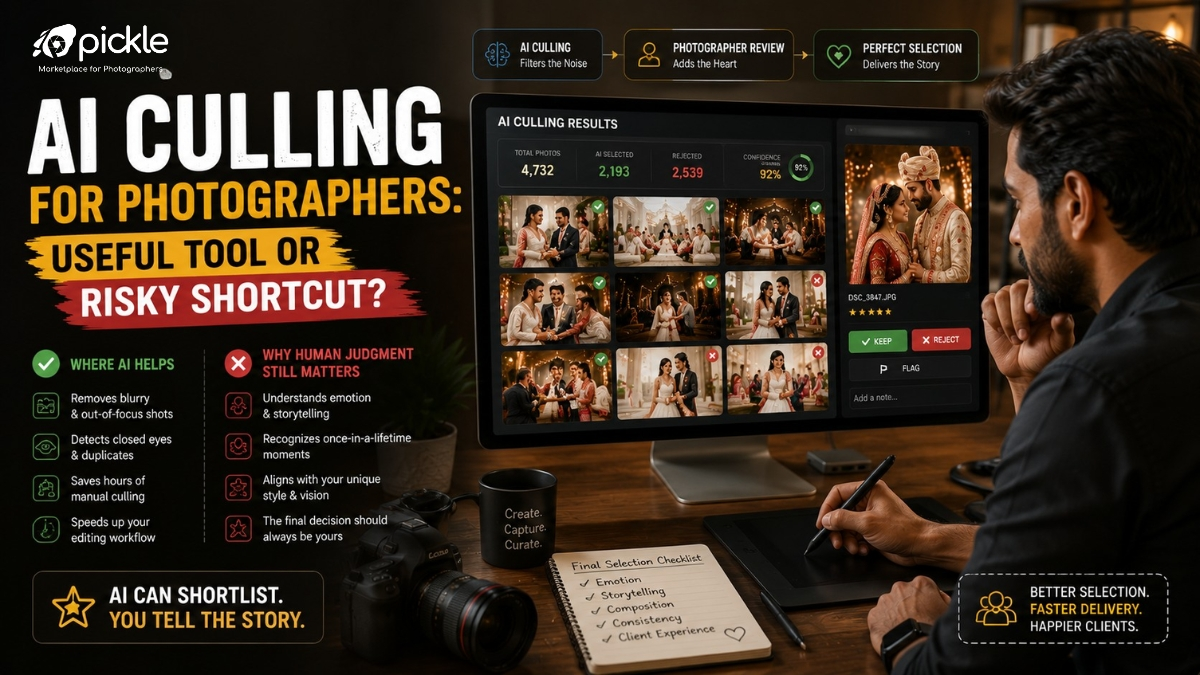
Imagine finishing a wedding with 4,000 photographs.
Traditionally, the next few hours are spent removing duplicates, closed eyes, missed focus, accidental frames, and burst sequences.
Today, AI photo culling software promises to complete much of that work automatically. It sounds like the perfect solution.
But should photographers trust AI with one of the most important parts of their creative process? The answer isn't simply yes or no.
It depends on where AI is being used.
The Parts AI Does Exceptionally Well
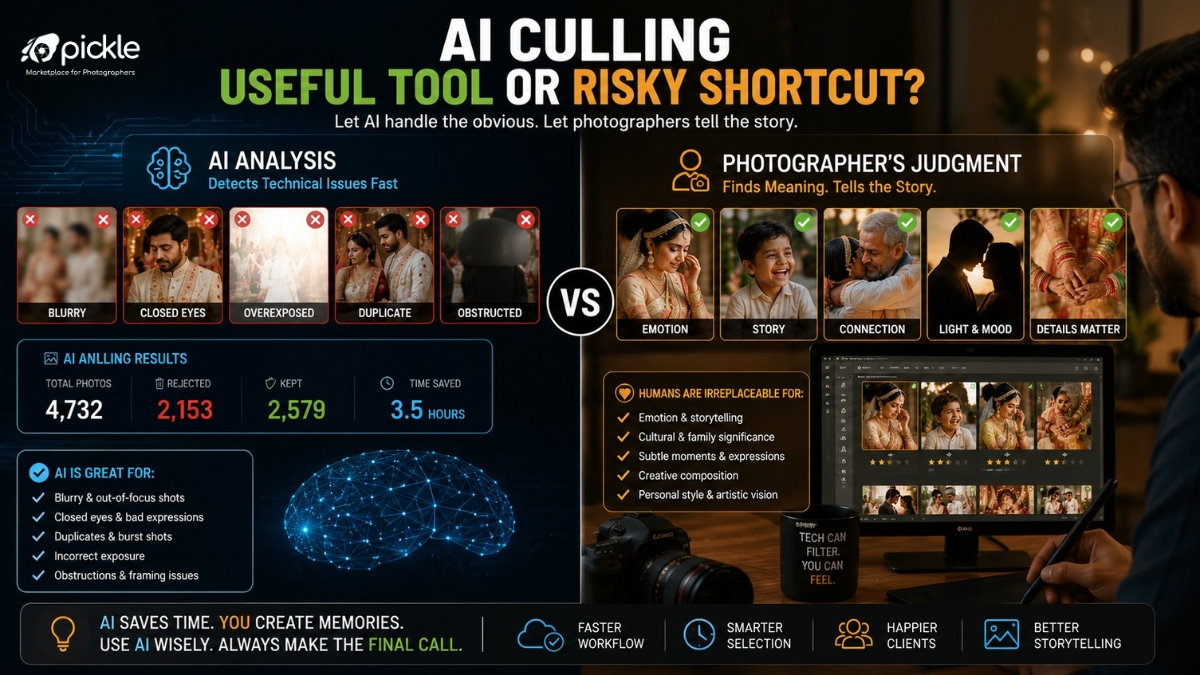
AI is remarkably good at repetitive technical decisions.
For example, it can quickly identify:
- Blurry photographs
- Closed eyes
- Duplicate frames
- Burst sequences
- Missed focus
- Incorrect exposure
- Camera misfires
- Similar compositions
Instead of reviewing thousands of nearly identical images manually, photographers receive a much smaller starting collection.
For wedding photographers handling multiple events every month, this can save several hours on every project.
From a studio productivity perspective, AI culling is a valuable assistant.
The Parts AI Still Doesn't Understand
Photography isn't only about technical perfection.
Some of the most memorable wedding photographs aren't technically perfect at all.
Think about:
- A tear rolling down a father's face.
- A child laughing while running across the stage.
- A bride looking nervously at her parents before the ceremony.
- Grandparents smiling quietly in the background.
These moments carry emotional weight. AI doesn't understand family relationships, cultural significance, or the story unfolding during the event.
It evaluates pixels. Photographers understand people. That difference matters.
AI Should Remove Choices, Not Make Them
One of the biggest misunderstandings around AI photo culling is expecting it to deliver the final gallery. A better approach is much simpler. Let AI remove the photographs that clearly shouldn't be edited.
Then let the photographer decide which photographs deserve to represent the story. Think of AI as the first assistant in the editing room. Not the creative director.
Every Photography Genre Needs Different Judgment
Different assignments require different selection criteria.
Wedding Photography
Emotion, storytelling, family interactions, traditions, and complete event coverage matter most.
Portrait Photography
Expression, posture, eye contact, and personality become more important than simply technical sharpness.
Commercial Photography
Consistency, branding, lighting accuracy, and product presentation are often the deciding factors.
Sports & Events
Timing usually matters more than perfect composition.
The same AI settings cannot make the best decisions across every photography genre. Human review remains essential.
The Real Risk Isn't AI
The real risk is skipping the review process. A common mistake photographers make is assuming AI has already selected the best photographs.
Without checking carefully, important moments may disappear.
Sometimes AI rejects:
- Slightly soft but emotional photographs.
- Creative motion blur.
- Intentional artistic compositions.
- Documentary moments that don't follow standard patterns.
Those images often become clients' favourites. Creative judgment cannot be outsourced.
The Best Workflow Combines Both
Rather than replacing photographers, AI works best when combined with an organised workflow.
A practical workflow looks like this:
Wedding Completed
↓
Images Backed Up
↓
AI Removes Technical Rejects
↓
Photographer Reviews Storytelling Images
↓
Editing Begins
↓
Preview Gallery Shared
↓
Client Photo Selection
↓
Album Design
↓
Final Delivery
Every stage still has human oversight. AI simply reduces repetitive effort.
Where GoPickle Fits
GoPickle doesn't replace creative decision-making. Instead, it helps photographers organise everything that happens after the selection process.
Once photographers have chosen their final photographs, GoPickle helps manage:
- Client galleries
- Online photo selection
- Album approvals
- Bookings
- Quotations
- Invoices
- Payment tracking
- Complete client workflows
Whether AI was used for culling or not, photographers still need an organised system to deliver photographs professionally.
GoPickle helps manage that journey from enquiry to final album delivery.
Conclusion
AI culling is one of the most useful productivity tools available to photographers today.
It can remove hours of repetitive work and help studios manage large wedding galleries more efficiently.
But photography has never been about finding the sharpest image.
It's about choosing the photograph that tells the story.
That decision still belongs to the photographer.
The strongest workflow combines the speed of AI with the experience, creativity, and emotional judgment that only a photographer can provide.
Once those decisions are made, GoPickle helps photographers organise client galleries, selections, bookings, quotations, payments, and album delivery, all from one platform.
What is AI photo culling?
AI photo culling uses artificial intelligence to analyse large collections of photographs and automatically identify duplicates, blurry images, closed eyes, and other technically weak photographs.
Should photographers rely completely on AI culling?
No. AI is excellent for reducing repetitive work, but final image selection should always remain with the photographer because creative storytelling requires human judgment.
Does AI improve wedding photography workflows?
Yes. AI can significantly reduce the time spent reviewing thousands of photographs, allowing photographers to begin editing sooner while still making the final creative decisions themselves.
Can AI recognise emotional moments?
Not reliably. AI analyses technical quality much better than emotion, storytelling, family relationships, or cultural significance.