AI Guest Gallery for Weddings and Events: Give Every Guest Their Own Photos
Learn how AI Guest Galleries use face recognition, selfie search and QR photo sharing to help wedding and event guests instantly find their photographs without scrolling through thousands of images.

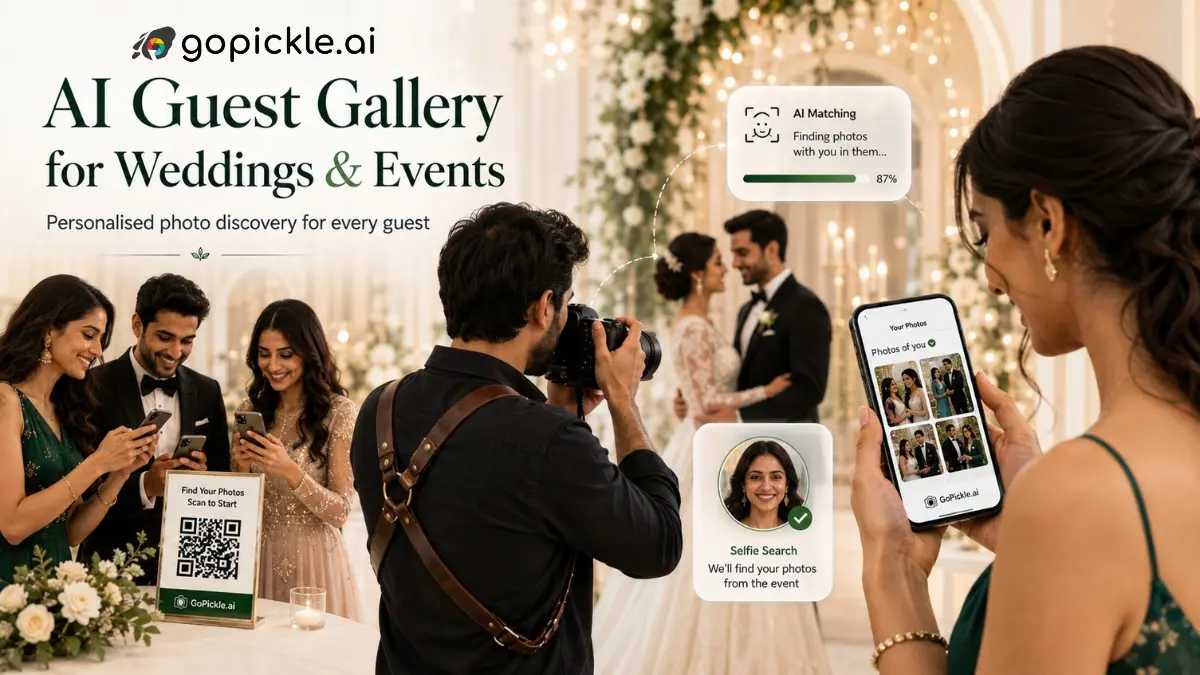
A wedding photographer can create 3,000 beautiful photographs and still leave most guests with the same problem: finding the few photographs they actually appear in.
Sending one large gallery does not solve that problem. A guest still has to open it, scroll through hundreds or thousands of photographs, remember which function they attended and search manually for themselves. Many simply give up and message the photographer, couple or event organiser instead.
An AI Guest Gallery changes the delivery model. Guests open an event link or scan a QR code, provide a selfie, and face recognition searches the event photographs for images in which that guest appears. The result is a personalised gallery rather than a giant folder everyone has to search. GoPickle currently supports this workflow through mobile browser access without requiring guests to install an app.
For wedding and event photographers, this is not merely an AI feature. It addresses one of the hardest parts of large-event photo delivery: getting thousands of professional photographs to the right people while the interest in those photographs is still high.
What Is an AI Guest Gallery?
An AI Guest Gallery is an event photo-sharing system that uses facial matching to help individual guests discover photographs they appear in.
The typical journey is simple:
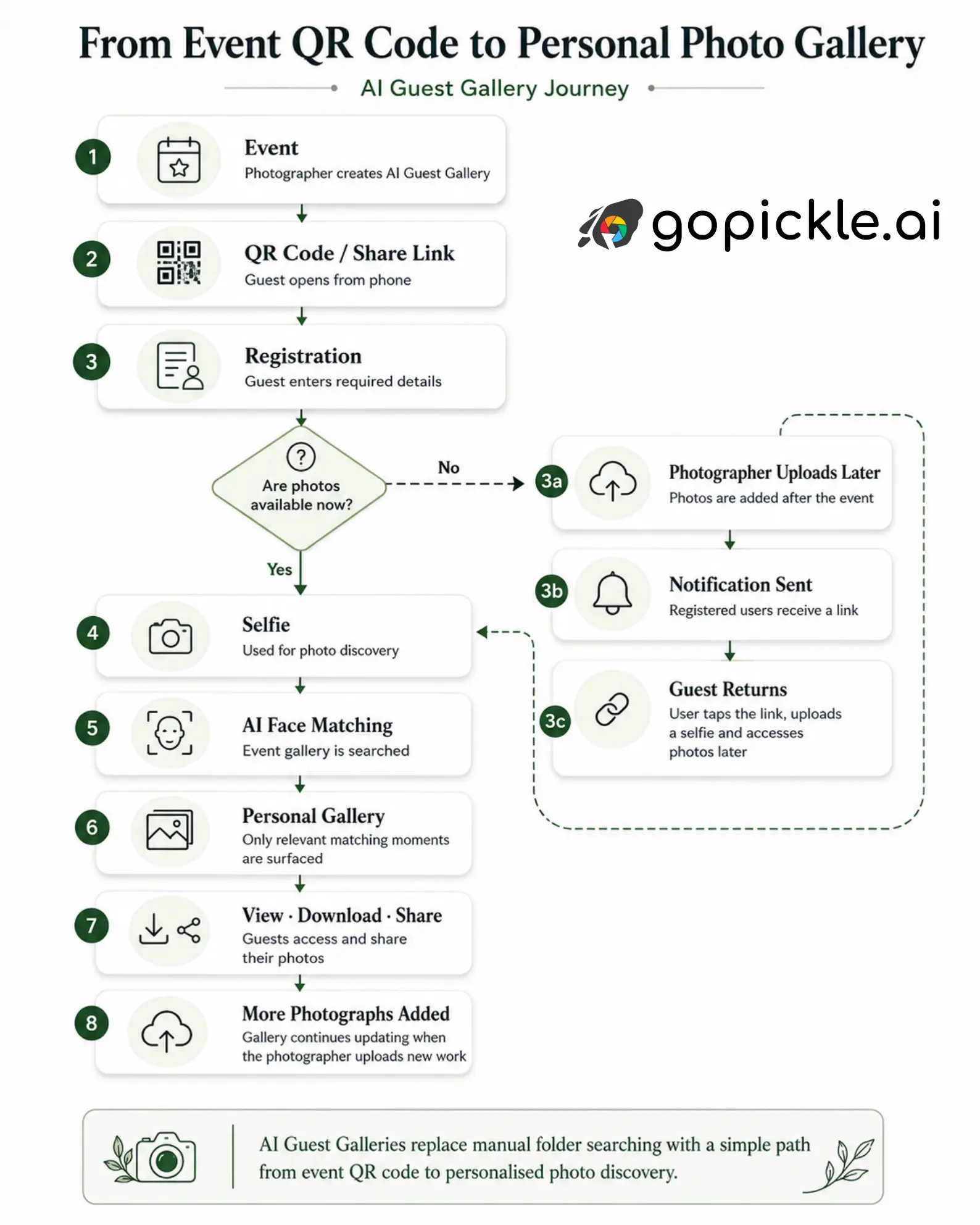
GoPickle's current AI Guest Gallery follows this model. A photographer creates an event gallery and shares a link or QR code. The guest uploads a selfie, GoPickle scans the gallery for matching photographs, and the results appear as a personalised mobile gallery.
This category is also described online as AI photo sharing, face recognition photo delivery, selfie search, AI live album, face recognition gallery and live event photo sharing. The terminology varies, but the underlying job is similar: reduce the distance between a person being photographed and that person actually receiving the photograph.
Why Traditional Wedding Photo Sharing Breaks Down at Guest Scale
A conventional Client Gallery works very well when the audience is the couple.
The photographer can organise the final wedding story into Haldi, Sangeet, ceremony, portraits and reception collections. The couple can browse the photographs, download them, select favourites and share the finished gallery with their families.
The problem changes when the audience becomes 300 wedding guests.
A reception guest does not necessarily want to browse every photograph of the bride getting ready, the family portraits, the Haldi ceremony and the entire wedding ritual. They usually want one thing:
“Where are my photographs?”
Google Drive does not answer that. WhatsApp does not answer it efficiently. Even a beautifully designed traditional gallery still requires manual browsing.
GoPickle makes the same distinction in its current product architecture: Client Galleries are intended for curated final delivery to the paying client, while AI Guest Galleries are built for guest discovery and interaction during or around the event.
The Best AI Guest Gallery Workflow Starts Before the Photographs Are Ready
One of the more useful parts of this model is that guest registration does not have to wait until final delivery.
Imagine a three-day wedding.
A QR code is displayed at the venue during the Sangeet. Guests scan it and register while they are already interested in the photographs. The photographer does not necessarily need to deliver the final edited gallery at that moment.
GoPickle supports two practical approaches: photographers can upload photographs during the event so matches begin appearing live, or guests can register first and the photographer can upload edited JPEGs later.
That second workflow matters.
Professional photographers should not have to compromise their editing standards simply because a platform advertises “instant delivery.” Registration can happen while guest attention is high; final photographs can still be delivered according to the studio's normal editing promise.
Workflow A: AI Live Album
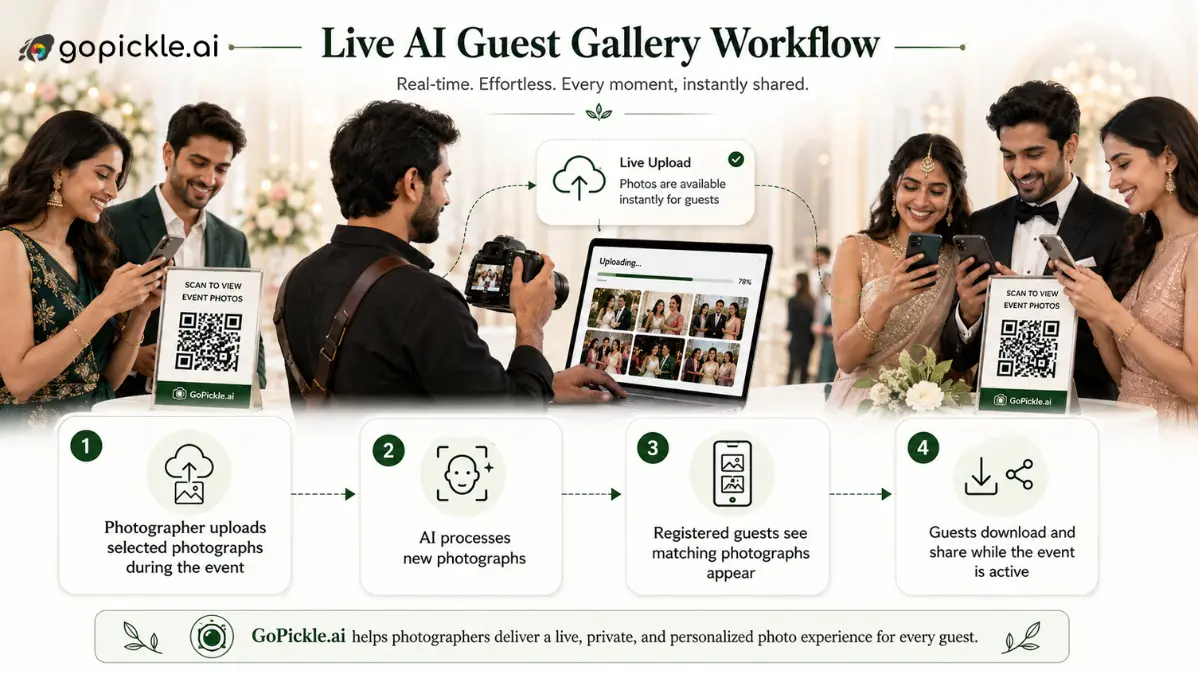
This is useful for receptions, corporate events, launches, conferences, college festivals and other situations where live engagement is valuable. GoPickle's public product page specifically supports photographs becoming discoverable during the event itself.
Workflow B: Register Now, Deliver Later
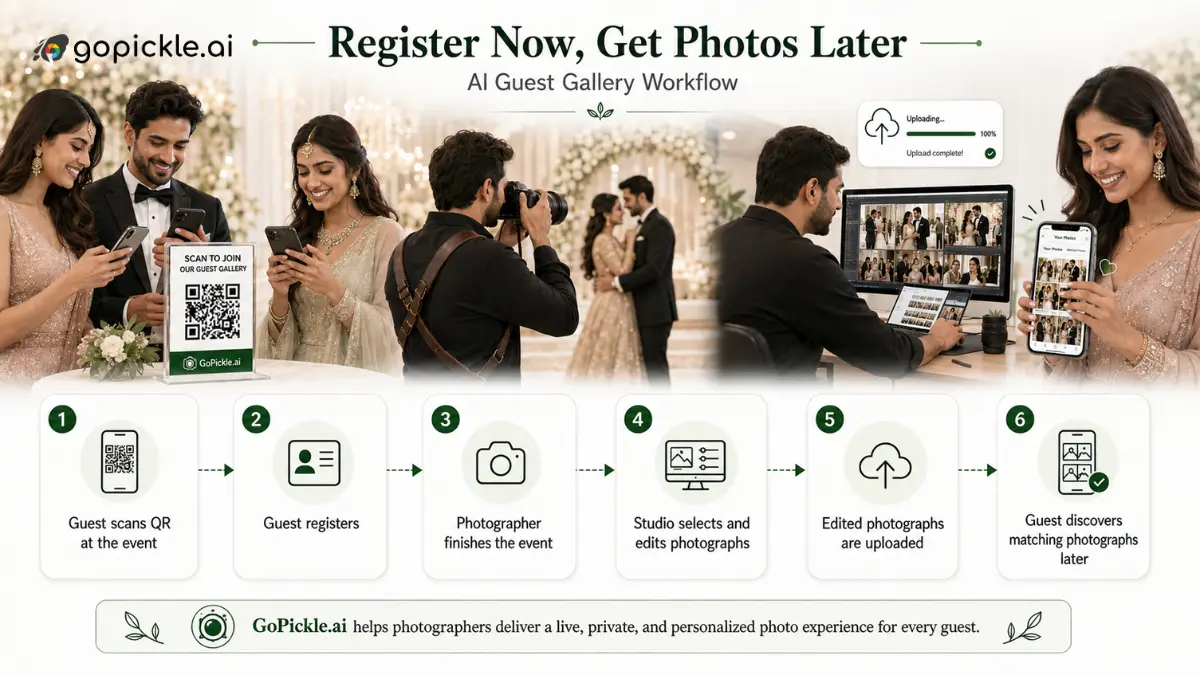
For many wedding studios, this is the healthier workflow because it keeps the immediacy of guest registration without forcing unfinished work into public delivery.
Why AI Photo Sharing Matters More at Weddings
Weddings are unusually well suited to face-based photo discovery because they combine large guest counts, large image volumes and strong personal interest in photographs.
A guest may appear in a group photograph during the Haldi, a candid at the Sangeet, a family portrait at the ceremony and several dancing photographs at the reception. Finding those manually across several thousand photographs becomes progressively harder as coverage increases.
Current AI photo-sharing products are therefore heavily positioning selfie search and facial matching around weddings and other high-volume events. The same category is also expanding into corporate conferences, marathons, school events, concerts and festivals where many people need to find photographs from one shared image pool.
GoPickle similarly supports AI Guest Galleries across weddings, corporate events, birthday celebrations, festivals, concerts, sporting events and other large gatherings.
What Changes for the Photographer?
The clearest benefit is not “AI saves time.” That is too vague. The real change is that the photographer stops acting as a search engine for the gallery.
Without guest discovery, the post-event workflow often becomes:
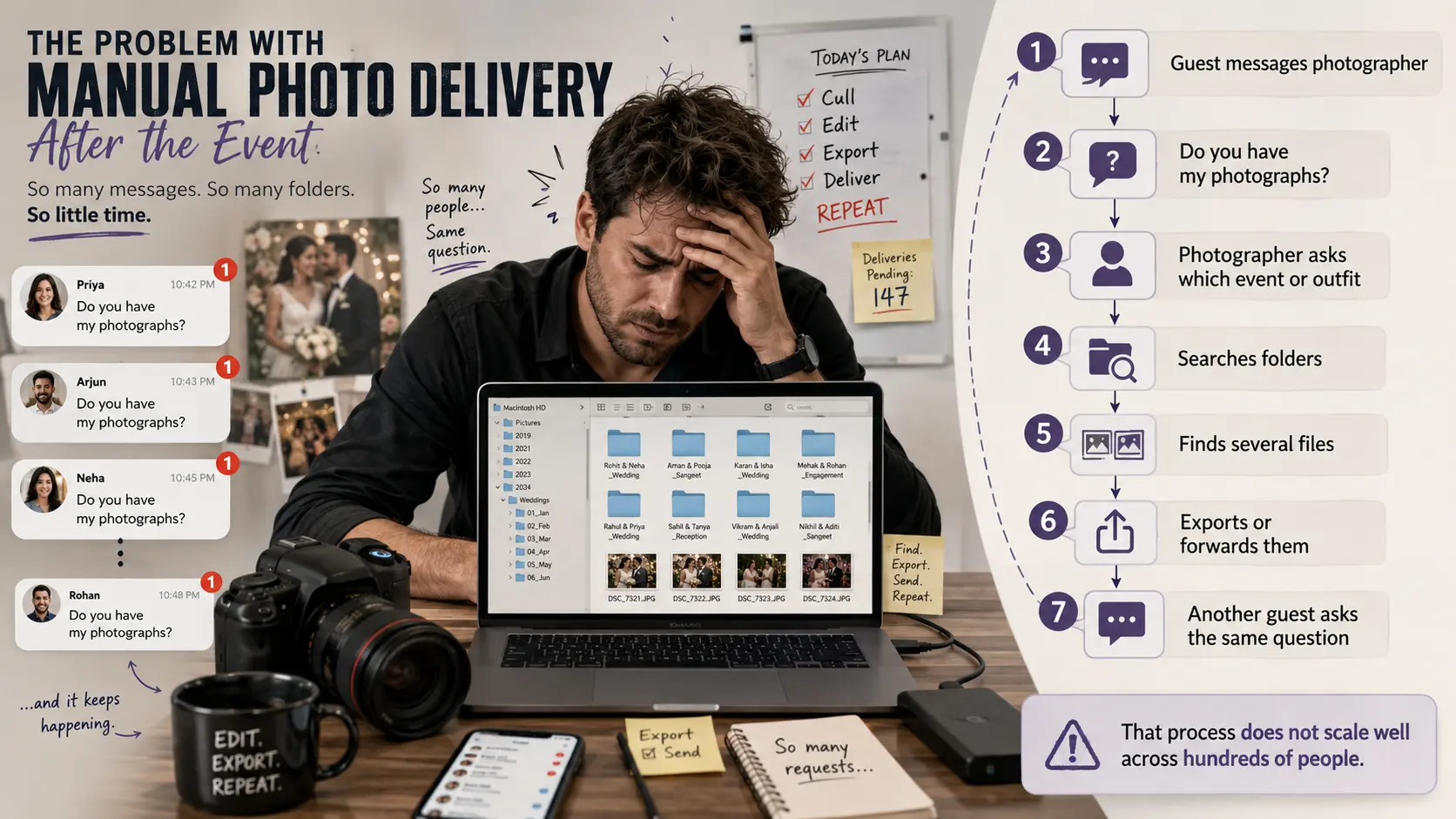
That process does not scale particularly well across hundreds of people.
With an AI guest photo gallery, the photographer can give everyone the same entry point and let each guest search through their own identity rather than through folder names.
GoPickle explicitly positions its AI Guest Gallery around reducing repeated guest requests and manual photo-sharing work.
Guests Get a Better Experience Too
The photographer's convenience should not be the only reason to adopt the technology. The guest experience is arguably more important.
A good wedding guest photo gallery should not require someone to understand the photographer's folder structure. Guests should not need to know whether a photograph sits inside:
Reception_Final / Candids / Batch_03
They should be able to arrive through a familiar QR code or link, provide what the matching system needs, and see relevant photographs.
GoPickle's current implementation is browser-based and mobile-first, so guests do not need to install another application before accessing the gallery. Matching photographs can then be viewed, downloaded and shared from the gallery.
That reduction in friction matters at live events, where asking a guest to download an app, create a complex account and learn a new interface can kill participation before it begins.
AI Guest Galleries Can Become Part of the Event Experience
This is where AI live albums are more interesting than conventional post-event delivery.
Imagine photographs from the reception being uploaded while the reception is still happening. A guest scans the QR code after dinner, finds a candid photograph taken earlier that evening and shares it while still at the venue.
The photograph has moved from something they might eventually receive to part of what they are experiencing right now.
GoPickle supports live photo discovery when photographers choose to upload during the event, while retaining the option to publish edited work later instead.
That flexibility is important because not every event should be run as a live-delivery production.
A premium wedding studio may prefer highly controlled post-production. A corporate activation may care enormously about near-real-time sharing. The software should accommodate both rather than forcing the same delivery model onto every photographer.
More Sharing Can Also Mean More Visibility for the Studio
There is a secondary commercial effect worth considering.
Traditionally, the photographer's strongest relationship is with the paying client. At a wedding with 300 guests, however, hundreds of other people are also seeing the photographer work.
If those guests later receive a generic Drive folder forwarded by someone else, the photographer's brand becomes almost invisible.
A branded AI photo sharing experience keeps the discovery journey closer to the studio. GoPickle positions personalised guest galleries as part of the photographer's own delivery experience rather than an anonymous file-sharing workflow.
Not every guest will become a lead, and photographers should not treat guest registration as automatic permission to market to someone. That distinction matters.
The useful business opportunity comes from delivering such a good experience that guests remember who created it and can choose to engage with the studio themselves.
AI Guest Gallery vs Client Gallery: Photographers Usually Need Both
These products solve different delivery jobs.
| Client Gallery | AI Guest Gallery | |
|---|---|---|
| Primary audience | Couple / paying client | Event guests |
| Main purpose | Curated final delivery | Personal photo discovery |
| Typical timing | After editing | During or after event |
| Navigation | Collections / gallery browsing | Selfie / face matching |
| Selection workflows | Useful | Usually secondary |
| Guest-scale discovery | Limited | Core purpose |
| Live event use | Optional | Strong use case |
| Photographer branding | Yes | Yes |
GoPickle deliberately separates the two experiences. Client Galleries support curated delivery and client interaction; AI Guest Galleries are designed for personalised guest discovery.
Where an AI Guest Gallery Has the Highest Value
Not every shoot needs face recognition. For a portrait session involving six family members and 80 photographs, a normal gallery is simpler. Everyone can browse the entire set comfortably.
The value increases as the number of people and photographs grows.
Weddings and receptions
Many guests, multiple functions and strong demand for personal photographs make this an obvious fit.
Corporate conferences
Attendees often want photographs with speakers, colleagues or branding installations without searching the entire event archive.
College festivals and concerts
Large audiences and high social-sharing behaviour make quick discovery useful.
Sports events
Participants may be photographed repeatedly across a large image set and want an easier way to locate themselves.
Award ceremonies and large community events
Guests can find stage moments and candid photographs without the organiser manually redistributing files.
GoPickle currently positions AI Guest Galleries for all of these event categories rather than limiting the product to weddings.
What Photographers Should Evaluate Before Choosing AI Photo Sharing Software
The words “AI face recognition” alone are not enough to evaluate a product.
Guest friction
Does the guest need an app? How many screens are involved? Can the experience work comfortably on a normal phone browser?
Live and post-event workflows
Can you deliver during the event and register guests now while uploading final photographs later?
This is particularly important for photographers who care about editing quality.
Image and guest limits
Event platforms frequently price according to photograph volume and guest volume. Make sure the chosen tier fits the real event rather than the sample demo.
Upgrade path
Guest counts are not always predictable. A system that lets the studio move to a larger event tier is easier to manage when participation exceeds expectations.
GoPickle currently allows AI Guest Gallery event plans to be upgraded as guest or photograph volumes increase.
Privacy and consent
Guests should understand why their selfie is being collected and what it will be used for.
Branding
The gallery is part of your delivery experience. Check whether your studio remains visible when photographs are shared.
Download and sharing controls
Determine what guests can view, download or share and whether those rules fit your client's expectation.
Photographer workflow
Most importantly, ask what happens on your side.
If the platform gives guests a brilliant experience but creates a complicated second upload process for the studio, the operational cost may outweigh the benefit.
How GoPickle Handles Event Photo Delivery
GoPickle's approach is broader than treating face recognition as a standalone AI utility. The platform connects AI Guest Galleries to a wider photography workflow containing enquiries, quotations, bookings, crew, invoices, payments and Client Galleries.
For an event photographer, that can look like:
- Confirm the event: Keep client, requirement, dates, venue and booking details together.
- Assign the photography team: Connect photographers, cinematographers, assistants or editors to the event workflow.
- Create the AI Guest Gallery: Set up the event's guest photo-discovery experience.
- Share the QR code or link: Guests can access the experience from their phones.
- Guests register: The selfie becomes the input for personalised photo discovery.
- Upload photographs live or later: Use live delivery when it suits the event, or wait for edited JPEGs when quality control matters more.
- AI matches photographs: Guests see relevant photographs without manually browsing the entire event collection.
- Deliver the final client gallery separately: The paying client receives the curated event story through a Client Gallery rather than using the guest-discovery experience as a substitute for final delivery.
GoPickle's event-photography workflow explicitly separates AI Guest Galleries for attendee discovery from Client Galleries for final client delivery.
What Does an AI Guest Gallery Cost?
AI face matching does not have the same usage pattern as a normal gallery subscription. Every event is different. A birthday with 60 guests and 600 photographs should not have the same capacity requirement as a wedding with 500 guests and 8,000 photographs.
Many AI photo-sharing platforms sell larger monthly, annual or bulk usage allowances. That can suit studios with consistently high event volumes, but photographers may end up paying for image or event capacity whether they actually use it or not.
GoPickle takes a more event-oriented approach. AI Guest Galleries are purchased according to the guest and photograph capacity required for an event, rather than forcing every photographer into one large recurring allowance.
Photographers can also purchase multiple event plans together at a discounted price when they know they have several weddings or events coming up. The important difference is that purchasing the bundle does not mean all those events immediately begin consuming capacity.
An event is counted only when the photographer actually activates and uses it for a real event.
For example, a wedding studio could purchase a discounted bundle for five upcoming events and use those event credits gradually as bookings are confirmed. Unused event capacity remains available for later instead of being consumed simply because the bundle was purchased.
This gives photographers two useful options:
Occasional event photographer:
Purchase the appropriate plan only when an event needs an AI Guest Gallery.
High-volume wedding or event studio:
Purchase multiple events together for a better effective price, then activate each one only when it is actually required.
This is different from buying a large bulk allowance that expires or is charged regardless of utilisation. The photographer can benefit from volume pricing while still connecting the cost to actual client work.
Prime and Focus subscribers also receive discounts on eligible AI Guest Gallery event plans, and an individual event can be upgraded if the original guest or photograph limit becomes insufficient.
The better way to compare AI photo-sharing pricing is therefore not simply:
“How much does the subscription cost?”
Instead ask:
How much am I paying per real event, how much capacity will I actually use, and what happens to the capacity I have paid for but have not yet needed?
For studios with seasonal wedding schedules or unpredictable event volumes, that difference can materially affect the real cost of providing AI-powered guest photo delivery.
Should Every Wedding Photographer Use AI Guest Galleries?
No.
A photographer delivering intimate weddings with 30 guests may gain very little from face recognition. A traditional gallery could be simpler for everyone.
But once you regularly photograph weddings and events containing hundreds of people and thousands of images, guest photo discovery becomes a real delivery problem rather than a novelty feature.
That is the point at which an AI Guest Gallery starts to make practical sense.
The strongest reason to use one is not because AI sounds modern. It is because the old delivery model asks every guest to manually search the photographer's entire output.
A better system reverses that relationship.
Instead of asking:
“Can you find yourself in our 4,000 photographs?”
the gallery asks:
“Who are you? Here are the photographs you appear in.”
For wedding and event photography, that is a materially better way to deliver work.
GoPickle combines that guest-discovery experience with the rest of the studio workflow, allowing photographers to manage the event itself and then deliver separately to the client and the guests.
If large-event photo requests are already becoming part of your studio's workload, test the experience using one real event rather than a demonstration gallery. Look at it from both sides: how quickly a guest can find their photographs, and how much extra work the photographer has to do to make that happen.
You can review GoPickle AI Guest Gallery or book a personal demo using the kind of wedding or event your studio actually photographs.