Booked Revenue vs Collected Revenue: What Photography Studio Owners Should Track
Understand booked, invoiced, collected and outstanding revenue in a photography studio, including future payments, refunds and cancellations.


A photography studio can finish the month with ₹12 lakh in confirmed bookings and only ₹4 lakh received from clients. Neither figure is necessarily wrong. They answer different questions.
For a growing studio, photography business revenue tracking becomes difficult when booking value, invoices, advances, pending balances and bank receipts are treated as one number. A confirmed wedding may be worth ₹2,50,000, but perhaps only ₹50,000 has been collected as an advance. Another client may have received an invoice for ₹80,000 but paid only half. A cancelled booking may still appear in an old sales report even though part of the expected money will never arrive.
Studio owners need several financial numbers, not one headline revenue figure.
Booked Revenue Shows What Clients Have Committed to Buy
For studio management purposes, booked revenue is the value of confirmed work currently on your books. If five clients have confirmed photography packages worth ₹2 lakh each, your booked value is ₹10 lakh before subsequent additions, reductions or cancellations.
This metric is useful for measuring future workload, sales performance and how much business the studio has secured. It is not the same as cash in the bank, and it should not automatically be treated as accounting revenue.
That accounting distinction matters. Under cash-basis accounting, revenue is generally recorded when cash is received, while accrual accounting recognises revenue when the service is earned or provided. Advance payments for work that has not yet been delivered can also be treated as deferred or unearned revenue under accrual accounting.
For day-to-day studio reporting, we recommend labelling this number clearly as Booked Value or Confirmed Booking Value rather than assuming it represents recognised accounting revenue.
GoPickle's Booking Management for Photographers keeps the current booking amount alongside the client, events, services, deliverables, advances and pending balances, which makes the commercial value easier to trace back to the actual assignment.
Invoiced Revenue Tells You What You Have Asked Clients to Pay
The next number is invoiced value.
Suppose a wedding booking is worth ₹2,40,000 with a payment structure of ₹60,000 at confirmation, ₹1,00,000 before the wedding and ₹80,000 before final delivery. The booking value is ₹2,40,000, but if you have currently invoiced only the ₹60,000 advance, your invoiced amount may still be ₹60,000.
As the project progresses, additional invoices or payment stages move more of the booked value into amounts formally requested from the client.
This is why photographer payment tracking should separate booking totals from invoices. The difference helps the studio identify work that has been sold but is not yet due for payment.
GoPickle's Invoice Software for Photographers supports advances, instalments, partial payments, final balances and due dates while keeping invoice activity connected to the underlying booking.
Collected Revenue Is the Money That Has Actually Arrived
For operational financial visibility, collected amount is the money clients have actually paid and that the studio has recorded as received.
Returning to the ₹2,40,000 wedding, imagine the studio has issued a ₹60,000 advance invoice but the client has paid ₹40,000 so far. The numbers now look like this:
Booked value: ₹2,40,000
Invoiced so far: ₹60,000
Collected: ₹40,000
Outstanding on current invoice: ₹20,000
Future scheduled payments: ₹1,80,000
Those figures describe the same client without contradicting one another.
This is the core of booked revenue vs collected revenue. The first measures secured business. The second tells you how much money has actually arrived.
GoPickle's invoicing workspace currently separates collected, pending, due and overdue amounts rather than stopping at “invoice sent.” For a studio owner, that is a much more useful payment view than looking only at total booking value.
Outstanding Revenue Needs Its Own Number
An unpaid invoice is not collected cash. Once a client has been billed and the payment remains unpaid, that amount becomes part of your outstanding receivables. In formal accounting, accounts receivable generally refers to money customers owe for goods or services already provided.
Photography studios should go one step further operationally and separate amounts that are upcoming, due now and overdue.
An ₹80,000 balance due three weeks before a wedding is not the same problem as an ₹80,000 invoice that became overdue 45 days ago. Combining both under “pending payments” hides where action is needed.
Future Payments Are Not the Same as Outstanding Invoices
Photography packages frequently involve payments that are agreed today but intentionally scheduled for later.
If the client owes ₹1,00,000 ten days before the event and the wedding is six months away, that amount may be part of the confirmed booking but not yet an overdue receivable. It is better described internally as an expected future payment or scheduled balance.
Be careful with terminology here. “Deferred payment” in normal business conversation may simply mean that payment is due later. Deferred revenue, however, has a specific accounting meaning: cash received before the corresponding service has been earned or delivered.
Keeping those terms separate prevents an operational payment schedule from being confused with accounting treatment.
Cancellations and Refunds Must Change the Revenue Picture
Revenue reports become unreliable when cancelled bookings remain in the original booked total.
Suppose a ₹1,50,000 booking is cancelled. The client had already paid ₹30,000, of which ₹20,000 is refunded under the applicable agreement. You should not continue reporting ₹1,50,000 as active expected booking value, nor should you report the original ₹30,000 payment as though all of it remains collected.
The booking status, revised expected value and actual refund need to be reflected in your reporting. The precise accounting and tax treatment depends on your accounting method, contract and jurisdiction, so this should be reconciled with your accountant. Accounting systems also treat refunds as adjustments that affect revenue and cash rather than leaving the original sale untouched.
The same principle applies when clients downgrade packages, add extra coverage or change deliverables. Your current revenue report should represent the current commercial position, not the quotation that existed three months ago.
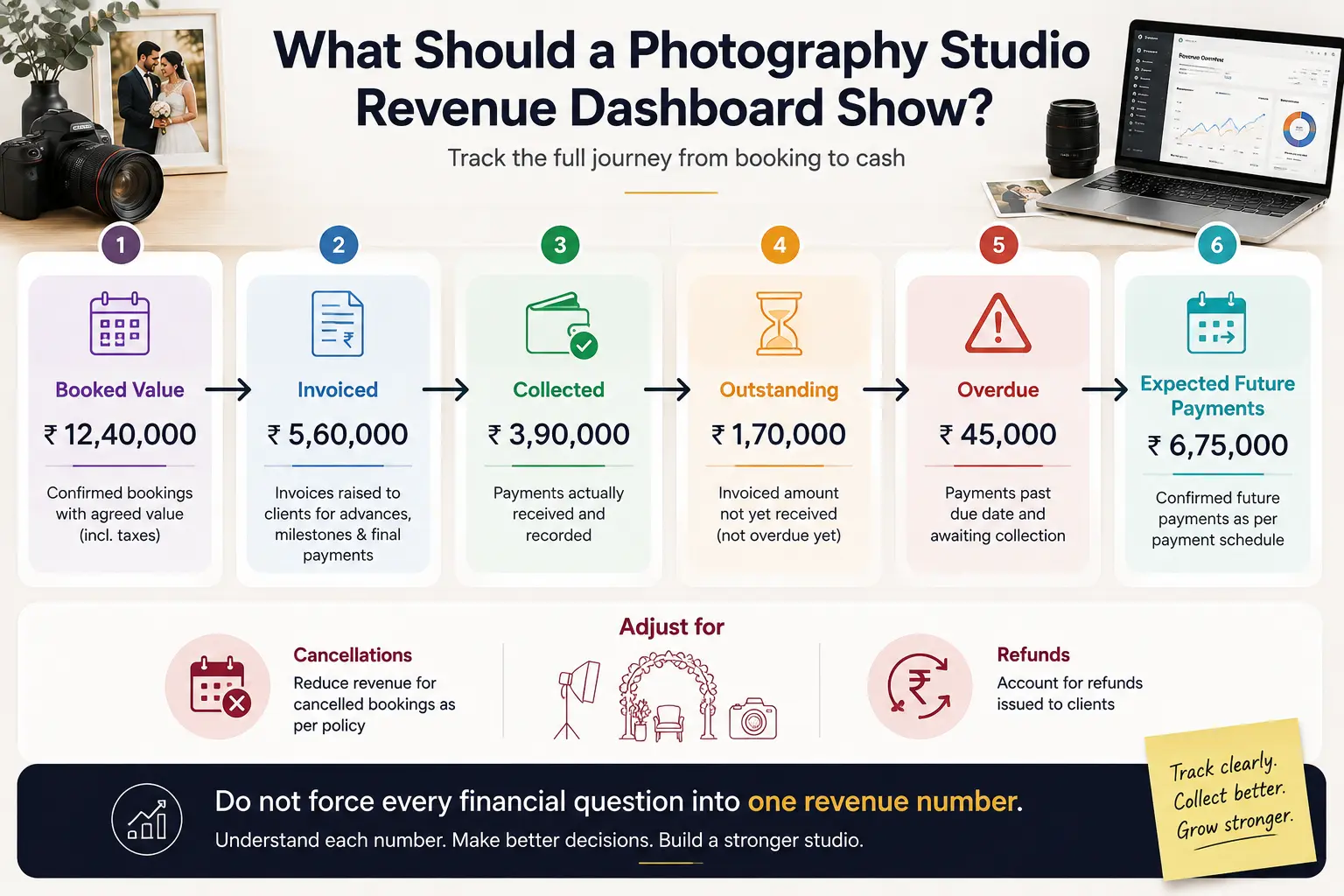
The Revenue Dashboard a Photography Studio Actually Needs
At GoPickle, we would rather see a photography studio track seven clear numbers than one impressive but ambiguous “revenue” total:
Confirmed booking value → Invoiced amount → Collected amount → Outstanding amount → Overdue amount → Expected future payments → Refunds/cancellations
Together, those numbers answer much better business questions. How much work have we sold? How much have we billed? How much money has arrived? What needs collecting? What is expected later? How much business has disappeared through cancellations or refunds?
GoPickle's payment workflow connects bookings, invoices, advances, instalments and balances so studio owners can see the commercial story behind each client instead of rebuilding it from WhatsApp messages, spreadsheets and bank screenshots. Its Smart Invoicing workspace specifically surfaces collected, pending, due and overdue payment information.
That visibility does not replace bookkeeping or accounting software. It gives the photography studio a cleaner operational view of the money attached to its bookings.
A strong month is not simply the month with the highest booking value. The more useful question is whether the studio understands how much was sold, how much became payable, how much was actually collected and how much is still likely to arrive.
That is the foundation of reliable photography studio finances.