How to Assign Work to Studio Members Without Losing Accountability
Learn how to assign leads, event crews, editing, album design and payment follow-ups without missed handovers or unclear responsibility.

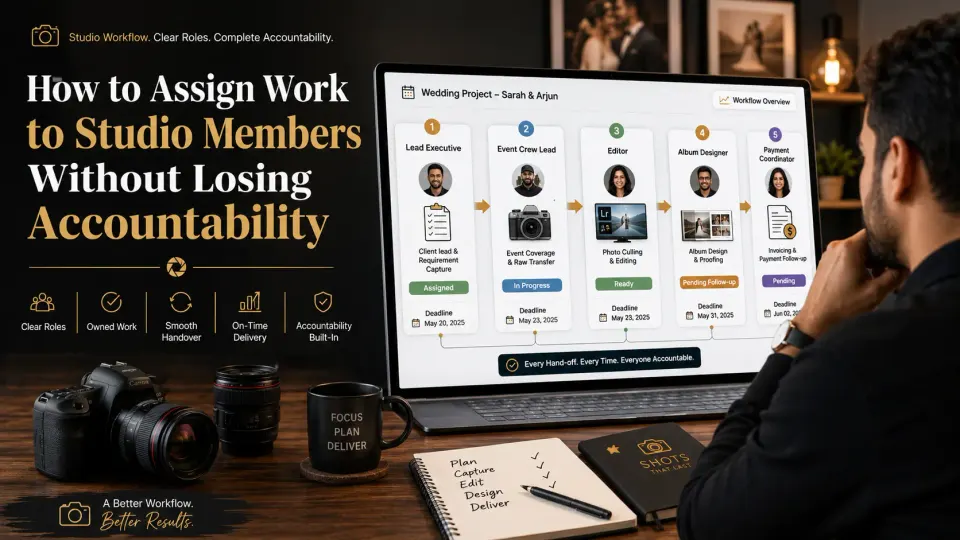
Delegating work should reduce pressure on a photography studio owner. In many studios, it creates a different problem: everyone is involved, but nobody is clearly responsible.
The lead executive thinks the owner will follow up. The photographer assumes someone else confirmed the venue timing. The editor waits for files. The album designer works from an outdated selection. The finance team expects the client manager to request the balance payment.
The problem is not a lack of effort. It is unclear ownership.
Every important activity in a photography studio needs four things:
One responsible owner, one deadline, one visible status and one clear handover.
Assignment Is Not the Same as Accountability
Several people may contribute to a booking, but one person should remain accountable for each stage.
For example, a wedding may involve two photographers, a cinematographer, an editor and an album designer. That does not mean all five people jointly own the complete project.
Each person should know:
- What they are responsible for
- When their work must be completed
- What information or files they need
- Who receives the work next
- Who must be informed when something changes
Avoid assignments such as:
Team, please handle the Meera wedding.
Use a specific assignment:
Arjun owns event coverage. Call time is 6:00 AM. He must confirm the full crew by Thursday and hand over all files to Neha before noon on Monday.
The second version can be checked. The first depends on assumptions.
Give Every Lead One Owner
A new enquiry may be visible to the entire sales team, but one person should own the conversation.
The lead owner should be responsible for:
- Collecting the event date and requirement
- Confirming availability
- Understanding the budget
- Sharing the appropriate package
- Scheduling the next follow-up
- Updating the lead status
- Recording why the lead was won or lost
Two team members should not contact the same client without knowing what the other person has discussed.
The lead record should also remain accessible to the studio. Ownership should not mean that all information stays inside one employee’s personal WhatsApp account.
GoPickle’s booking workflow stores client details, event requirements, shoot dates, booking stages and payment information together, while role-based access helps the team see the information relevant to their work.
Assign Event Crew by Role, Not Only by Name
Adding four people to an event does not explain what each person is expected to cover.
A crew assignment should include:
| Role | Responsibility |
|---|---|
| Lead photographer | Own overall photography coverage and client coordination |
| Second photographer | Cover assigned ceremonies, guests or alternate angles |
| Cinematographer | Complete agreed video coverage and audio requirements |
| Assistant | Handle equipment, lighting and file support |
| Crew coordinator | Confirm attendance, call times and schedule changes |
Add the venue, reporting time, client contact, dress expectations, coverage priorities and special instructions to the assignment.
One person, usually the lead photographer or studio manager, must remain responsible for confirming that the whole crew has accepted the assignment.
GoPickle supports assigning photographers, editors, cinematographers and freelancers to specific events. Assigned people can see the schedules and updates connected to their work, while studios can track confirmations and identify overlaps before busy shoot days.
Make the Editing Handover Measurable
“Send the files to the editor” is not a complete handover.
The editor needs to know:
- Which booking the files belong to
- Where the files are stored
- Whether backups are complete
- Which events or folders are included
- The expected number of deliverables
- Editing style or reference
- Priority photographs
- First-review deadline
- Final-delivery deadline
The editor should acknowledge receipt. Otherwise, the studio owner may discover days later that the upload was incomplete or the editor was waiting for instructions.
A useful status flow is:
Files pending → Files received → Culling → Editing → Internal review → Corrections → Approved for gallery
The person currently responsible should change as the project moves through these stages. The handover should never rely on the next person noticing a message inside a group chat.
Keep Album Design Separate From Photo Editing
Editing the final photographs and designing the printed album are related, but they are not the same responsibility.
The album designer should receive:
- The client’s approved image selection
- The correct album size and spread count
- Design preferences
- Current version number
- Consolidated correction notes
- Approval deadline
- Printing instructions
One person should own client communication during album approval. When the couple, parents and studio team send corrections separately, the designer may receive contradictory instructions.
Use a version sequence such as:
Album V1 → Client corrections → Album V2 → Final approval → Print
Do not send an album to print based on unclear messages such as “looks okay” or “most pages are approved.” Record final approval against the correct version.
Name One Person for Payment Follow-Up
Payment responsibility often becomes unclear because several team members speak with the client.
The photographer may discuss the balance at the event. The sales executive may have shared the quotation. The accounts person may have raised the invoice. The owner may assume someone else followed up.
Assign one payment-follow-up owner for each booking.
That person should know:
- Total booking value
- Advance received
- Upcoming instalment
- Due date
- Pending balance
- Last reminder sent
- Client response
- Whether delivery depends on payment completion
The payment owner does not need to control the entire booking. Their responsibility is to keep the financial next step visible and completed.
GoPickle allows studios to track advance payments, pending balances and booking status in the same workflow, reducing the need to reconstruct payment history from screenshots or separate spreadsheets.
Use One Accountability Format Across the Studio
Every assignment can follow the same format:
Owner: Neha
Work: Complete wedding highlight edit
Due: 22 July, 6:00 PM
Input needed: Selected footage and music preference
Status: In progress
Next handover: Internal review by Arjun
Blocker: Client has not confirmed the song
This format works for leads, shoots, edits, albums and payments.
It also makes review meetings faster. Instead of asking, “What is happening with this booking?” the studio can see what is pending, who owns it and what is blocking completion.
Avoid Shared Ownership
Statements such as “sales and accounts will follow up” or “the editing team will handle it” sound collaborative but weaken accountability.
There may be supporting members, but there should be only one primary owner for a specific outcome.
A practical ownership map looks like this:
| Workflow stage | Primary owner |
| New enquiry | Lead owner |
| Quotation and follow-up | Sales owner |
| Booking accuracy | Studio manager |
| Event execution | Lead photographer |
| File handover | Shoot lead |
| Editing completion | Assigned editor |
| Album design | Album designer |
| Client album approval | Client coordinator |
| Payment collection | Finance or payment owner |
| Final project closure | Studio manager |
The owner can request help. They should not transfer responsibility silently.
Review Exceptions, Not Every Small Action
Accountability does not mean the studio owner must monitor every click or message.
The owner or manager should mainly review:
- Overdue tasks
- Unconfirmed crew
- Missing files
- Delayed edits
- Client corrections awaiting action
- Album approvals pending too long
- Upcoming or overdue payments
- Tasks with no assigned owner
This creates visibility without micromanagement.
GoPickle’s crew-management workflow keeps assignments, confirmations, schedules, editing handovers and delivery context connected to real events, rather than treating studio operations as disconnected generic tasks.
Build Accountability Into the Handover
A photography studio becomes difficult to manage when every stage depends on the owner remembering who was supposed to do what.
The solution is not more calls or larger WhatsApp groups. It is a clear operating rule:
Every task has one owner. Every owner has a deadline. Every deadline has a visible status. Every completed task has a named next recipient.
When that structure is followed, lead conversations remain consistent, crews arrive prepared, editors receive complete files, albums move through approval correctly and payment follow-ups do not disappear.
GoPickle.ai connects bookings, crew assignments, schedules, payments and delivery so responsibility can remain attached to the actual client and event from enquiry to completion.