How to Calculate Photography Profit Margin on Every Booking
Learn how to calculate photography profit margin after crew, editing, travel, albums, revisions, payment fees and overhead.

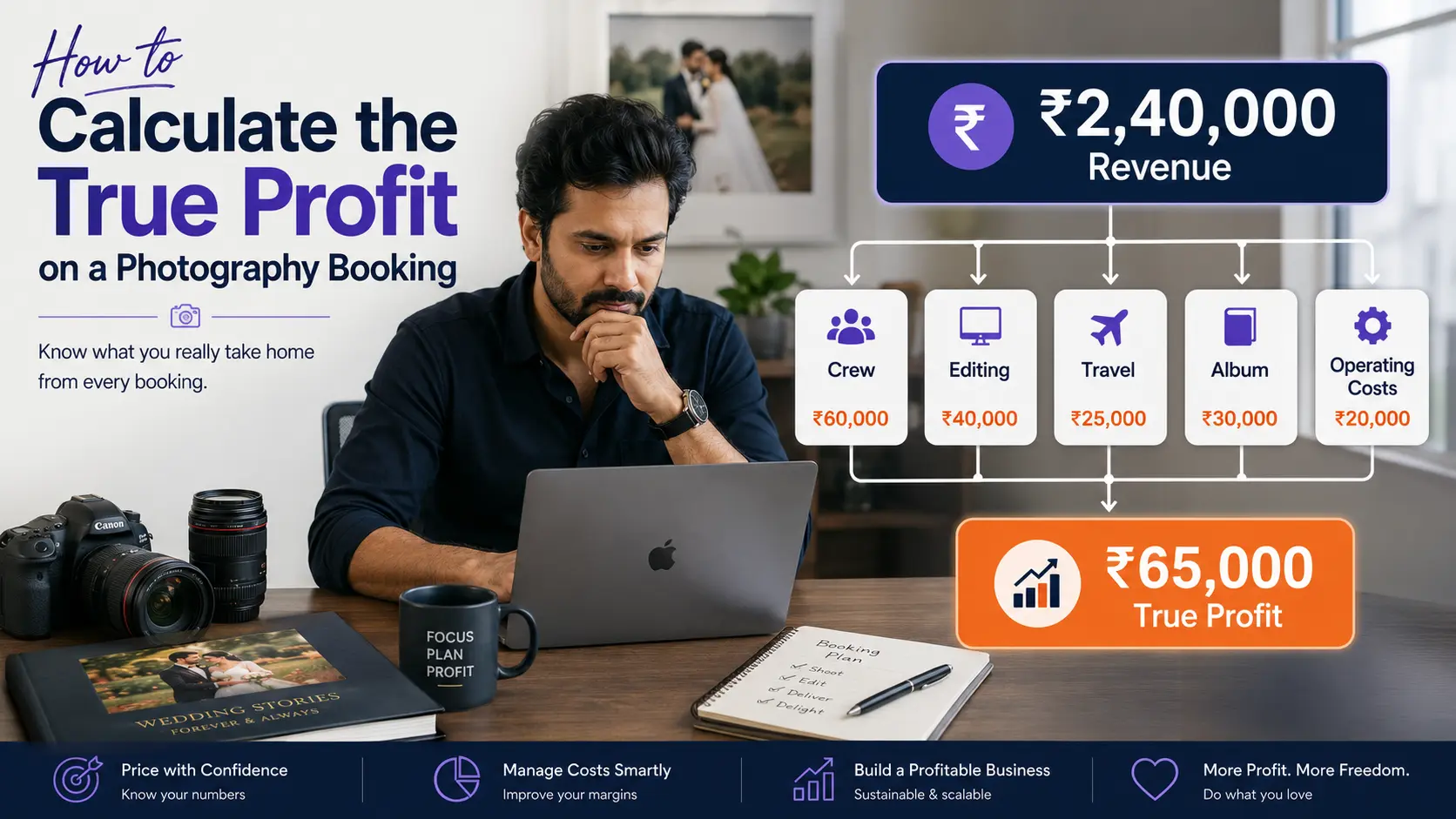
A ₹2,00,000 photography booking does not mean your studio made ₹2,00,000. It does not even mean you made ₹1,00,000.
The amount written on the quotation is revenue. Between that quotation and the final delivery are photographers, editors, travel, albums, accommodation, outsourcing, payment charges, revisions, software, equipment and your own time.
Some costs are obvious. Others disappear into day-to-day studio spending.
That is why we think every professional photographer should know the photography profit margin of individual bookings, not only their annual revenue.
Professional Photographers of America makes a similar distinction in its business guidance, studios should separately track sales, cost of sales, general expenses and owner compensation plus net profit rather than relying only on tax records to understand business performance.
Here is a practical way to calculate it.
Start With the Right Photography Profit Formula
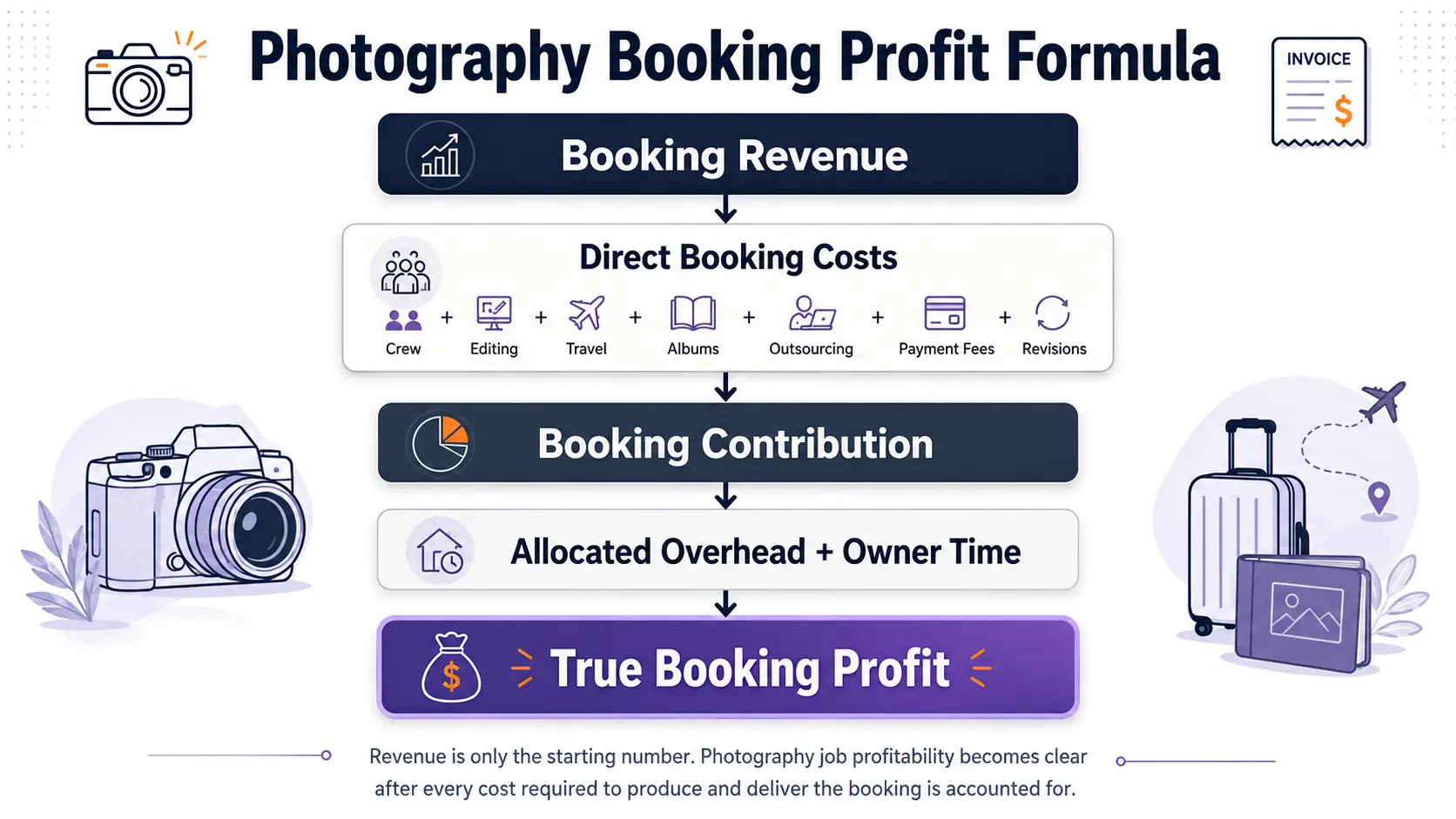
For a single booking, begin with:
Booking Contribution = Net Booking Revenue − Direct Booking Costs
Then calculate:
Booking Contribution Margin = Booking Contribution ÷ Net Booking Revenue × 100
This tells you how much money remains after paying the expenses caused directly by that particular job. But there is one more step if you want a more realistic picture.
Fully Loaded Booking Profit = Booking Contribution − Allocated Business Overhead − Owner Labour
Then:
True Photography Profit Margin = Fully Loaded Booking Profit ÷ Net Booking Revenue × 100
This second number is far more useful when making decisions about pricing.
What Counts as Revenue?
Use the amount your studio actually earns from the booking.
That can include:
- photography package
- cinematography
- additional events
- albums
- prints
- extra hours
- additional photographers
- drone coverage
- reels
- premium editing
- express delivery
- other paid add-ons
Subtract discounts and refunds.
Taxes collected on behalf of tax authorities should generally not be treated as business income for profitability analysis; the precise accounting treatment depends on your jurisdiction and business structure, so confirm this with your accountant.
Suppose you quoted:
Wedding photography package: ₹2,20,000
Extra album upgrade: ₹20,000
Additional hour of coverage: ₹10,000
Discount: ₹10,000
Your net booking revenue is:
₹2,40,000
That ₹2,40,000 is where the profitability calculation starts.
Not where it ends.
Now Record Every Cost Caused by That Booking
This is where photography job profitability is usually overstated.
A photographer remembers paying the second shooter ₹15,000 but forgets the album courier, three extra retouching rounds and two nights of accommodation. For each booking, ask one simple question: Would I have incurred this expense if this booking did not exist?
If the answer is no, it probably belongs in the direct cost of the job.
Crew Costs
Include everyone required to complete the booking:
- primary photographers
- second shooters
- traditional photographers
- cinematographers
- drone operators
- assistants
- lighting crew
- editors
- album designers
- freelancers
Do not ignore internal employees simply because their salary is paid monthly. If one editor spends three days working specifically on a wedding, part of that employee cost belongs to the economics of that wedding.
PPA's profitability guidance similarly recommends accounting for the time spent not only shooting, but also in meetings, pre-production, travel, setup and post-production.
Editing and Post-Production
Editing becomes expensive when the scope quietly expands.
Track:
- culling
- colour correction
- retouching
- video editing
- teaser editing
- reels
- album designing
- outsourcing
- cloud processing fees directly tied to the job
- revision rounds
Suppose your original package assumes one album revision but the client requests four. Those revisions have a real cost even if you decide not to charge the client.
Travel and Accommodation
For destination weddings and event photography, travel can change the margin dramatically.
Include:
- fuel
- flights
- trains
- taxis
- tolls
- parking
- accommodation
- crew transport
- baggage charges
- equipment transport
A ₹3,00,000 destination wedding can be less profitable than a ₹2,00,000 local wedding if production costs are substantially higher.
Albums, Prints and Physical Deliverables
Albums are easy to underestimate because photographers often remember the printing price but forget everything surrounding it.
Include:
- album production
- premium paper upgrades
- boxes
- frames
- prints
- packaging
- shipping
- album design outsourcing
- replacement or reprint costs
PPA's photography-pricing guidance specifically treats cost of goods sold as part of profitable pricing rather than something that should be absorbed after the sale.
Equipment Hired Specifically for the Booking
If you rented:
- lenses
- cameras
- lights
- audio equipment
- drones
- stabilisers
- computers
- backup storage
include those costs.
Your own cameras are different. Their purchase price normally belongs in your broader cost-of-doing-business calculation rather than being charged entirely to one wedding.
Payment Collection Costs
The client may pay ₹2,40,000, but your business may not receive the full ₹2,40,000. Payment gateways, card processors and international payment services can deduct transaction charges.
Use the actual fee shown on your payment statement, rather than estimating it. If collecting the booking generated ₹3,500 of processing charges, that is another ₹3,500 removed from the booking's contribution.
Rework and Unplanned Expenses
These often explain why a job that looked profitable during quotation becomes disappointing after delivery.
Examples include:
- extra editing
- unplanned travel
- an additional crew member
- equipment replacement
- reprinting an album
- additional courier charges
- additional storage
- extra shooting hours
- client-requested changes that were not billed
Good profitable photography pricing requires watching what happens after the quotation is accepted, not just calculating costs before sending it.

A Realistic Photography Booking Profit Example
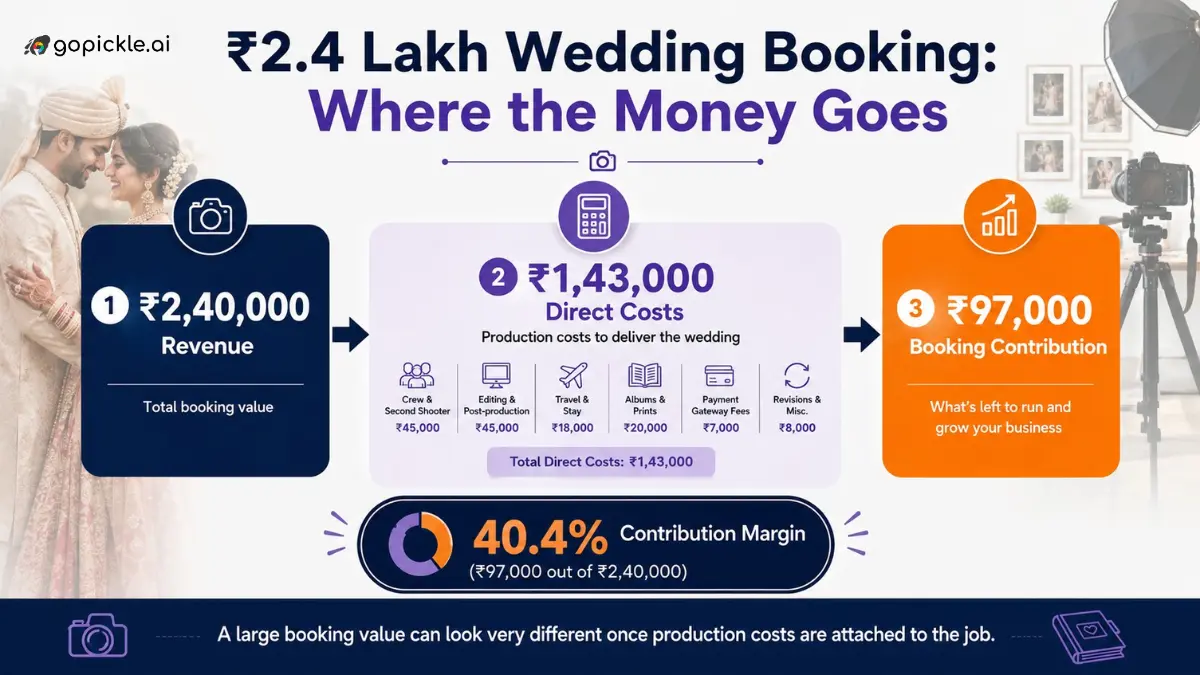
Consider a wedding studio that sells a booking for ₹2,40,000 before applicable taxes.
Its final costs look like this:
| Booking expense | Cost |
|---|---|
| Second photographer | ₹18,000 |
| Cinematographer | ₹25,000 |
| Assistant | ₹8,000 |
| Photo editing | ₹18,000 |
| Video editing | ₹22,000 |
| Album production | ₹16,000 |
| Travel | ₹10,000 |
| Accommodation | ₹8,000 |
| Equipment rental | ₹6,000 |
| Payment processing | ₹3,500 |
| Extra revision work | ₹5,500 |
| Delivery and miscellaneous direct costs | ₹3,000 |
| Total direct cost | ₹143,000 |
Booking revenue:
₹2,40,000
Minus direct costs:
₹1,43,000
Booking contribution:
₹97,000
Contribution margin:
₹97,000 ÷ ₹2,40,000 × 100 = 40.4%
At first glance, that booking produced a healthy ₹97,000 contribution.
But that still is not the studio's final profit.
Add the Photography Business Expenses That Exist Even Without the Booking
Every studio also has costs that cannot be cleanly attached to one client.
Examples include:
- studio rent
- accounting
- business insurance
- website hosting
- CRM or photography business software
- editing subscriptions
- gallery software
- marketing
- advertising
- internet
- phone
- office salaries
- legal and compliance costs
- equipment depreciation
- repairs
- general cloud storage
- administrative expenses
These are overheads. You do not need to randomly add your entire annual expense bill to one wedding. Allocate it. Suppose the studio's relevant operating overhead is ₹1,20,000 per month and it completes 10 comparable revenue-producing bookings during that period.
A simple allocation would be:
₹1,20,000 ÷ 10 = ₹12,000 overhead per booking
There are more sophisticated ways to allocate overhead by revenue, staff hours or project type. The exact method matters less than consistently recognising that overhead exists.
PPA explicitly distinguishes cost of sales from general business expenses for this reason.
Our wedding now becomes:
Booking contribution: ₹97,000
Allocated overhead: ₹12,000
Remaining: ₹85,000
Do Not Treat Your Own Time as Free
This is one of the biggest distortions in photography pricing.
Imagine you personally spent:
- 4 hours in client meetings
- 3 hours planning
- 18 hours shooting
- 4 hours travelling
- 5 hours reviewing selections
- 8 hours overseeing editing and delivery
That is 42 hours. If the business only appears profitable because the owner works those 42 hours without assigning any value to that labour, the pricing model is incomplete.
Decide what owner compensation should reasonably be associated with the project. Suppose you allocate ₹25,000 for your work.
Our example now becomes:
₹97,000 booking contribution
− ₹12,000 overhead allocation
− ₹25,000 owner compensation
= ₹60,000 true operating profit
True booking margin:
₹60,000 ÷ ₹2,40,000 × 100 = 25%
That is a very different number from looking at the ₹2,40,000 quotation and thinking, “This was a ₹2.4 lakh job.”
Profit Margin and Markup Are Not the Same
This causes pricing mistakes surprisingly often.
Suppose a project costs ₹1,00,000 to deliver and you charge ₹1,50,000.
Your profit is ₹50,000.
Your markup is:
₹50,000 ÷ ₹1,00,000 = 50%
But your profit margin is:
₹50,000 ÷ ₹1,50,000 = 33.3%
If you are using a photography pricing calculator, confirm whether it asks for markup or margin.
They are not interchangeable.
Discounts Come Directly Out of Margin
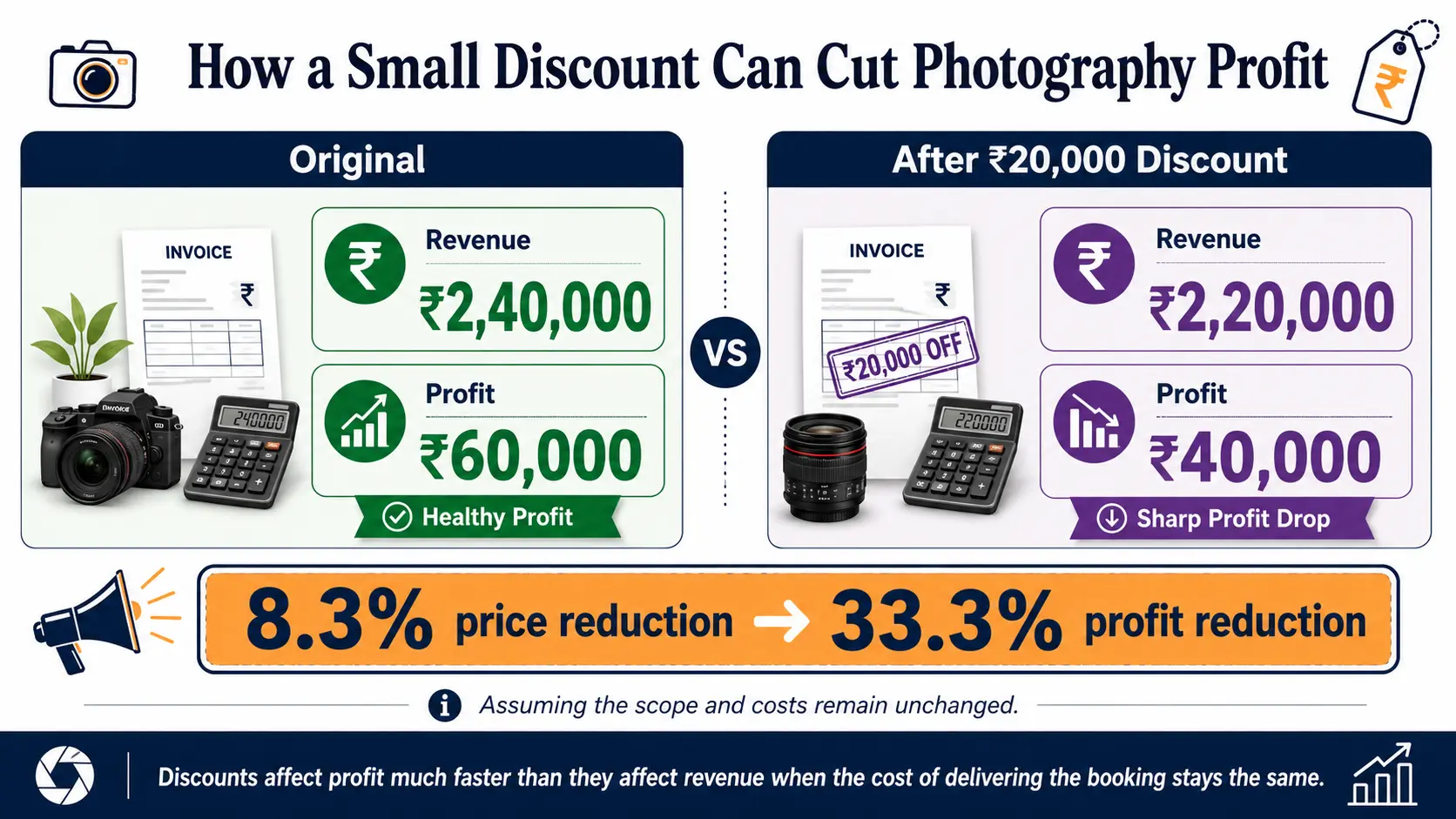
Suppose a client asks for ₹20,000 off the ₹2,40,000 package.
If the services, crew, album and delivery remain unchanged, almost none of your costs disappear.
Revenue becomes:
₹2,20,000
If your fully loaded cost remains ₹1,80,000, profit falls from:
₹60,000 to ₹40,000
The quotation received an 8.3% discount.
Your profit fell by 33.3%.
This is why photographers should never evaluate discounts only as a percentage of the package price.
Before reducing a quotation, remove scope where possible.
A lower price could mean:
- fewer coverage hours
- smaller crew
- fewer events
- standard rather than premium album
- fewer deliverables
- different turnaround time
Our guide on how to explain photography pricing without sounding defensive covers the client-facing side of this conversation.
Use Past Booking Profitability to Price the Next Job
This is where the calculation becomes genuinely useful. Do not calculate margins once and file them away. Compare bookings.
You may discover that:
- destination weddings generate high revenue but weak margins
- album upgrades are highly profitable
- video packages require more post-production than expected
- corporate assignments have better margins than large weddings
- certain venues consistently create extra travel costs
- certain packages produce excessive revisions
- a specific outsourced editor changes job economics
- smaller local weddings generate better profit per working hour
That gives you evidence for future wedding photography pricing, package design and staffing. If your premium package repeatedly delivers a 15% margin while your mid-tier package delivers 30%, selling more premium packages may not solve the problem. The package itself may need redesigning.
Quote With the Expected Margin in Mind
Profitability should be estimated before the quotation goes out. When building a photography quotation, estimate:
Expected revenue minus Expected production cost minus required owner compensation and overhead
Then check whether the remaining margin justifies accepting the booking.
If not, you have four main levers, raise the price, reduce the scope, lower the delivery cost, or decline the project.
Using professional photography quotation software can help keep services, deliverables, pricing, discounts, taxes and client approvals structured before the work becomes a confirmed booking. GoPickle currently supports quotation-to-booking handoff and photography-specific scope such as events, albums and add-ons.
Keep the Cost Context Attached to the Booking
The harder part is usually not the formula. It is finding the numbers three months later.
The quotation may be in a PDF. Crew details are in WhatsApp. An advance is in the bank statement. Album pricing is with the printer. Travel expenses are sitting in someone's messages. The final amount collected is somewhere else.
That makes reliable photography job profitability difficult.
At GoPickle, we think the booking should become the operational centre of the job.
Our Booking Management for Photographers keeps the client, events, services, deliverables, crew, quotations, invoices and payment context connected around a confirmed project.
Crew planning also matters because people are often one of the largest direct costs of event photography. GoPickle Crew Management supports photographer and editor assignment, availability and crew-payment organisation around actual bookings.
For revenue, GoPickle Invoicing for Photographers keeps advances, instalments, invoice totals, amounts received and pending balances tied to the booking.
You can then use those operational records alongside your accounting records or profitability spreadsheet to calculate the real margin.
GoPickle is not a substitute for your accountant or statutory accounting system. Its role is to keep the photography workflow organised enough that the commercial story behind a booking is easier to reconstruct.
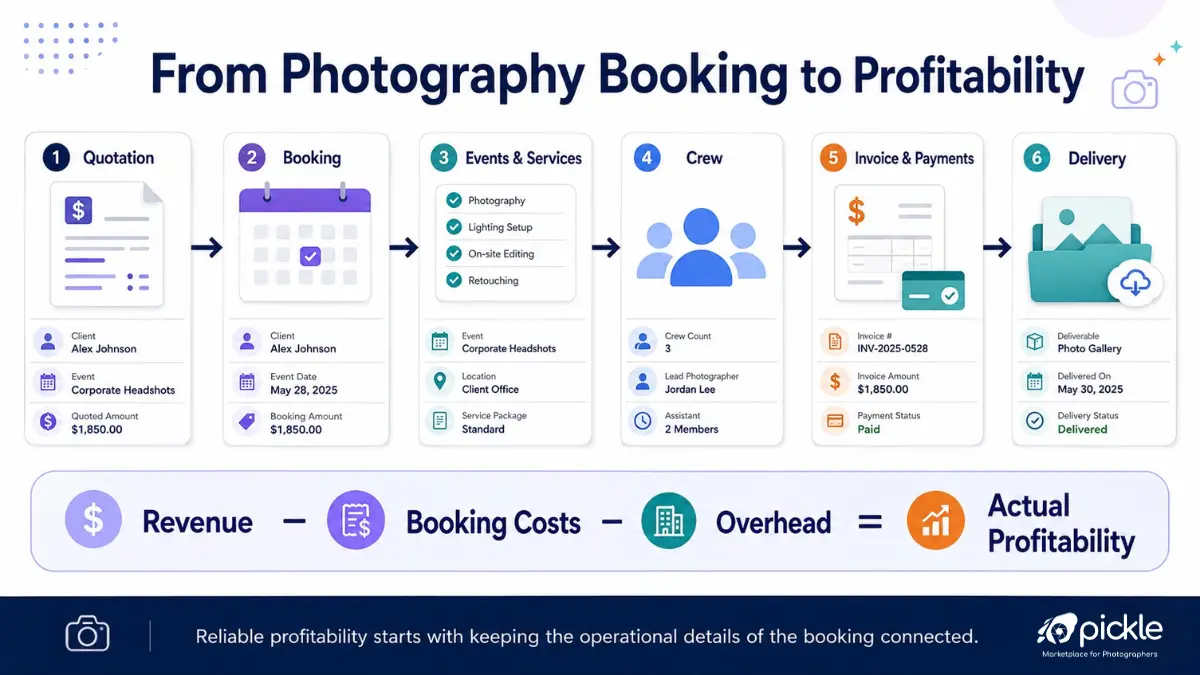
The Number Worth Watching Is Not Your Biggest Booking
Revenue still matters. But a studio can have its busiest season ever and still finish disappointed if crew costs, outsourcing, discounts and production work increase faster than prices.
That is why we would rather see a photographer know, “This wedding generated a 28% fully loaded margin.” than simply “This was a ₹3 lakh booking.”
One tells you how impressive the quotation looked. The other tells you whether the business made money.
Track that number across your weddings, portraits, commercial jobs and events. Once you know which bookings actually contribute to the studio, decisions about photography pricing, packages, discounts, crew, outsourcing and growth become much easier to defend.
And when the operational side becomes too complicated for spreadsheets, chats and disconnected documents, GoPickle.ai gives photographers one place to manage the workflow from enquiry and quotation through booking, crew, payments and final delivery.