Photography Business Break-Even Point: How Many Bookings Do You Need?
Learn how to calculate your photography business break-even point, understand studio expenses and set realistic monthly booking and revenue targets.

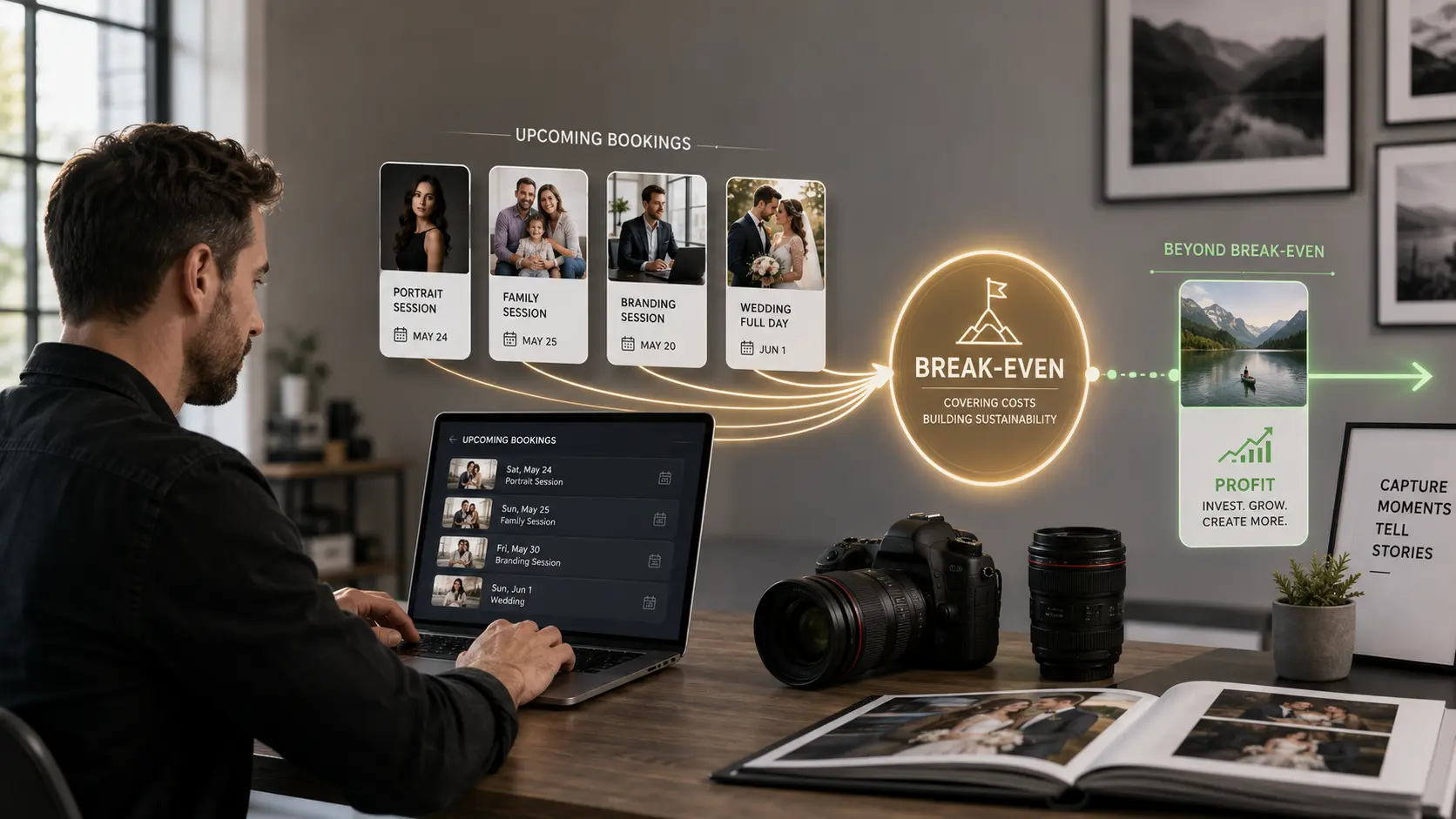
How many bookings does a photography studio need every month?
There is no useful industry-wide number.
A wedding photographer working with a second shooter, cinematographer, editor and album supplier may need a very different booking volume from a portrait photographer working alone. A commercial studio with permanent employees and rented space has a different cost structure again.
The question that matters is not how many bookings other photographers are getting.
It is How much work does your photography business need to cover the cost of staying in business each month?
That is your photography business break-even point.
Once you understand it, monthly booking targets stop being arbitrary. You can make better decisions about photography pricing, discounts, hiring, advertising, studio rent and the type of assignments worth pursuing.
What Does Break-Even Mean for a Photography Business?
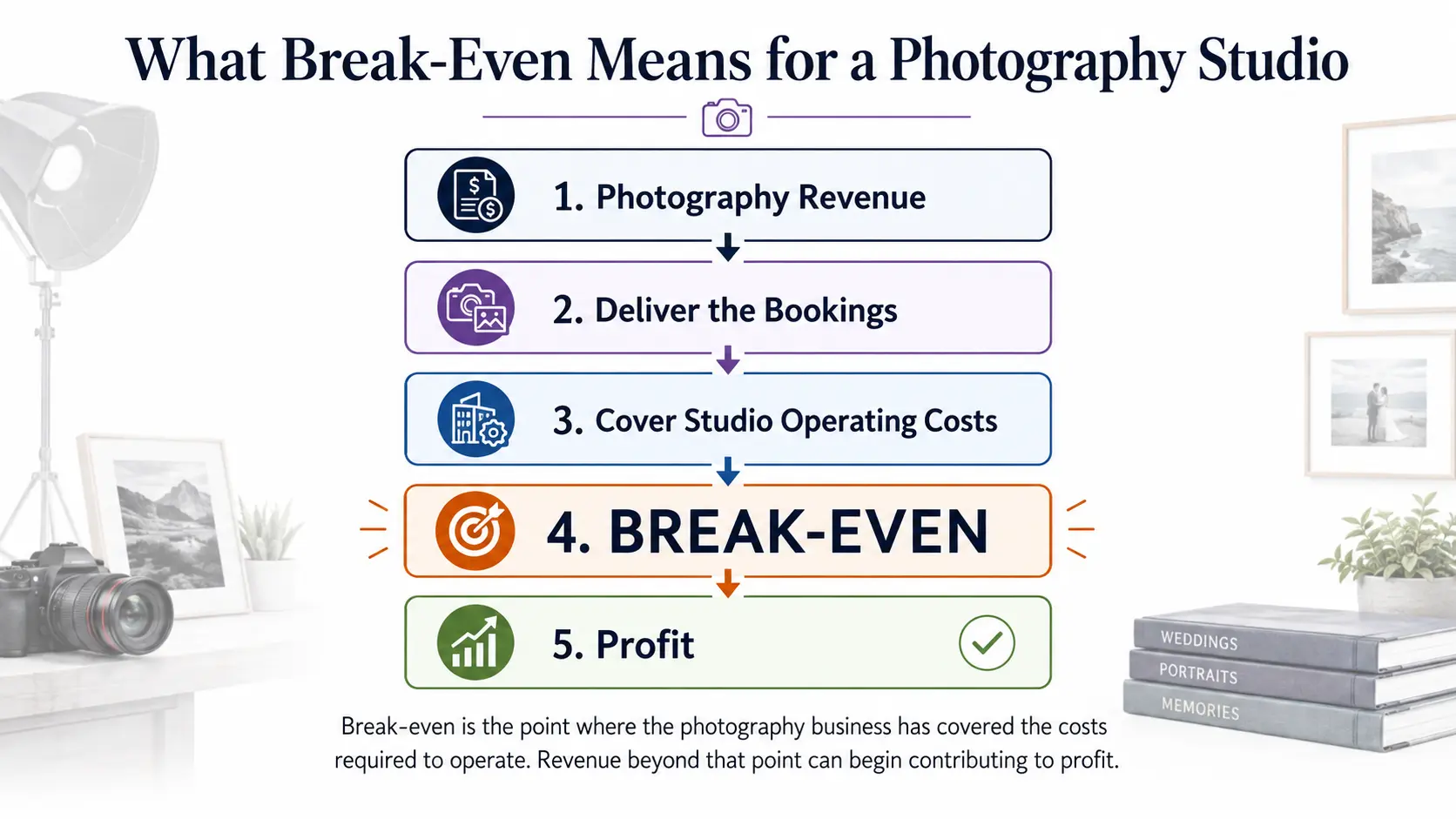
Break-even is the point where the money generated by the business has covered the costs required to operate it. You are no longer operating at a loss. You have not necessarily made the profit you want either. That distinction matters.
A photographer may finish a busy month feeling successful because several projects were completed and clients paid substantial invoices. But revenue alone does not tell you whether those projects covered the studio's underlying costs.
Some of that revenue had to pay photographers, editors, travel costs, album suppliers and other expenses required to deliver the work. What remains has to support the business itself. Only after those costs are covered does the studio start creating operating profit.
Break-even analysis therefore gives you a useful dividing line between being busy and being financially sustainable.
Start by Separating Studio Costs From Booking Costs
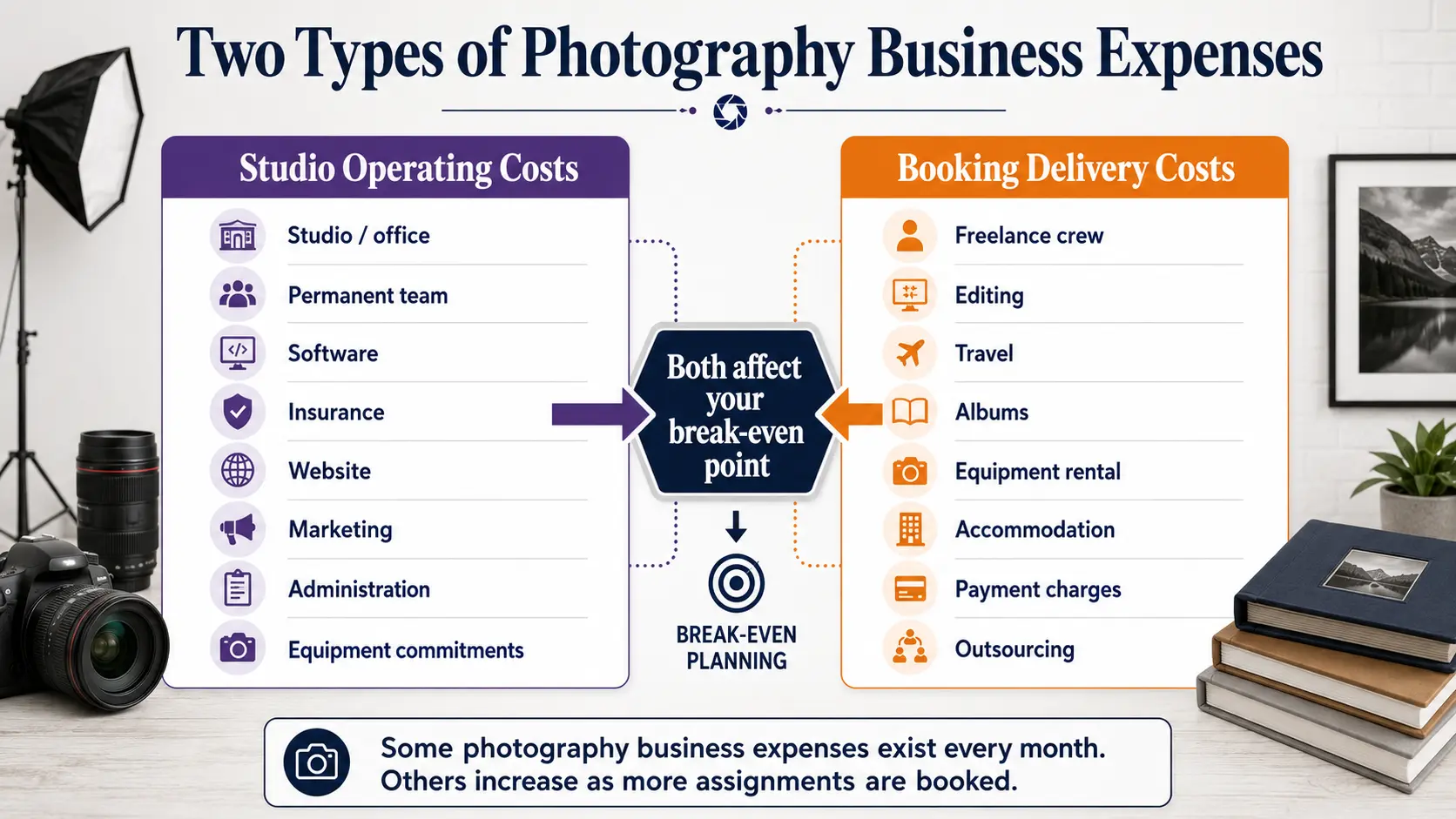
This is the most important distinction in the entire calculation. A photography business usually carries two broad types of expenses.
Costs of running the studio
These exist whether you have a full calendar or a quiet month.
Depending on your business, they may include studio rent, permanent salaries, business insurance, website costs, software subscriptions, accounting, administration, general cloud storage, recurring marketing commitments and equipment financing.
A solo photographer working from home might have a relatively light monthly cost base.
A larger wedding or commercial photography studio might have sales staff, editors, office space, equipment payments and several software systems to support before it photographs a single client.
These costs establish the financial weight the business carries every month.
Costs of delivering each booking
Other expenses appear because a particular assignment exists.
Think about a wedding that requires two photographers, a cinematographer, travel, accommodation, an outsourced editor and a physical album. Or a commercial shoot requiring equipment rental, assistants, retouching and location expenses. These are directly connected to the work being sold.
Professional Photographers of America recommends looking beyond the shoot itself when understanding photography costs, including labour, post-production, packaging, storage and delivery.
That gives us a much clearer picture of what each booking actually contributes to the business.
Your Booking Price Is Not What the Booking Contributes
This is where break-even planning often goes wrong.
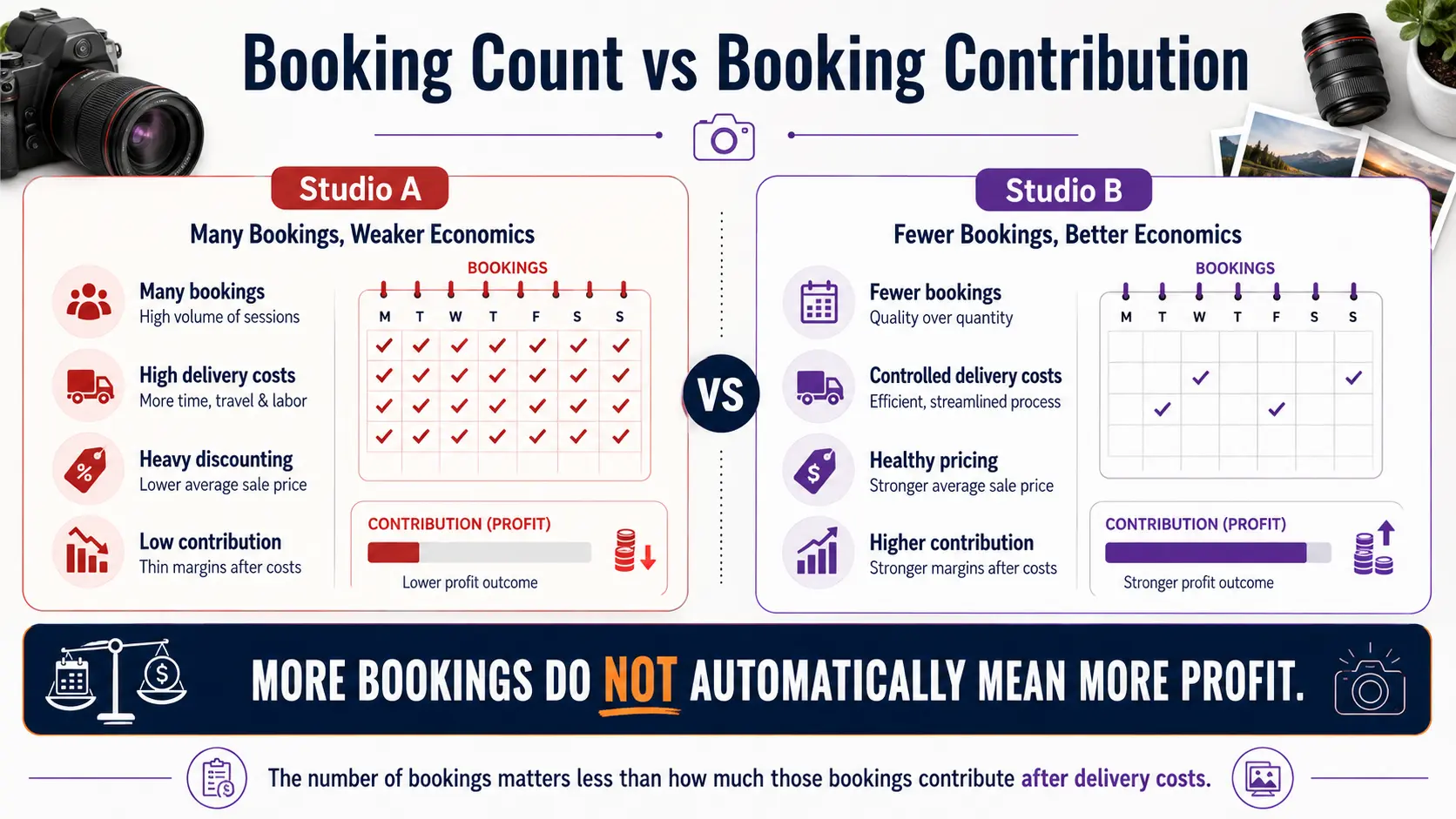
Suppose you sell a photography package for a certain amount. That full amount is not available to pay your studio rent, permanent employees and software subscriptions. The booking first has to be produced. Crew needs to be paid. Editing needs to happen. Travel may be required. Products may need to be manufactured and delivered. The amount left after those booking-specific expenses is called the contribution.
In simple terms:
Booking revenue − costs required to deliver that booking = booking contribution
That contribution is what helps pay the expenses of keeping the business running. This is why two equally priced photography packages can have completely different financial value.
A package requiring a large crew, expensive album and extensive post-production may leave much less behind than another package sold at the same price.
For photography business profitability, the amount left behind matters more than the headline quotation value.
How Contribution Determines How Many Bookings You Need
Once you understand contribution, the idea of break-even becomes much easier.
Imagine your studio has a certain amount of operating cost to cover every month. Every completed booking contributes something toward that amount. The first booking covers part of it. The next booking covers more. Eventually, the combined contribution from your bookings covers the studio's operating expenses. You have reached break-even.
The basic formula is:
Monthly operating costs ÷ average contribution per booking = approximate break-even booking target
You do not need to obsess over the exact decimal. The purpose is to understand the relationship.
If each booking leaves a strong contribution, you may need fewer bookings to support the business.
If every booking has heavy production costs, frequent discounts or expensive deliverables, you may need considerably more work to cover the same studio expenses.
That is why simply copying another photographer's monthly booking target tells you very little about your own business.
Break-Even Revenue Can Be More Useful Than Booking Count
Booking count works well when most of your assignments are reasonably similar. Many professional photography studios do not operate that way.
A wedding photographer might shoot a large wedding, a smaller engagement and several portrait sessions during the same month.
A commercial photographer might have one major campaign alongside several smaller assignments.
One booking is not necessarily comparable to another.
In that situation, think less about reaching an exact number of jobs and more about generating enough contribution across your entire monthly booking mix.
Your real monthly target becomes:
How much profitable work must we sell for the studio to cover its operating costs?
That is a much better way to think about photography monthly revenue.
High revenue with weak margins can still leave a studio under pressure.
Lower revenue from carefully priced, well-controlled assignments can sometimes produce a healthier business.
Break-Even Is Not the Same as a Healthy Income
Covering the studio's bills is only the first threshold. The business also needs to support the photographer. This is especially easy to overlook in owner-operated studios.
If every supplier gets paid, every software subscription is renewed and every client receives their photographs, but the owner repeatedly works without taking a reasonable income, the business has technically survived without necessarily becoming financially healthy.
It helps to think about the business in stages:
Cover booking costs
↓
Cover studio operating expenses
↓
Reach business break-even
↓
Pay the owner appropriately
↓
Create sustainable profit
Your desired profit sits above break-even.
That difference gives the business room to replace equipment, handle quieter periods, invest in marketing, hire people and grow without depending on the next client payment to survive.
Your Break-Even Point Moves as the Studio Changes
Break-even is not a number you calculate once and keep forever. It moves with the business. Hire a permanent editor and your monthly operating commitment rises. Move into a larger studio and it rises again. Increase your advertising budget or finance new equipment and the business needs more contribution each month to support those decisions.
The opposite is also possible.
Raise your average booking value without significantly increasing delivery costs and each booking may contribute more. Charge separately for expensive add-ons instead of absorbing them into packages and margins may improve. Reduce unnecessary outsourcing or design packages around the services clients actually value and the amount required from additional bookings may fall.
This is where break-even becomes useful as a management tool.
Before adding another permanent expense, ask:
How much additional profitable work will the studio need every month to support this decision?
Before giving a large discount, ask:
How much contribution are we giving away while keeping the same workload?
Before creating a new premium package, ask:
Does the higher price actually create a better margin, or are we simply adding more crew, products and editing?
PPA's pricing guidance similarly argues that photography pricing should reflect cost of sales, profit goals, service level and deliverables rather than simply copying competitor prices.
Break-Even Also Helps You Set Better Photography Prices
Pricing becomes easier to defend when you understand what the business needs.
Instead of asking:
“What are other photographers charging?”
you can ask:
“What must this booking contribute for the business to remain healthy?”
Competitor pricing still gives useful market context. It should not be the entire pricing model.
Your crew structure, editing process, deliverables, equipment requirements, positioning and operating costs are your own. A profitable photography pricing strategy needs to work for your business first.
This is also why a quotation should clearly define what the client is purchasing. Adding another photographer, extra coverage, more albums or additional edits without adjusting the price changes the economics of the booking.
Using a structured quotation system for photographers helps keep package scope, pricing and client approval connected before a project becomes a confirmed booking. GoPickle's quotation workflow can carry that information forward into the booking instead of leaving the quote as a disconnected PDF.
Know Where the Studio Stands Before the Month Is Over
The mathematics behind break-even is straightforward. The difficult part is having reliable information.
How much work is confirmed?
Which bookings still need crew?
What has been quoted?
What has actually been invoiced?
Which payments are outstanding?
How many projects are moving into the next month?
When this information sits across spreadsheets, WhatsApp conversations, calendars and separate PDFs, even a simple profitability calculation becomes difficult to maintain.
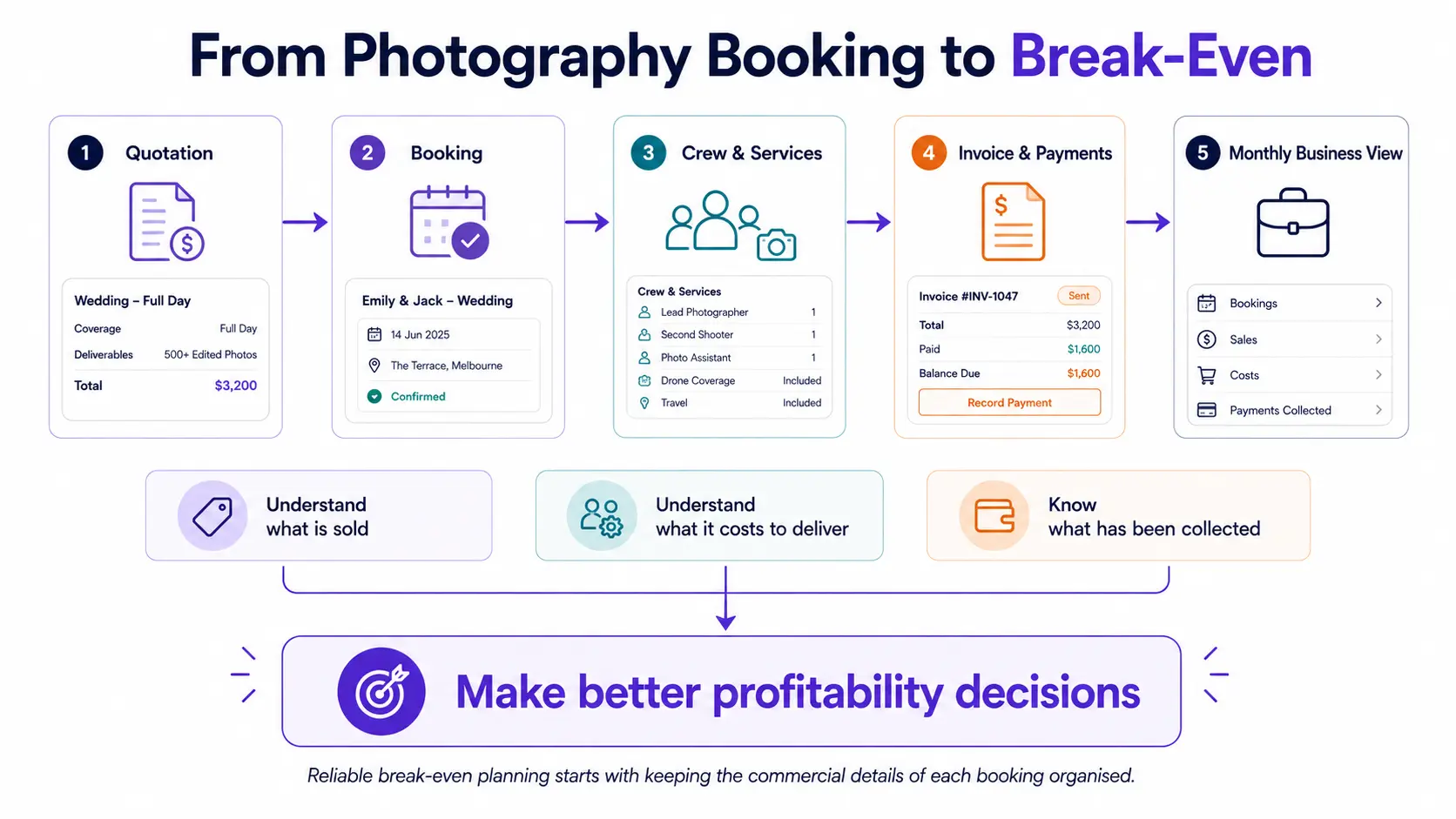
At GoPickle, we think the booking should remain connected to the commercial workflow around it.
GoPickle photography workflow management brings quotations, bookings, invoices, payments and crew assignment into the same photography-focused system.
Studios can track set of leads, follow-ups and everything related to ensure every enquiry gets converted to a booking. Read more on lead management using GoPickle.ai here.
Studios can keep assignment details and team allocation organised through crew management for photographers, while the photography invoicing workflow keeps amounts billed, paid and still outstanding connected with the client workflow. Current GoPickle product information confirms event-level crew assignment and connected quotation, booking and payment workflows.
GoPickle is not an accounting replacement, and we would not suggest treating operational records as formal financial statements.
The value is simpler: better operational records make it easier to understand what the studio is selling, delivering and collecting.
The Goal Is Not to Stay Busy
A full calendar can be encouraging. It is not proof of a profitable photography business. The healthier target is to know how much contribution your studio needs each month and then build the right mix of bookings to reach it. That may mean more bookings. It may mean better pricing. It may mean changing packages, reducing unnecessary delivery costs or becoming more selective about the work you accept.
Once you know your photography business break-even point, the question changes from:
“How many shoots can we book this month?”
to:
“How much profitable work does this studio actually need?”
That is a much better number to build a photography business around.