Photography Inquiry Form: What to Ask Before a Lead Reaches Your CRM
Build a photography inquiry form that qualifies leads without overwhelming prospects. See which contact, date, location, budget and source fields to ask.

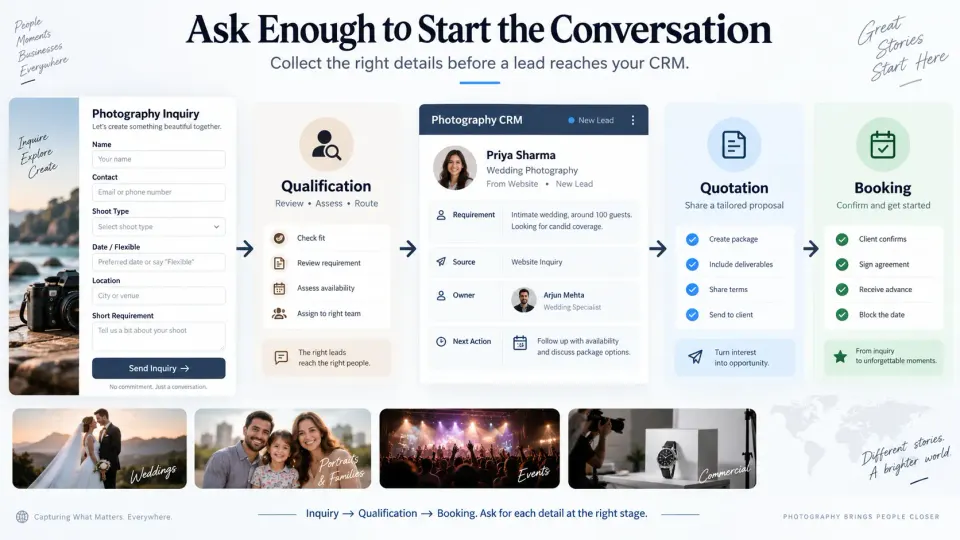
A photography inquiry form has one job: collect enough information to start the right sales conversation. It is not the place to plan the entire shoot.
That distinction matters because prospective clients are still deciding whether to contact you. A wedding couple may be comparing photographers from several browser tabs. A commercial client may be checking availability before a campaign brief is final. A parent looking for a family session may only know the month, not the exact date. If your photography website contact form asks them to complete a miniature production questionnaire before they can say hello, you are asking for certainty they may not have yet.
At GoPickle, we think the best inquiry forms sit between two bad extremes: a three-field “name, email, message” form that gives the studio almost no context, and a long intake form that makes a new prospect answer questions you will only need after they book. The useful middle ground is a photographer lead form that captures identity, service, timing, location, enough scope to route the enquiry, and only the qualification information you genuinely use.
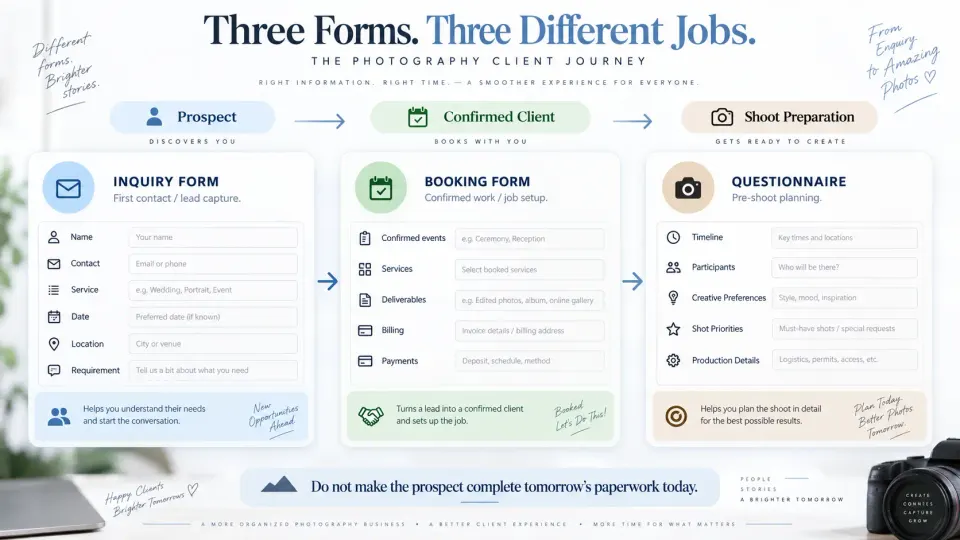
Inquiry form vs booking form vs questionnaire: keep the stages separate
An inquiry form belongs at the top of the client journey. Its purpose is to identify the prospect, understand what they are looking for and give the studio enough information to check fit, availability and the appropriate next step.
A booking form comes later, after the client has decided to move forward. That is where confirmed dates, event functions, exact venues, chosen services, deliverables, billing information and other operational details start becoming part of the job record. We cover that stage separately in Photography Booking Form Fields Every Studio Should Collect. Keeping the topics separate is important: an inquiry is an opportunity; a booking is confirmed work.
A questionnaire usually goes deeper still. Once a portrait client has booked, you can ask about participants, outfits and preferences. Once a wedding client is committed, you can collect family groupings, schedules and important moments. A commercial client may later provide brand guidelines, usage requirements, shot lists and production contacts. Those questions can improve the shoot, but they do not necessarily belong between “I like your work” and “Can we talk?”
Essential contact fields: ask only for details you will actually use
For most studios, the essential contact layer is small. You need the prospect’s name and at least one reliable way to respond. Email is useful because quotations, brochures and scheduling links are easy to send there. A phone or messaging number can also be valuable for studios whose sales process relies on calls or messaging, but it does not have to be mandatory for every business.
A practical photography inquiry form template can start with the following:
| Field | Usually required? | Why it belongs at inquiry stage |
|---|---|---|
| Name | Yes | Identifies the prospect and personalises the reply |
| Usually | Gives the studio a dependable response channel | |
| Phone / messaging number | Depends on workflow | Useful if calls or messaging are part of the sales process |
| Service or shoot type | Yes | Routes the lead to the right offer or team member |
| Preferred date or timeframe | Usually | Allows an early availability check |
| Location / city | Usually | Identifies travel, venue and market implications |
| Short requirement / message | Yes | Captures context fixed fields cannot predict |
| Budget | Optional | Helps qualify fit when the studio has a clear reason to use it |
| How did you find us? | Optional | Adds self-reported lead-source context |
The test is simple, if removing a field would not change your first response, availability check, routing decision or qualification process, it probably does not need to be required.
Ask for service, event and date in language clients understand
“Service required” may make sense inside a CRM, but your visitor may think in different terms. A wedding studio can offer Wedding, Engagement, Pre-wedding or Elopement. A portrait photographer might use Family, Maternity, Newborn, Headshots or Personal Branding. An event studio may use Conference, Corporate Event, Awards, Sports or Private Event. A commercial studio may need Product, Campaign, Editorial or Corporate Photography.
Keep the choices aligned with the services people have already seen on your website. If you cover several categories, conditional fields can reveal relevant follow-up questions instead of displaying every possible field to everyone.
Date deserves similar flexibility. For a wedding photography inquiry form, the event date is often one of the most important fields because availability can determine whether the conversation can continue. A family portrait prospect may only know “October” or “a weekend in spring.” For a commercial assignment, the production window or campaign deadline may be more useful than an exact shoot date. Offering Exact date / Flexible / Not decided yet is often more useful than forcing someone to invent a date just to submit the form.
Location should tell you about the job, not collect an address book
At inquiry stage, the studio usually needs geography, not a complete postal address. City, region, venue if already confirmed, or an indication that travel is required is often enough to decide whether the opportunity is workable.
For a wedding, asking for the venue or ceremony city can expose travel requirements. For event photography, the city and venue type may be sufficient until a production call. For commercial work, you might need to know whether the assignment is at the client’s premises, a rented studio or several locations. A portrait client may simply choose Studio / Outdoors / At home / Not sure yet.
Do not ask for street addresses, parking instructions, room numbers or detailed logistics unless they genuinely affect whether you can take the enquiry. Those details can wait for the confirmed booking or pre-shoot questionnaire.
Budget is useful only when you know what you will do with the answer
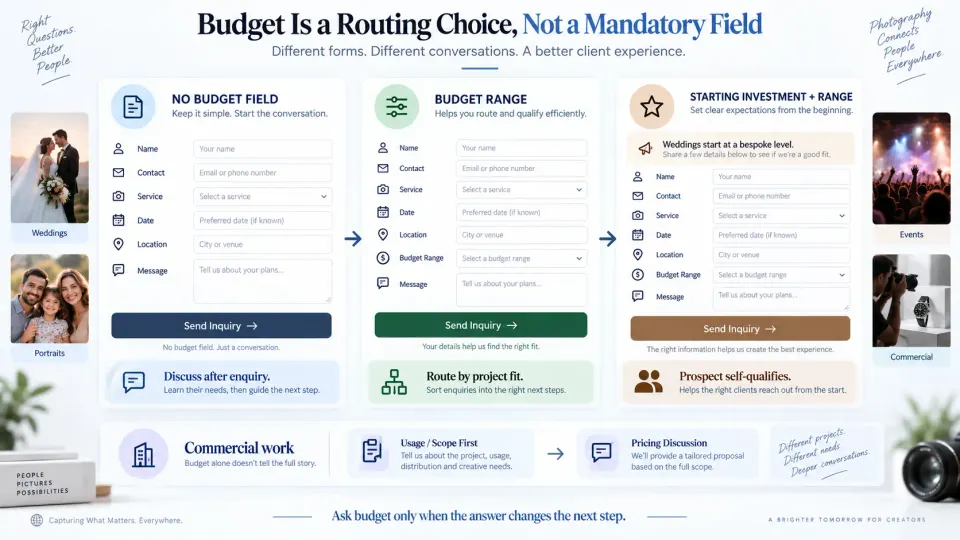
Budget is one of the most debated photographer contact form questions. It can expose obvious mismatches early, but it can also feel premature when the prospect does not yet understand your packages or what their project requires.
There are several defensible approaches:
| Approach | Works well when | Trade-off |
|---|---|---|
| Do not ask budget | Your pricing is simple or you prefer qualification through conversation | More enquiries may require manual pricing discussion |
| Ask a budget range | You handle several project sizes and can route enquiries by range | Some prospects will guess before understanding scope |
| Show a starting investment, then ask range | You have a meaningful minimum and want prospects to self-qualify | It may reduce enquiry volume as well as poor-fit leads |
Avoid a blank “What is your budget?” field if experience tells you most prospects do not know what to enter. Ranges are easier to answer, but those ranges should reflect your own pricing and market rather than numbers copied from somebody else’s photography enquiry form.
Commercial photography needs extra care. A budget figure can be difficult to interpret without knowing production scope, deliverables and intended usage. In that case, “What are the photographs being created for?” may tell you more than an early budget number.
Capture lead source without relying only on “How did you hear about us?”
Source attribution should begin before the lead reaches your CRM. If your website and analytics setup can preserve campaign, landing-page, referral or advertising information automatically, retain it. Then an optional question such as How did you find us? can capture information analytics cannot reliably explain: a past client, wedding planner, venue, friend, event guest or another photographer.
Inside your CRM, use consistent source names. “Instagram,” “Instagram DM,” “IG” and “Social” may describe essentially the same source but become four reporting categories if everybody records them differently.
That becomes important when you evaluate marketing performance because the channel generating the most photography leads is not necessarily the one generating the strongest bookings. Our guide to which lead sources work best for photography studios explains how website enquiries, referrals, social channels, paid campaigns and partner sources can behave differently once lead quality and conversion are considered.
Separate enquiry communication from marketing consent
Someone completing a photography enquiry form expects you to respond about that enquiry. That does not automatically mean they want newsletters, promotional messages or unrelated marketing later.
Your form should make the immediate communication expectation clear. If you also intend to collect consent for future marketing, treat that separately and follow the privacy and electronic-marketing requirements that apply to the countries in which you operate. Where consent is required, or where consent is the legal basis you choose to rely on, do not bury marketing permission inside the submit button, terms or a pre-selected checkbox.
A privacy notice should also be accessible near the form so a visitor can understand who is collecting their information and for what purpose. Privacy and electronic-communications laws differ internationally, so studios working across markets should adapt their wording rather than copying a form written for another jurisdiction.
What not to ask before the prospect has decided to work with you
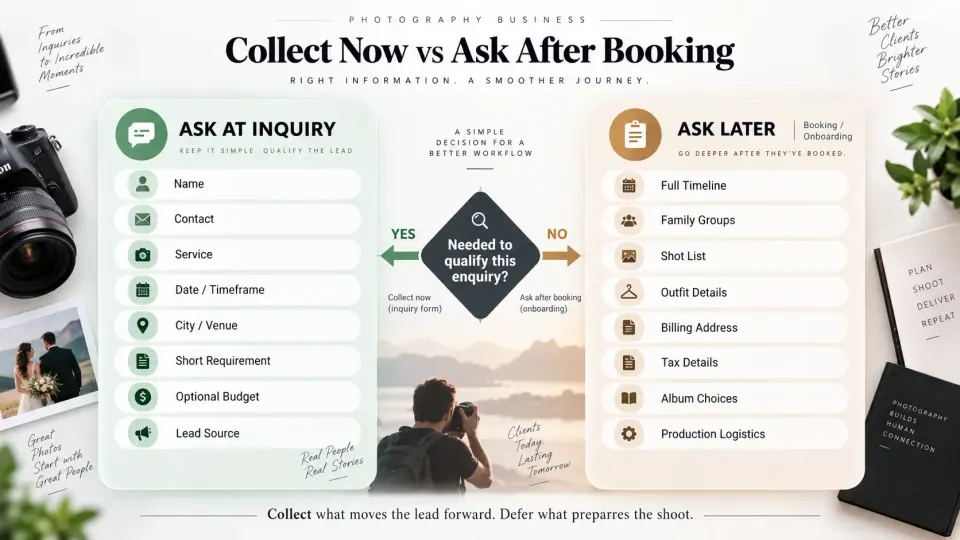
The temptation is to make the photography website contact form solve every future information problem. Resist it. Detailed wedding timelines, family group lists, outfit choices, complete shot lists, inspiration boards, emergency contacts, album specifications, billing addresses, tax information, payment schedules and production logistics are useful at different stages, but most are not necessary to decide whether a new enquiry deserves a response.
There are legitimate exceptions. A destination wedding photographer may need the country and number of event days. A school photographer may need an estimated participant count. A commercial photographer may need basic usage or deliverable context before determining whether the assignment is a fit. Conditional fields are useful here, ask the extra question only when the selected service makes it relevant rather than making every prospect complete a form designed for your most complicated project.
Design the form around the first CRM decision
The best photography inquiry form is not the one that collects the most data. It is the one that gives the studio enough information to make the next decision without making the prospect do unnecessary work.
Before publishing your form, examine every field and ask what happens because of the answer. Does it determine availability? Route the enquiry to a wedding, portrait, event or commercial workflow? Change what package you send? Identify travel? Flag a genuine pricing mismatch? Preserve useful lead-source information? If the answer is no, consider moving that question to a later stage.
Once the enquiry becomes a lead, the CRM should preserve that context and give the studio a clear next action. GoPickle Lead Management is designed around photography enquiries, requirements, dates, sources, ownership and follow-ups, so the useful information captured at first contact can continue through the sales process instead of disappearing into an inbox, spreadsheet or chat thread.
The handoff to aim for is Inquiry → Qualification → Quotation → Booking → Detailed onboarding. Each stage collects the information required to move the job forward without forcing the client to complete the next stage early. If you are rebuilding the wider process around your photography leads, GoPickle also maps this commercial journey in Get More Photography Bookings.