Usage Rights, Licensing and Buyouts in Commercial Photography Quotes
Learn how to price and define commercial photography usage rights, licensing fees, media, territory, duration, exclusivity, renewals and buyouts.

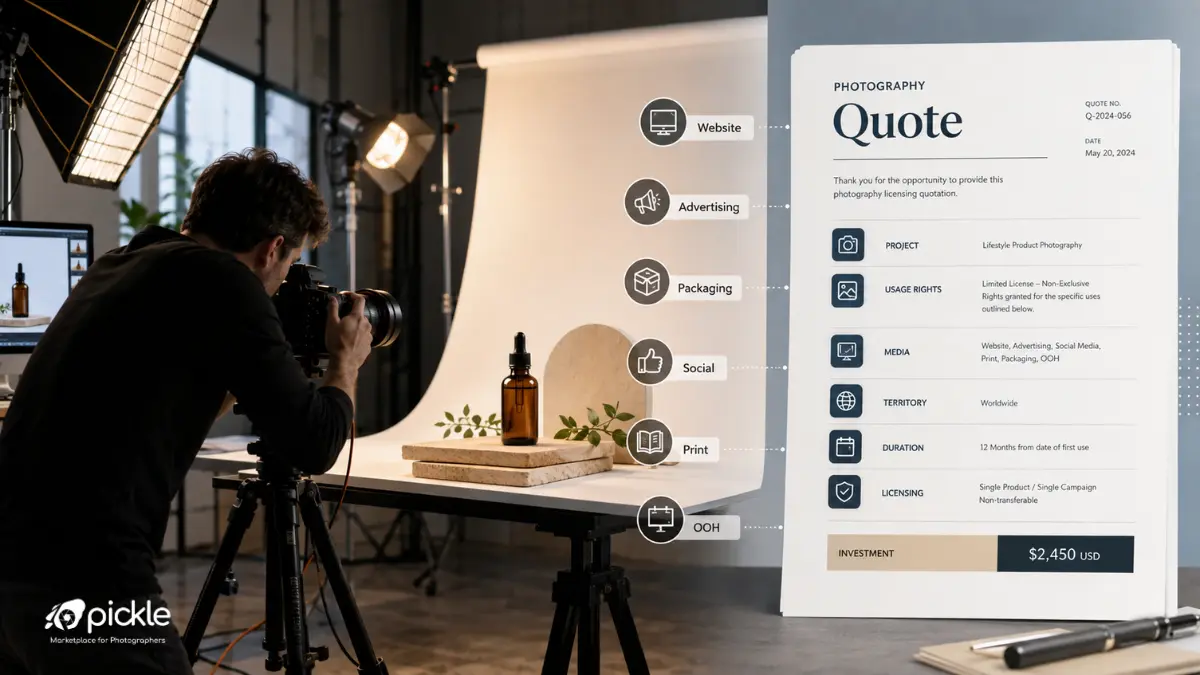
A commercial photography quote can be detailed about shoot days, crew, retouching and deliverables and still leave the most valuable part undefined: what the client is allowed to do with the finished images. A photograph made for a company website is not commercially equivalent to the same photograph appearing in paid social campaigns, retail packaging, outdoor advertising and distributor marketing across several countries for years. The production may be identical, but the business value of the image is not.
For commercial photographers, usage rights should be discussed while the quotation is being built, not after the files have been delivered. A clear license gives the client usable rights for its real campaign while preventing the photographer from unintentionally granting a much broader package than was priced.
Commercial Photography Usage Rights Start With Ownership, Not File Delivery
Receiving high-resolution files does not, by itself, answer who owns the copyright or what commercial uses are permitted. In the United States, the Copyright Office states that original photographs are protected when they are created and that the copyright owner holds rights including reproduction, distribution, adaptation and public display. PPA also distinguishes a license, where the photographer can retain copyright while granting specified uses, from a copyright transfer.
That distinction is the foundation of photography licensing. A license is permission to use identified images within an agreed scope; a copyright assignment transfers ownership rights instead. The legal position can differ by country, employment status, work-for-hire rules and contract structure, so photographers should have jurisdiction-specific language reviewed by a qualified lawyer rather than relying on generic online clauses. PPA makes the same recommendation with its own contract templates, noting that enforceability can vary by jurisdiction.
Define the Licensing “Box” Before You Price It
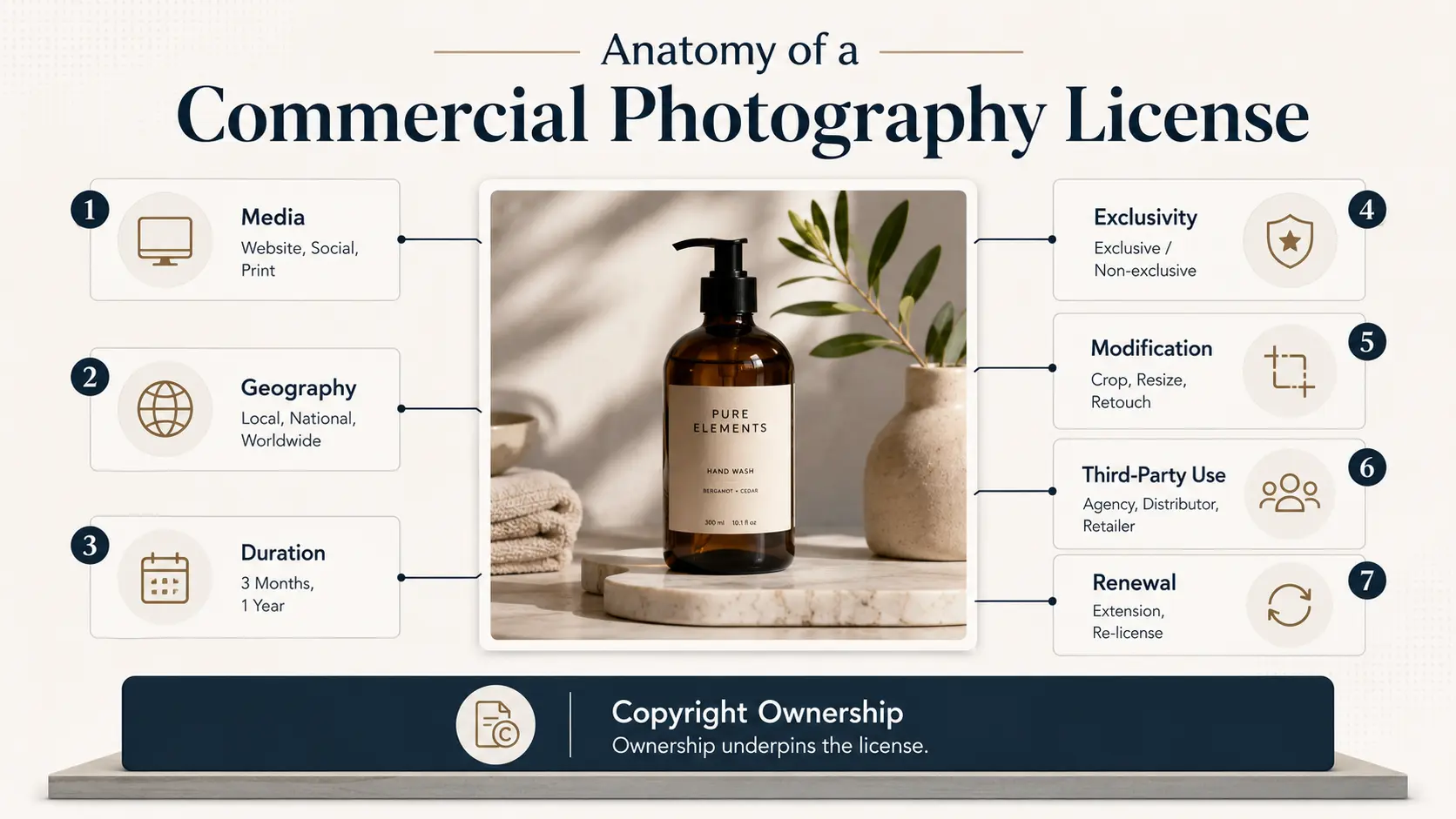
Wonderful Machine’s commercial estimating guidance identifies core elements of a photo license: the number of images, type of use, territory, duration, third-party use and exclusivity. ASMP guidance similarly emphasizes defining the work, permitted use, geographic territory, media or delivery platforms, exclusivity, assignment and reserved rights.
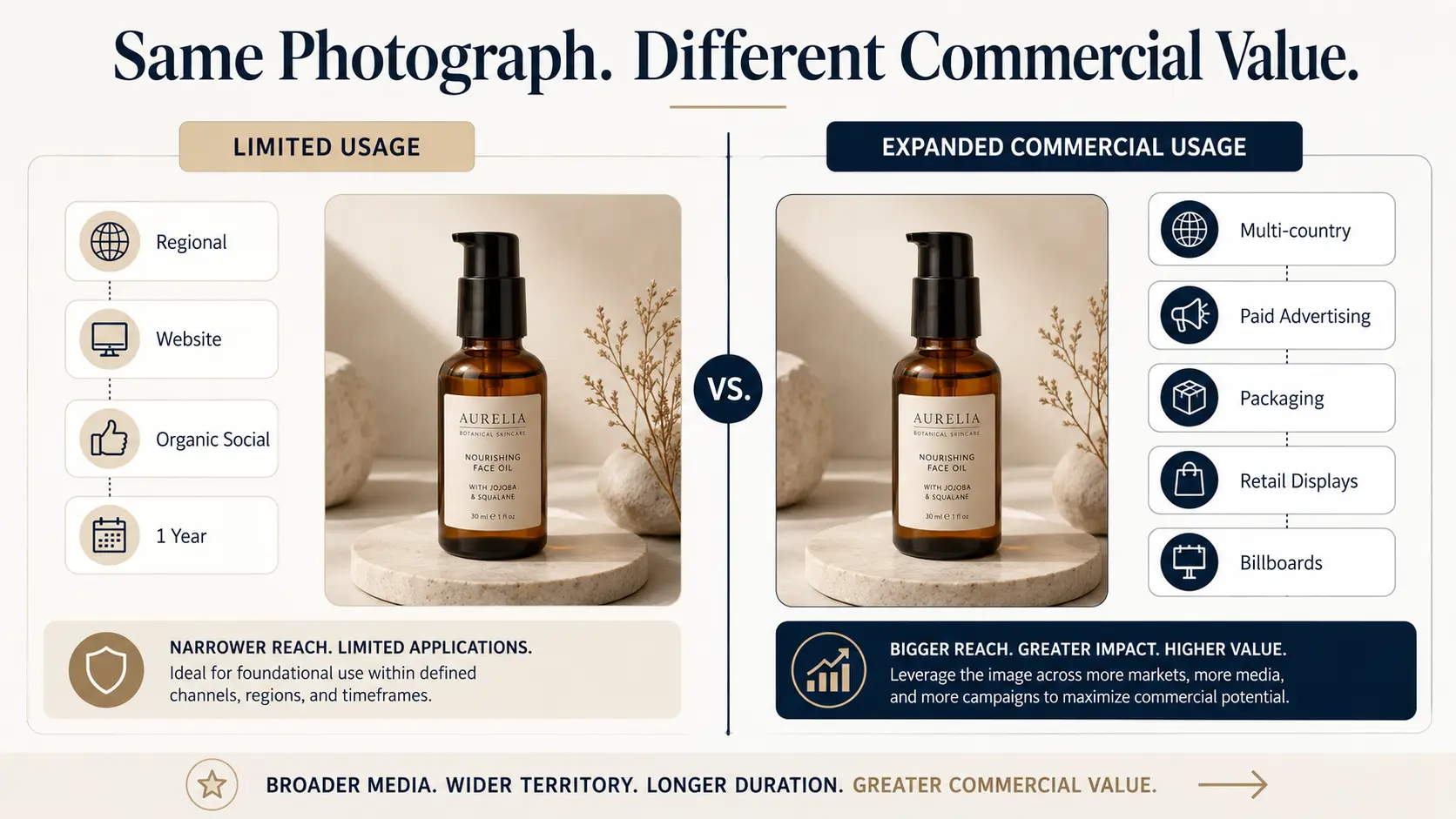
Start with media. “Digital use” is usually too vague for a serious campaign. Clarify whether the license covers the client’s website, organic social media, paid social advertising, display ads, email, brochures, press materials, point-of-sale displays, packaging, billboards or trade-show graphics. Then define geography and duration. Territory may be one country or worldwide; duration may be one campaign, one year, several years or perpetual. Wider and longer image usage rights grant more commercial value and should be considered accordingly in the photography licensing fee.
The remaining terms need equal precision. Exclusivity determines whether the photographer is restricted from licensing the same images to others and for how long. Modification rights should say whether the client can crop, resize, add copy, change colour, composite elements or materially retouch the work. Studios may also want to address AI-related alteration or training explicitly rather than assuming conventional editing permission covers it. Third-party use should distinguish a named agency acting for the client from independent use by retailers, distributors, franchisees, affiliates or other companies. PPA’s licensing material, for example, explicitly addresses alteration, transferability and redistribution rather than treating “usage” as one broad permission.
Price the Photography Licensing Fee Around the Rights Being Granted
There is no universal photography licensing fee that fits every commercial assignment. The fee should reflect the breadth and commercial value of the requested rights, together with the campaign scale, number of images, photographer’s market and production context. This is why a day rate alone can be misleading: the shoot fee addresses the work required to make the images, while the license addresses what the client may commercially do with them.
The creative fee and licensing fee may be shown separately or bundled, provided the license itself stays explicit. Wonderful Machine notes that commercial estimates can use either approach depending on the assignment. A regional company asking for one-year website, organic social and brochure use is buying a narrower package than the same company requesting national paid advertising, packaging and multi-year use. If the campaign later expands, the photographer can quote the additional media, territory or duration as a license extension rather than treating it as free continuation of the original shoot.
This is also why asking better questions can improve the quote. Instead of immediately offering “all media, worldwide, forever,” ask where the photographs are realistically expected to appear, which markets are included in the campaign, whether paid advertising is planned and how long the assets are expected to remain active. Sometimes the client needs less licensing than assumed. Sometimes the conversation reveals that the images are far more commercially important than the original brief suggested.
A Commercial Photography Buyout Must Be Defined, Not Assumed
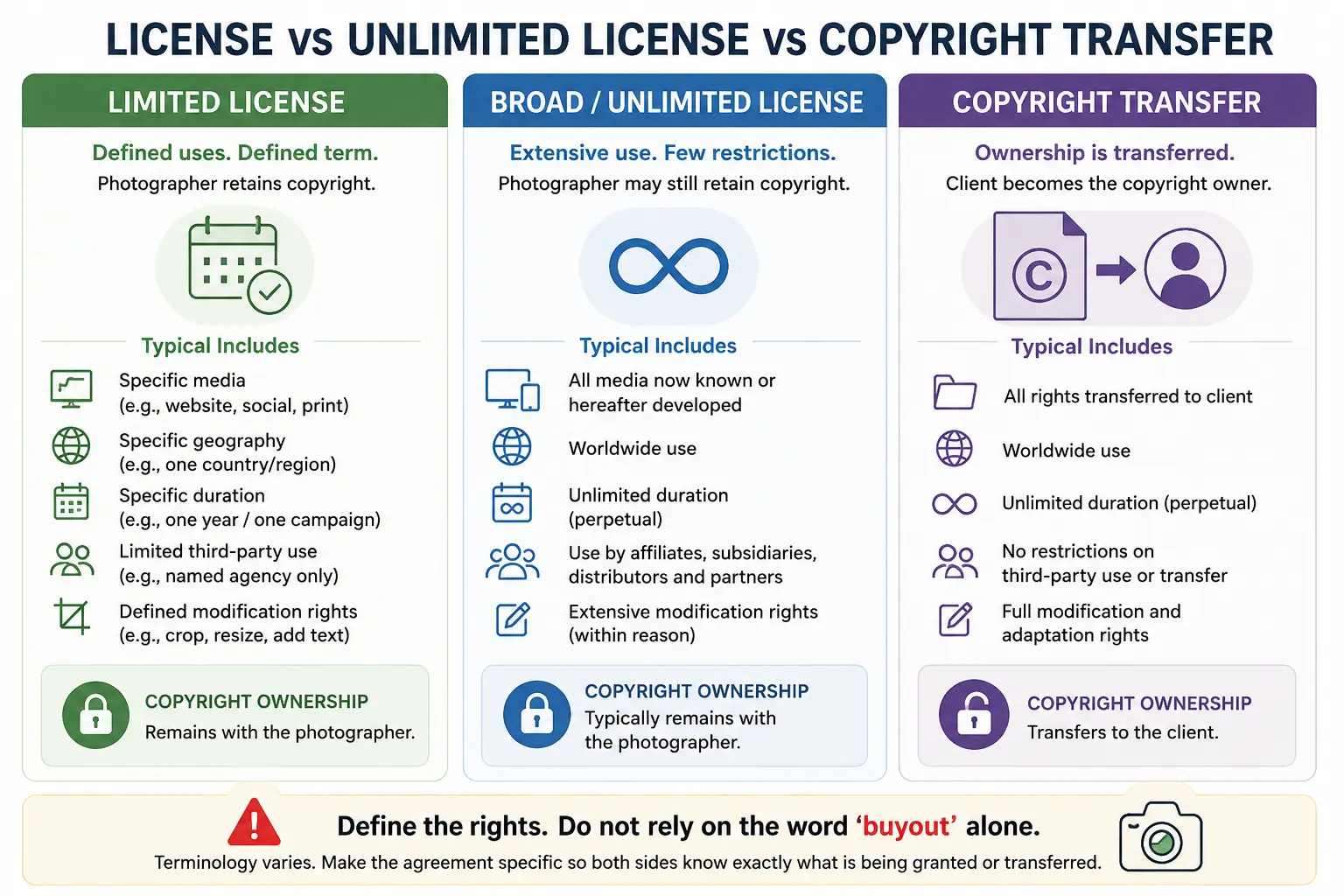
“Full buyout” is risky shorthand because it does not have one practical meaning across every client relationship. It may refer to broad perpetual usage while the photographer retains copyright, an exclusive perpetual license, or a complete copyright transfer. Those are materially different commercial outcomes.
A 2024 Wonderful Machine contract-review case showed this problem directly: the photographer and production company had different understandings of “full buyout.” The final clarification defined perpetual worldwide unlimited use while the photographer retained copyright. PPA’s licensing resources make the same distinction: an unlimited license can leave copyright with the photographer, while a copyright transfer changes ownership.
When a client requests a commercial photography buyout, ask what they actually need. Is perpetual use required because the company does not want to track expiry dates? Is worldwide advertising likely? Must agencies, subsidiaries or distributors use the files? Does the legal team genuinely require copyright ownership? Once the requirement is specific, the photographer can price the rights being granted or surrendered instead of attaching an arbitrary multiplier to an ambiguous word.
Make Renewal Part of the Original License
A time-limited license should explain what happens when it expires. The client may stop using the images, renew the same rights or request a broader license covering new media, territory or duration. The original quote does not need to predict every future renewal price, but it should state that continued use beyond the agreed term requires written renewal or extension.
This is practical for campaign photography because neither side may know how long a campaign will remain useful. If it performs well, the client can renew without commissioning another shoot, while the photographer is compensated for the extended commercial use. If it ends, the client has not paid upfront for years of rights it never needed. A defined renewal structure also gives the client’s marketing or procurement team something concrete to track instead of discovering an unclear licensing position several years later.
Put Usage Rights Inside the Quotation
The licensing summary should sit beside the assignment scope, deliverables and price so the client approves the commercial deal as one package. Our GoPickle photography quotation workflow helps photographers present project scope, deliverables, pricing and terms in one client-facing proposal, which is particularly useful for commercial assignments that require more context than a rate card. Our guide to creating a professional photography quotation also explains how to connect the requirement, deliverables, price and terms before approval.
A plain-English summary might read:
License: Up to 20 final selected photographs for Client Brand’s owned website, organic social channels, paid digital advertising and printed sales collateral in the United States and Canada for 12 months from first publication. Non-exclusive. Client’s named advertising agency may reproduce the images solely on the client’s behalf. Cropping, resizing and addition of brand copy are permitted; material retouching, sublicensing, resale and AI training are not included. Additional media, territory, term or third-party use requires written approval and an additional licensing fee.
That is an illustration of the information a commercial photography quote can capture, not legal language to copy unchanged. A lawyer familiar with the photographer’s jurisdiction and client base should review the studio’s licensing terms, copyright provisions, model or property releases where relevant, assignment provisions and work-for-hire language. Copyright ownership alone does not resolve privacy, publicity, trademark or release questions around people and property appearing in commercial imagery.
Clear Licensing Makes Future Changes Easier to Price
Good commercial photography licensing is about matching permission to the client’s real needs and matching the fee to the value being granted. Before sending a quote, confirm the licensed images, media, geography, duration, exclusivity, modification permissions, third-party access, renewal process and whether copyright ownership changes at all.
Once those points are explicit, the client knows what it can publish, the studio knows which rights have been sold, and any campaign expansion has a clear commercial starting point. At GoPickle, we see the quotation as the point where creative scope and commercial terms should become one record. The proposal and approval can then continue into a connected photography workflow rather than leaving licensing decisions scattered across emails, PDFs and chat messages. Jurisdiction-specific legal wording, however, should remain something the studio develops with appropriate legal counsel.