Wedding Photography Questionnaire Template: What to Ask 4–8 Weeks Before the Wedding
Use this wedding photography questionnaire template to collect timelines, venue details, family groups, priorities, vendor contacts and crew information before the wedding.


A wedding photography questionnaire should not be a personality quiz for the couple. By the time a wedding is four to eight weeks away, the photographer needs information that can change what happens on the day: where the team reports, when coverage begins, how long travel takes between venues, which family combinations matter, whether certain people should not be grouped together, what moments cannot be repeated and who can make a decision when the couple is unavailable.
That is the purpose of the questionnaire in our view at GoPickle.
The strongest wedding photography client questionnaire takes information that may currently exist across the planner's timeline, WhatsApp conversations, email threads and the couple's memory, then turns it into a working production plan. If a question does not affect preparation, timing, access, coverage, crew, family photographs or client expectations, ask whether it needs to be there at all.
This is also why the late-stage wedding questionnaire should be different from the form used when the client first enquires. At enquiry stage, you need enough information to price and confirm the work. Four to eight weeks before the wedding, the job is already booked. Now you need to know how to execute it.
When should a wedding photographer send the questionnaire?
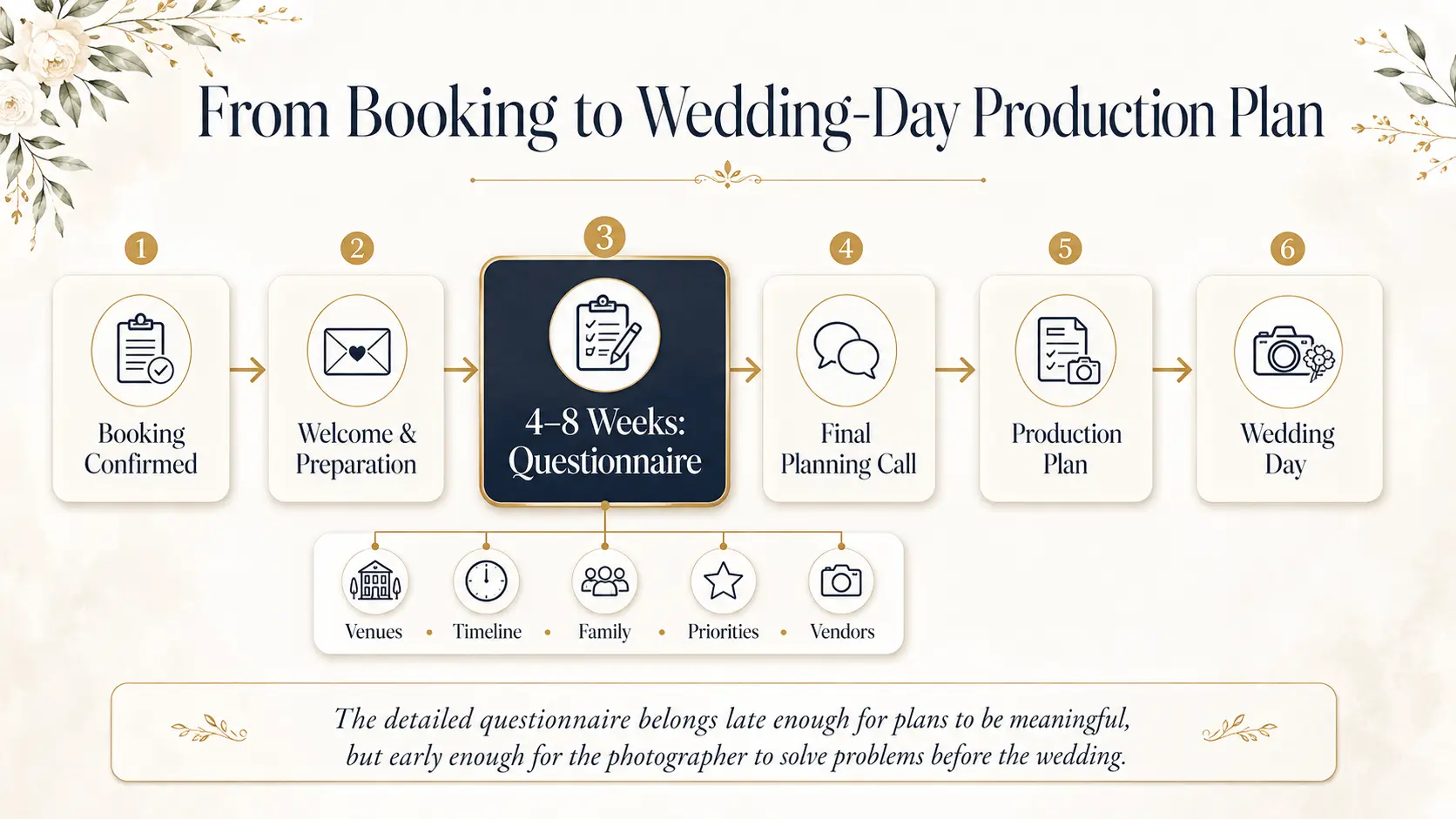
For most weddings, we recommend sending the detailed wedding photography questionnaire around four to eight weeks before the wedding, with the exact timing depending on the complexity of the event. A relatively simple single-location wedding can sit toward the later end of that planning window. A destination wedding, multi-day celebration or wedding involving several venues and photography crews deserves more time because the questionnaire may expose travel, staffing or timing problems that still need to be resolved.
Sending the full questionnaire immediately after booking is usually too early. The couple may not yet know the final ceremony time, preparation venue, reception schedule, family arrangements or vendor team. You end up collecting provisional answers and then asking for the same information again.
Waiting until the final few days creates the opposite problem. If the questionnaire reveals that the preparation locations are far apart, the ceremony has photography restrictions or twelve additional family groups are expected in a ten-minute portrait window, there may be little room left to solve the problem properly.
A practical workflow is:
Booking confirmed → Welcome and preparation information → Wedding questionnaire 4–8 weeks out → Photographer reviews answers → Final planning call → Production plan → Wedding day
The questionnaire should not replace the final conversation. It should make that conversation more useful because both the photographer and the couple can focus on unresolved decisions rather than reading basic information to each other.
For studios running multi-event weddings, the final details should also be reflected in the actual booking rather than leaving the completed form as a disconnected attachment. GoPickle Booking Management is built around keeping event dates, venues, services, deliverables and crew connected to the confirmed photography job.
Ask for contact, venue and access details you can actually use
A pre wedding questionnaire for photographers should start with operational facts, but avoid asking the couple to re-enter information that has already been confirmed and is still accurate. If you already have their names, wedding date and package inside the booking, do not make them type everything again simply because a generic template includes those fields.
Instead, confirm what may have changed.
Useful questions include:
- What is the best phone number for each partner during the final weeks before the wedding?
- Who should the photography team contact on the wedding day if you are unavailable?
- Where will each partner be getting ready? Please provide the venue name, full address and room or suite details if known.
- What is the ceremony venue and exact address?
- What is the reception venue and exact address?
- Are there separate locations for portraits, religious ceremonies or other wedding events?
- Are there parking, loading, entry, security or vendor-access instructions we should know?
- Has the venue given you any photography restrictions relating to movement, lighting, flash or access?
- Is there a planner or venue coordinator who should be contacted before arrival?
The value of these questions becomes obvious with multi-location weddings. “Getting ready at the hotel” is not enough information for a photographer who has to decide which entrance six people carrying equipment should use, where the second shooter reports and when that crew needs to leave for the ceremony.
The questionnaire should convert place names into instructions someone can execute.
Build the wedding-day timeline around transitions, not only ceremony time
Many wedding photographer questionnaires ask, “What is your wedding-day timeline?” and leave one enormous text box underneath it. That can produce anything from a detailed planner schedule to “ceremony at 4, reception afterwards.”
Ask for the parts of the day individually, or request the latest planner timeline and then ask questions around the photography-specific gaps.
Depending on the wedding, you may need:
- Photography coverage start and finish time
- Hair and makeup completion target
- Getting-ready photography time
- First look, if planned
- Couple portraits
- Wedding-party portraits
- Family photographs
- Ceremony start and expected finish
- Cocktail hour
- Couple entrance
- Speeches or toasts
- Cake cutting
- First dance and other planned dances
- Planned performances or traditions
- Send-off or exit
- Travel between every location
- Any surprise the photography team needs to anticipate
Travel deserves particular attention. Do not treat a 20-minute driving estimate as a 20-minute transition. The team may need to pack equipment, reach the vehicle, leave a busy venue, park at the next location, pass security and set up before photography resumes. If two crews are separating during the day, the schedule also determines who needs to be where.
This is where a wedding questionnaire stops being a form and starts influencing staffing. If one partner is getting ready at a hotel while the other is at a venue across the city, one photographer may not realistically cover both preparations without compromising something else.
Collect family groups, VIPs and sensitive relationships before the wedding day
Family formals are one of the easiest parts of a wedding to make unnecessarily difficult.
A weak questionnaire asks:
“Which family photographs would you like?”
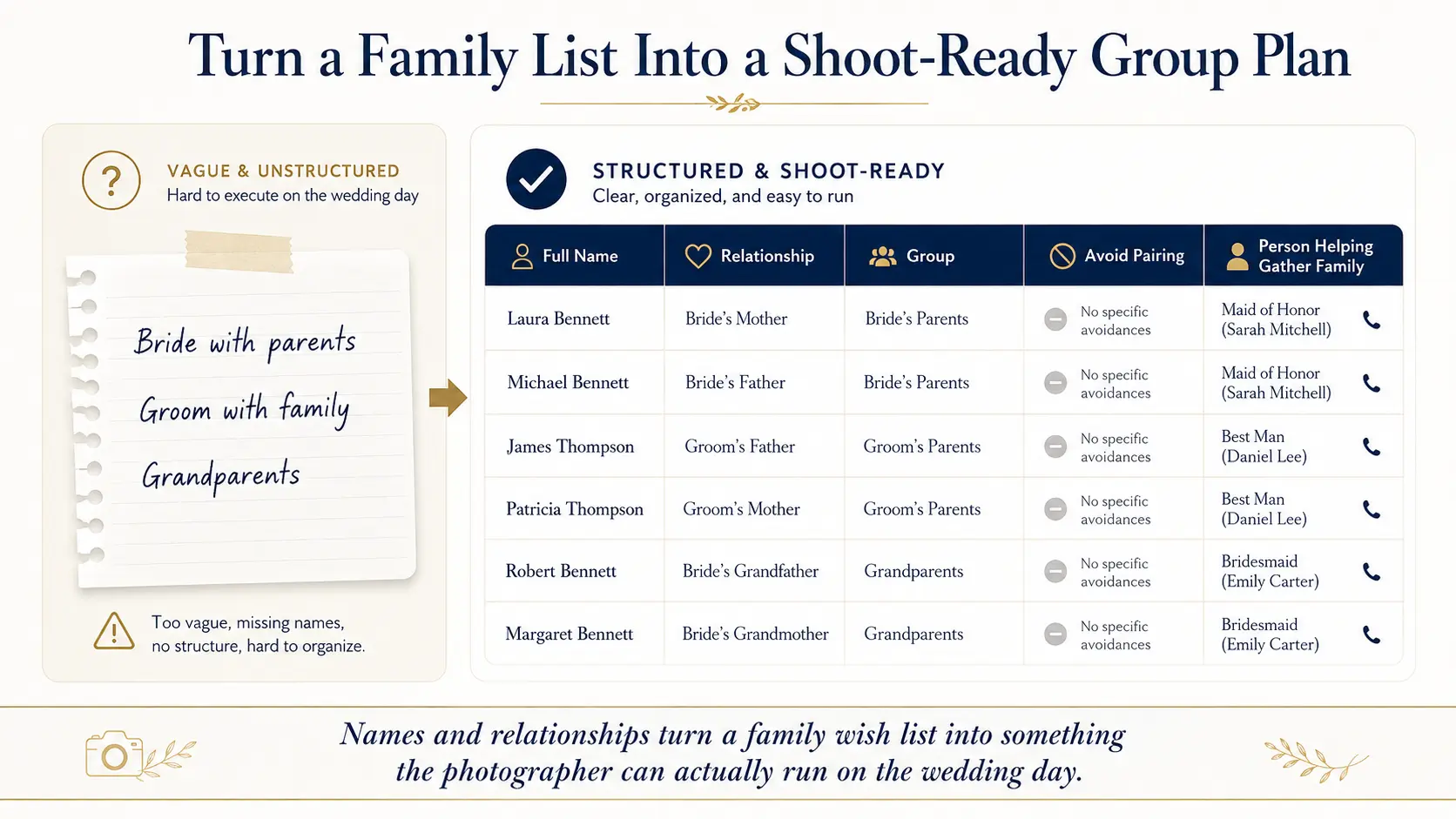
A stronger wedding photographer questionnaire asks for full names, relationships and the groups that genuinely matter.
Instead of receiving:
Bride with parents
Groom with family
Grandparents
you want enough information to build a usable call list:
Maya + Daniel + Maya's mother, Anita Sharma + Maya's father, Raj Sharma
Maya + Daniel + Daniel's mother, Susan Lee
Maya + maternal grandparents, Ravi and Latha Rao
Names matter because the photographer or assistant can call actual people rather than repeatedly asking the couple to identify “the groom's aunt”.
This section should also give clients a discreet way to flag relationships that require care. Keep the wording neutral and collect only what you need to execute the photographs respectfully:
“Are there any family members who should not be grouped together, or any family arrangements we should be aware of when planning formal photographs?”
You do not need the history behind a difficult relationship. You need to know whether putting two people beside each other would create an avoidable problem.
It can also be useful to ask whether anyone important will require additional time or easier access during group photographs, and who among the wedding party or family can help gather people. A sibling, planner or trusted friend who knows the families can often make a long group list run far more smoothly than a photographer trying to identify thirty strangers.
Ask about photography priorities without requesting an impossible shot list
Clients should be able to tell you what matters to them. They should not have to direct every frame you make.
There is an important difference.
A questionnaire that asks the couple to upload dozens of Pinterest screenshots or provide a list of 150 photographs can create the expectation that the photographer will reproduce a predetermined catalogue while also documenting a live event. It can shift attention away from what is actually happening.
Instead, ask for priorities that you could not reasonably discover on your own.
Good questions include:
- Which three to five parts of the wedding are most important to you photographically?
- Are there people attending whose presence is especially significant to you?
- Are there family photographs outside the normal immediate-family groups that are essential?
- Are there heirlooms, gifts, clothing details or personal objects with particular significance?
- Are there cultural or religious moments that we should understand before the day?
- Is anything unusual planned that the photography team needs to be positioned for in advance?
- Is there anything you definitely do not want photographed?
- Are there any photography requests we have discussed previously that you want us to reconfirm?
This gives the photographer useful direction without asking the couple to design the coverage.
For example, “Get photographs of the bride with her grandmother because she is travelling internationally to attend” is actionable. “Take a candid photograph of everyone laughing during dinner” is not something a photographer can schedule or guarantee.
The questionnaire should identify significance, not manufacture moments.
Collect the vendor and coordinator contacts that affect photography
A photographer does not need a directory of every company involved in the wedding simply because other questionnaire templates collect one.
Ask for the people your team may actually need to coordinate with.
For most weddings that means the wedding planner or coordinator, venue contact, videography lead and the person responsible for the reception schedule, such as an MC or DJ. Hair and makeup contacts may matter when preparation timing is tight. Transport contacts may matter when the wedding party is moving together between locations.
The reason for collecting these details is coordination, not vendor networking.
If the planner moves the first look by 20 minutes, the photography team should know who has authority to confirm that change. If the videography team needs the same narrow space for a ceremony setup, both teams benefit from knowing who is leading each crew before they meet at the venue.
On a larger wedding, those answers may also change your own assignments. GoPickle Crew Management lets studios organise photographers and other team members around actual wedding events, roles, timings and venues rather than keeping crew instructions in a separate chat thread.
What should not be in a wedding photography questionnaire?
Longer does not automatically mean more professional.
The easiest way to improve an existing wedding questionnaire template is often to remove questions that do not change anything.
Do not use the late-stage questionnaire to renegotiate the contract, confirm legal rights or collect overdue payments. Those belong in the appropriate contract, invoice and booking workflows. Do not make the couple repeat package details that your studio already has. Do not bury essential venue and family information among twenty questions about favourite colours, songs and how the couple met unless you genuinely use those answers in your work.
Avoid asking for sensitive personal information merely because a downloaded template contains a field for it. If you need to understand an access requirement, ask only for the practical accommodation your team needs to make. If you need to avoid a difficult family pairing, ask which grouping should be avoided rather than asking for the story behind the relationship.
And do not use the questionnaire as a substitute for judgement. The form can tell you that twelve family groupings are requested. The photographer still has to decide whether the available portrait time can support twelve groupings and raise that issue before the wedding.
Turn the questionnaire answers into the final production plan
The questionnaire is not finished when the couple presses Submit.
That is where the studio's work begins.
Review every response and flag anything that affects timing, staffing, equipment, travel, family coordination or expectations. Resolve contradictory information rather than choosing whichever version happens to be in the latest message. If the planner's schedule says the ceremony begins at 3:30 PM and the couple's questionnaire says 4:00 PM, confirm it.
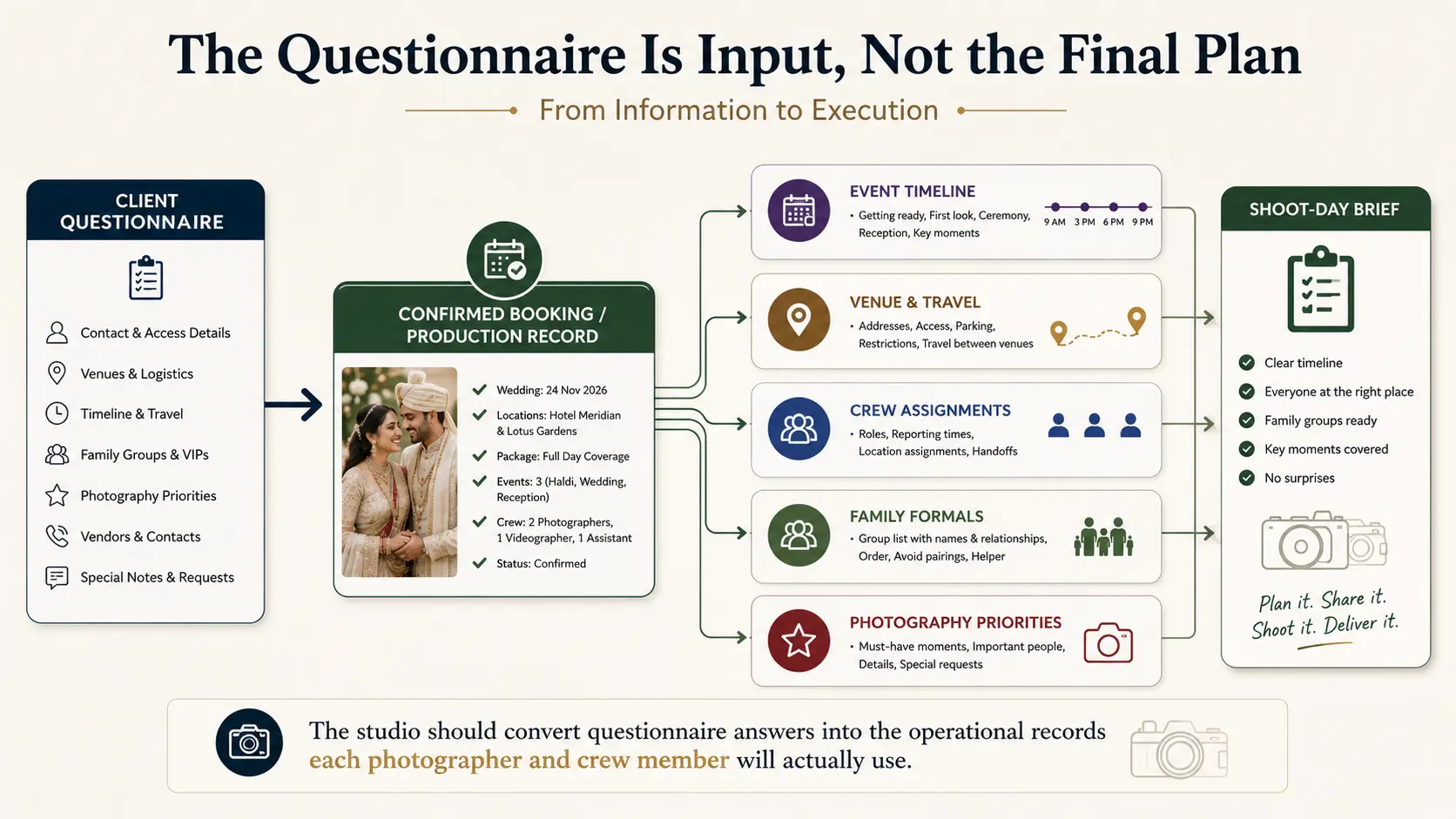
Then transfer the final decisions into the records your team will actually use.
The production flow should look something like this:
Questionnaire answers → Confirmed wedding timeline → Event and venue plan → Crew assignments → Family-formal list → Photography priorities → Final client confirmation → Shoot-day brief
For a multi-day studio, the Haldi photographer may not need every reception instruction, while the studio manager needs the complete picture. The lead photographer needs family information and creative priorities. A second shooter needs reporting time, venue, assignment and handoff instructions. The point is not to send the entire questionnaire to everybody. It is to convert client answers into the right operational information for each person.
GoPickle's wedding photography workflow is designed around that distinction. A wedding can contain several events, locations, crew assignments, services and deliverables while remaining connected to one booking. Whether the questionnaire itself comes from your preferred form tool, email or a planning call, the final confirmed plan should end up somewhere your studio and crew can rely on.
Copyable wedding photography questionnaire template
The exact form should be adapted to your style and wedding types, but this is a practical starting structure:
Wedding-day contacts
- What are the best current phone numbers for both partners?
- Who should we contact on the wedding day if we cannot reach you?
- Who is your wedding planner or day-of coordinator? Please share their phone number.
Locations and access
- Where will Partner 1 be getting ready? Include the full address and access details.
- Where will Partner 2 be getting ready?
- What are the ceremony and reception addresses?
- Are there any other locations we will photograph?
- Are there parking, security, access or photography restrictions we should know about?
Timeline
- Please share your latest wedding-day timeline.
- Is a first look planned?
- When are family and wedding-party photographs currently scheduled?
- Are there any important events, traditions, surprises or performances not shown on the timeline?
- How is the wedding party travelling between locations?
Family and important people
- Please list immediate family members using their full names and relationship to you.
- Which family group photographs are essential?
- Are there any people who should not be grouped together?
- Is there anyone who may need additional time or easier access during family photographs?
- Who can help us gather family members for group photographs?
Photography priorities
- Which moments or people are most important to you photographically?
- Are there meaningful details, heirlooms or traditions we should know about?
- Is there anything you would prefer us not to photograph?
- Are there any previous photography requests that you would like us to reconfirm?
Coordination
- Who is the lead?
- Who controls the reception timeline on the day?
- Is there anything else that could affect where our photography team needs to be, when we need to be there or what we need to prepare?
A useful wedding photography questionnaire gives the couple fewer things to explain on the wedding day and gives the photographer fewer things to discover by accident. That is the standard worth designing the form around.
The questionnaire does not need to know everything about the wedding. It needs to know everything that can materially change how your team photographs it.