World Photography Day 2026: Behind Every Photograph That Feels Like Home Is a Photographer
On World Photography Day 2026, we celebrate the photographers who preserve home, family, memory and the moments people only understand the value of with time.


Some photographs become more important long after they are taken.
A wedding photograph may first live in a gallery, an album or a social media post. Years later, the same frame can hold something much bigger: parents as they once looked, grandparents who are no longer there, a childhood home, old friendships, familiar streets, traditions, and people standing together in a way that may never happen again.
Photography has an unusual relationship with time.
The photographer records a fraction of a second. The meaning of that fraction can continue growing for decades.
On August 19, 2026, World Photography Day celebrates the art, craft, science and history of photography around the world. This year's optional theme is “HOME.” Photographers are being invited to share what home means to them, whether that is where they grew up, their country, where they live today or something far more personal.
For us at GoPickle, it feels like a particularly meaningful theme. Because professional photographers spend much of their working lives preserving what somebody else calls home.
Home Is Not Always a Place
Home can be a house. But photographers know how quickly the idea becomes more complicated than that.
Home can be a mother fixing her daughter's jewellery minutes before a wedding ceremony. A father waiting at the entrance. Children climbing onto their grandparents' bed. Friends sitting together after everyone else has left.
It can be the street someone grew up on, a family business, a familiar kitchen, a village thousands of kilometres from where a person now lives, or a new apartment where a young couple is beginning their life together.
The official World Photography Day theme intentionally leaves that interpretation open. “Home” can be where someone grew up, where they are now, their home country or anything they feel represents belonging.
Photography gives those ordinary places and relationships a second life. That is often what makes a photograph valuable. Not technical perfection alone.
Recognition.
Someone looks at an image years later and thinks: I remember this. I remember them. I remember what it felt like to be there.

The Photographer Is Usually Missing From the Photograph
Look at a great wedding photograph and you see the couple. Look at a family portrait and you see the family. Look at a photograph of an old neighbourhood and you see the place.
The photographer disappears.
That is part of the profession.
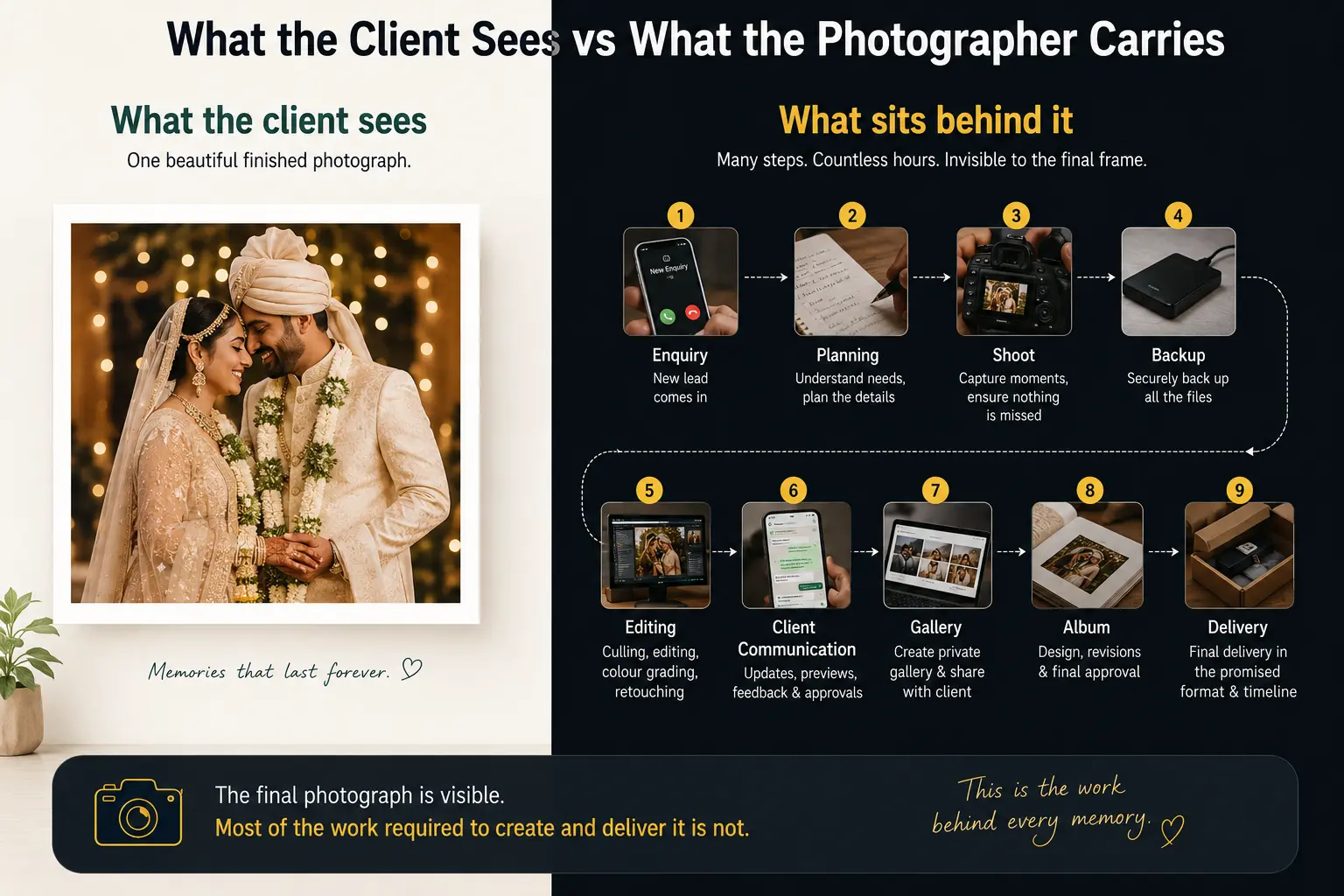
The final photograph gives almost no indication of everything that happened around it. There was an enquiry before the shoot. A conversation about what mattered. A date to protect. Travel to arrange. Equipment to prepare. People to coordinate. Light to understand. Moments to anticipate.
After the camera was put away came backups, culling, editing, retouching, client communication, gallery preparation, album decisions and delivery.
For a professional photographer, the photograph may be the reason for the business. But an entire business has to operate around that photograph.
Creative Talent Is Only Half of a Professional Photography Career
Photographers spend years learning to see. Light. Timing. Composition. Expression. Colour. Movement. Story.
Running a photography business requires a completely different set of skills.
Someone has to reply to enquiries, follow up with potential clients, prepare quotations, confirm dates, organise the crew, track payments, manage revisions and make sure promised work leaves the studio on time.
For a solo photographer, that “someone” is often the photographer.
For a growing studio, the responsibilities may be spread across several people but still depend heavily on the founder knowing what is happening.
That operational work is necessary. It just should not consume the part of the photographer that clients are actually hiring.
Protect the Work That Only You Can Do
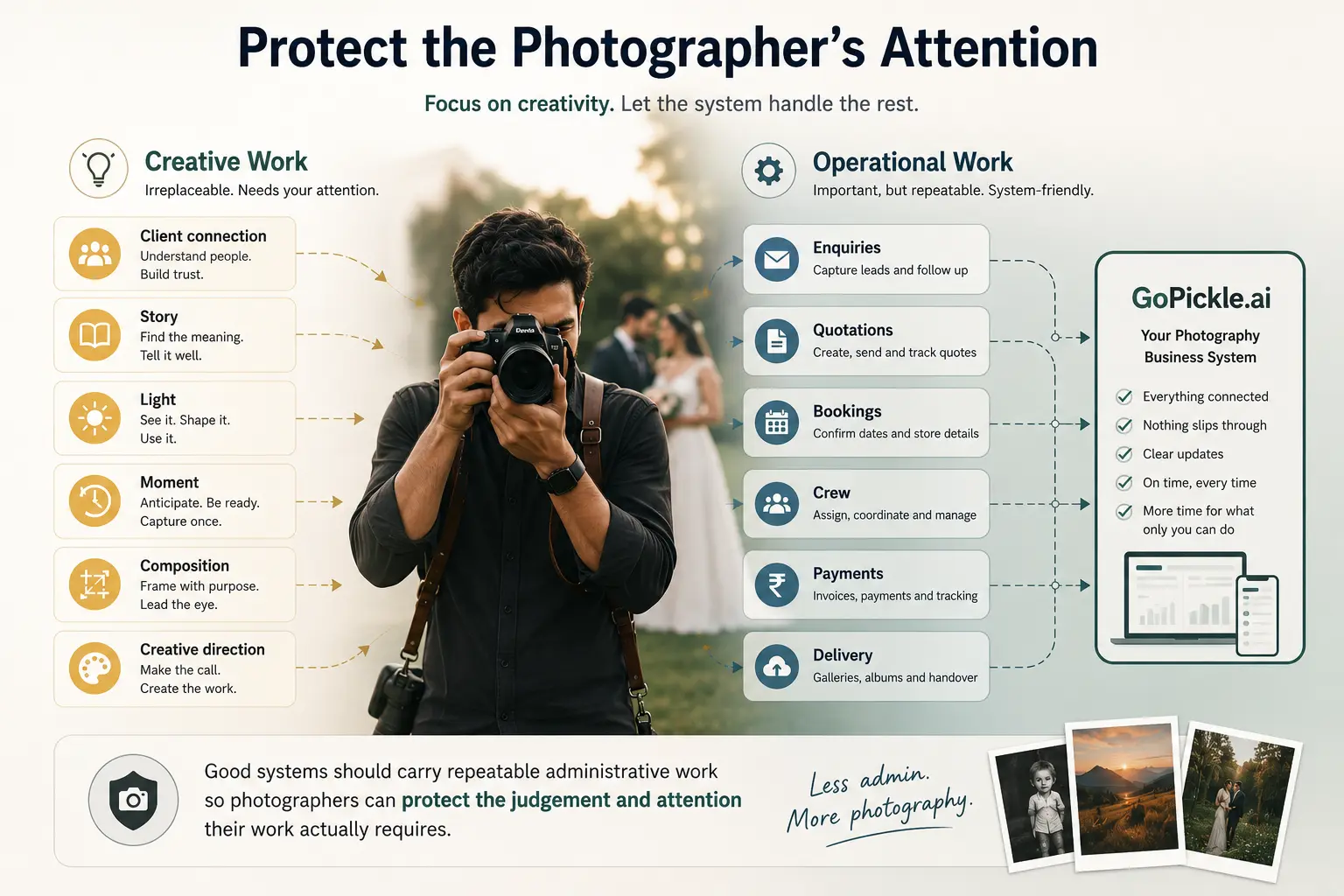
A useful question for any professional photographer is Which parts of this business genuinely require my creative judgement?
Understanding what matters to a client does.
Knowing when to press the shutter does.
Directing people without making the moment feel directed does.
Choosing the images that tell the story properly does.
Remembering whether an invoice has been partially paid does not.
Searching through messages to find a venue address does not.
Trying to remember which enquiry needs a follow-up tomorrow does not.
Recreating information from a quotation when the client finally confirms should not.
A good photography workflow protects attention.
It gives administrative work somewhere reliable to live so that the photographer does not have to carry the entire business in memory.
A Better-Run Studio Can Protect the Photography
Business systems can sound separate from creativity. In practice, the two affect each other constantly. Accept too many weddings and editing begins to fall behind. Promise too much inside a package and revisions start taking over the week.
Coordinate a crew at the last minute and the shoot becomes harder than it needed to be. Lose track of an enquiry and good work never reaches the calendar.
Lose track of payments and financial pressure starts influencing which assignments the studio accepts.
Poor operations eventually reach the client. More importantly, they eventually reach the photographer.
There are only so many evenings someone can spend replying to messages, checking spreadsheets and remembering unfinished tasks before that work begins taking energy away from photography itself.
A sustainable photography business is not about turning a creative profession into administration.
It is about keeping administration from consuming the creative profession.
Protect More Than Your Calendar
A photography business becomes healthier when it protects a few things deliberately.
Protect the time required to complete each booking properly. An open shoot date does not mean much if editing and delivery are already overloaded.
Protect pricing from becoming disconnected from the real work. Crew, travel, post-production, albums, revisions and delivery are part of the assignment even when the client never sees them happening.
Protect expectations. Clients should know what they are buying, what will happen next and when they should expect delivery.
And protect the relationship people have with your work after the shoot. A professional gallery, thoughtful album or well-organised delivery can become part of how the photographs are experienced for years.
These are business decisions.
But they ultimately protect the photography.
Technology Should Support the Photographer, Not Become the Photographer
This matters to us at GoPickle. Photography is entering a period where technology can do more than it ever could before.
That makes it even more important to decide what technology should do.
We do not think the interesting future is one where software replaces the reason somebody hired a photographer.
The photographer still sees the moment.
The photographer earns the trust.
The photographer decides what deserves to become a photograph.
Technology is much more useful when it carries the operational weight around that work.
That principle is part of how we describe GoPickle itself: the software should carry the operational weight while the photographer keeps the human part.
Why We Built GoPickle Around the Work Behind the Photograph
A professional photograph does not begin when the shutter opens.
And the job does not necessarily finish when the files have been edited.
There is a client journey around it.
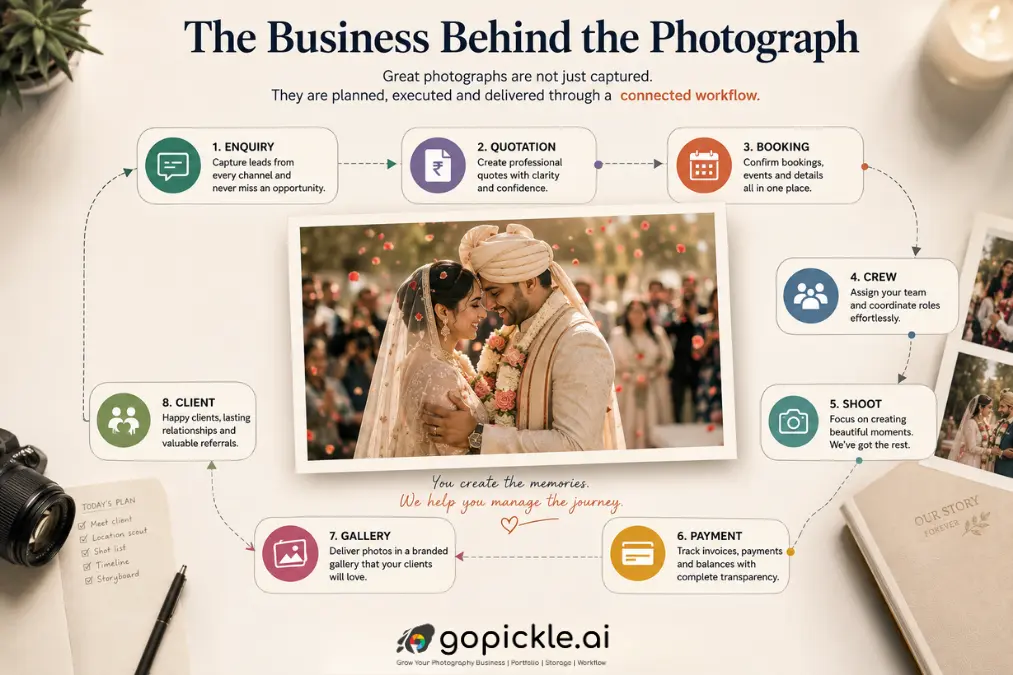
At GoPickle.ai, we are building that journey into one connected photography business workflow: enquiry, quotation, booking, crew, invoices, payments and final gallery delivery.
A new enquiry can stay visible instead of disappearing inside a conversation.
A photography quotation can carry the actual events, package, deliverables, pricing and approval into the next stage rather than becoming another forgotten PDF. GoPickle currently supports visual proposals with event-specific scope, packages, add-ons and direct movement from an approved quotation into a booking.
Bookings can keep dates, services and people together.
Invoices can stay connected with advances and balances.
And when the work is ready, Client Galleries give photographers a branded way to organise and deliver finished photographs with collections, favourites, access controls and downloads.
None of that creates the photograph.
That is precisely the point.
The system should support the work without trying to become the work.
On World Photography Day, Look Back at What You Have Preserved
World Photography Day exists in part to recognise photography's role in art, communication, documentation and preservation. Its August 19 date commemorates the public announcement of the daguerreotype process by the French government in 1839.
Nearly two centuries later, the equipment is different. The speed is different. The way photographs are shared is almost unrecognisable.
But one part remains familiar.
Somebody notices that a moment matters.
And decides not to let it disappear.
On August 19, thousands of photographers will share remarkable landscapes, portraits, weddings, wildlife, streets, families and everyday scenes from around the world. The official World Photography Day initiative encourages photographers to share work using #WorldPhotographyDay and, for the 2026 theme, #WorldPhotographyDay2026.
For the photographers reading this, we would add one more reason to look through your archive.
To every photographer building a life around doing that work: Happy World Photography Day.
Keep making photographs people will want to come home to.
- The GoPickle.ai Team