AI Face Recognition Gallery vs Standard Event Gallery: Which Delivery Model Fits the Job?
Compare AI face recognition galleries and standard photo galleries for event photography across discovery, event size, privacy, consent and client delivery.

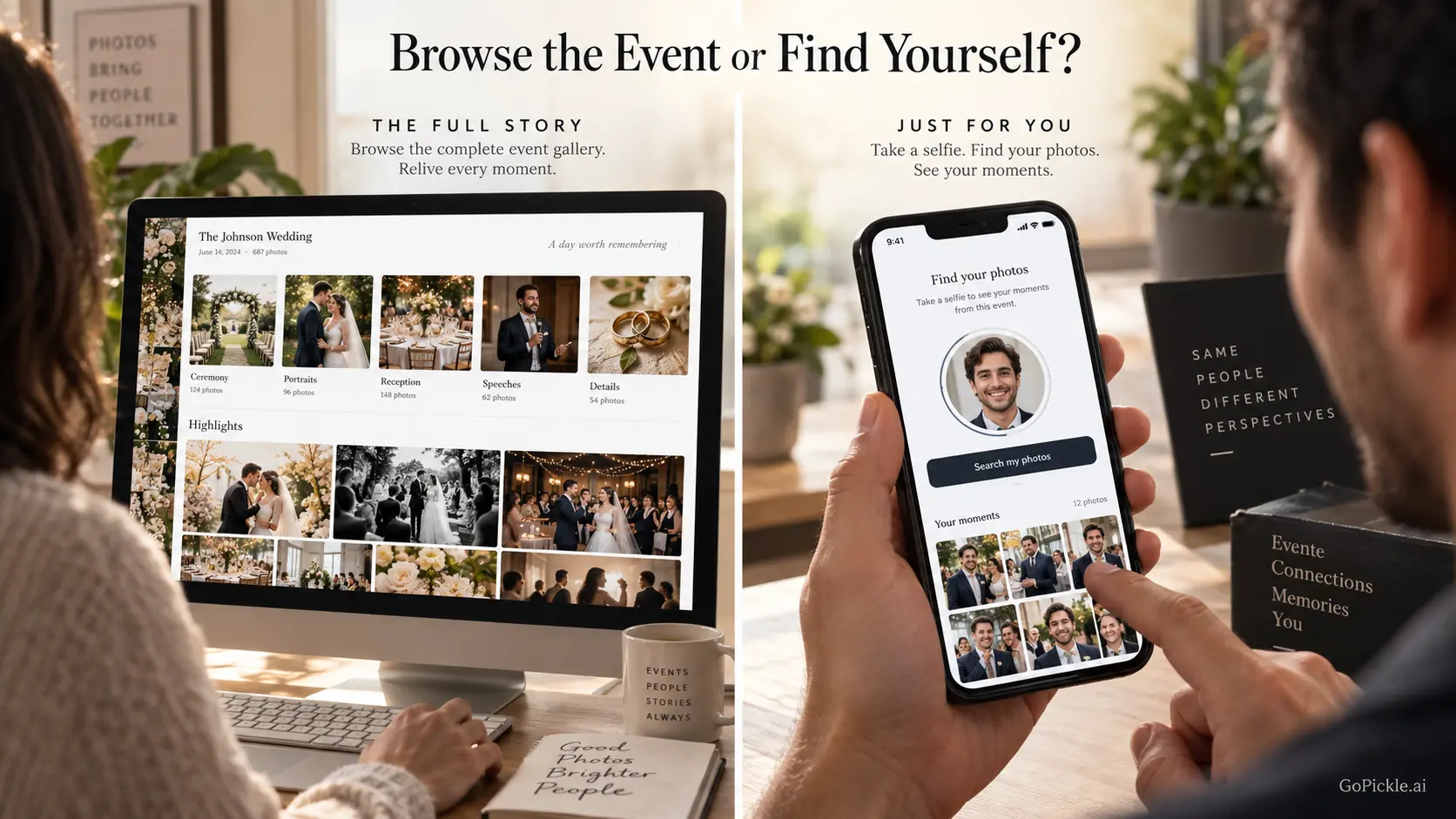
Two galleries can contain exactly the same event photographs and still solve very different problems.
The paying client may want to open a beautifully organised gallery, move through the event in sequence, revisit speeches, portraits and candid moments, download the finished collection and share it with family or colleagues. An individual attendee usually has a narrower goal: find the photographs I appear in.
That difference is the useful starting point when comparing an AI face recognition gallery vs photo gallery delivery model. Face search is not simply a more advanced version of browsing, and a standard gallery is not outdated because it lacks AI. They are different ways of helping different audiences reach photographs.
For event photographers deciding between them, the choice should be based on who will use the gallery, how many people need access, what those people are trying to find, how private the event is and what responsibilities come with processing facial information.
How a standard event gallery works
A standard online photo gallery is fundamentally browse-first.
The photographer publishes a finished collection and gives the client or approved viewers access. Photographs may be organised into collections such as preparation, ceremony, portraits, reception, speakers, awards or highlights. Viewers move through those sections, mark favourites where available, download permitted files and experience the event as a body of work.
That model is particularly strong when the gallery itself is part of the final deliverable.
A wedding couple normally wants more than photographs of their own faces. They want the complete story: family reactions, décor, guests, speeches, details and moments they did not personally see. A corporate client may need photographs of speakers, branding, networking, venue details and award presentations. A family may want to browse an entire celebration rather than retrieve only images containing one person.
This is the role of a professional Client Gallery. The gallery provides an organised, branded environment for the people responsible for receiving the finished work.
Browsing also gives the photographer editorial control. Sequence, collections and curation can communicate how the event unfolded instead of reducing the delivery experience to a search result.
How face-search delivery changes photo discovery
An AI event photo gallery changes the discovery problem.
Instead of asking an attendee to look through the complete event, the system gives that person a way to identify themselves, commonly through a selfie. Face-matching technology compares the reference image with faces detected in the event photographs and returns relevant matches.
The practical shift is from:
Open gallery → browse everything → find yourself
to:
Open gallery → identify yourself → see likely matching photographs
That difference becomes important when an event gallery contains far more photographs than any one attendee reasonably wants to inspect.
GoPickle's AI Guest Galleries use this guest-discovery model. A guest can enter through an event link or QR code, register, provide a selfie and receive a personalised set of matching event photographs in the browser. Photographers can make photographs available during the event or complete their usual editing process and publish them later.
The AI is therefore solving discovery, not replacing photography curation.
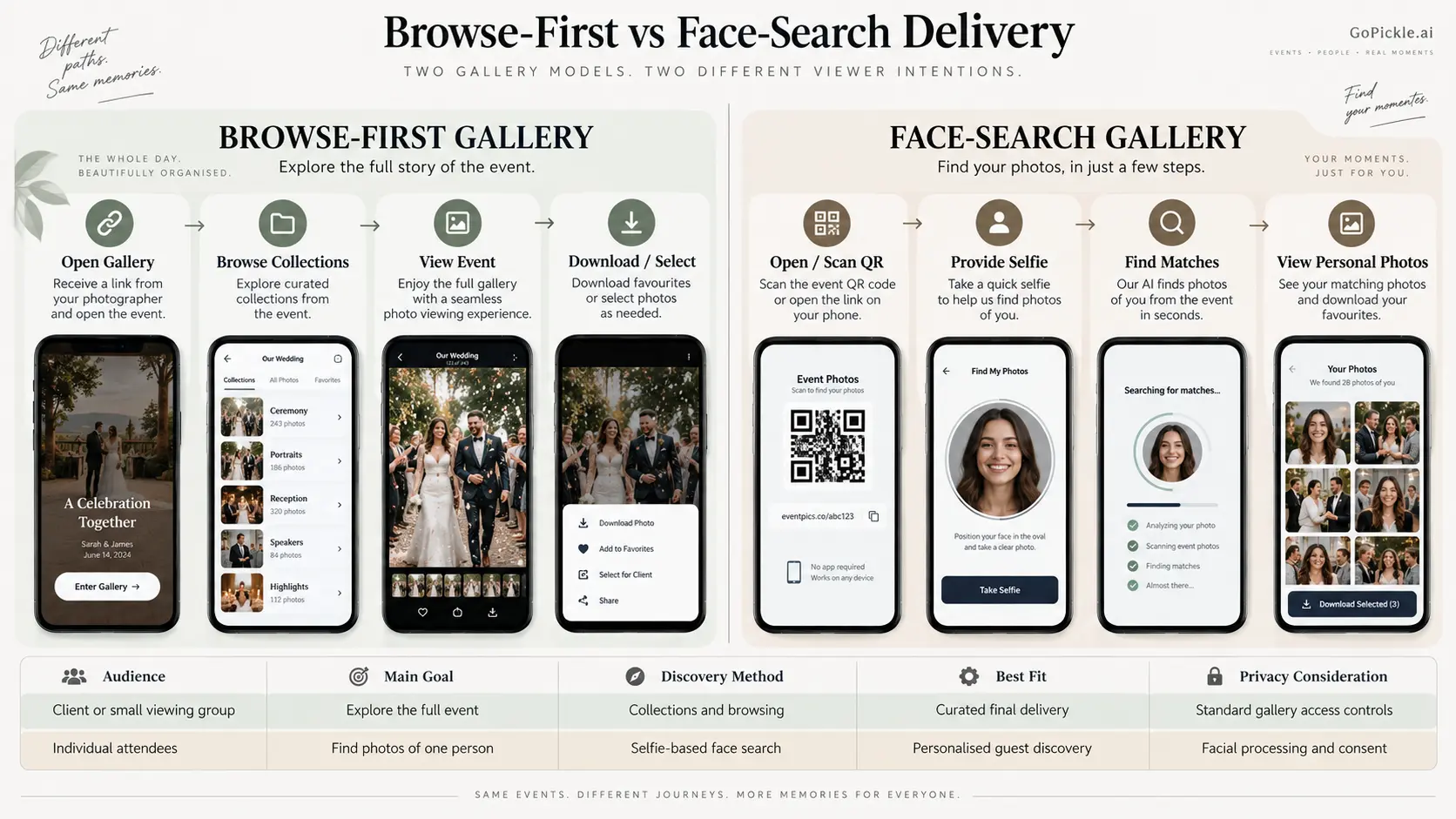
| Delivery question | Standard event gallery | AI face recognition gallery |
|---|---|---|
| Primary audience | Client, couple, family or organisation | Individual event attendees |
| Main behaviour | Browse the event | Find photographs containing me |
| Discovery method | Collections, sequence and visual browsing | Selfie-based face search |
| Best use | Curated final delivery | Personalised guest discovery |
| Event scale | Works at any scale; particularly natural for smaller viewing groups | Becomes more valuable as guest-discovery complexity grows |
| Storytelling | Strong | Secondary to personal relevance |
| Guest effort | View and browse | Submit reference image and search |
| Additional privacy consideration | Gallery access and image permissions | Facial processing, consent and data lifecycle |
| Can both be used? | Yes | Yes |
The mistake is treating the final column as an automatic upgrade from the middle one. The useful question is not “Do we want AI?” It is “What is this viewer trying to accomplish?”
Private client events and large guest populations create different delivery problems
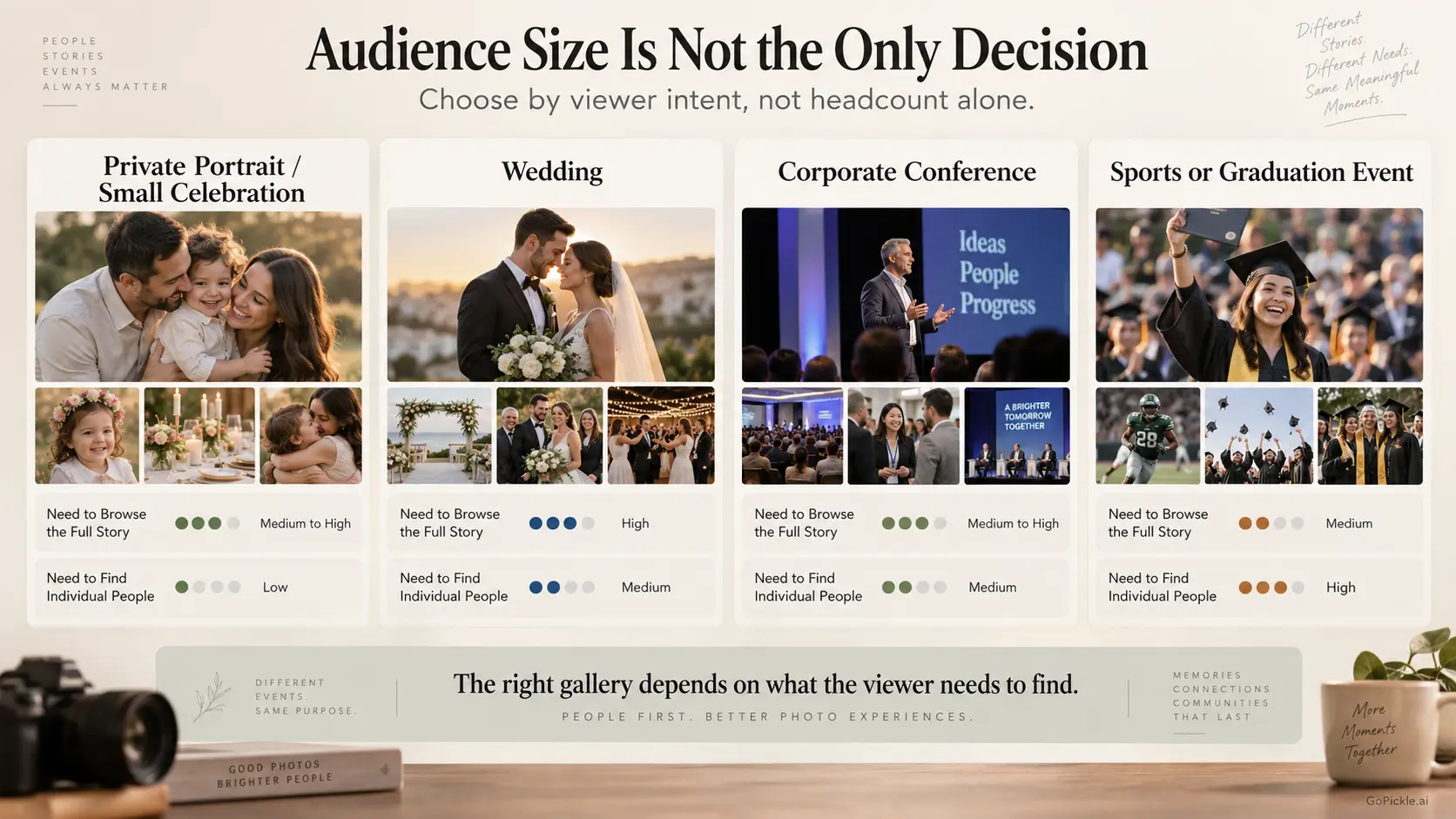
Event size matters, but headcount alone is a poor decision rule.
Imagine a small private celebration where almost everyone knows one another and the finished gallery contains a manageable number of photographs. Browsing may be part of the enjoyment. People want to see the room, the cake, relatives, group photographs and moments they missed.
Now consider a conference, large wedding, marathon, graduation or awards event where many attendees appear in only a small fraction of the final photographs. Giving every attendee the complete gallery may technically provide access while still making discovery inconvenient.
This is where event photo sharing AI can become operationally useful. Instead of the photographer, organiser or main client repeatedly receiving requests to locate photographs of particular people, attendees have a direct discovery path.
The important variable is therefore audience fragmentation.
Ask how many different people will enter the gallery with different intentions. If ten authorised people all need to review the same complete event, browse-first delivery is logical. If hundreds of attendees each want a tiny personalised subset from one large image pool, photo gallery face search addresses a more specific problem.
Professional event studios should evaluate this as part of the wider event photography workflow, alongside coverage, crew, post-production and delivery rather than adding face search simply because an event is labelled “large”.
When browsing is actually the better experience
Face search saves searching only when searching is the problem.
There are many assignments where asking somebody for a selfie before showing photographs adds an unnecessary step.
A couple receiving their wedding photographs usually wants to explore the event. A portrait client may have a carefully curated set containing only that client's session. A commercial client may need to review images by scene, product, location or campaign usage rather than by the people visible in them.
Browsing can also be better when context matters. An organiser choosing photographs for press coverage may need to see room shots, branding, stage photographs and audience reactions together. Face recognition cannot infer that editorial requirement simply by identifying a person.
There is also a difference between finding photographs and selecting photographs. Face search can surface photographs in which someone appears, but the client may still need a conventional gallery experience for favourites, approvals, downloads or final selection.
This distinction is why we treat Client Galleries and AI Guest Galleries as separate delivery experiences rather than presenting one as the replacement for the other.
Consent, privacy and sensitive events need to influence the decision
Face recognition introduces considerations that do not arise in exactly the same way when somebody simply views a photograph.
An ordinary photograph is not automatically biometric data merely because a face is visible. The regulatory position can change when facial characteristics are technically processed so a person can be uniquely recognised or matched. Under the EU GDPR, biometric data processed for the purpose of uniquely identifying a person is included among special categories of personal data. UK guidance similarly distinguishes ordinary photographs from photographs subjected to technical processing for biometric recognition and notes that explicit consent is likely to be an appropriate condition in many face-recognition scenarios.
That does not produce one worldwide rule for photographers.
Privacy and biometric laws vary by country and, in some places, by state or region. The responsibilities may also differ between the photographer, event organiser and technology provider. A workflow appropriate for a private adult celebration cannot automatically be copied to a school, employee event, healthcare setting or another sensitive gathering.
Before enabling a face recognition photo gallery, establish at minimum:
- what guests are told before they provide a selfie;
- why facial information is being processed;
- what happens to the selfie and any information derived from it;
- how long that information is retained;
- who processes or stores it;
- what happens when the event gallery expires;
- how deletion or withdrawal requests are handled where applicable;
- whether participation is optional and what alternative exists for people who do not want face search;
- whether contact details collected for photo access are kept separate from promotional marketing permission.
That last distinction is easy to overlook. Someone providing information to retrieve an event photograph has not necessarily asked to receive future advertising from the photography studio.
For higher-risk or sensitive assignments, obtain jurisdiction-specific advice rather than copying consent wording from another photographer's website. Studios evaluating a provider should also examine the provider's current privacy documentation and data-processing terms; GoPickle publishes its Privacy Policy for the platform.
For a deeper software-evaluation framework covering face matching, guest limits, processing, privacy and delivery controls, see our face recognition software buyer's guide for event photographers.
Hybrid delivery often makes more sense than choosing only one
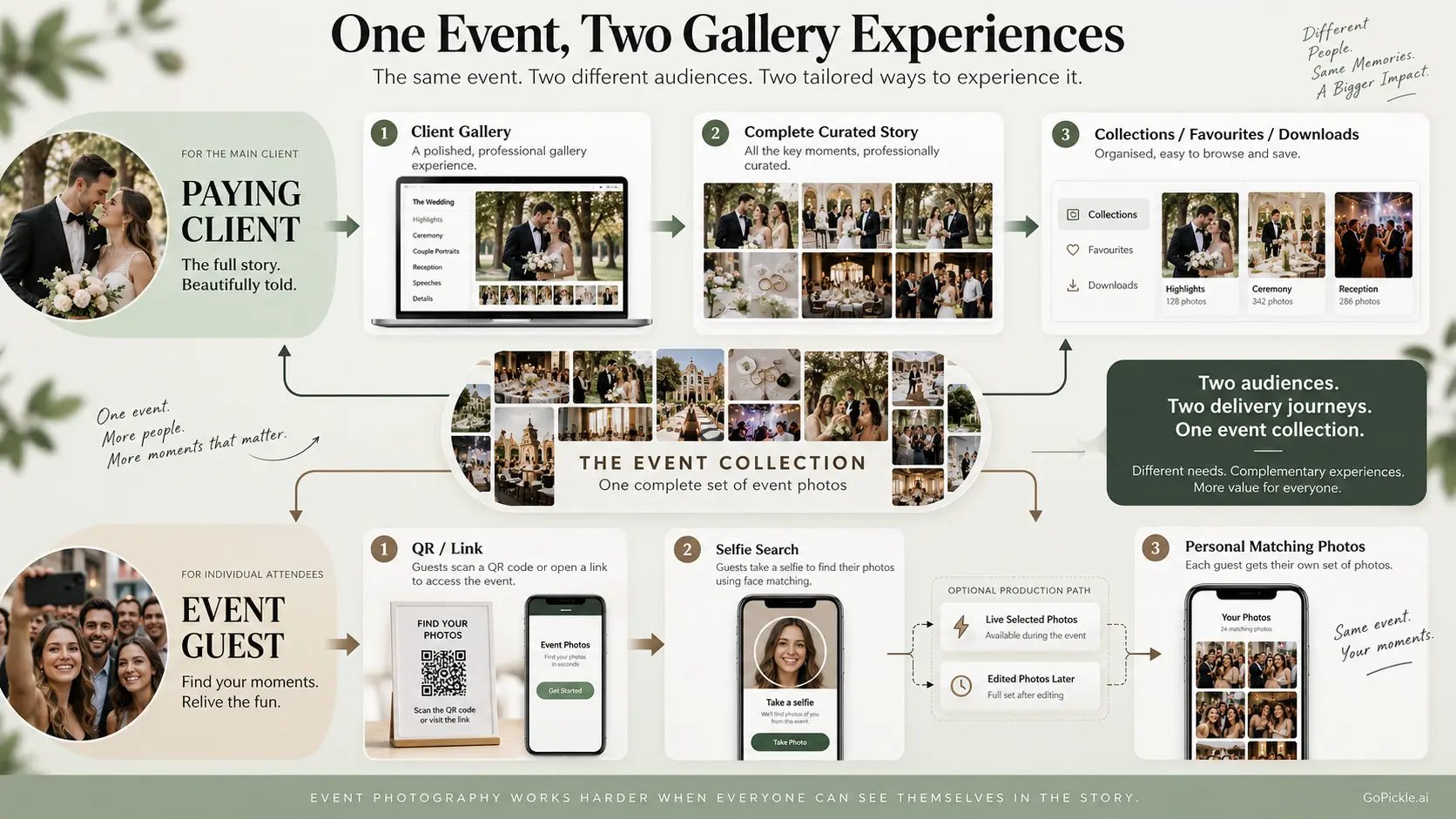
For many professional event jobs, the strongest workflow is not AI or standard gallery. It is two delivery experiences for two audiences.
Take a large wedding.
The couple receives the complete edited story through a Client Gallery. Their experience is organised around the finished wedding: getting ready, ceremony, couple portraits, family, reception and other collections determined by the studio.
Guests receive a different entry point. They access an AI Guest Gallery and use selfie-based discovery to find photographs in which they appear.
The same principle applies to corporate events. The organisation may receive the complete approved event collection for marketing, internal communication and archival use, while eligible attendees use a guest-facing discovery experience to locate their own photographs.
A hybrid model can also separate event-day engagement from final delivery.
Photographers who have the production team, connectivity and editing workflow for live sharing can make selected photographs discoverable while the event is underway. Studios that prefer a finished visual standard can instead let guests register during the event and upload the edited JPEGs later. GoPickle supports both AI Guest Gallery approaches, so a studio does not have to publish straight-from-camera work merely to offer face-based discovery.
That distinction matters commercially. If you sell “instant AI photo delivery”, your team must actually be capable of selecting, transferring, processing and publishing photographs during the event. If your normal standard requires careful culling and colour work, an edited-later experience may represent your brand better.
Decision checklist for photographers
Before choosing an event gallery model, run the assignment through the questions below.
| Ask this | Lean toward browse-first | Lean toward face search |
|---|---|---|
| Who is receiving the photographs? | One client or small authorised group | Many individual attendees |
| What does the viewer want? | The complete event story | Their own appearances |
| Is the full collection useful to each viewer? | Usually yes | Often no |
| Are photographs naturally organised by event section? | Strong reason to browse | Helpful, but personal search may still add value |
| Will attendees repeatedly ask for their photographs? | Limited likelihood | Stronger reason for personalised discovery |
| Does the studio want curated final presentation? | Strong fit | Use alongside guest discovery |
| Is facial processing appropriate for this audience and jurisdiction? | Not required for basic browsing | Must be assessed before enabling |
| Does the team have a genuine live-delivery workflow? | Not necessary | Relevant if promising live AI sharing |
| Do both client and attendees need different experiences? | Use Client Gallery | Consider a hybrid model |
There is no minimum guest count at which AI suddenly becomes the correct answer. A relatively modest event can benefit from personalised discovery if the audience is fragmented, while a very large event may still require traditional controlled delivery because of confidentiality, policy or consent constraints.
Choose the gallery around the discovery problem
The most useful difference between an AI face recognition gallery vs photo gallery is not the technology underneath them. It is the question each one answers.
A standard gallery says: Here is the photography from your event. Explore it.
A face recognition gallery says: Here are the photographs that may contain you.
Professional photographers increasingly need both capabilities because their audience is no longer always one client. Weddings have couples and guests. Conferences have organisers and attendees. Sporting events have commissioners, participants and spectators. Each group can need a different route into the same body of photography.
At GoPickle, that is why we keep curated Client Galleries and personalised AI Guest Galleries conceptually separate. The aim is not to add face recognition to every delivery. It is to use the right gallery experience when finding one person's photographs has become a different problem from viewing the event itself.