Backup Photographer Plan: What to Do If a Crew Member Cannot Shoot
Build a backup photographer plan for weddings and events, covering replacement roles, emergency escalation, client communication, travel, gear and crew records.

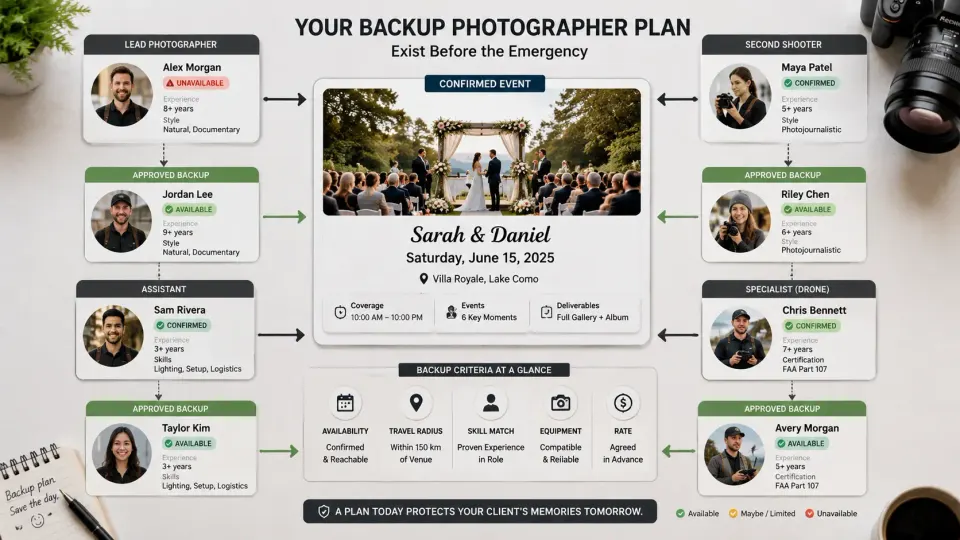
A photographer contingency plan is easy to postpone because the problem feels hypothetical until someone wakes up ill, misses a connection, has a family emergency or simply cannot reach the venue. By then, the studio is no longer planning. It is trying to protect a paid assignment while the clock is moving.
A useful backup photographer plan is more than a phone full of photographer contacts. The studio should already know which roles are critical, who can replace each person, how far those backups can travel, whether their equipment and working method fit the assignment, what information they need, who contacts the client and how the changed crew and cost records will be updated.
That matters for solo photographers as much as larger wedding and event teams. A freelancer may only need two or three dependable peers, while a busy studio may need a deeper roster divided by role, skill and geography. The principle is the same, decide how replacement works before peak season, not during the emergency.
Our article on How to Plan Photography Studio Workload During Peak Wedding Season explains the priliminary planning that needs to be done for a peak season.
1. Define which photography roles are actually critical
Not every absence creates the same operational risk. If an assistant cannot attend a small portrait session, the lead photographer may be able to simplify the setup. If the only lead wedding photographer is unavailable three hours before a ceremony, the studio has a very different problem.
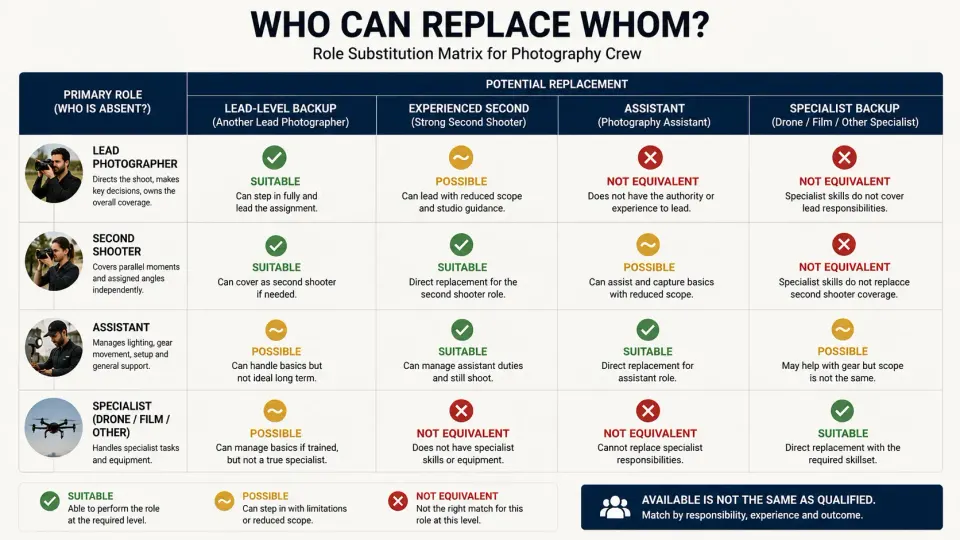
Start by listing the roles you regularly sell or assign and deciding what an acceptable replacement actually means for each one.
| Role | What the replacement must be able to do | Can another role absorb it? |
|---|---|---|
| Lead photographer | Run the timeline, direct people and make technical decisions independently | Usually only another lead-level photographer |
| Second shooter | Cover parallel moments and assigned sections without constant supervision | Sometimes, if coverage can be reduced |
| Photography assistant | Manage lighting, equipment movement and setup | Sometimes, depending on production complexity |
| Specialist operator | Handle drone, film, tethered or other specialist work | Only with matching competence and required permissions |
This is why headcount is a poor way to judge photography crew capacity. Five available people do not solve the problem if none can replace the person responsible for a critical role. In a structured photography crew management workflow, people should be assigned according to what the event actually requires rather than treated as interchangeable names on a roster.
2. Maintain an approved backup roster before peak season
A wedding photographer emergency backup should not begin with a message asking, “Does anyone know somebody free today?” Build a small approved roster while the calendar is still manageable. For every role that could stop a shoot from running properly, identify a preferred replacement and at least one fallback where your local market makes that realistic.
Record the photographer's usual role, portfolio, experience with your type of assignment, expected rate, overtime approach, travel radius, current city, equipment system, lighting familiarity, file workflow and whether they have previously worked with your studio. For destination or cross-border assignments, check any travel documents, work permissions, permits or insurance relevant to the location instead of assuming that an available photographer can automatically take the job.
Equipment compatibility also deserves attention. A second shooter replacement does not need to own the same camera brand as the original photographer, but different batteries, radio triggers, lens mounts, flash systems and recording media can complicate a shared production. For multi-camera weddings and events, also think about camera-clock synchronisation, colour profiles and how the replacement's files will enter the post-production workflow.
Review this roster before the busiest part of your season. Backup photographers change cities, rates and availability just like regular crew. This review should sit beside your broader peak-season capacity planning rather than being left until every Saturday is already full.
3. Prepare the minimum information a replacement needs
A capable photographer can still struggle if they arrive with incomplete context. Your replacement brief should be short enough to read quickly but detailed enough that the incoming photographer does not have to reconstruct the assignment from old messages.
Include the booking name, date, reporting time, venue sequence, access instructions, expected coverage hours, assigned role, event schedule, relevant client or planner contacts, must-cover moments, group priorities where applicable, dress expectations, equipment responsibility, venue restrictions and the file handoff process. For weddings, the replacement may also need cultural or ceremonial context that another experienced photographer cannot be expected to know automatically.
For a second shooter, define boundaries as clearly as tasks. Who covers which preparation location? Who owns the wide ceremony coverage? Who handles family groups if the lead is delayed? Where do the memory cards go after the shoot? Who synchronises camera clocks? Those details reduce unnecessary duplicate coverage and prevent an important moment from disappearing between two photographers who each believed the other person had it.
This is where photography booking management software becomes useful operationally. The current venue, schedule, services and crew responsibilities should live with the booking so a replacement receives the latest information rather than whichever PDF or chat screenshot is easiest to find.
4. Set an event-day availability escalation before you need it
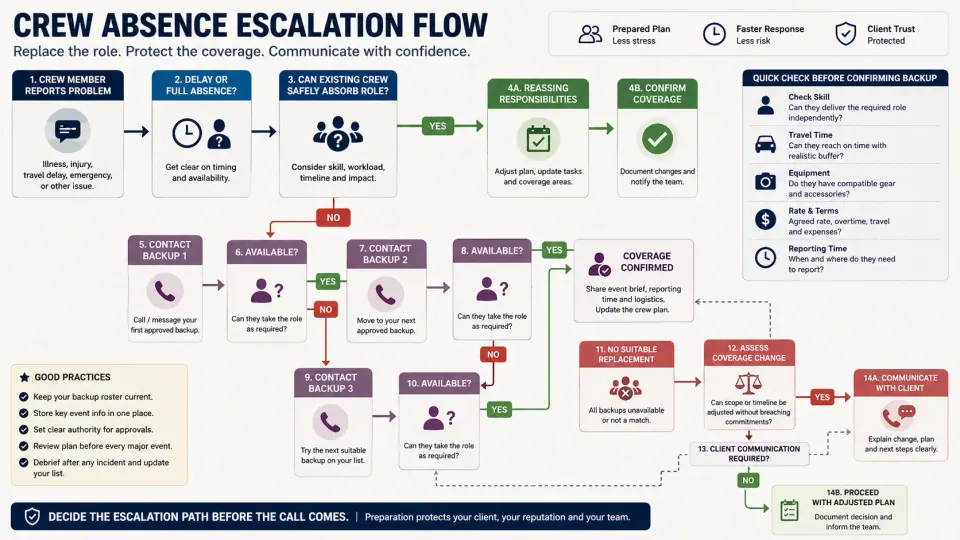
An event-day escalation should change according to the role, the amount of notice and the consequences of leaving the position uncovered. The studio should not spend the first hour of an emergency deciding who has permission to call a freelancer or approve additional travel expenses.
A practical flow begins when the assigned photographer reports a problem. The person responsible for crew confirms whether it is a delay, partial availability or complete absence, then checks whether the remaining team can safely absorb the responsibility. If not, the first approved backup is contacted, followed by the next suitable person until replacement coverage is confirmed. If no equivalent photographer is available, the studio must decide whether the coverage can be changed within what was agreed with the client or whether the client needs to be contacted about a material change.
Do not build a photography crew backup plan around one dependable friend. Your preferred backup may already be shooting another wedding, travelling or unavailable for exactly the same peak-season reason affecting your original team. For important multi-day weddings, large events and destination assignments, it is worth knowing which approved photographers are realistically within reach before the first function begins.
5. Communicate with the client when the change is material
Clients do not need a minute-by-minute account of internal crew troubleshooting, but they should not discover a significant replacement when a different photographer arrives at the venue. If the lead photographer changes, a specific photographer was promised by name, specialist coverage is affected or the replacement changes the agreed scope, communicate promptly and factually.
Explain what changed, who will cover the assignment, why that person is suitable for the role and whether anything about the schedule, deliverables or client's responsibilities has changed. Avoid making new promises about refunds, compensation or contractual rights during the emergency unless those promises are already supported by the signed agreement and applicable law.
Your photography agreement should address photographer illness at a wedding or event, emergencies, substitution and what happens if the studio cannot provide the agreed service. Contract wording and available remedies differ between countries and jurisdictions, so photographer-failure and replacement clauses should be reviewed appropriately for the markets where you operate.
This point matters particularly when a studio markets a named photographer. “Our studio will photograph your wedding” and “this photographer will personally photograph your wedding” create different expectations even when the package deliverables are identical.
6. Update the crew assignment and replacement cost records
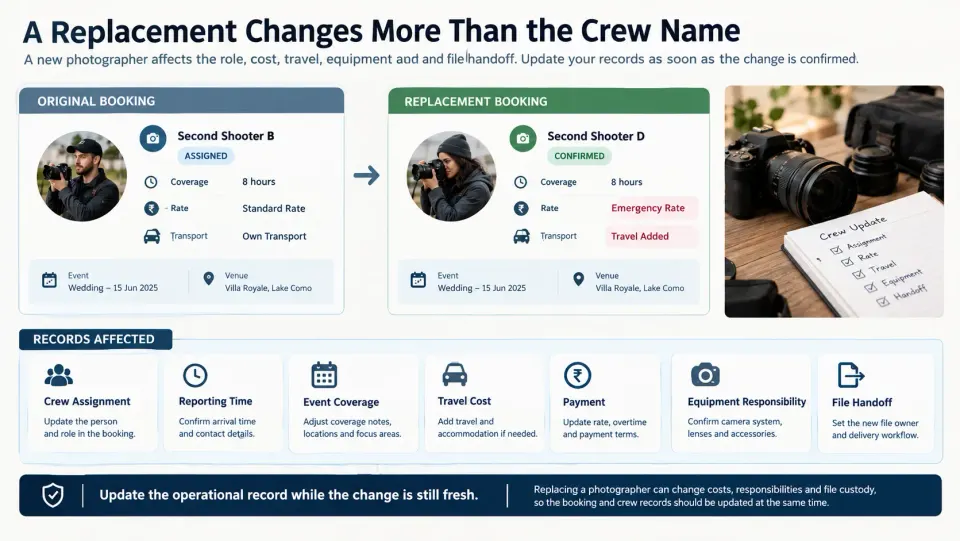
Once someone agrees to cover the assignment, the emergency is operationally under control, but the records still need to catch up. Replace the absent person in the crew assignment, confirm the incoming photographer's role and reporting time, and record the agreed rate, travel or accommodation costs, overtime terms, payment responsibility and any change to the original crew budget.
This matters when emergency cover costs more than the original assignment. A last-minute photographer, urgent transport or an additional hotel night can materially change the margin on the job. Recording that variance allows the studio to understand the real cost of its backup photographer plan rather than discovering an unexplained payment weeks later.
Update the booking as well if coverage hours, equipment responsibilities, individual events or the file handoff owner changed. Photography crew management software is most useful here when availability, assignments, roles and payments remain connected to the event rather than living in a separate spreadsheet, while the booking record continues to hold the latest venues, services and deliverables.
7. Review the incident after the files are safe
The incident is not finished when the replacement photographer arrives. Once the shoot has ended and the file handoff is secure, review what happened while the details are still fresh.
Look at how early the absence was reported, how long it took to secure a replacement, which backup contacts responded, whether the replacement actually matched the required role, what additional cost was incurred and whether the client experience or coverage changed. Then update the roster. A photographer who stepped in successfully becomes a more valuable contingency contact because you now know how they work. Someone who repeatedly fails to respond should probably not remain the first person your studio calls.
If one critical role still has no credible substitute, treat that as a capacity problem before accepting more work. Studios that depend heavily on freelancers usually need a wider network and stronger pre-qualification, while studios with full-time photographers still need external fallback for illness, travel disruption and overlapping assignments.
A backup photographer plan cannot prevent illness, accidents or transport problems. What it can do is remove many of the decisions that make those situations harder to manage. Know which roles are essential, approve potential replacements before the busy season, keep the briefing information ready, define who owns the escalation, communicate meaningful changes clearly and record what the incident actually cost the studio.
At GoPickle, we see crew contingency as part of normal production management rather than a document that only appears during an emergency. If your studio coordinates lead photographers, second shooters, assistants or editors across several bookings, keeping crew availability and assignments connected to the work gives the contingency plan somewhere practical to live instead of leaving it in somebody's contacts list.
Related Reading:
Photography Cancellation and Rescheduling Policy: What to Define Before Taking an Advance