Freelance vs Full-Time Photographer: Which Staffing Model Fits a Growing Studio?
Compare freelance vs full-time photographers for a growing studio. Understand costs, availability, training, consistency, utilisation and peak-season staffing.

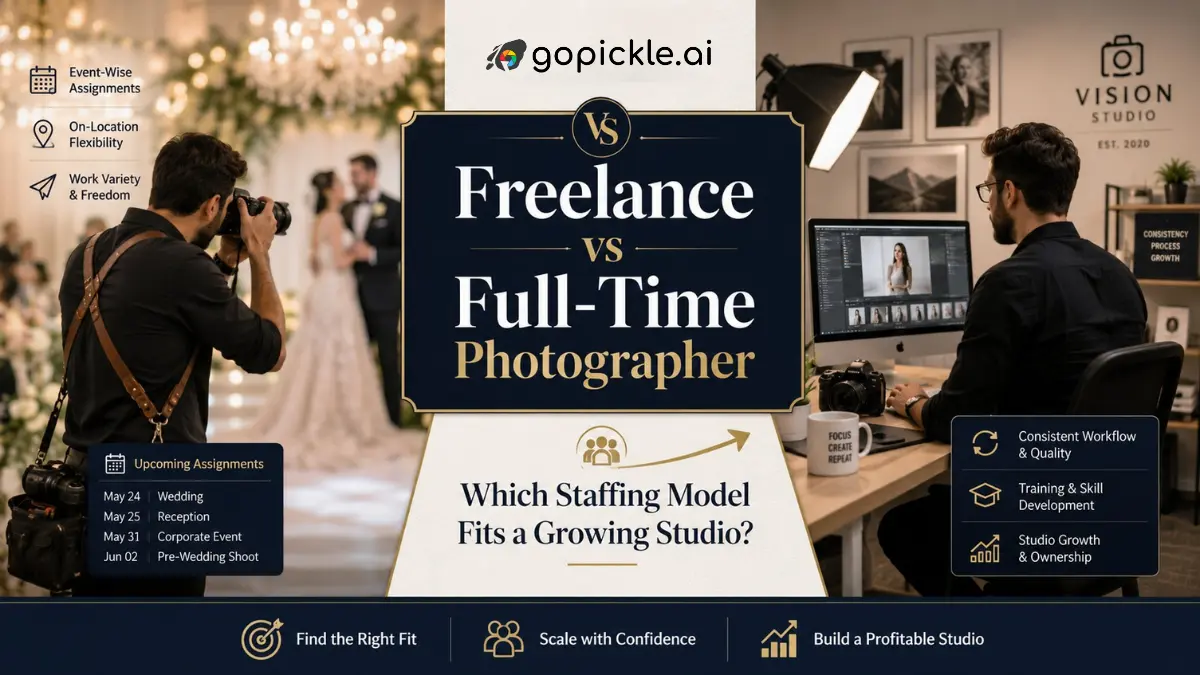
A growing photography studio eventually reaches an awkward stage.
There is too much work for the founder to shoot alone, but perhaps not enough predictable work to comfortably add another permanent salary.
The obvious question becomes: should you hire freelance photographers or build a full-time photography team?
There is no universal winner.
Freelancers usually give a studio more flexibility. Full-time photographers can give it more control and continuity. The right model depends on how regularly you need the person, what work they will own and how expensive unused capacity would be.
Freelance vs Full-Time Photographer at a Glance
| Factor | Freelance photographer | Full-time photographer |
|---|---|---|
| Cost structure | Mostly variable | Mostly fixed |
| Peak-season scaling | Strong | Limited by team size |
| Guaranteed availability | Lower | Higher |
| Training investment | Usually lower | Usually higher |
| Process consistency | Depends on freelancer | Easier to standardise |
| Long-term accountability | Assignment-based | Ongoing |
| Quiet-season cost | Lower | Salary continues |
| Studio knowledge | May vary | Builds over time |
| Specialist access | Easier | Depends on internal skills |
The table is useful, but the real decision starts with workload.
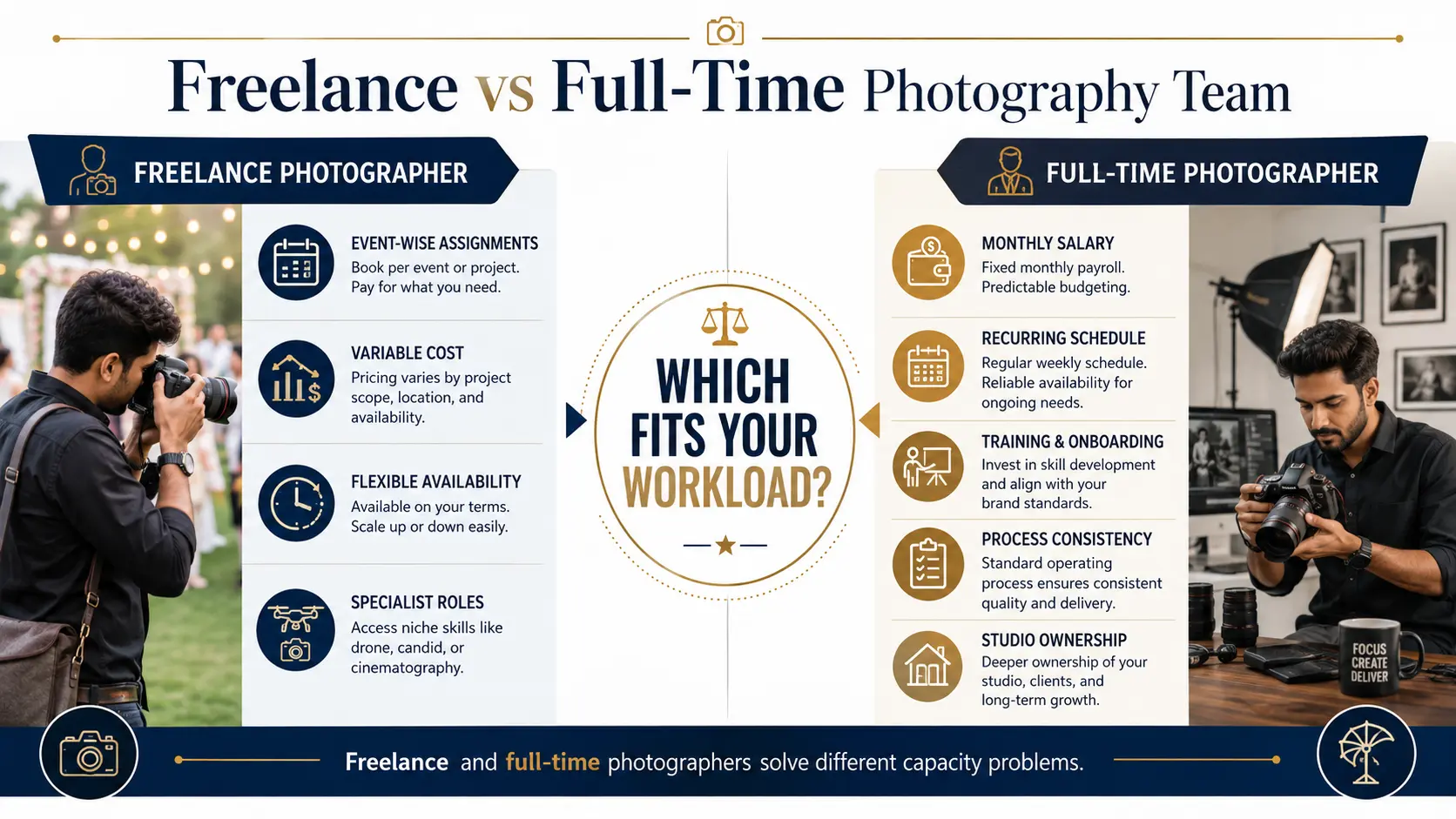
Start With Utilisation, Not Salary
Comparing a freelancer's day rate with an employee's monthly salary can be misleading.
A full-time photographer creates value only when the studio has enough useful work for that person.
Suppose you need additional shooting support on four wedding days this month. Paying freelancers for those assignments may make more sense than carrying another permanent employee through the remaining working days.
But if someone is needed almost every week for shoots, planning, equipment preparation, file management, client coordination and other production responsibilities, recurring freelance payments can eventually become the more expensive model.
A simple calculation helps:
Monthly freelance cost = number of assignments × average freelancer cost per assignment
Then compare that with:
Full-time employment cost = salary + employment-related costs + equipment + training + software + management overhead
Do not stop there. Ask how much of that employee's available time you can actually use productively. This is where photography studio staffing becomes a capacity decision rather than simply a payroll decision.
Freelancers Work Well When Demand Moves Up and Down
Wedding and event photography rarely produces perfectly even workloads.
You might need:
- two additional candid photographers for one weekend;
- another cinematographer for a destination wedding;
- a drone operator for selected assignments;
- three additional shooters during peak season;
- no additional shooting capacity during a quieter month.
Hiring every specialist full-time would create substantial unused capacity.
A trusted freelance network allows the studio to expand and contract around the booking calendar. This is particularly useful when you hire photographers for studio assignments that require specialist skills rather than permanent roles. The trade-off is availability.
A capable freelancer is probably working with other studios too. Your preferred photographer may already be committed when an important booking arrives. That means a freelance model needs more than a contact list. You need visibility into availability, role, assignment and confirmation.
GoPickle's Crew Management for Photographers is designed around this workflow. Studios can maintain crew information, check availability, assign people to events and manage both salary-based and event-wise payment models.
Full-Time Photographers Give You More Process Control
A permanent team becomes more valuable when clients are buying a recognisable studio experience rather than simply access to whichever photographer is available.
You can train a full-time photographer around:
- your shooting style;
- equipment setup;
- file handling;
- backup standards;
- client communication;
- posing approach;
- shot priorities;
- turnaround expectations;
- internal handoffs.
Over time, those routines become part of the studio's operating system.
That matters when a studio owner wants to stop personally supervising every assignment.
A freelancer can absolutely learn your process too, especially if you use the same people repeatedly. But the relationship is still assignment-based, and their work with other clients or studios can limit how closely their availability and development align with yours.
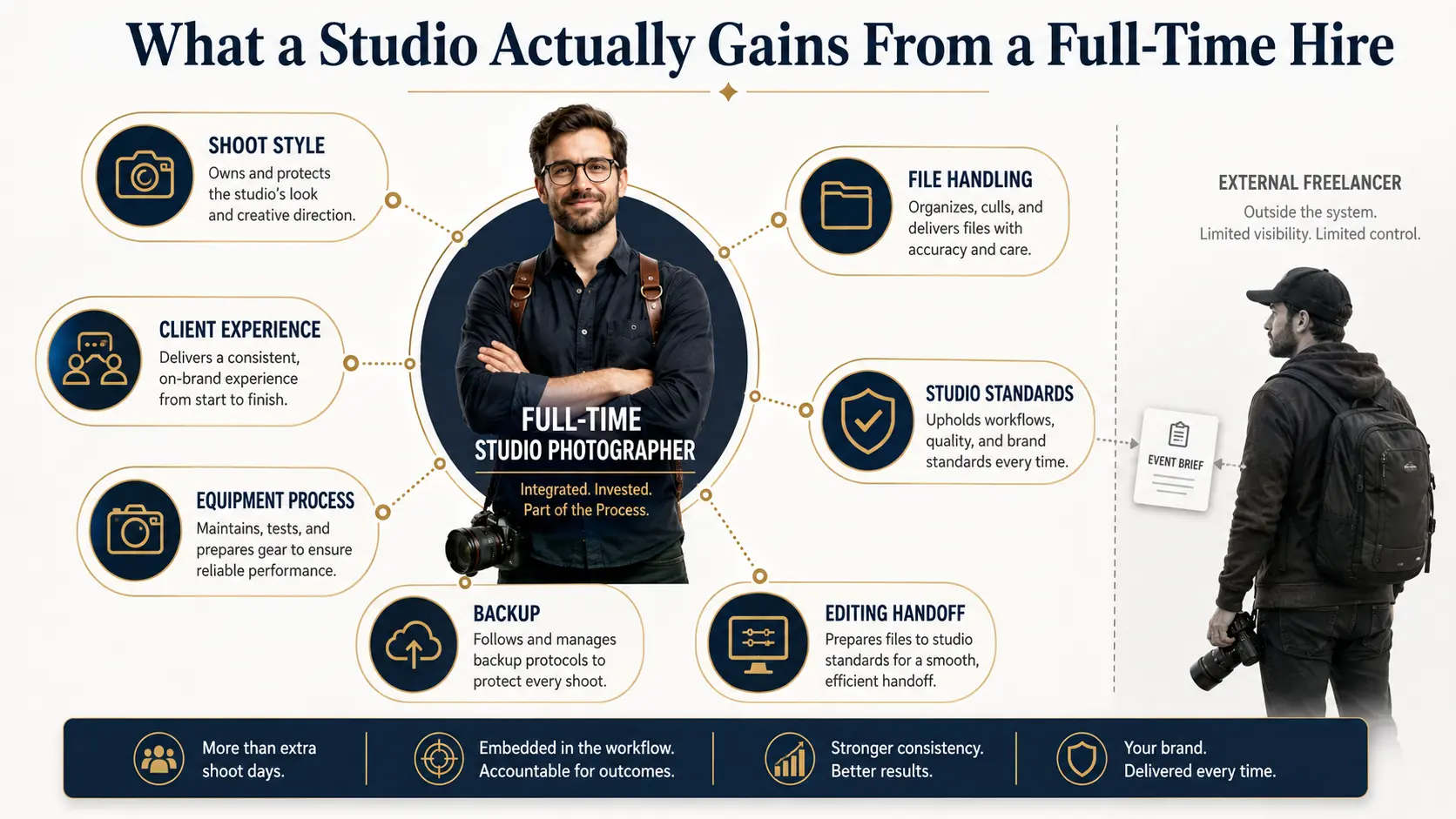
Availability and Accountability Are Different Problems
Studios often combine these into one issue.
They are not the same.
Availability asks: Can this person take the assignment?
Accountability asks: Who owns the work until it is completed?
A freelancer may be perfectly accountable for an agreed shoot while still being unavailable next weekend.
A full-time employee may always be available but still need clearer responsibility for backups, uploads, selections or editing handoffs.
Good photography team management therefore requires roles and ownership regardless of the staffing model.
For a wedding with multiple functions, for example, you may have:
- an in-house lead photographer;
- a freelance candid photographer;
- a freelance cinematographer;
- an employed editor;
- a contract album designer.
The client does not care which employment model sits behind each person. They care that the team functions as one studio.
Connecting crew assignments to the actual booking helps. GoPickle's photography booking management workflow keeps booking details, events and crew planning connected instead of treating staffing as a separate spreadsheet.
Full-Time Hiring Makes More Sense Once Work Becomes Predictable
A useful hiring trigger is recurring demand. Look at the last six to twelve months and ask: How many days per month did we genuinely need this role? Not just shoot days.
Include useful recurring work such as preparation, equipment management, editing, client meetings, location scouting or post-production if those responsibilities would belong to the employee. Then look forward.
Are those requirements supported by confirmed and consistently recurring bookings, or are you assuming future growth?
Hiring because one month was exceptionally busy can create a fixed cost problem later.
Hiring because the studio repeatedly needs the same role and is continuously paying external people to fill it is a much stronger case.
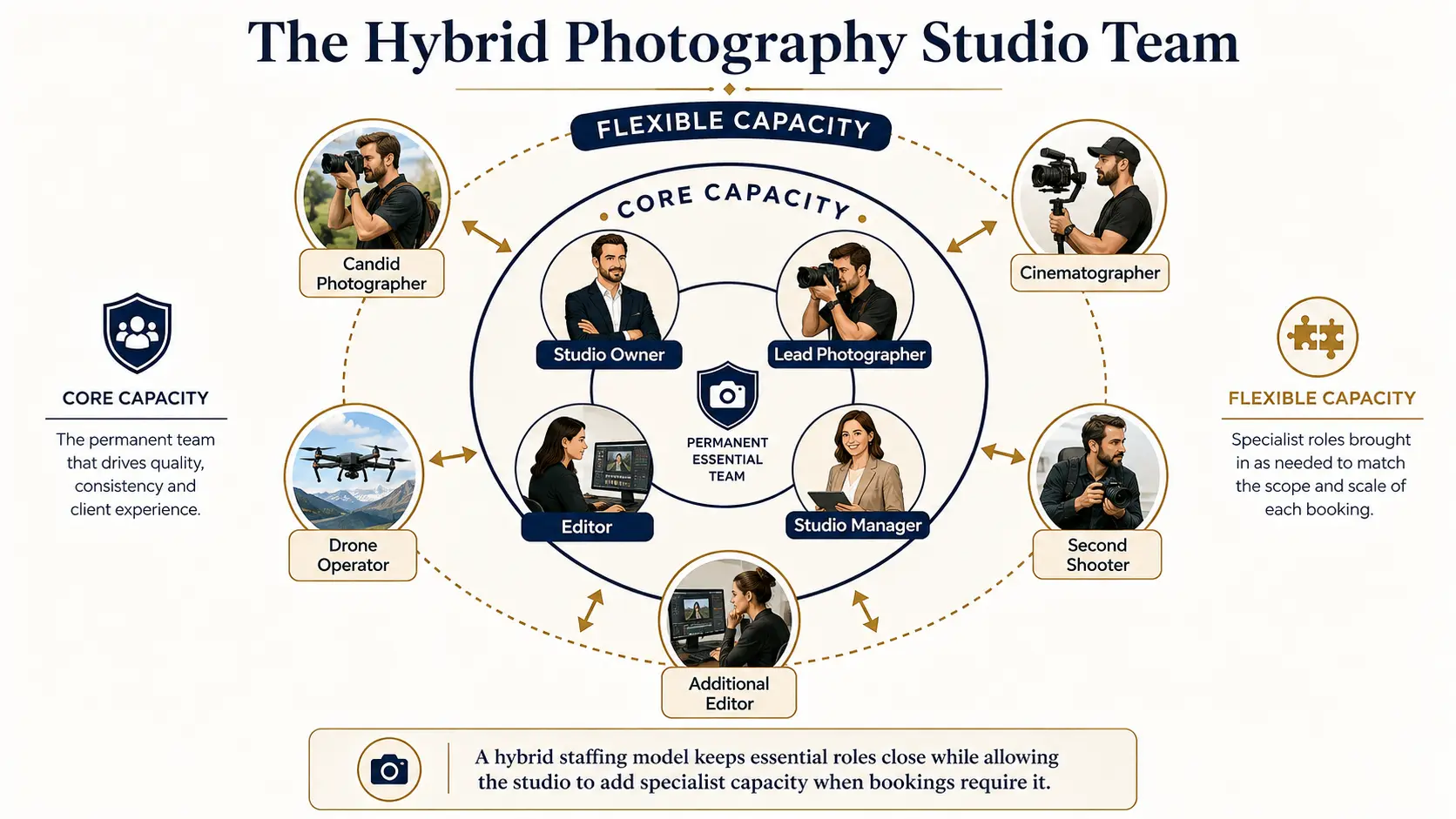
The Hybrid Model Fits Many Growing Studios Better
The choice does not have to be entirely freelance or entirely full-time.
A practical growing studio might keep:
Full-time: lead photographer, studio manager and core editor.
Freelance: second shooters, additional cinematographers, drone operators and peak-season editors.
That gives the business a stable operating core while preserving variable capacity around demand. It also reduces a common scaling problem: hiring a large permanent team to survive peak wedding season and then carrying excessive payroll once the season ends.
Before Hiring, Run This Simple Staffing Test
Take one role at a time.
For example, candid photographer.
Review:
- How often did we need this role during the past year?
- How much did we spend outsourcing it?
- How often was our preferred freelancer unavailable?
- Did inconsistent photographers affect our shooting or client experience?
- Is there useful work for this person outside shoot days?
- Can our current and expected bookings support the fixed cost through slower months?
- Would bringing the role in-house remove a meaningful operational bottleneck?
If the role is occasional and demand is unpredictable, keep it flexible. If demand is frequent, predictable and central to your studio's quality, investigate a permanent hire. If the numbers sit somewhere between the two, build a dependable freelance pool before increasing fixed payroll.
Your Staffing Model Will Probably Change as the Studio Grows
A solo photographer might begin with freelancers for every additional requirement.
A growing wedding studio may eventually bring its lead shooting and editing roles in-house while continuing to use freelance crew for larger events.
A larger studio may build several permanent teams but still rely on specialists during unusually busy periods. The important part is not choosing one model forever. It is knowing what each role costs, how often it is required, whether the person is available and how much capacity the studio actually needs.
At GoPickle, we built Crew Management around that reality. A photography business can contain permanent employees, regular collaborators and event-based freelancers at the same time. The operational challenge is keeping availability, assignments, responsibilities and payments clear around each booking.
Your next hire should not simply make the team bigger. It should remove a constraint that is already limiting the studio.