From Wedding Client to Family Client: A 3-Year Retention Workflow for Photography Studios
A practical photography client retention workflow for turning wedding clients into anniversary, maternity, newborn, family portrait and referral clients over three years.

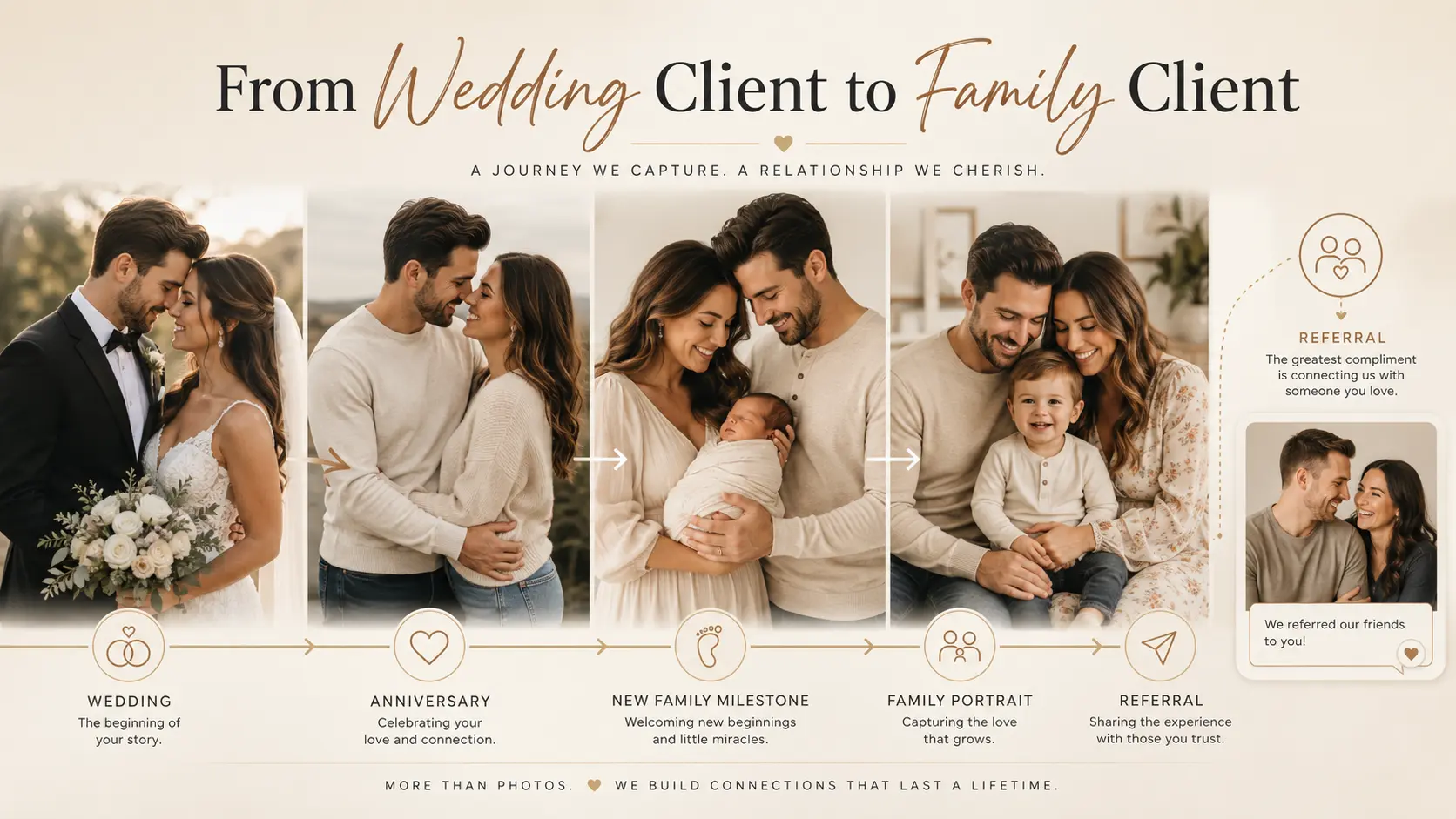
A wedding may be the first time a couple hires your studio, but it does not have to be the last. Over the next few years, the same client may need anniversary photographs, maternity photography, a newborn session, birthday coverage, family portraits or photography for another celebration. They may also recommend you when a sibling, colleague or friend starts looking for a wedding photographer.
That opportunity is often lost because studios treat every completed booking as a closed file. The gallery is delivered, the album is finished and the client's details disappear into an old WhatsApp conversation or spreadsheet. Twelve months later, the studio is spending money finding new leads while hundreds of previous clients already know the work, the team and the experience.
Good photography client retention is not about sending those clients more promotions. It is about keeping the relationship organised so there is a sensible reason to reconnect when another photography requirement appears.
One Client Can Have Several Photography Requirements
The first change is operational.
Do not think of a wedding client and a future family client as two unrelated people simply because they are booking different services. The person or couple remains the client. What changes is the requirement.
A three-year client history might eventually look like this:
Rahul & Priya
Wedding photography - November 2026
Anniversary session - November 2027
Maternity enquiry - May 2028
Newborn photography - October 2028
Family portrait session - October 2029
Referral - Priya's sister books her wedding
Each assignment should still have its own quotation, booking, pricing, deliverables and agreement. The advantage is that the studio retains the relationship around those individual jobs instead of repeatedly starting from an unknown enquiry.
This matters for a photography studio CRM because repeat business becomes visible. The team can see that a new portrait enquiry is coming from an existing wedding client, understand what the studio photographed previously and continue the conversation with context.
In GoPickle, enquiries can carry their requirement and next action into quotations and bookings rather than being treated as isolated names in an inbox. That same principle becomes valuable when an existing client returns with a different photography requirement.
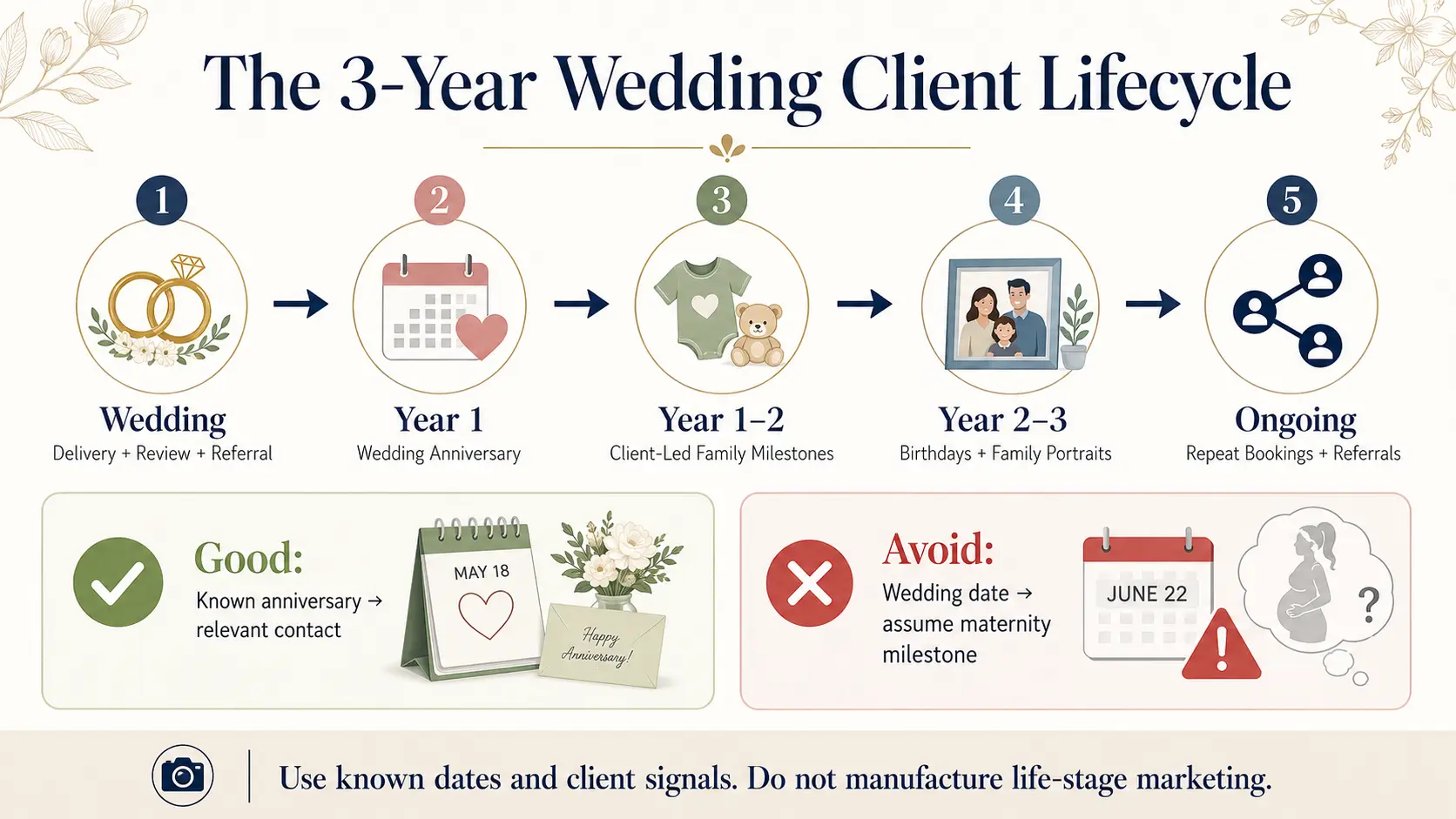
A Practical 3-Year Photography Client Lifecycle
There is no reason to schedule three years of automated sales messages on the wedding day. Build a few useful checkpoints instead.
| Period | Possible opportunity | Studio action |
|---|---|---|
| Wedding delivery | Review, referral, future relationship | Finish the job well and retain useful client context |
| 6–12 months | Wedding anniversary | Send one relevant anniversary message |
| Year 1–2 | Maternity, newborn, new home or family events | Act only on a real client signal or enquiry |
| Year 2–3 | Birthdays, family portraits, anniversaries | Reconnect where the previous relationship makes the offer relevant |
| Any time | Referral | Make it easy for clients to recommend the studio |
The distinction between a known milestone and an assumed milestone is important.
You know the wedding date, so an anniversary message can be appropriate. You should not assume that every couple will have a baby, buy a house or celebrate the same milestones on a predictable timetable. A maternity or newborn follow-up makes sense after the client has shared that information or made an enquiry. It should not be triggered simply because nine or twelve months have passed since the wedding.
Recent photography-industry guidance from Pixieset and ShootProof also puts the emphasis on thoughtful, timed contact such as anniversaries and occasional client follow-up rather than indiscriminate messaging.
Client Retention Starts With How the Wedding Ends
A studio cannot fix a poor client experience with an anniversary campaign.
If the couple had to chase the photographer for delivery, repeatedly ask about their album or wait for someone to confirm an outstanding payment, the relationship has already been weakened. Retention starts while the original booking is still active: clear communication, agreed deliverables, sensible timelines and a professional final handoff all influence whether the client wants to return.
The gallery is particularly important because it is often the final substantial interaction the client has with the studio. A well-organised client gallery for photographers gives the couple a clear place to view, select, download and share their photographs. GoPickle Client Galleries are designed for that delivery stage, with branded galleries, organised collections, favourites and controlled downloads.
Once delivery is complete, ask for a review if the experience warrants it. Make your studio details easy to share if someone asks the couple for a recommendation. Then stop selling for a while.
A successful wedding client should leave with a good memory of the photographs and the studio, not with the feeling that completing one booking placed them into a permanent sales funnel.
Year One: The Anniversary Is a Natural Reason to Reconnect
The wedding date is one piece of lifecycle information a studio already has for a legitimate operational reason. That makes the first anniversary an obvious, low-pressure point of contact.
The message itself does not have to contain a discount or package. A simple acknowledgement can be enough to put the studio back into the client's mind. If anniversary sessions are part of your service mix, you can make that option visible without turning the message into a hard sell.
Some clients will book. Most probably will not need photography at that exact moment. The contact still works if it feels appropriate and does not demand a response.
This is where a photography follow-up system is more useful than somebody setting a personal phone reminder. The studio should be able to retain the date and relationship even if the photographer who handled the wedding is unavailable a year later.
Years One to Three: Follow Signals, Not Assumptions
The strongest repeat bookings often come from information the client gives you directly.
A former bride messages asking whether you photograph maternity sessions. A previous wedding client enquires about his child's first birthday. A couple responds to an Instagram Story asking about family portraits. A client calls because her parents' anniversary is approaching. Those are signals.
Create a new requirement against the existing relationship, understand the new shoot properly and quote it as a separate job. Do not simply send an old wedding client a generic "family package" because enough time has passed.
This distinction makes wedding client retention useful rather than intrusive.
It also makes the sales conversation easier. A completely new lead may still be evaluating your photography, reliability and working style. A repeat client has already experienced all three. You still need to qualify the new requirement and agree on price and scope, but you are not rebuilding trust from zero.
Repeat clients should still receive a current quotation, contract or service agreement. Previous business does not mean the scope, price or policies from the first booking automatically carry into the next one. Pixieset makes the same point in its guidance for repeat-client service agreements: each new engagement should document the current terms and deliverables.
What Client Information Is Actually Worth Keeping?
A useful photography client lifecycle does not require collecting every possible personal detail.
Keep information that helps you understand the professional relationship:
Client identity and contact information: names, contact details and appropriate communication preferences.
Booking history: wedding, portrait, newborn, birthday or other assignments previously completed.
Relevant dates: wedding date and dates associated with previous bookings.
Previous requirements: what the client hired the studio to photograph, the services purchased and important notes connected with that work.
Relationship history: previous enquiries, referrals and meaningful follow-ups.
Communication preferences: whether the client has agreed to receive the type of marketing communication you intend to send, where applicable.
The studio should not collect private life information simply because it may become useful for selling another shoot. Retention works better when the information has a legitimate relationship to the work and clients are contacted in accordance with the privacy and electronic-marketing rules that apply to the business and the client's market.
How to Increase Repeat Photography Clients Without Constant Marketing
For many studios, the answer is surprisingly unglamorous: finish jobs properly, keep client records usable, make returning easy and contact people only when the reason makes sense.
A practical workflow could be:
Wedding enquiry → Wedding booking → Gallery delivery → Client retained → Anniversary contact → New requirement → New quotation → Family booking → Gallery delivery → Referral
Notice that there is no weekly promotional sequence in that workflow.
The client may also re-enter at any point. Someone can return after three months, eighteen months or five years. A good photography client management system preserves enough history that the studio can recognise the relationship when it happens.
GoPickle's wider workflow connects leads, quotations, bookings, invoices, payments and galleries so the operational context does not have to be rebuilt at every stage.
If you want to see how an enquiry progresses into an organised requirement and booking, read How to Manage Photography Leads in GoPickle.ai. GoPickle's existing lead workflow covers requirement capture, ownership, follow-up, quotation and conversion into a booking.
Measure Retention, Not Only New Leads
A photography studio may know exactly how many Instagram enquiries arrived last month while having no idea how many bookings came from clients it had already paid to acquire.
Track a few numbers:
- Percentage of bookings from previous clients
- Percentage of bookings generated by referrals
- Number of clients who have booked more than once
- Average time between the first and second booking
- Revenue from repeat clients
- Most common next service after a wedding
- Number of past-client opportunities that were never followed up
These figures tell the studio whether repeat photography clients are becoming a meaningful source of business.
They can also change marketing decisions. If family portraits frequently follow maternity sessions, that is useful. If wedding clients generate referrals but rarely book anniversary sessions, that is useful too. The studio can invest in the relationships that are actually producing demand rather than inventing a lifecycle because it looks good in a marketing plan.
The Goal Is to Be Remembered at the Right Moment
A three-year retention workflow should not feel like three years of follow-up. The photographer's job is to create a strong first experience, keep the client relationship identifiable and make the next booking easy when a genuine need appears. Sometimes the next opportunity is an anniversary. Sometimes it is a newborn session. Sometimes the original couple never books again but sends three friends to the studio.
All three outcomes can make the original wedding client valuable long after the wedding itself is finished.
That is the useful definition of photography client retention: not keeping people inside a campaign, but building a studio relationship that is still relevant when they need a photographer again.
For photography studios trying to organise that journey, GoPickle connects the operational stages around the client, from enquiry and quotation through booking, payment and final gallery delivery, without requiring every interaction to begin from scratch.