How Long Should Photographers Keep RAW Files, Edited Photos and Client Galleries?
How long should photographers keep RAW files, edited photos and client galleries? Build a practical photography file retention policy for storage, recovery and privacy.

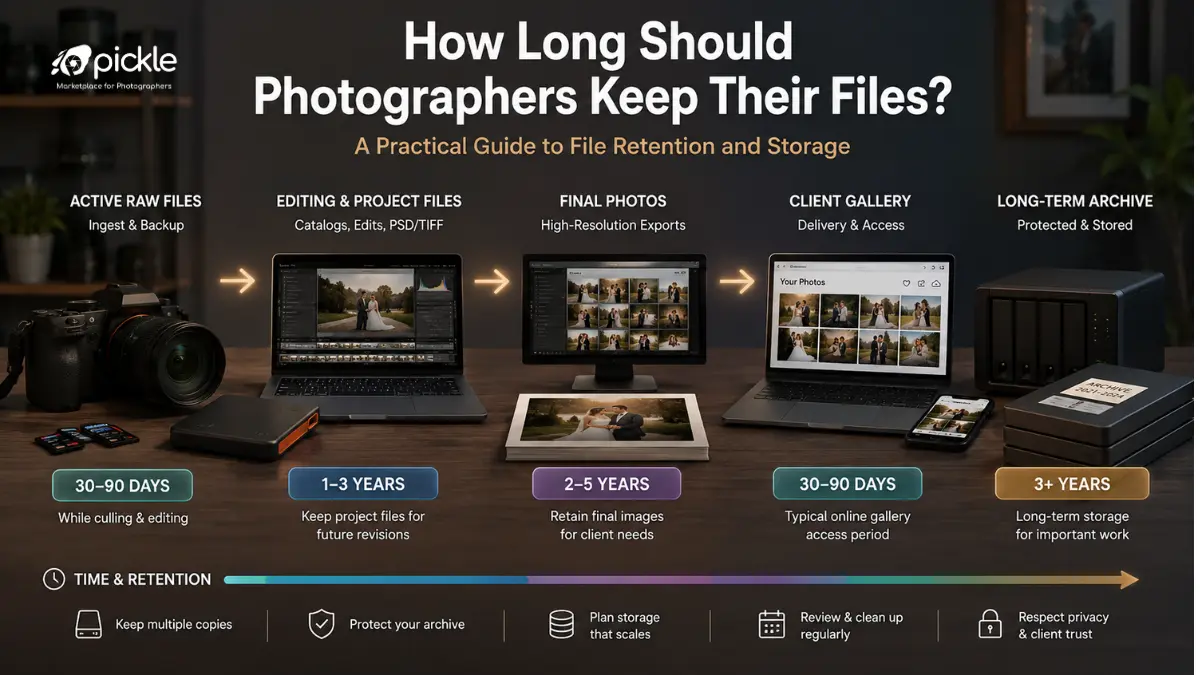
How long should photographers keep photos after a job is delivered? There is no single period that works for every studio. A wedding photographer handling thousands of RAW files has different storage economics from a commercial studio producing a small number of heavily retouched images, and neither should automatically keep every file forever.
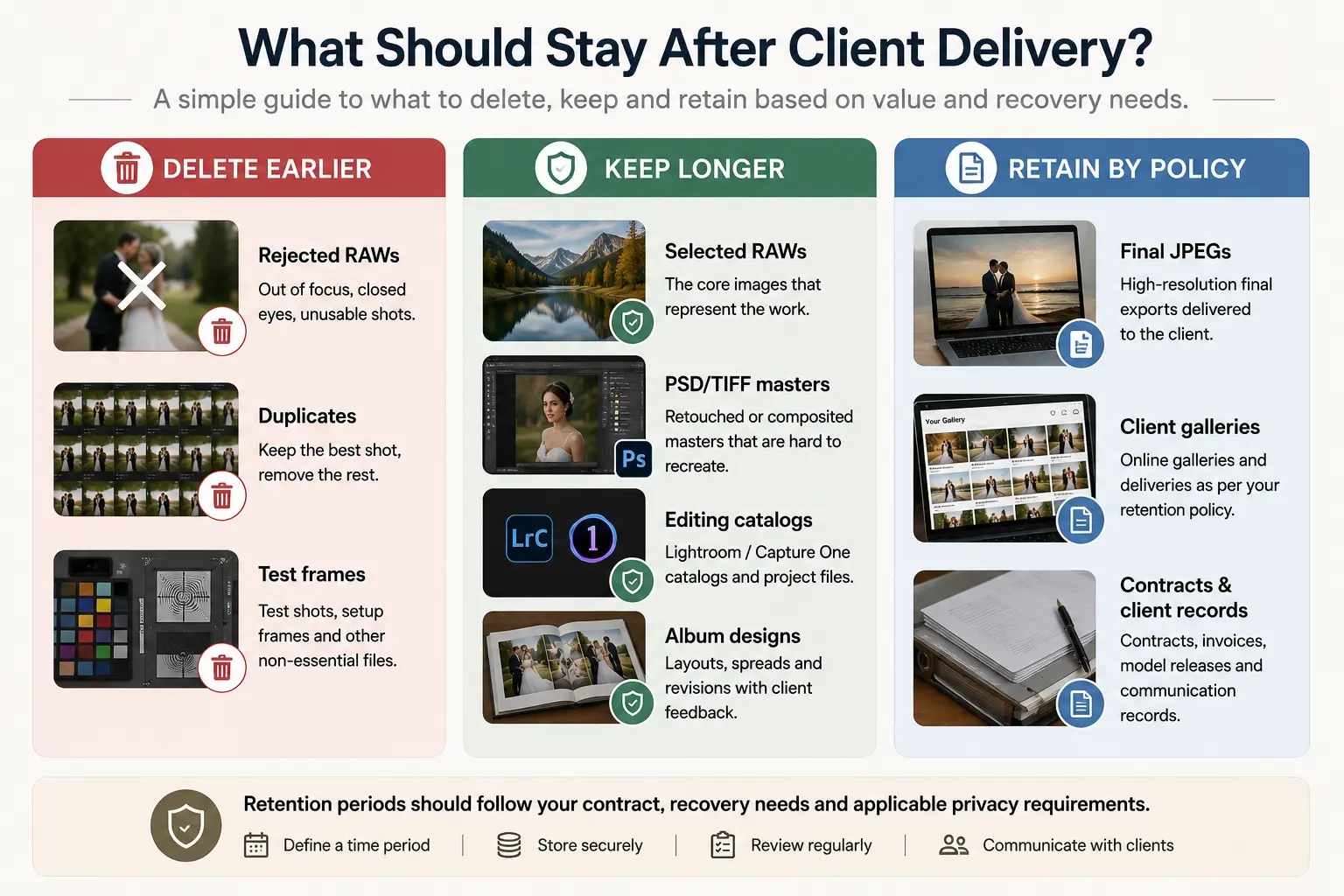
A better photography file retention policy separates the job into different assets: rejected RAW files, selected RAW files, editing files, final exports, album designs, client galleries and business records. Each has a different recovery value and a different reason for being retained.
The first rule is contractual: never delete files earlier than the period you have promised the client. After that, storage cost, privacy obligations and the likelihood of a genuine recovery request should determine what stays.
A Practical Photography File Retention Schedule
The periods below are useful operating ranges, not legal requirements.
| File type | Practical retention starting point |
|---|---|
| Rejected / unselected RAW files | 30–90 days after final delivery |
| Selected RAW files | 1–3 years |
| Lightroom / Capture One catalogs and working files | Final approval + 6–12 months |
| PSD / TIFF retouched masters | 1–3 years for important finished images |
| Final high-resolution JPEGs | 2–5 years, or longer if promised |
| Album design files | Until album approval + 1–3 years |
| Delivered client gallery | Commonly 30–90 days unless your policy says otherwise |
| Contracts, invoices and client records | According to applicable accounting, tax and legal requirements |
These ranges should be adjusted to the type of photography you sell. A ₹500 passport session, a corporate campaign and a large wedding do not need identical archive policies.
You Usually Do Not Need Every RAW File Forever
RAW files consume most of the storage in a photographer file archive, which is why RAW file storage for photographers needs a deliberate policy. Immediately after a shoot, every usable card should remain protected until ingestion and backup are verified. During culling and editing, keeping the complete RAW set also makes sense because selections can change and clients may request corrections.
The value of the rejected frames drops sharply once the project is completed. Out-of-focus photographs, duplicates, test exposures and obvious rejects rarely justify occupying primary and backup storage for several years. A reasonable studio policy may therefore keep the full RAW set through delivery and a short recovery buffer, then retain only selected RAW files or important originals.
The selected RAW files deserve longer retention because they give you the ability to recreate a finished photograph if an exported file is lost or a client later requests a different crop or treatment.
Keep the Files That Would Be Expensive to Recreate
Photographers sometimes focus so heavily on the original RAW photographs that they forget how much labour exists in the working files. A finished commercial image may include extensive Photoshop work. A wedding may contain Lightroom adjustments across hundreds of photographs. An album may have taken several rounds of client revisions.
Deleting those files immediately after delivery means a later request can require doing the work again.
For that reason, your archive should normally preserve the Lightroom or Capture One project data associated with retained images, important PSD or TIFF masters, final high-resolution exports and approved album designs for an appropriate period. The question is not simply how large the file is. Ask: how difficult would this be to reproduce if the client contacted us next year?
A Client Gallery Is Delivery, Not Permanent Storage
Client gallery retention should be defined separately from file archive retention. A gallery exists primarily so the client can view, select, share and download photographs. Keeping every gallery permanently online increases storage requirements and leaves old client material accessible long after the original delivery may have been completed.
A 30-, 60- or 90-day gallery window is common in photography workflows, although there is no industry rule requiring those periods. What matters more is communicating the expiry clearly and maintaining whatever independent archive your contract promises. Several current gallery workflow guides similarly recommend setting an expiry before delivery rather than surprising clients after access disappears.
With GoPickle Client Galleries, photographers can use a branded gallery with controlled access, downloads, favourites and organised collections for final delivery. That gallery should still be treated as the delivery layer. Your studio's own backup and archive policy should decide whether the finished files remain recoverable after the gallery is removed.
If your current process mixes cloud storage and client delivery into the same folder system, our comparison of Google Drive vs professional client galleries explains why those are better treated as separate jobs.
Storage Cost Should Influence What You Keep, Not Whether You Back Up
A studio shooting 40 weddings a year can generate several terabytes surprisingly quickly. Because a proper backup system keeps multiple copies, every unnecessary terabyte may eventually consume several terabytes across working storage, local backup and off-site storage.
That does not mean deleting aggressively. It means moving completed work through stages.
Keep current projects on fast working storage. Move finished projects you still need to retain onto lower-cost archive storage. Remove obvious rejects once your agreed safety period has passed. Keep the high-value assets that would be difficult to recreate. Maintain an independent backup for everything you have committed to preserve.
Storage becomes easier to budget when the studio knows what enters the archive and when it leaves.
Privacy Is Another Reason Not to Keep Everything Indefinitely
Long-term retention is not only a storage question. Photographs of identifiable people can constitute personal data under privacy laws such as the GDPR and UK GDPR. The storage-limitation principle requires personal data to be retained only for as long as necessary for the purpose for which it is being processed. Importantly, the UK Information Commissioner's Office states that the UK GDPR does not prescribe one fixed retention period for every category of personal data; organisations need to justify their own periods based on purpose.
A photographer serving clients across different jurisdictions should therefore avoid writing a blanket policy such as “we keep everything forever” without considering why the data is still needed. Contracts, tax records, photographs used under continuing licences and client galleries may also have different retention requirements.
For jurisdiction-specific requirements, obtain appropriate legal or accounting advice rather than applying one global number to every file.
Put the Retention Period in the Client Contract
The easiest way to create future disputes is to leave clients assuming that their photographer is a permanent free archive.
Your contract and delivery communication should state:
- How long the online gallery remains available.
- How long the studio guarantees retention of delivered photographs.
- Whether RAW files are retained or supplied.
- Whether recovery after the normal period is guaranteed.
- Whether archived-gallery restoration carries a fee.
Then send a reminder with the final gallery telling clients to download and independently back up their photographs.
A Simple Policy Is Better Than “We Keep Everything”
For most studios, the strongest answer to how long should photographers keep photos is not one number. Keep the complete project while the job is active, retain valuable working files and final photographs for a defined recovery period, let disposable RAW files expire sooner, and remove online galleries according to a clearly communicated delivery policy.
That gives clients realistic expectations while preventing the studio archive from becoming an uncontrolled collection of every image ever captured.
At GoPickle, we think of client delivery as one stage in that wider photography workflow. A professional client gallery can make the handoff cleaner, but your studio should still decide independently what will be retained after that handoff is complete.