Photography Booking Change Log: Track Scope, Venue, Time and Deliverable Changes After Confirmation
Learn how to track photography booking changes to dates, venues, services, deliverables, crew and pricing while preserving client approval and scope history.

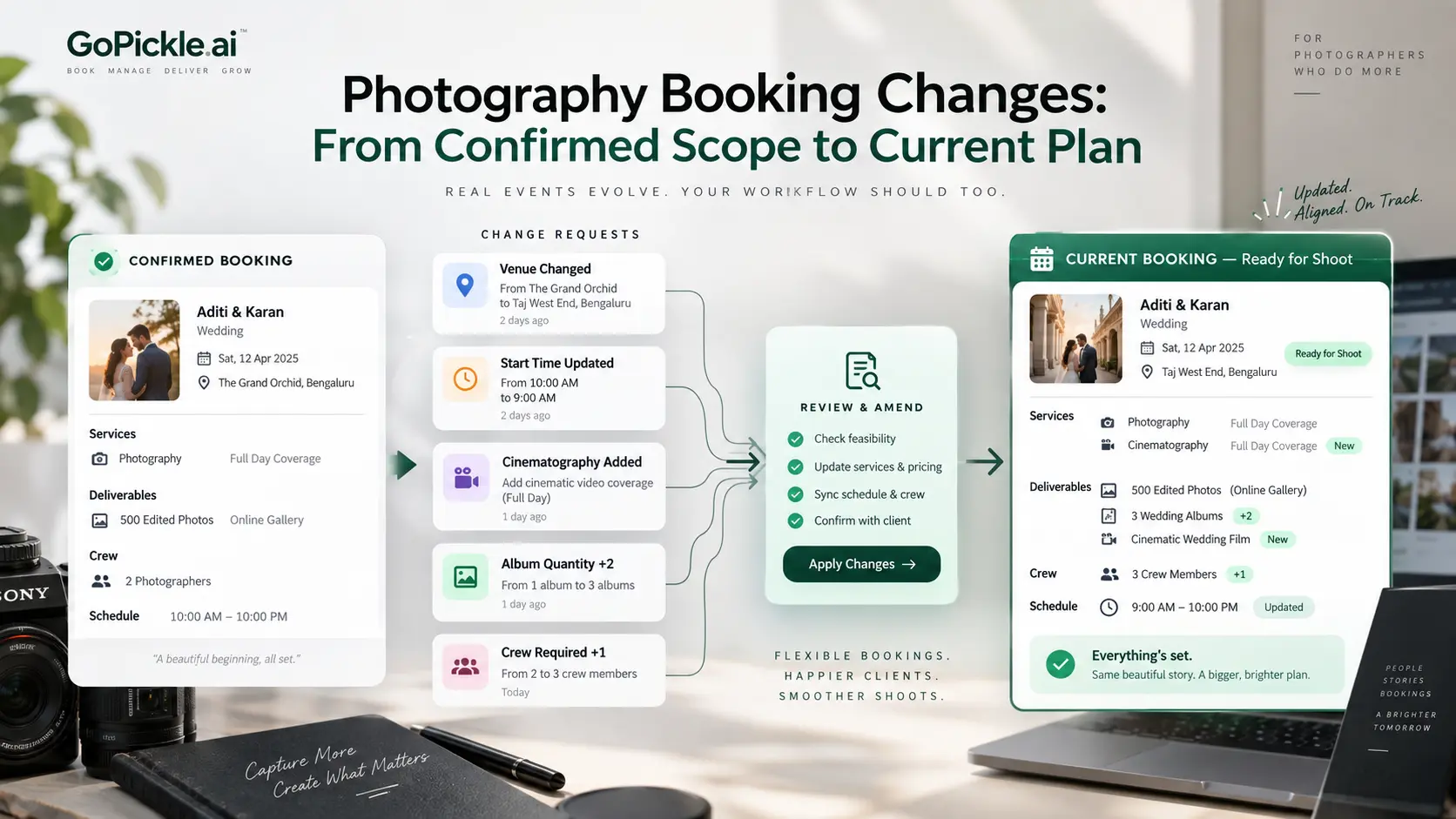
A confirmed photography booking rarely remains completely unchanged until shoot day. A wedding venue moves. A ceremony starts two hours earlier. A corporate client adds executive portraits to an event assignment. A family decides it wants an album after originally choosing digital delivery only. A second photographer becomes necessary because coverage has expanded across two locations.
None of these changes is unusual. The operational problem begins when the change is accepted in a message, remembered by one person and never carried through the rest of the booking.
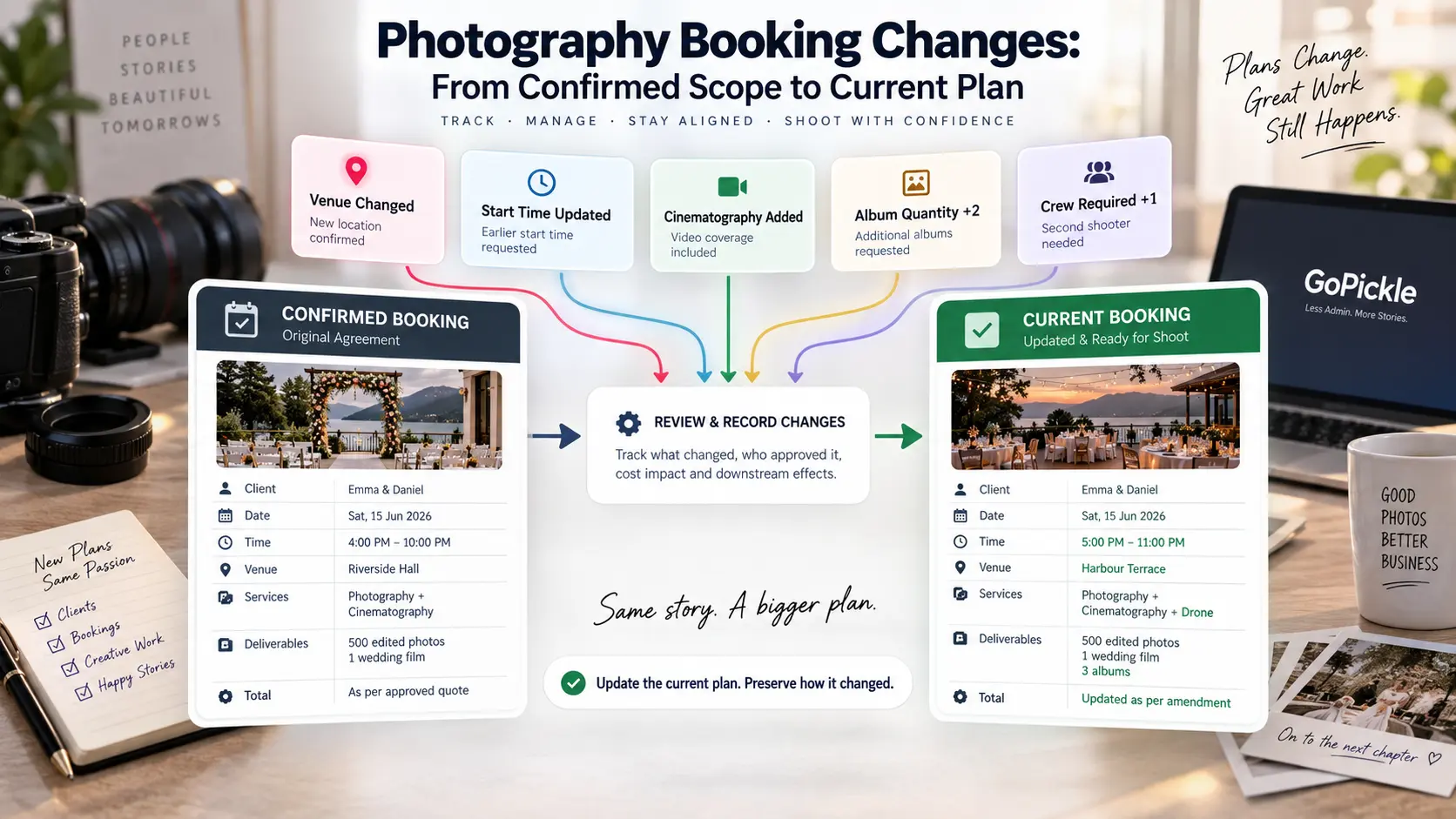
Photography booking changes need more than an edited calendar entry. Once a client has approved a scope, every material amendment should answer four questions, what changed, who approved it, what does it affect and what is now the current booking?
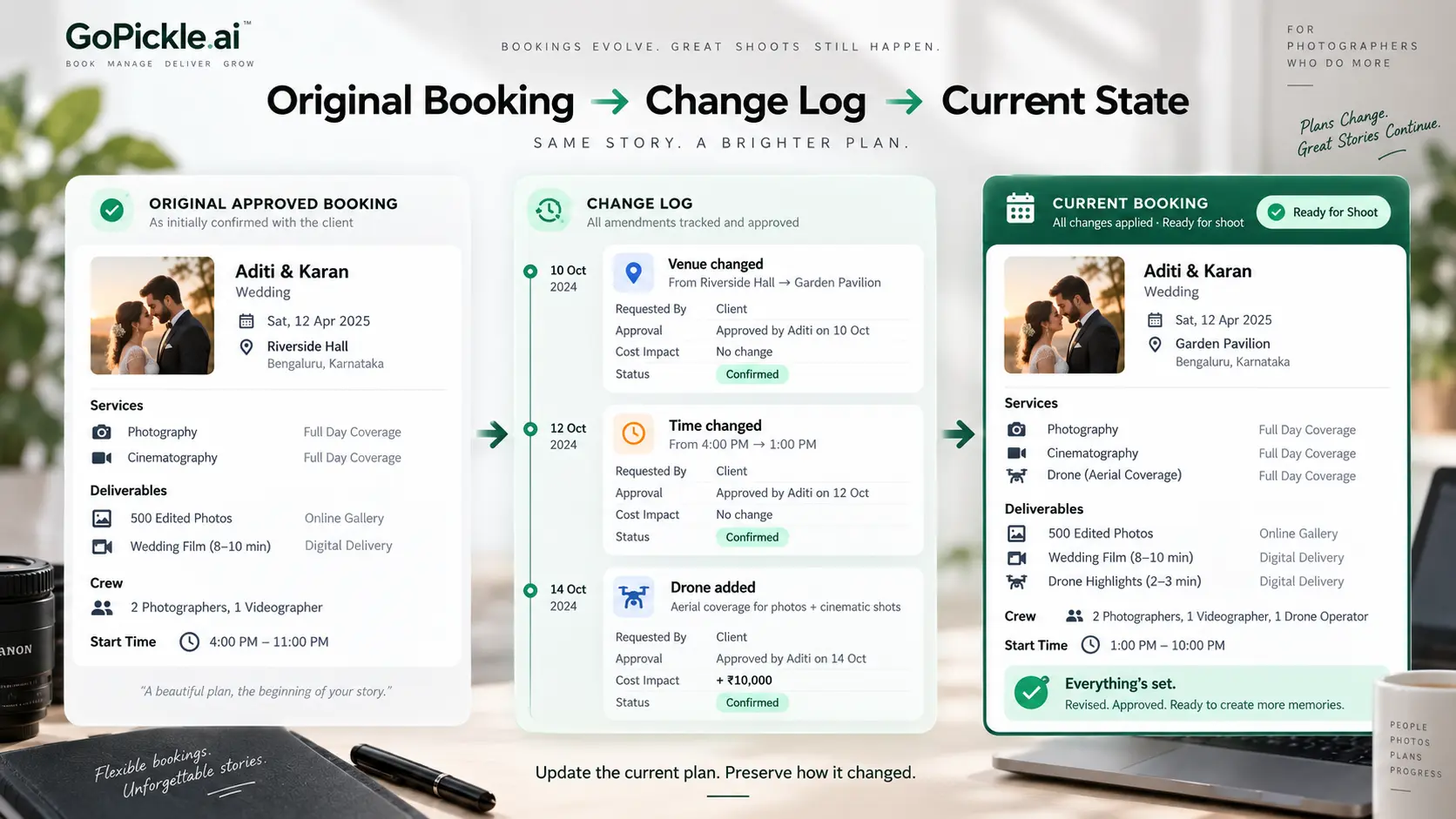
For us at GoPickle, the useful distinction is between the original approved booking, the record of changes made after confirmation and the current operational version the team should actually execute. A studio needs all three. Keeping only the original creates outdated instructions. Keeping only the latest version removes the history that explains how the job reached its current scope.
What should count as a photography booking change?
Not every new piece of information requires a formal amendment. A client sending the parking entrance, coordinator's mobile number or room number is usually additional operational context. A client moving the ceremony from 4:00 PM to 1:00 PM is different because the change may affect reporting time, crew availability, travel and coverage.
A useful test is simple: does this new information alter something the studio previously agreed to provide, reserve, schedule, price or deliver?
| Change | Example | What may need reviewing |
|---|---|---|
| Date | Wedding moves from Saturday to Sunday | Availability, crew, travel, pricing |
| Time | Coverage starts three hours earlier | Reporting time, overtime, transport |
| Venue | Local venue changes to another city | Travel, accommodation, permits, crew |
| Event scope | Reception coverage is added | Hours, equipment, photographers, price |
| Service | Client adds cinematography or drone coverage | Crew, equipment, permissions, cost |
| Deliverable | One album becomes three parent albums | Production cost, delivery date, invoice |
| Coverage | One location becomes two simultaneous locations | Crew size, transport, scheduling |
| Commercial scope | Usage, revisions or production requirements expand | Quotation, licence, price, timeline |
For a small portrait session, only a few of these fields may matter. For a multi-event wedding or commercial production, one amendment can affect several parts of the job simultaneously. That is why a proper photography booking management workflow needs to hold more than a date on a calendar. Events, venues, services, deliverables, crew and payment context need to remain connected to the confirmed work.
The threshold should not be based only on money. A change can have zero client-facing cost and still matter operationally. Moving an event to another floor of the same venue may require nothing more than updating instructions, while moving a ceremony by four hours could create a crew conflict even if the package price remains unchanged.
Never overwrite the original context silently
Imagine the client originally approved:
Ceremony · Saturday · 4:00 PM · Riverside Hall · Photography + Cinematography
Three weeks later, the booking screen simply reads:
Ceremony · Saturday · 1:00 PM · Garden Pavilion · Photography + Cinematography + Drone
The current information may be correct, but an important part of the record has disappeared. Who requested the venue change? When was drone coverage added? Was the additional service included free, or was a revised price approved? Did the new timing create additional crew or travel requirements?
Instead of silently replacing old values, preserve the approved baseline and create a photography booking change log between that baseline and the current booking.
A practical change entry can record:
- date the change was requested;
- person who requested it;
- original booking detail;
- proposed new detail;
- reason or supporting context;
- client-facing price, credit or refund impact;
- crew, schedule or delivery impact;
- approval status;
- approving person and approval date;
- revised documents or operational records that must be updated.
Not every studio needs a complicated change-order system. What matters is that somebody opening the booking later can reconstruct what happened without searching through months of messages.
This is particularly important when several people manage the same job. Sales may have handled the quotation, a studio manager may coordinate the booking, another person may assign crew and accounts may issue the final invoice. The change record becomes the bridge between those responsibilities.
Treat date, time and venue changes as operational changes, not calendar edits
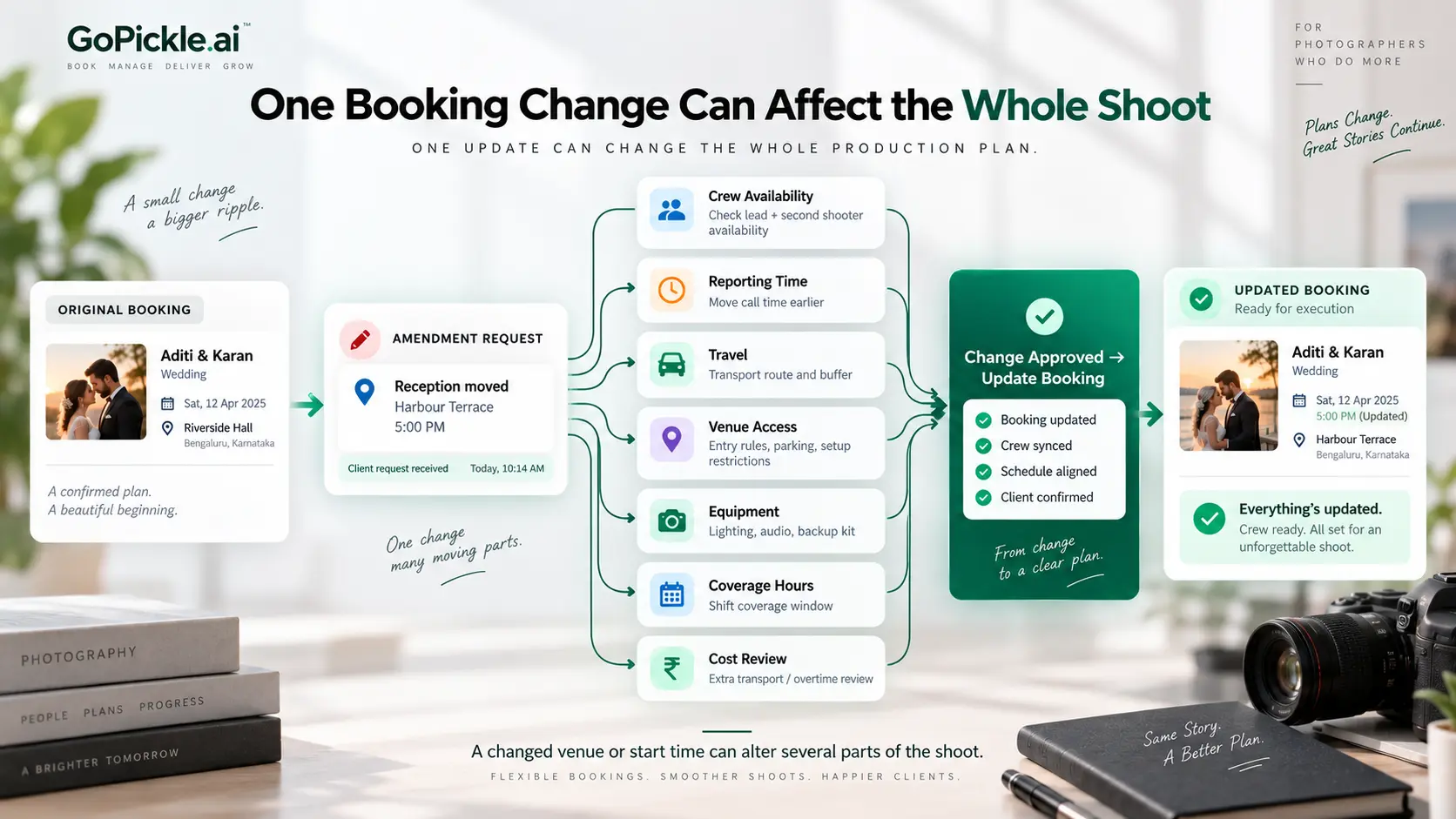
Date changes are the most obvious photography booking amendments, but time and venue changes deserve the same discipline.
Before accepting a new date, check availability. Before accepting a new time, check reporting schedules and overlaps with other assignments. Before accepting a different venue, check distance, access, travel requirements, venue restrictions and whether the existing crew plan still works.
For multi-event bookings, make the change at event level rather than treating the entire booking as one block. A four-function wedding could retain the original Sangeet, ceremony and reception arrangements while only the welcome dinner changes venue. Rewriting the whole wedding itinerary increases the chance of introducing unrelated errors.
We cover the date-specific process separately in our guide to what happens when a photography client changes the event date. The broader principle is the same for venue and timing changes: assess the consequence before confirming the amendment, then update everyone working from the booking.
A photography booking change log should therefore show more than “venue updated.” It should make the transition understandable:
Previous: Grand Ballroom · 6:00 PM
Current: Harbour Terrace · 5:00 PM
Approved: Client · 14 October
Impact: Crew reporting moved to 3:30 PM · additional transport required
Status: Confirmed
The current booking remains clean enough to operate from, while the history explains why it changed.
Service and deliverable changes need to flow back to the commercial scope
Some of the most expensive photography scope changes look small when they first arrive.
“Can we add video coverage?”
“We now need two additional albums.”
“Could you also cover the welcome dinner?”
“We need 80 final commercial images instead of 40.”
These requests alter more than the booking description. They may change production hours, post-production effort, equipment, subcontractor requirements, delivery dates and the final amount payable.
Start with the version the client originally approved. GoPickle's photography quotation workflow is structured around event-specific scope, services, deliverables, packages, add-ons, revisions and client approval. That approved scope provides the baseline against which a later addition or reduction can be understood.
If a client removes an album, do not simply delete the album field and assume the original total can stay untouched. Determine whether the change creates a credit under the agreed terms, whether production has already begun and whether taxes or payment stages need adjustment. If the client adds cinematography, determine what coverage is being added, which events it applies to, what is delivered and whether the existing delivery deadline remains realistic.
The booking should eventually show the current promise. The change record should explain how that promise differs from the one originally approved.
Review crew and cost impact before saying yes
A client request should not become a confirmed change until the studio understands whether it can actually deliver it.
Adding another event may require a second photographer. Extending coverage into the night could affect an existing freelancer agreement. Moving the venue might increase travel time enough to create a conflict with another booking. Adding same-day editing could require an editor on location instead of during normal post-production.
For studios working with multiple photographers, videographers, assistants and editors, run every meaningful amendment through a resource check. GoPickle's crew management workflow connects assignments to bookings and individual events so the studio can plan roles, availability, reporting times and handoffs around the actual work.
The financial review should happen at the same point. Additional client charges are only one side of the calculation. A studio may decide not to charge for a minor change, but it should still understand its internal impact. Additional transport, another freelancer, equipment hire or an extra editing day can turn a seemingly harmless amendment into a margin problem.
The decision might therefore be to approve the request at the original price, quote an additional amount, reduce something elsewhere, extend delivery or decline the amendment because the studio cannot resource it reliably. What matters is that this is an intentional decision rather than an accidental consequence discovered after the shoot.
Get client approval and revise the documents that depend on the change
A request is not the same thing as an approved photography booking amendment.
For material changes, confirm the revised scope in writing using the approval method appropriate to your contract, client and jurisdiction. Depending on the situation, that could involve a revised quotation, amendment, change order, purchase order, approved written instruction or another agreed form of acceptance. Contract and electronic-signature requirements differ worldwide, so studios should use terms and approval methods appropriate to the markets in which they operate.
The workflow should look like this:
Change requested → Impact reviewed → Revised scope/pricing prepared → Client approval recorded → Booking updated → Crew and financial records updated
Preserve the earlier approved document rather than making it impossible to see what changed. If the client originally approved one package and later adds services, a revised photography quotation or amendment should make the difference understandable instead of presenting a new total with no explanation.
The same principle applies downstream. If the amendment changes the payable amount, the photography invoice and payment workflow needs to reflect the current commercial position, including any advance already received and the remaining amount due. An invoice should not surprise the client with scope that was never visibly approved.
Studios should also define their change rules before problems occur. A clear photography cancellation and rescheduling policy can establish how date, venue, travel and significant scope changes will be reviewed instead of negotiating those rules for the first time during an urgent amendment.
Audit the final booking before shoot day
The purpose of a photography booking change log is not to make the booking harder to manage. It is to allow the studio to arrive at one reliable current version.
Before the final crew briefing, review the booking as though nobody on the shoot had seen the previous messages. Can they understand exactly what they are expected to execute?
Check the final event dates and timings, venue and reporting instructions, coverage included, services, deliverables, assigned crew, equipment or travel dependencies, client contact details, current quotation or amendment, invoice status and any unresolved change requests.
Pay particular attention to differences between systems. If the booking says the reception begins at 6:00 PM but the crew instruction still says 7:00 PM, the workflow is not finished. If the revised quotation includes an additional album but the delivery plan still shows one, the commercial change has not yet become an operational change. If the invoice includes additional coverage but there is no approval record explaining it, the financial record has moved ahead of the client agreement.
This final audit is where the distinction between history and current state becomes useful. Crew should not need to read the entire amendment history before leaving for a shoot. They need the latest confirmed plan. The studio, however, should still be able to trace any important difference back to the request and approval that created it.
GoPickle's booking workspace connects clients, events, venues, services, deliverables, crew, quotations, invoices and payment context around the photography job. The change-management discipline sits across that connected workflow: preserve what was originally agreed, record material amendments clearly and make sure every affected part of the booking reflects the approved current position.
Clients will change their minds. Venues will move. Timelines will shift and packages will grow. A professional photography studio does not need to prevent those changes. It needs a reliable way to absorb them without losing the agreement, the margin or the shoot plan.