Photography Crew Skill Matrix: Match Roles, Experience and Equipment to Each Assignment
Build a photography crew skill matrix to match roles, experience, equipment and eligibility to each assignment before allocating photographers and freelancers.

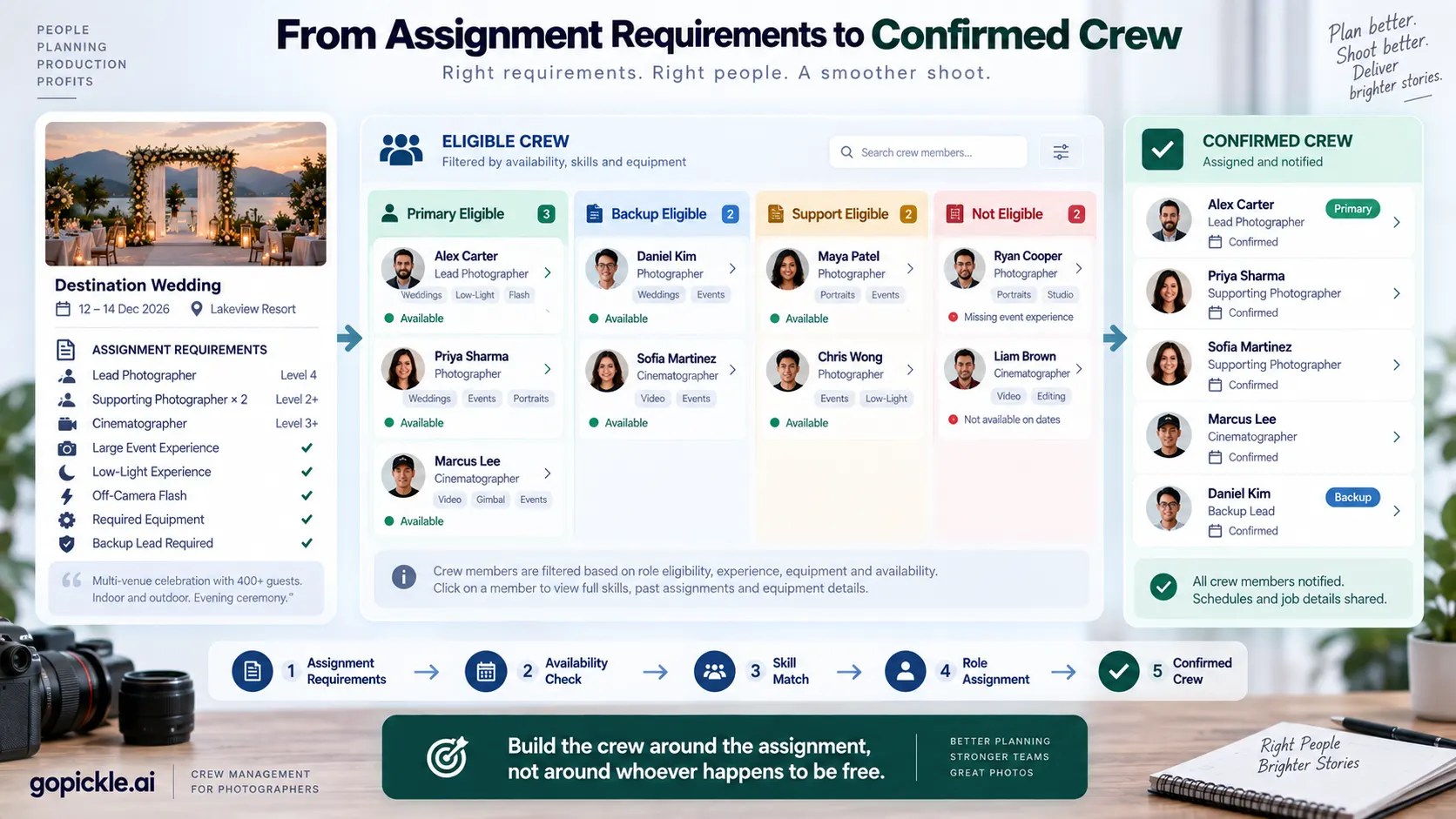
A photographer being available on Saturday does not mean they are the right photographer for Saturday's assignment.
They may be excellent at controlled portraits but have little experience managing a fast-moving wedding ceremony. A cinematographer may be strong with handheld coverage but unfamiliar with the audio setup required for an interview. Someone may own a drone without currently meeting the regulatory requirements for the location where it needs to be flown. Another photographer may be technically capable of leading the shoot but not yet ready to manage a demanding client, a large crew or a complicated production schedule.
This is the gap a photography crew skill matrix is designed to close. Availability tells the studio who could work. A skill matrix helps determine who should work.
For studios coordinating employees, regular freelancers and specialist crew, that distinction becomes increasingly important as the number and variety of bookings grows. The objective is not to score photographers for the sake of administration. It is to build a reliable assignment system that connects the requirements of a real job with the people who have already demonstrated that they can handle it.
Availability is not eligibility
Crew planning usually starts with the calendar, and it should. There is little value evaluating somebody for a role if they are already committed elsewhere. Our photography crew availability matrix guide covers the scheduling side in detail, including holds, confirmed assignments, travel blocks and other states that make a simple Available/Busy calendar inadequate.
Suitability is the next filter.
Imagine that six photographers are available for a large corporate conference. Two have extensive conference experience, one regularly photographs portraits but has never worked a live stage, another is comfortable with events but does not use the lighting system required at the portrait station, and two are newer crew members who are suitable as supporting photographers but have not yet led an assignment of that complexity.
The availability view says six people. The eligibility view gives the studio a much more useful answer.
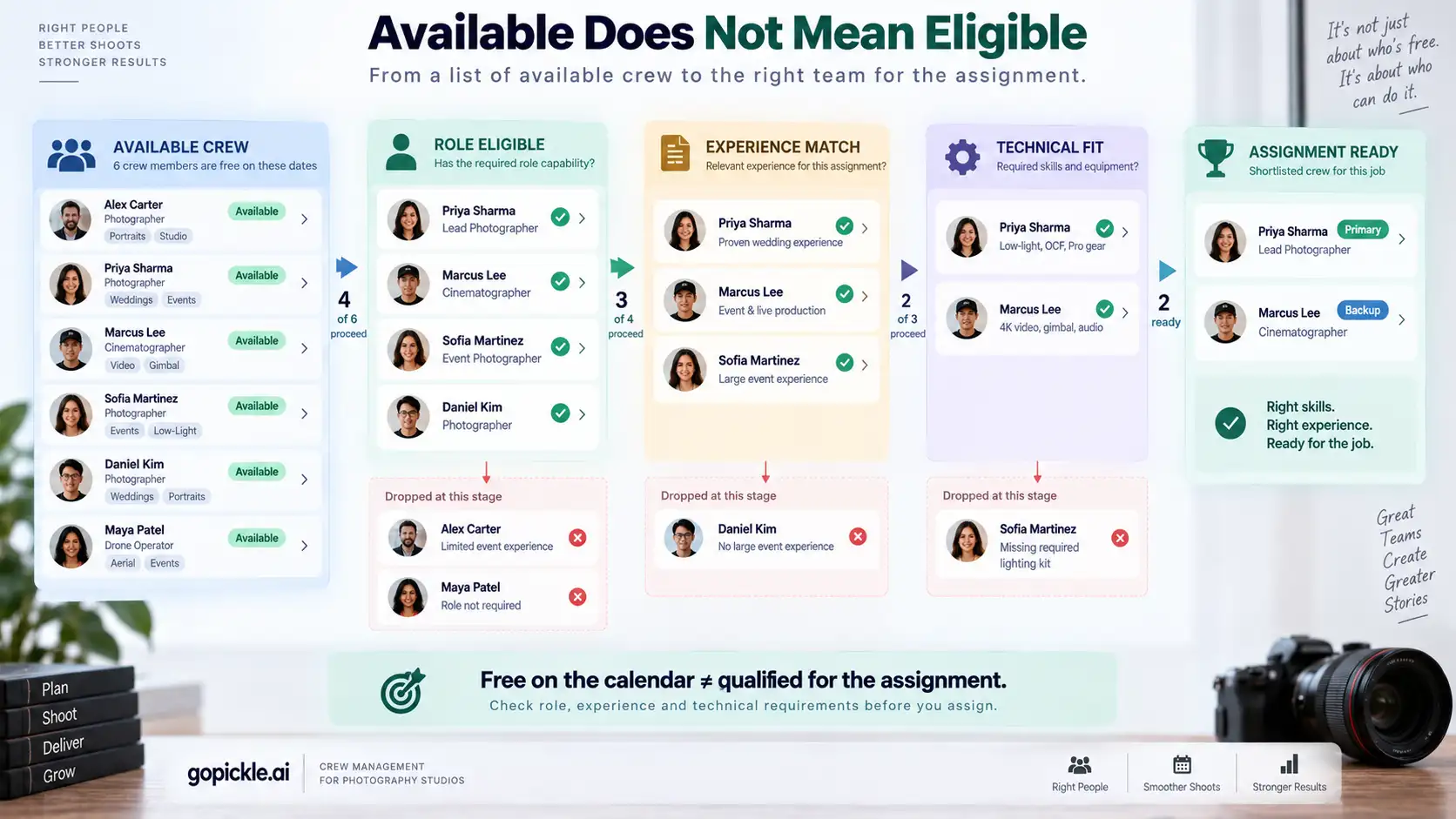
A practical staffing decision can therefore follow a sequence such as:
Available → Eligible for role → Suitable for assignment → Assigned → Confirmed
That prevents the common mistake of treating every photographer with the same job title as interchangeable.
Define roles and skill levels before assigning scores
A photography crew skill matrix works best when it describes capabilities rather than vague labels such as junior, senior or good photographer.
Start with the roles your studio actually assigns. Depending on the work you do, those might include lead photographer, supporting photographer, candid photographer, studio photographer, cinematographer, drone operator, lighting specialist, digital technician, editor, retoucher or album designer. The point is not to create the longest possible list; it is to represent the operational roles that affect who can safely and confidently be assigned to a booking.
Then define a small proficiency scale.
| Skill level | Practical meaning for assignment |
|---|---|
| 0 - Not assessed | No reliable evidence yet |
| 1 - Learning | Can perform the work with close guidance |
| 2 - Supporting | Can perform reliably as part of an experienced team |
| 3 - Independent | Can own the role without routine supervision |
| 4 - Lead / Specialist | Can handle complex work and guide others |
The descriptions matter more than the numbers. If one studio manager interprets Level 3 as "has done this before" and another interprets it as "can lead the assignment alone," the matrix becomes unreliable.
Avoid letting self-assessment determine the entire record. Portfolio review, previous assignments, practical testing, feedback from lead photographers and completed-job reviews provide stronger evidence. A crew member can also be highly experienced in one area and still be developing in another.
That is exactly what the matrix should reveal.
Record experience by photography type, not only years worked
"Eight years of experience" sounds reassuring, but it tells you remarkably little about assignment suitability.
Eight years photographing products in a controlled studio does not automatically translate into experience covering a three-day cultural wedding. Years of wedding photography do not necessarily qualify someone to handle executive headshots at a tightly scheduled corporate activation. A strong sports photographer may be excellent at anticipating action yet have limited experience directing families or working inside a formal client-production hierarchy.
Instead of relying primarily on tenure, record relevant experience by the types of work your studio accepts.
A worldwide studio skill matrix might include areas such as:
- Weddings and multi-event celebrations
- Portrait and family sessions
- Corporate events and conferences
- Commercial and advertising productions
- Product and e-commerce photography
- Fashion and editorial work
- Sports and action
- School or volume photography
- Property and architectural photography
- Food and hospitality
- Live performance
- Video interviews and branded films
Do not turn these into simple Yes/No fields either. The useful distinction is whether someone can support, work independently or lead work of that type.
Complexity should also matter. Photographing a 30-person private ceremony is not operationally identical to leading photography across several venues, multiple functions and a large team. In wedding photography crew planning, for example, the studio might distinguish between experience supporting a wedding, independently covering an event within the wedding, and leading the complete photography team.
This protects good photographers from being promoted into assignments before they are ready and gives developing crew a visible progression path instead of an arbitrary seniority label.
Add equipment and licence requirements where the assignment depends on them
Skill alone does not always make someone eligible.
Some assignments depend on the person having access to, or demonstrated competence with, particular equipment. A photographer expected to cover distant stage action may need appropriate long lenses. A studio portrait assignment may require confidence with the studio's lighting and triggering system. Video work may depend on stabilisation, audio capture or a specific camera workflow used by the rest of the production team.
Record the requirement separately from general photography ability.
A useful crew profile might therefore say:
Corporate Events - Independent
Off-camera Flash - Independent
Studio Strobes - Supporting
Gimbal Operation - Not Assessed
Drone Operations - Verified for applicable assignments
That final example requires particular care. Drone rules differ between countries and sometimes between categories of operation, airspace and location. Depending on the jurisdiction, an operator may need registration, competency certification, operational authorisation or other permissions. Do not use a generic "Drone: Yes" field as proof that someone is legally eligible to perform every aerial assignment. Record whatever credential or verification matters to your business and recheck the relevant aviation authority when planning the job.
The same principle applies anywhere an assignment requires a permit, accreditation, insurance condition or client-mandated qualification. A photography team management system should distinguish owns the equipment, knows how to use it and is permitted to perform the required operation.
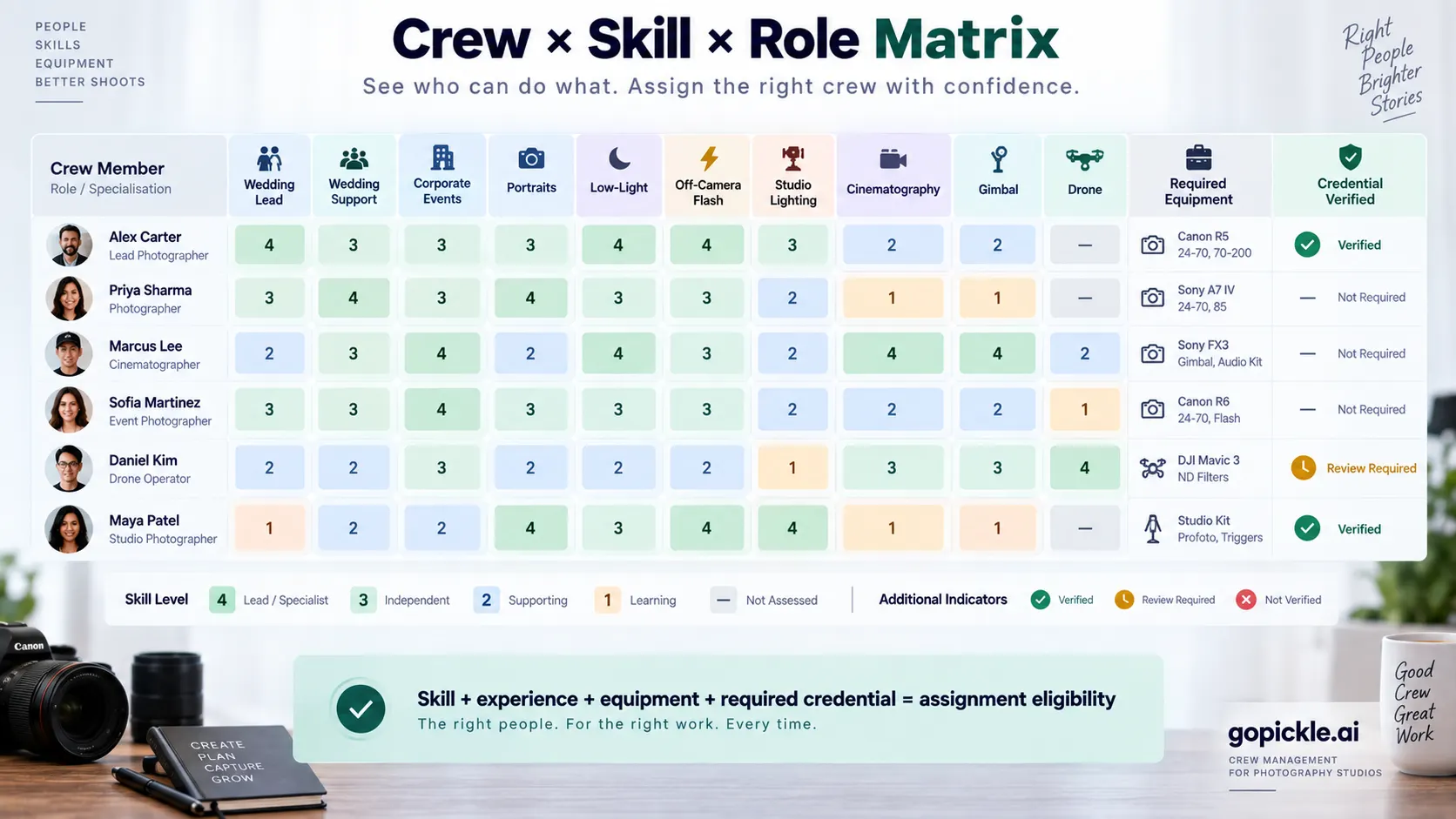
Equipment records also help with a less dramatic but frequent problem: assigning the right person and discovering later that the required kit is unavailable. Crew eligibility and equipment availability are separate questions, so both should be checked before the assignment is considered ready.
Define primary and backup role eligibility
A strong photography crew plan should not contain only the first-choice name.
For important roles, identify who can serve as the primary assignment and who is genuinely qualified to replace that person. "Backup" should not mean whoever happens to be available if someone cancels.
Consider a multi-event wedding where one photographer is approved to lead the main ceremony, two others are independently capable of taking over that role, and several more are qualified only as supporting photographers. That distinction should already exist before the week of the wedding.
A simple eligibility model can work well:
| Eligibility | Meaning |
|---|---|
| P - Primary eligible | Proven to own the role at the required level of complexity |
| B - Backup eligible | Capable of stepping into the role if the primary becomes unavailable |
| S - Support eligible | Suitable when working alongside an eligible lead |
| N - Not currently eligible | Should not be assigned to this role without supervision or additional preparation |
This is especially useful for roles where failure is difficult to recover from: lead photographer, primary cinematographer, drone operator, live-stream operator, lighting lead or on-site data manager.
Backup eligibility should be based on capability, not convenience. If the backup cannot realistically take over the responsibilities of the primary person, the studio does not actually have redundancy.
The same logic can extend beyond a single role. A crew member might be Primary eligible for candid wedding coverage, Backup eligible for lead photography at smaller weddings and Support eligible for a large commercial production.
That level of detail makes photography studio team management far more useful than storing one generic job title against each person.
Use the matrix while assigning photographers to jobs
A skill matrix should influence the assignment workflow, not sit in a spreadsheet that nobody checks.
Start by defining what the booking requires. A job may need:
- One lead photographer
- Two supporting photographers
- One cinematographer
- Off-camera flash experience
- Experience covering large indoor events
- Familiarity with a particular production workflow
- Appropriate equipment
- A verified licence or credential where required
The studio can then compare those requirements against the available crew.
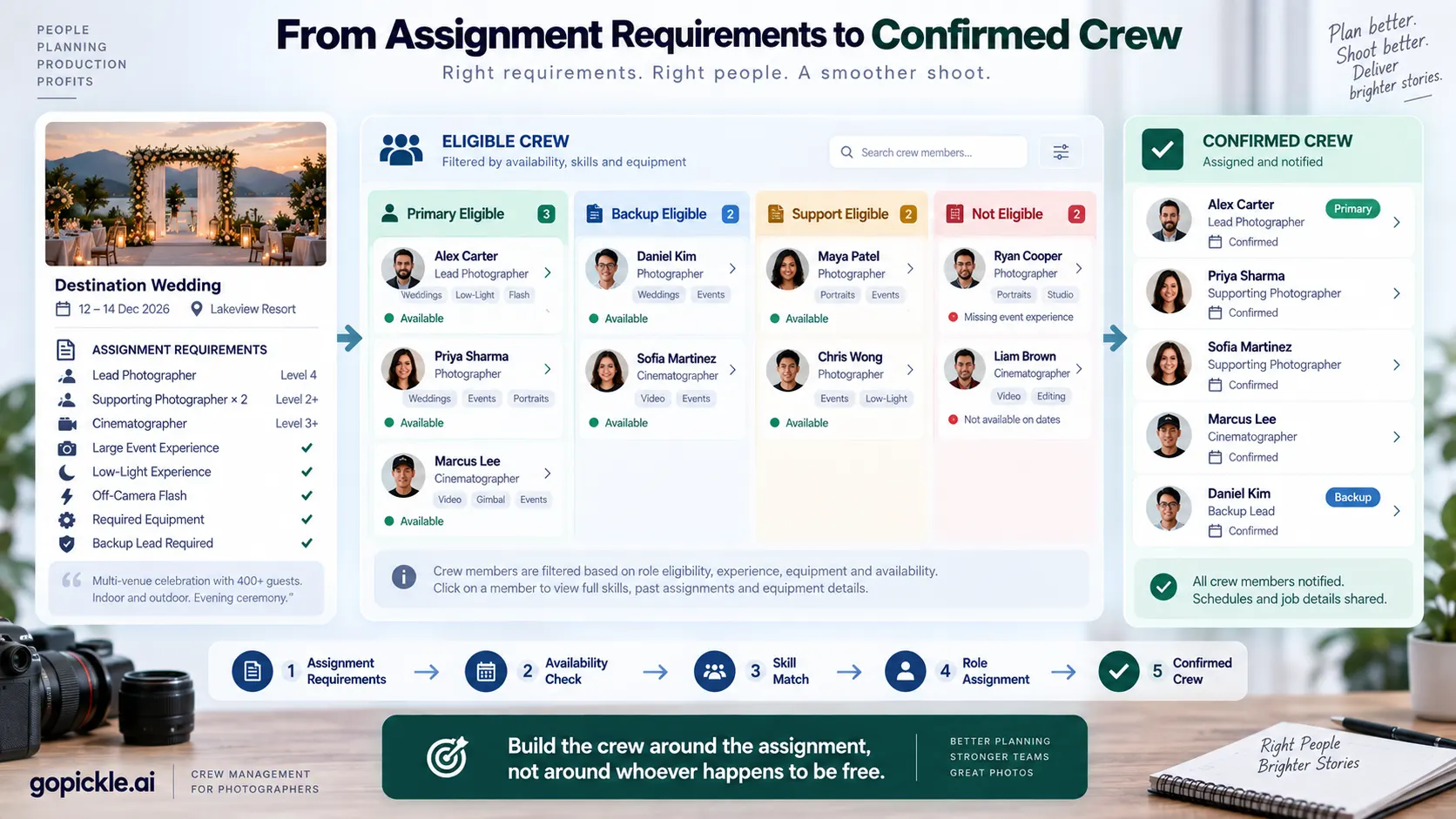
A useful assignment sequence is:
1. Define the role
What does this person need to be responsible for?
2. Define the minimum eligibility
What skill level, experience and equipment competence does the role require?
3. Check availability
Who is actually free or otherwise assignable during the relevant dates and times?
4. Filter by suitability
Which available people satisfy the role requirements?
5. Compare operational factors
Consider travel, existing workload, team compatibility, client familiarity and backup coverage.
6. Assign and confirm
The selected person becomes part of the booking only after availability and eligibility have both been checked.
This is particularly valuable when studios assign crew directly to photography bookings rather than coordinating jobs through disconnected calendars and chat messages. When the booking already contains its events, services and crew requirements, assignment decisions can be made in the context of the actual work.
The matrix should guide decisions rather than automatically pick the "highest-rated" photographer every time. A Level 4 wedding photographer does not need to cover every small portrait session simply because they score highest. Good crew planning also considers workload distribution, development opportunities and cost.
Sometimes the best assignment is a Level 3 independent photographer with a Level 2 crew member supporting them so the second person gains relevant experience under controlled conditions.
Review skills after completed jobs
A photography crew skill matrix becomes less trustworthy every month it goes without review.
Crew members improve. New equipment is introduced. Someone who previously supported five commercial productions may now be ready to work independently. Another person's drone credential may expire. A photographer who performs well technically might still need more experience managing a large team or working directly with high-pressure clients.
Completed bookings provide the evidence needed to update the matrix.
After a meaningful assignment, the studio does not need to conduct a lengthy appraisal. Record only information that can change a future staffing decision:
- Did the crew member perform the assigned role independently?
- Was technical execution reliable?
- Did they manage the expected pace and complexity?
- Could they handle a similar assignment again without additional supervision?
- Did the job reveal a new skill?
- Is there an area that still requires support?
- Are they now eligible as a backup or primary for this role?
For freelancers, this ongoing record complements the initial photography freelancer onboarding process because onboarding tells you who has entered the crew pool, while completed-job reviews tell you what you now trust them to handle.
Do not downgrade someone because of one subjective stylistic preference or upgrade them simply because one assignment went well. Look for repeatable evidence.
The result is a matrix that changes as the studio's real capability changes.
A skill matrix makes crew planning more reliable
As a photography business grows, its crew list usually grows faster than its understanding of that crew.
Names accumulate in contacts. Managers remember who is "good at weddings" or who "knows lighting." A freelancer becomes the default choice because they worked on the last three jobs. Eventually the studio starts relying on individual memory to decide who should handle increasingly valuable assignments.
A photography crew skill matrix replaces that memory with a shared operational record.
The important shift is simple:
Availability answers: Can this person work?
Eligibility answers: Should this person do this work?
Combining the two gives studios a much stronger foundation for assigning photographers to jobs. Availability protects the calendar. Role eligibility protects the assignment. Experience data protects against mismatching people to unfamiliar work. Equipment and credential checks prevent technical or compliance surprises. Primary and backup eligibility make the plan more resilient when something changes.
At GoPickle, we see crew management as part of the booking itself rather than a separate list of photographers. GoPickle Crew Management helps studios organise crew and connect assignments with the photography work being delivered. The skill matrix described here adds the decision framework around that workflow: first establish who is suitable, then assign the right people to the job.
The best crew plan is not the one with the most available photographers. It is the one where every important role has someone who is available, capable and prepared to own it.