Photography Crew Availability Matrix: Prevent Double-Booking Freelancers and Staff
Build a photography crew availability matrix that tracks available, held, confirmed, travel-blocked and unavailable crew without double-booking staff or freelancers.

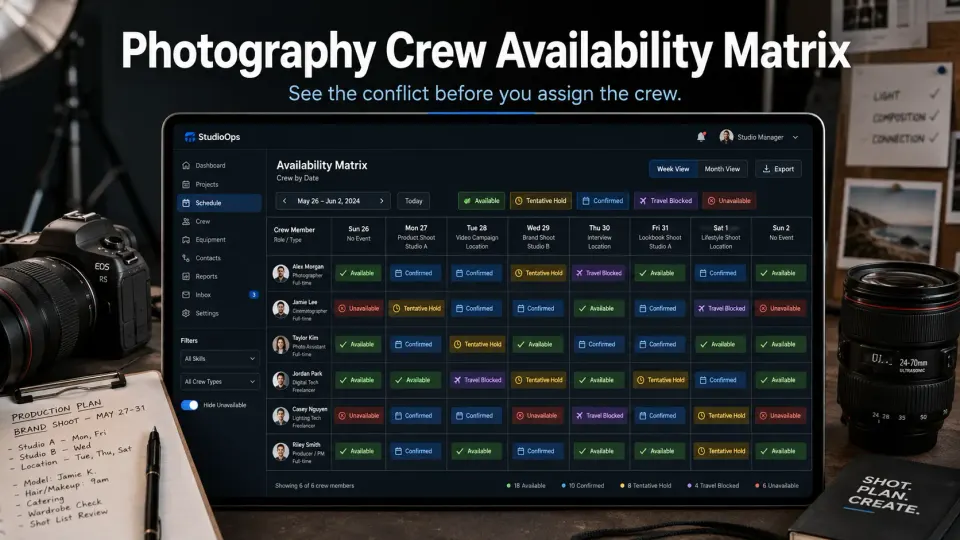
A photographer's calendar can look free while that photographer is completely unusable for the job you are trying to staff.
They may already be travelling back from another assignment. They may have tentatively promised the date to another studio. They might be free during the afternoon but booked for an evening event that makes your schedule impossible. Or they may technically be available but lack the role, equipment or experience required for the assignment.
That is why photography crew availability needs more than a yes/no calendar.
For a studio working with employees, regular freelancers, second shooters, cinematographers, editors and specialists, a useful availability system should answer three questions at the same time:
Is this person free? Are they suitable for this role? Can they realistically complete this assignment without conflicting with another commitment?
A photography crew availability matrix gives the studio that view before somebody confirms the wrong person for the wrong date.
Define photography crew availability with more than Available or Busy
The first improvement is to stop treating every calendar date as either empty or occupied.
A freelancer who has verbally held a Saturday for your studio is not as available as somebody with no commitment. A photographer flying home from an international wedding on Sunday morning should not appear identical to someone sitting at home. A crew member confirmed for another booking is different again.
For most photography studios, five availability states are enough to make the schedule substantially more useful:
| Availability state | What it means | Can you assign them? |
|---|---|---|
| Available | No known assignment or restriction affects the required window | Yes, subject to confirmation |
| Tentative Hold | The person or date has been provisionally reserved | Not without resolving the hold |
| Confirmed | The crew member has accepted another assignment | No for overlapping work |
| Travel Blocked | Travel, overnight stay or recovery time makes the person unavailable | Usually no |
| Unavailable | Leave, personal commitment or another hard restriction | No |
The important word in the first row is known. “Available” should mean that you have checked the working schedule, not simply that no confirmed shoot happens to appear on the calendar.
For wedding crew availability, this distinction becomes especially important because one booking may contain several functions across multiple days. A photographer could be available for Friday's welcome dinner but already confirmed elsewhere during Saturday's ceremony. Marking the entire weekend green would create a false picture of capacity.
This crew-level view should also remain separate from client booking availability. Your studio may still accept a wedding even if one preferred photographer is unavailable because another qualified crew member can cover it. The client date and the individual crew member's availability answer different operational questions.
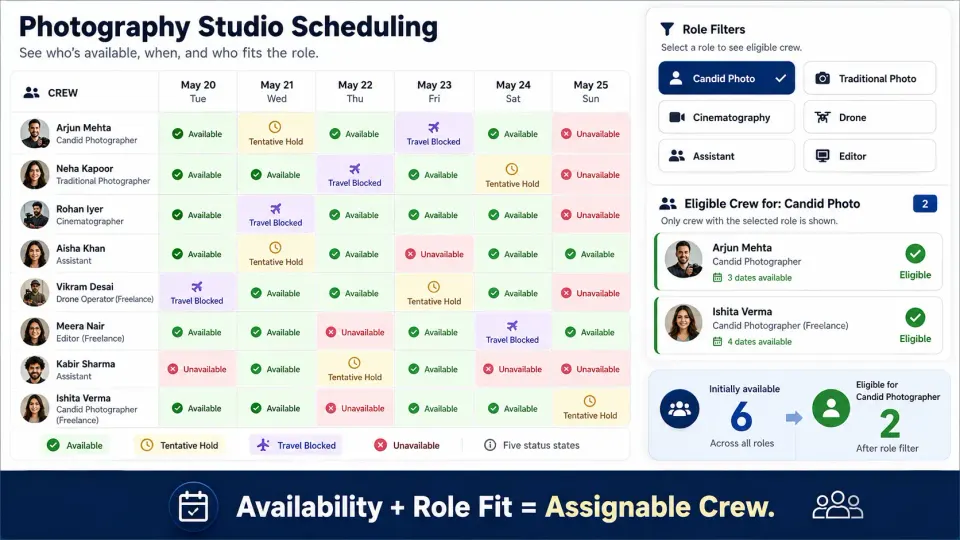
Record role and skill eligibility alongside availability
A photography team scheduling system becomes misleading when it counts people instead of capabilities.
Suppose your availability matrix shows seven crew members free on Saturday. The wedding requires two candid photographers, one traditional photographer, two cinematographers and a licensed or qualified drone operator. If only one free person can shoot candid work to your required standard and nobody available can legally or practically operate the drone in that location, you do not have seven available crew. You have a staffing gap.
Add role eligibility to the matrix.
A useful crew record might include:
Primary role: Candid photographer
Secondary role: Traditional photographer
Other capability: Lighting / assistant
Own equipment: Yes
Can travel: Yes
Preferred assignment type: Weddings and events
Current status: Available
Do not make every capability binary. Some people can technically perform a role but should not be your first choice for a demanding assignment. You might distinguish Primary, Secondary, Developing and Not Assigned rather than claiming that every photographer with a camera is interchangeable.
This is especially useful in studios that combine permanent employees with freelancers. As we explain in our guide to freelance vs full-time photographers, freelancers can provide valuable peak-season capacity, but their availability is less controllable than that of an internal team. A good crew directory should therefore tell you both who could do the job and who can actually take it.
Tentative holds need an expiry rule
Tentative work is where many crew calendars become unreliable.
A wedding enquiry looks promising, so you ask your preferred second shooter to keep 14 December free. The couple takes another two weeks to decide. Meanwhile, another studio asks the same freelancer about a confirmed assignment on that date.
If the original hold has no owner, priority or expiry, everybody ends up negotiating from memory.
Treat a tentative hold as a real scheduling state. Record which opportunity created it, when the hold started, who controls the decision and when it should be reviewed or released. If your studio uses priority holds, make the order visible rather than promising the same person to several jobs without indicating which request came first.
A simple record could look like:
14 December · Tentative Hold · Maya & Daniel Wedding · Candid Photographer · Review by 6 December
The review date matters. A hold that never expires quietly becomes an unavailable date even though no client has actually booked it.
Your studio's client-side tentative booking policy and the crew-side hold should also connect. If a client quotation expires or the lead is lost, the crew hold should not survive indefinitely. Our wedding photography discovery call guide already recommends checking both date availability and existing tentative commitments before progressing a serious enquiry.
Add travel and turnaround buffers to the photographer availability calendar
Travel consumes availability even when nobody is photographing.
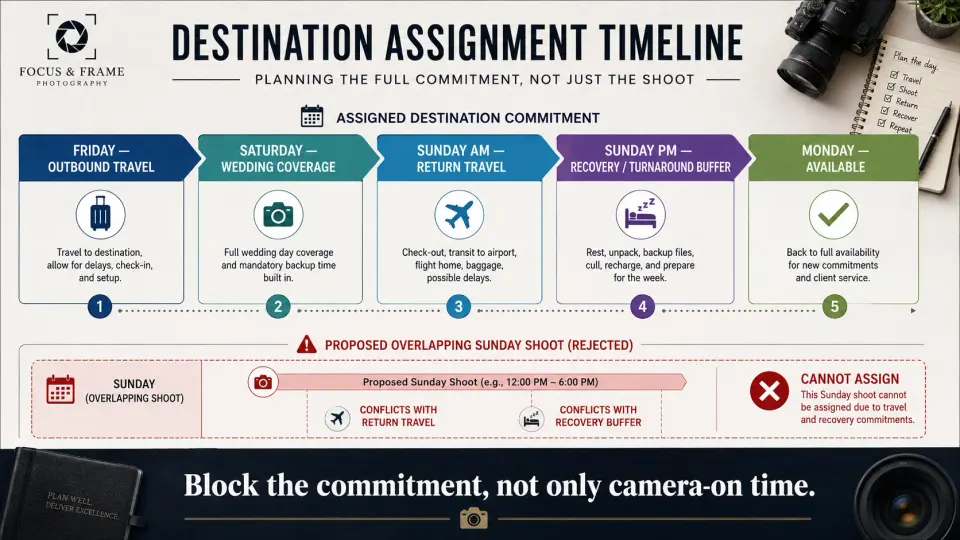
Imagine a photographer is covering a destination wedding on Saturday that ends at midnight. Their flight home is Sunday morning. A local Sunday afternoon corporate shoot may look possible if your photographer availability calendar contains only event start and end times.
Operationally, it may be a poor assignment.
The photographer still needs to leave the venue, protect and transfer media, reach the airport, travel, collect equipment and get to the next location with enough margin for delays. Even if the timings technically fit, fatigue and transport risk can turn a packed schedule into a coverage failure.
For destination photography, block the actual occupied period:
Outbound Travel → Shoot / Events → Overnight Stay → Return Travel → Required Buffer
The required buffer will differ by studio and assignment. A one-hour local transfer should not be treated like an overnight international journey. The point is to represent the real commitment rather than pretending only camera-on time consumes capacity.
Our guide to photography travel fees and travel days looks at the same problem from the pricing side. Crew scheduling should mirror it operationally: if a destination assignment occupies four calendar days, those four days need to be considered when checking the next booking.
Prevent overlapping assignments inside multi-day jobs
Multi-day weddings are one of the easiest places to create accidental double bookings because the client has one booking while the crew may have several separate assignments.
Consider this schedule:
| Date | Event | Required role |
|---|---|---|
| Friday | Welcome dinner | 1 photographer |
| Saturday morning | Ceremony | 2 photographers + video |
| Saturday evening | Reception | 2 photographers + video |
| Sunday | Post-wedding session | 1 photographer |
Your lead photographer may be required for all four events. A freelancer may cover only Saturday evening. Another cinematographer may be free for the ceremony but unavailable for the reception.
Do not represent the wedding as one vague block called “Wedding — Fri to Sun” if your crew changes between functions. Build availability and assignments at the event level, then roll them up into the booking.
The same principle applies outside weddings. A conference may need one photographer for registration, another for breakout sessions and a specialist photographer for executive portraits. A commercial production may have preparation, shoot and strike days involving different crew.
This is why GoPickle Crew Management for Photographers connects crew assignments to the events the studio actually runs rather than treating the team as a static staff list. The rota can show assignments, workload and overlapping work while the booking retains the wider client context.
Release unused holds before they distort your capacity
Tentative work should not quietly accumulate until half the crew appears unavailable.
Review every unresolved hold against its real commercial status. Has the client approved the quotation? Is the advance still pending? Has the enquiry gone cold? Did the event date move? Did another crew member become the preferred assignment?
If the original reason for the hold no longer exists, release it.
This matters most during peak season. A studio may reject a profitable enquiry because its preferred photographer appears unavailable, only to discover later that the conflicting date belonged to a lead that had stopped responding three weeks earlier.
Availability data needs maintenance just like pricing or client data. An old calendar entry is not automatically a valid commitment.
Review photography staff scheduling once a week
The best time to discover a crew conflict is not when you are assigning tomorrow's shoot.
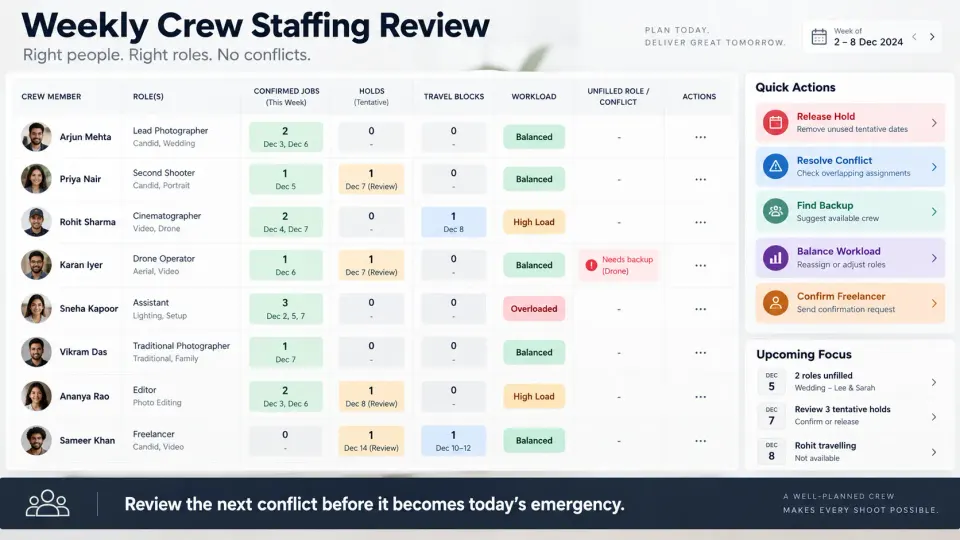
Once a week, review the next few weeks by person and by role. Start with confirmed work, then examine tentative holds, unavailable periods, travel blocks and any crew member carrying an unusually heavy sequence of assignments.
A practical weekly review should answer:
- Which confirmed events still have unfilled roles?
- Which tentative holds need a decision or release?
- Is anybody assigned to overlapping events?
- Are travel days and overnight commitments blocked properly?
- Which specialist roles have little remaining capacity?
- Which crew members are carrying too much work?
- Which freelancers still need to confirm upcoming assignments?
Then zoom out from individual availability to studio capacity. Our guide to how many weddings a photography studio can safely take per month covers the wider calculation across crew, editing, albums, travel and delivery workload. The photography crew availability matrix solves one part of that problem: whether the people required to fulfil those bookings are genuinely usable when you need them.
Crew availability should connect to workload and payment, not become another spreadsheet
A standalone availability sheet is useful at first. It becomes less useful as soon as the studio needs to answer the next question.
Rahul is available, but how many assignments has he already taken this month? Priya is confirmed, but has she accepted the exact event and reporting time? A freelancer completed three weddings last month, but which payouts are still pending? One photographer keeps accepting extra work, but is the workload becoming unhealthy? If the studio rewards additional assignments or particular responsibilities, where is that incentive recorded?
This is the direction we are building around GoPickle's crew workflow.
GoPickle Crew Management already brings crew records, event assignments, availability and rota visibility, workload context, salary and event-wise payment information closer to the bookings the studio is actually delivering. We are extending that thinking around the wider crew timeline: clearer free/available views, workload visibility, payment context and incentive tracking so a studio can understand not only whether somebody is free, but also how much work they are carrying and what the studio owes or rewards them for.
That matters because crew planning is not finished when a green square appears on a calendar.
A useful photography crew availability system should help the studio move from Who is free? to Who is suitable, genuinely available, not overloaded, properly assigned and ready to take this job?
That is the question that prevents double-bookings before they become shoot-day problems.