Wedding Photography Discovery Call: Questions to Ask Before You Send a Quote
Learn which questions to ask on a wedding photography discovery call before sending a quote, from availability and coverage to budget, deliverables and next steps.


A wedding enquiry often begins with a deceptively simple question: “Can you send me your packages?”
Sometimes sending a starting price is enough to establish whether you are broadly within the couple's budget. But a proper wedding photography quotation usually needs more context. A three-function wedding across two venues is not the same assignment as a single ceremony and reception. Eight hours of photography-only coverage is different from photography, cinematography, reels, drone coverage and two albums. Even two weddings with an identical schedule can require different teams because the clients expect very different styles of coverage.
That is the real job of a wedding photography discovery call. It is not a performance where the photographer talks for 30 minutes about awards, equipment and packages. It is a structured conversation that gives both sides enough information to decide whether there is a fit and gives the studio enough information to price the requirement without guessing.
The best wedding photography consultation questions therefore have a purpose. Each answer should help you establish availability, understand expectations, define scope, recommend an appropriate service or identify something that still needs clarification before the quote goes out.
What must be known before the call
Do not start every photographer consultation call from zero.
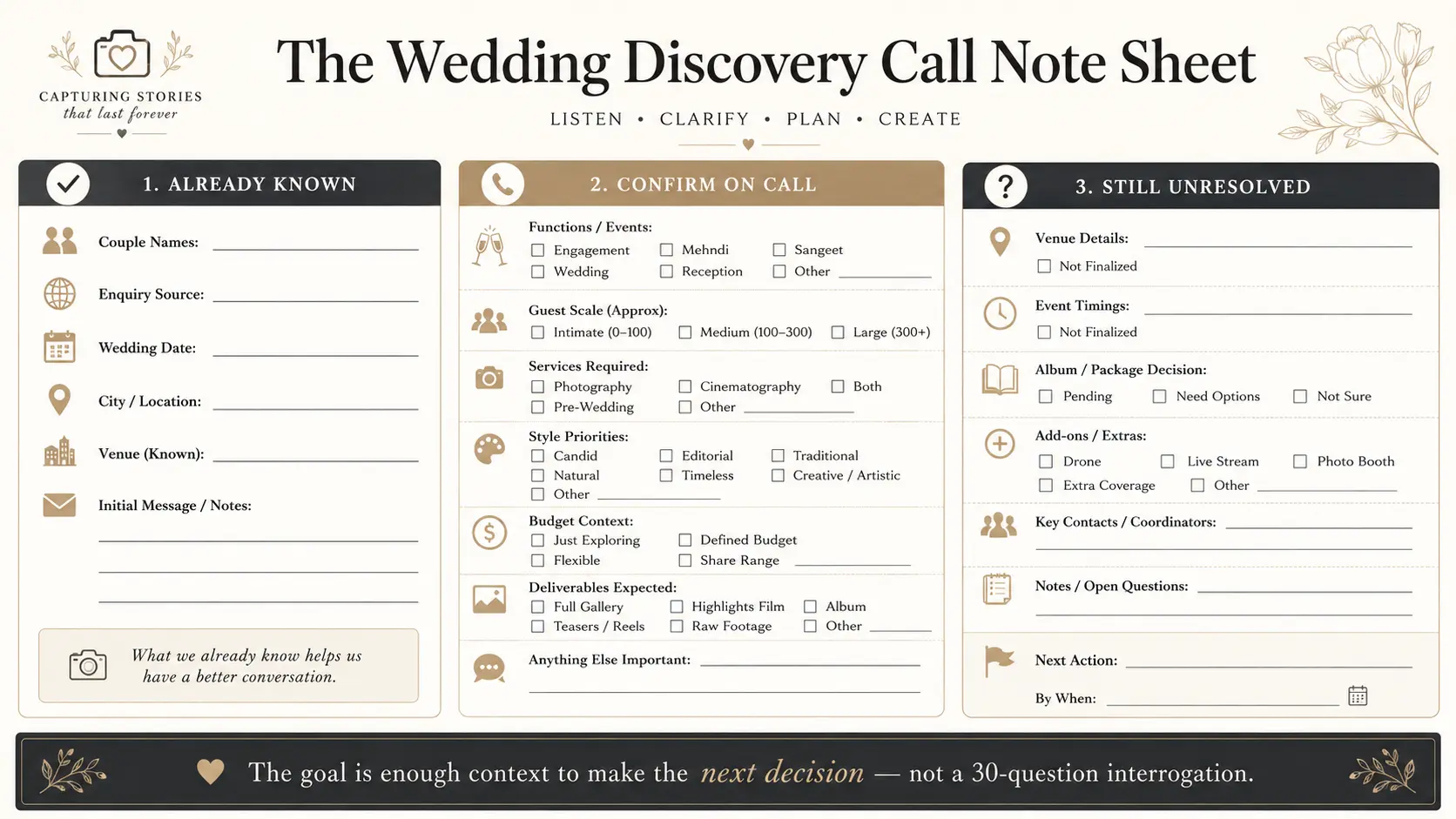
By the time a couple reaches the discovery-call stage, your lead record should ideally contain the information that was already available when they enquired: their names, contact details, wedding date or expected date range, city or venue if known, source of enquiry and a rough idea of what they are looking for. If they have already asked for a particular package, mentioned a budget, shared their Instagram profile or referred to a gallery on your website, keep that context visible too.
This does not require sending a 30-question form before agreeing to speak with someone. In fact, collecting too much information too early can make a promising enquiry feel like paperwork. We prefer a progressive approach: capture enough information to decide the next action, then deepen the requirement as the lead becomes more serious. That is also how we approach photography lead management at GoPickle, where the enquiry, requirement, follow-up and eventual quotation remain connected.
Before calling, check your own side as well. Is the date available? Are you already holding another tentative booking? Do you serve the location? What are your relevant packages or starting prices? Which portfolio or full wedding galleries would be useful if the couple asks about a particular style?
Going into the conversation with that information means you can spend the call understanding the wedding rather than searching your calendar while the client waits.
Open with logistics and availability
The first part of a wedding photography discovery call should establish whether the assignment is practically possible.
Start with the date and location if they have not already been confirmed. For a multi-day Indian wedding, ask about the individual functions rather than recording one generic wedding date. Engagement, haldi, mehendi, sangeet, wedding and reception may happen on different days, at different venues and sometimes in different cities.
Useful questions include:
- What are the confirmed wedding dates?
- Which functions are planned?
- Where will each event take place?
- Are the venues final or still being shortlisted?
- Approximately how large is each event?
- Are you looking for photography only, or photography and video coverage?
- Are there any events for which you do not need professional coverage?
Notice that these are not questions designed to impress the client. They are questions that materially affect the job.
Venue changes can affect travel and crew movement. A morning wedding followed by an evening reception may require a different shift structure from continuous coverage. Two simultaneous preparations in separate locations may require additional photographers. A destination wedding can introduce accommodation, travel days and equipment logistics.
If the basic requirement cannot be served, discovering that in the first few minutes is better for both parties than having an enthusiastic 40-minute conversation before finding out that the date is already booked.
Understand priorities, style and client expectations
Once the practical basics work, the conversation should move away from logistics.
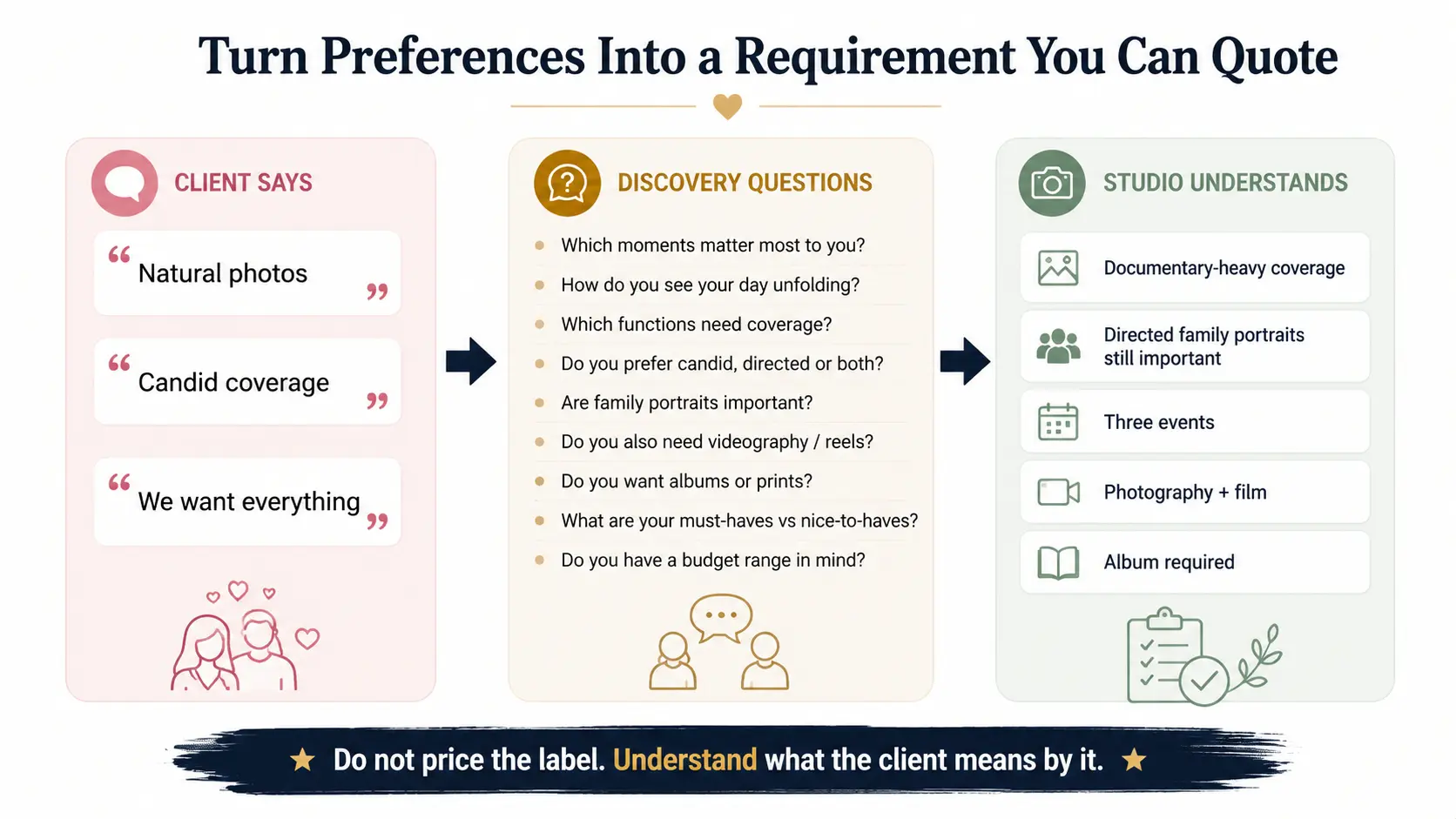
This is where many lists of questions to ask wedding photography clients become too mechanical. Asking “What photography style do you like?” may produce an answer such as “candid,” “natural” or “cinematic,” but those words can mean very different things to different people.
Ask questions that expose what the couple actually responds to.
You might ask:
- What made you contact our studio specifically?
- Was there a wedding, gallery or photograph from our work that stood out to you?
- What photographs from your wedding would matter most to you a few years from now?
- Do you prefer the photographer to stay observational, or are you comfortable with more direction for portraits?
- Are family portraits a major priority?
- Are there parts of the celebration where you want the coverage to feel particularly candid or unobtrusive?
- Have you seen a photography style that you definitely do not want?
The answers help you identify expectation gaps before they become booking problems.
A client might say they love documentary wedding photography but then describe a long list of editorial portraits they expect to recreate. Another couple may initially ask for “candid photography” but place enormous importance on formal photographs with extended family. Neither preference is wrong. Your job during the consultation is to understand what those words mean to this particular client.
This also gives you a chance to explain your approach without turning the conversation into a sales presentation. If the couple wants something your studio does especially well, show relevant work. If they expect a style you do not normally produce, say so before accepting the assignment.
Fit works in both directions.
Scope coverage, events, locations and deliverables
Once you understand what the client values, translate those expectations into production scope.
For each function, establish the approximate duration and the services required. A useful working note might eventually look like this:
Haldi
Bengaluru · Morning · 4 hours
Candid photography + traditional photography
Sangeet
Bengaluru · Evening · 6 hours
Candid photography + cinematography + reels
Wedding
Mysuru · Full-day coverage
Candid + traditional photography + cinematic film + drone subject to venue permissions
That is far more useful for pricing than a note that says “three-day wedding.”
Then discuss outputs. Does the couple want an album? One album or parent copies as well? A cinematic film, full ceremony edit or short highlight? Social-media reels? A private online gallery? Same-day edits? Guest photo delivery? Pre-wedding photography?
Do not assume every deliverable must be finalised on the discovery call. The purpose is to identify what materially affects the proposal. Smaller preferences can be confirmed after booking.
This distinction is important because the discovery call is not the wedding-day questionnaire. You do not normally need the names of every family member, the complete group-shot list, vendor phone numbers and minute-by-minute ceremony schedule before you know whether the couple will hire you. Those details become operationally important later.
If the client proceeds, a structured photography booking management system can carry the approved events, services, venues and deliverables into the actual booking rather than leaving them buried in consultation notes.
Discuss pricing without interrogating the client
Budget belongs in the conversation, but the way you reach it matters.
Opening a consultation with “What is your budget?” can make the call feel less like an attempt to understand the wedding and more like an attempt to discover the maximum amount the client can pay. At the opposite extreme, some photographers avoid money completely, have an excellent conversation and then discover that their normal package is far outside what the couple expected to spend.
Neither approach is particularly useful.
If you publish starting prices or have already shared a package range, you can build from that context:
“You mentioned that you were looking at our three-event coverage. Is that roughly the level of coverage you had in mind, or are you still comparing different options?”
You can also explain the likely scope first and then bring the conversation to price:
“Based on the three events and the photo-plus-film coverage you described, this would need a larger team than our entry wedding package. Have you already set aside a photography and cinematography range that you are trying to stay within?”
The objective is not to make the client reveal a secret number. It is to prevent both sides from constructing an offer that was never commercially realistic.
If the budget is lower than the proposed scope, do not immediately discount the same work. Look at the requirement. Perhaps one smaller function needs photography but not cinematography. Perhaps album quantities can change. Perhaps additional reels are optional. Scope adjustment is much easier to explain than silently removing margin from an unchanged production requirement.
Record decisions and unresolved questions
A good photography discovery call creates information. A good sales process makes sure that information survives after the call ends.
Do not rely on remembering what the couple said because the conversation felt memorable. After several enquiries, phrases such as “they wanted the larger album” or “I think the reception was at another venue” become surprisingly easy to confuse.
Record confirmed facts separately from unresolved items.
Confirmed
- Wedding: 18 January
- Sangeet: 17 January
- Bengaluru
- Photography + cinematography
- Album required
- Client prefers candid-heavy coverage
Still to confirm
- Reception venue
- Pre-wedding shoot
- Parent album copies
- Exact sangeet timing
- Drone permission
Then record the next action.
If the studio needs to send a quotation by Thursday, that should become the next action. If the client needs to confirm a venue first, record that instead. A serious enquiry should not leave the discovery call with no clear owner and no next step.
This is one reason we designed GoPickle's lead workflow around the requirement and the next action rather than treating a lead as just a name and phone number.
What the quote should contain after the call
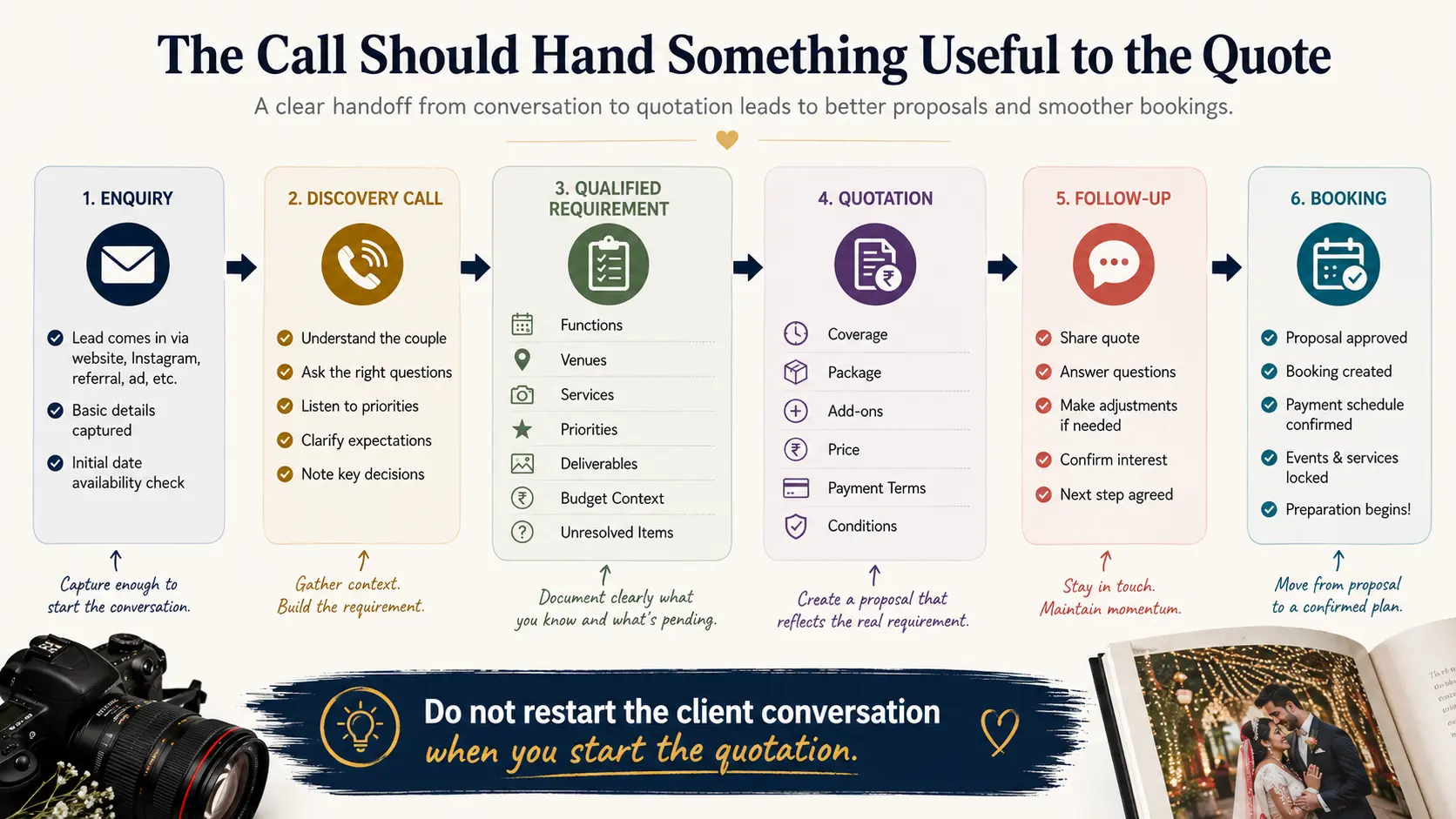
The discovery call has done its job when you can build a quotation that feels like a response to the client's wedding rather than a generic rate card.
A wedding photography quote produced from the conversation should normally show the client and event details, functions covered, services for each function, proposed crew or coverage where relevant, deliverables, optional add-ons, price, taxes where applicable, payment stages, quotation validity and important commercial terms. Travel or accommodation should be visible where it applies rather than appearing as a surprise later.
Most importantly, make sure the proposal reflects the requirement you just discussed.
If the couple told you that family coverage matters deeply, but the proposal is nothing more than “Premium Wedding Package – ₹X,” the consultation context has disappeared at the moment it could have made your recommendation more meaningful.
Our guide to creating a professional photography quotation goes deeper into how to structure the proposal itself. GoPickle's photography quotation management also allows photographers to build a proposal around packages, event coverage, portfolio work, add-ons, pricing and terms, then carry the approved scope into booking.
There should also be an obvious next step after the quote is sent. The client may need time to review it, but your studio still needs to know when to follow up and what the follow-up is for. “Check whether the client has questions about the quotation on Monday” is an action. “Quotation sent” is only a status.
A wedding photographer sales call does not need clever closing lines or a rigid script to do its job. It needs enough structure that important questions are not forgotten and enough flexibility that the couple can actually talk about the wedding they are planning.
The strongest discovery calls tend to leave the studio with something very practical: a clear picture of the client, a clear picture of the work, an honest view of whether the fit makes sense, and enough information to send a quote without inventing the missing details.
That is a much better standard than simply asking whether the call “went well.”