Photography Travel Fees: Mileage, Accommodation, Travel Days and Destination Work
Learn how to price photography travel fees for mileage, flights, accommodation, travel days, crew expenses and destination photography without losing margin.


A photographer drives 35 kilometres to a wedding venue and returns home the same night. Another flies with three crew members to a destination wedding, arrives a day early, stays for three nights and gives up two otherwise bookable working days to make the assignment possible.
Calling both of those costs a photography travel fee hides an important difference.
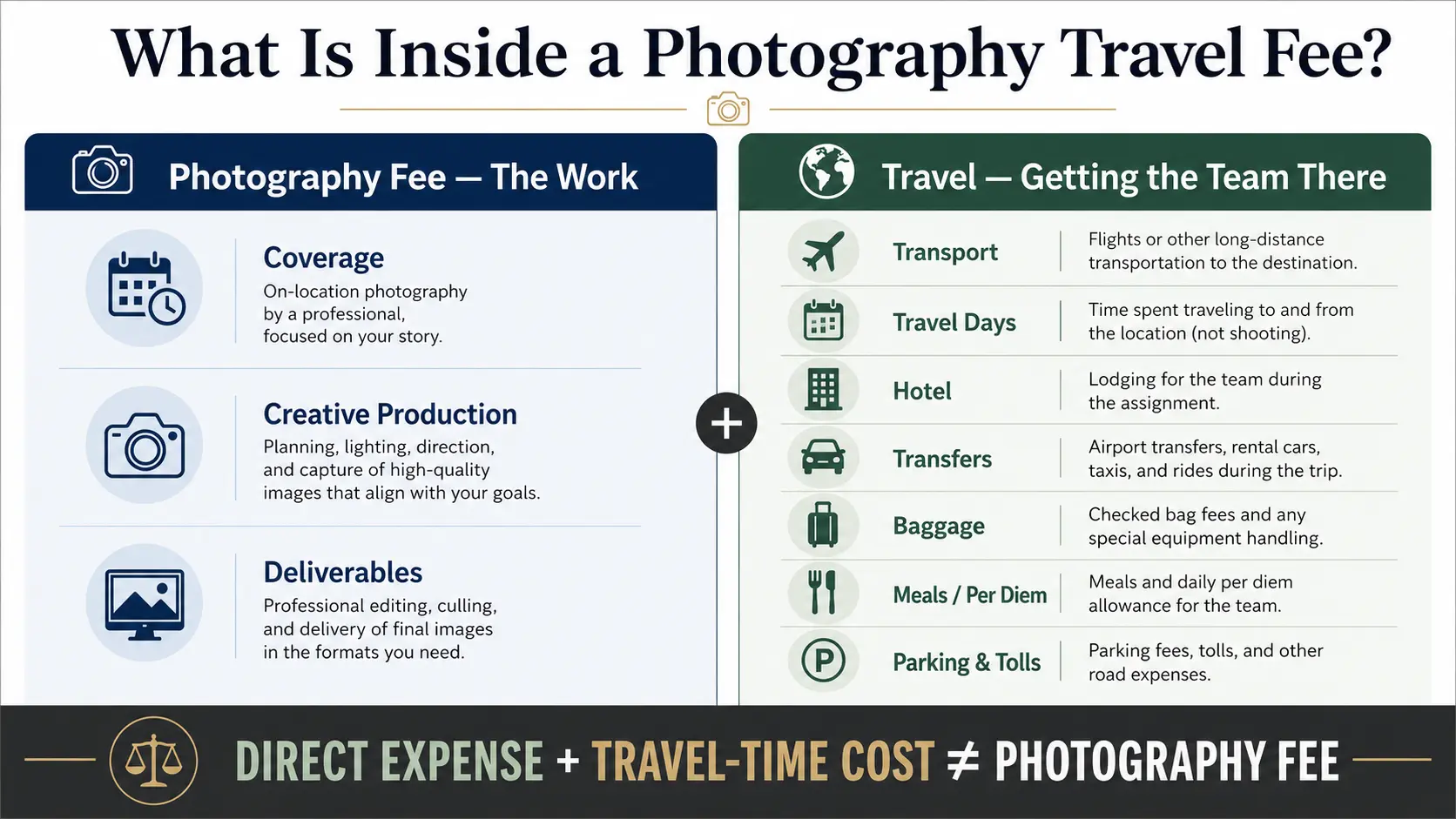
Travel creates two kinds of cost for a photography business. The first is direct expenditure: fuel, mileage, flights, trains, tolls, parking, accommodation, local transport, meals and baggage. The second is the time and capacity consumed by getting the photographer and crew to the assignment. A six-hour journey does not produce photographs, but it can still remove most of a working day from the studio's calendar.
A useful travel-pricing policy needs to deal with both. Otherwise destination work can look profitable on the quotation while becoming much less attractive once the studio accounts for everything required to get there.
Separate the travel expense from the photography fee
Start by separating the price of creating the photographs from the cost of reaching the assignment.
The photography fee covers the professional service: preparation, coverage, equipment, creative work, crew where included, post-production and deliverables according to the scope. Travel expenses cover the logistics required because of where the client has asked that service to be performed.
This separation makes quotations much easier to understand. A commercial client comparing locations can see that moving the shoot from their local office to a factory several hundred kilometres away changes the logistics without necessarily changing the underlying photography service. A wedding client can see why a destination event costs more than an equivalent wedding close to the studio.
It also helps photographers understand their own margins. Travel should not disappear inside the package price unless you have deliberately priced it there.
For example, a destination quotation might contain:
| Quote component | What it covers |
|---|---|
| Photography fee | Agreed shoot coverage and deliverables |
| Travel day fee | Photographer or crew time spent travelling |
| Transport | Flights, train, vehicle, fuel or mileage |
| Accommodation | Required hotel nights |
| Ground transfers | Airport, station, venue and hotel transport |
| Baggage / equipment transport | Additional luggage or equipment movement |
| Per diem / meals | Daily travel subsistence where applicable |
| Parking / tolls / permits | Assignment-specific direct expenses |
You do not need every line on every job. The purpose is to stop different types of cost from becoming one vague “travel extra.”
The same distinction appears in our guide to calculating photography profit margin on every booking, where travel, accommodation and other direct booking expenses are costs that need to be accounted for before the studio knows what the job actually earned.
Local travel radius models
Most photographers do not need to calculate a complicated photography mileage fee for every nearby assignment.
A simpler approach is to define a local service area that is already included in your normal price. For example, a studio might include travel within its home city or within a stated distance from the studio, then charge beyond that boundary.
There are several workable models.
A distance model charges for kilometres or miles beyond the included radius. This can work well where driving distances are predictable, but the quotation should state whether the calculation is one-way or round trip.
A zone model divides travel into bands: local, regional and long-distance, for example. Clients receive a fixed travel amount based on the venue rather than a calculation for every kilometre.
A time model focuses on how long the journey takes. This can be useful in locations where 30 kilometres can take dramatically different amounts of time depending on traffic and route.
You can also combine them. A studio may include the first 25 kilometres, charge mileage beyond that point and separately review assignments that require several hours of driving.
There is no universal photography mileage rate that works for every studio or country. Government mileage allowances and tax rules are jurisdiction-specific and may have been designed for taxation or employee reimbursement rather than as a mandatory client-facing photography price. If your studio uses a local government benchmark, make sure you understand what that number represents before building your pricing around it.
The commercial question is simpler: what does the journey cost the business, and at what point does travel become substantial enough to deserve a separate charge?
Outstation and destination photography jobs
Long-distance assignments need a different conversation because mileage is no longer the main variable.
A destination photography travel cost can include flights or trains, checked camera equipment, hotel rooms, airport transfers, local vehicles, meals, visas, permits and additional nights required to arrive safely before the shoot. For a team, those costs multiply quickly.
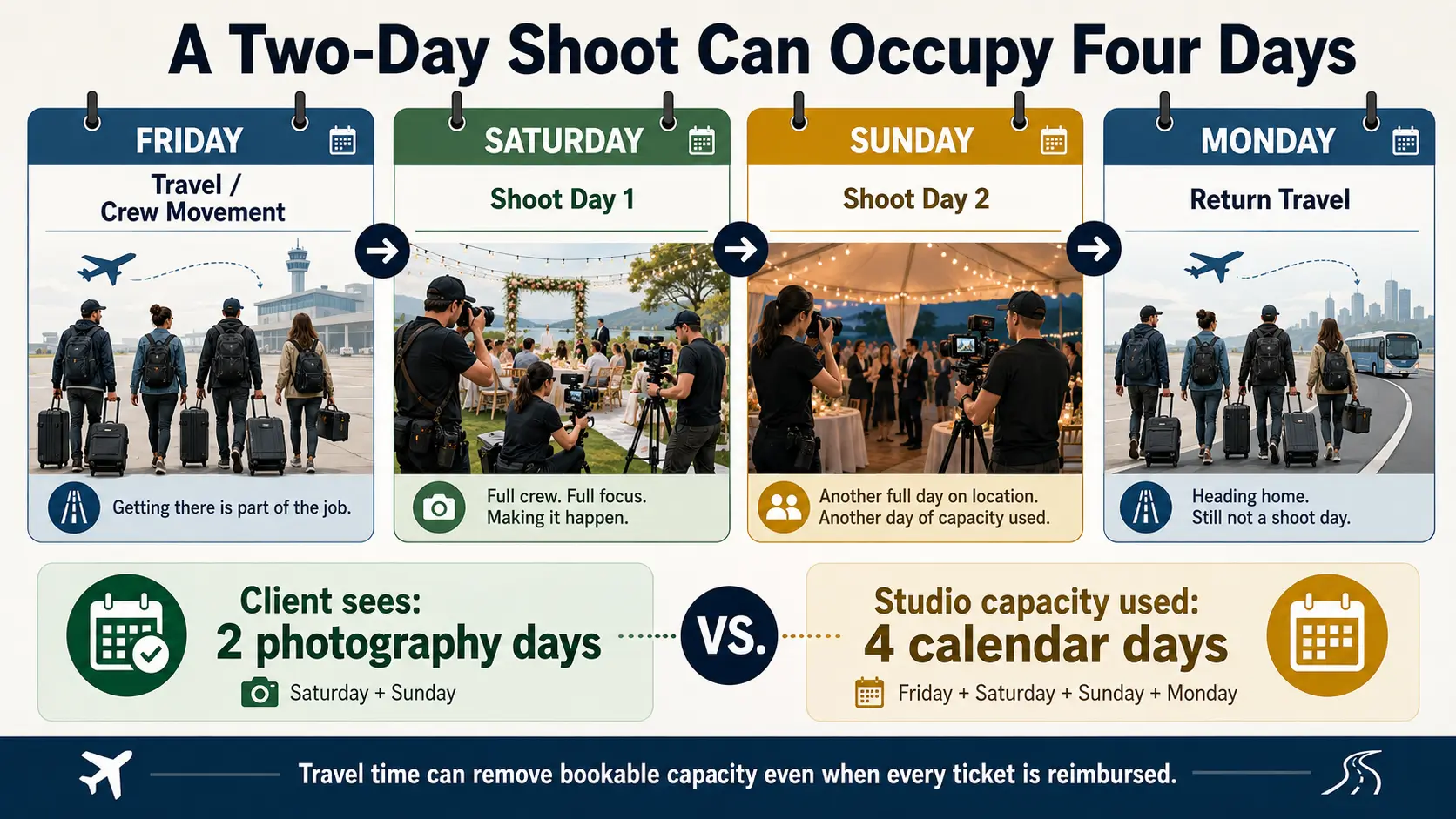
Destination wedding photography is a clear example. A studio may need to move a lead photographer, second photographer, cinematographer and assistant. The event might run for two days, but the team could be away for four because they need to arrive before the first function and cannot return until the following morning.
The same problem appears in commercial work. A one-day factory shoot can require a flight the previous evening and another night after production if the shoot finishes too late for a reasonable return journey.
This is why travel dates should be discussed while the quotation is being built. Our article on what a corporate photography quotation should include recommends showing travel and accommodation where they apply rather than allowing them to appear later as unexpected additions.
For destination jobs, establish who is responsible for booking each component. There are three common approaches: the photographer books travel and charges the client, the client books approved travel directly, or the studio quotes one fixed travel allowance.
Each transfers risk differently. If the photographer books and invoices actual costs, the client gets transparency but the studio may have to pay suppliers first. If the client books directly, the studio avoids financing airfare and hotels but needs clear standards for arrival time, location, baggage and room arrangements. A fixed travel fee makes the proposal simpler, but the photographer carries the risk if the real cost later exceeds the estimate.
Travel days and lost booking capacity
This is the part most likely to be missed when a photographer calculates only receipts.
Suppose a commercial shoot pays well and covers every flight, hotel and taxi. The assignment is three hours away by air, however, and requires travel on Monday, production on Tuesday and the return journey on Wednesday.
The client has reimbursed every expense, but the photographer has committed three calendar days to a one-day shoot.
That is where a photographer travel day rate can make sense.
A travel-day fee compensates the studio for time that cannot reasonably be sold as another normal production day. It does not have to equal the full photography day rate because the photographer is not shooting for the entire period. It also does not have to be automatically discounted. The appropriate figure depends on how much of the day is blocked, how far the assignment is from home, the type of client, crew obligations and what other work the studio must postpone.
Instead of looking for a supposedly standard percentage online, decide how your own capacity behaves.
A two-hour evening drive after another shoot may not justify a separate travel day. A ten-hour international journey clearly creates a different commitment. An overnight flight followed immediately by production can also create a fatigue and reliability problem even if technically no extra hotel night is required.
Pricing the travel day encourages the studio to plan the assignment around workable arrival and departure times rather than designing the journey purely around the cheapest ticket.
Crew travel and multiple vehicles
A photographer travel fee that works for a solo portrait photographer may fail immediately for a wedding studio.
If five people need to reach the venue, the studio may require a larger vehicle, two cars, multiple train tickets or several flights. Accommodation may mean three rooms rather than one. A cinematographer carrying stabilisers and additional cases may have different baggage requirements from a photographer travelling with one roller case.
Crew time matters as well.
If freelancers are paid for travel, those payments belong in the cost of the assignment. If the studio's normal crew arrangement covers only the shoot date, confirm what happens when a destination job occupies additional days. Do not assume that a crew member who is available for Saturday's wedding is automatically available for Friday travel and Sunday return.
For larger studios, this is where operational planning and pricing have to connect. GoPickle's crew management for photographers keeps assignments and crew availability attached to real events, which is useful when a destination booking consumes more dates than the event itself.
How to quote estimated versus actual travel costs
Some travel expenses are known when the quotation is prepared. Others are not.
The venue may already have published parking charges, while airfare six months from now can change substantially. A client may confirm the city before deciding which hotel will host the wedding. A commercial buyer may require the photographer to use its corporate travel desk.
Your quotation should therefore distinguish fixed costs, estimates and actual reimbursable expenses.
A clear destination section could look like:
Photography Fee: Fixed as quoted
Travel Day: One outbound and one return travel day at the agreed rate
Flights: Reimbursed at actual booked cost after client approval
Accommodation: Three nights, estimated at ₹X, final amount based on approved booking
Local Transport: Billed at actual cost
Meals / Per Diem: Fixed daily allowance for four crew members
The amounts will depend on the assignment, but the method should be clear.
If the client is booking travel directly, define reasonable requirements before tickets are purchased. Confirm the travelling crew, origin airport or station, baggage needs, arrival deadline, departure window and accommodation location. A cheap flight that arrives shortly before the ceremony can create more risk than the savings justify.
For quotation management, the useful principle is that travel belongs inside the scope the client approves. GoPickle's photography quotation software allows photographers to build proposals around events, coverage, add-ons, pricing and terms so travel does not have to survive as a separate calculation hidden in a message thread.
Rescheduling and non-refundable travel costs
Destination assignments become particularly difficult when plans change after travel has been purchased.
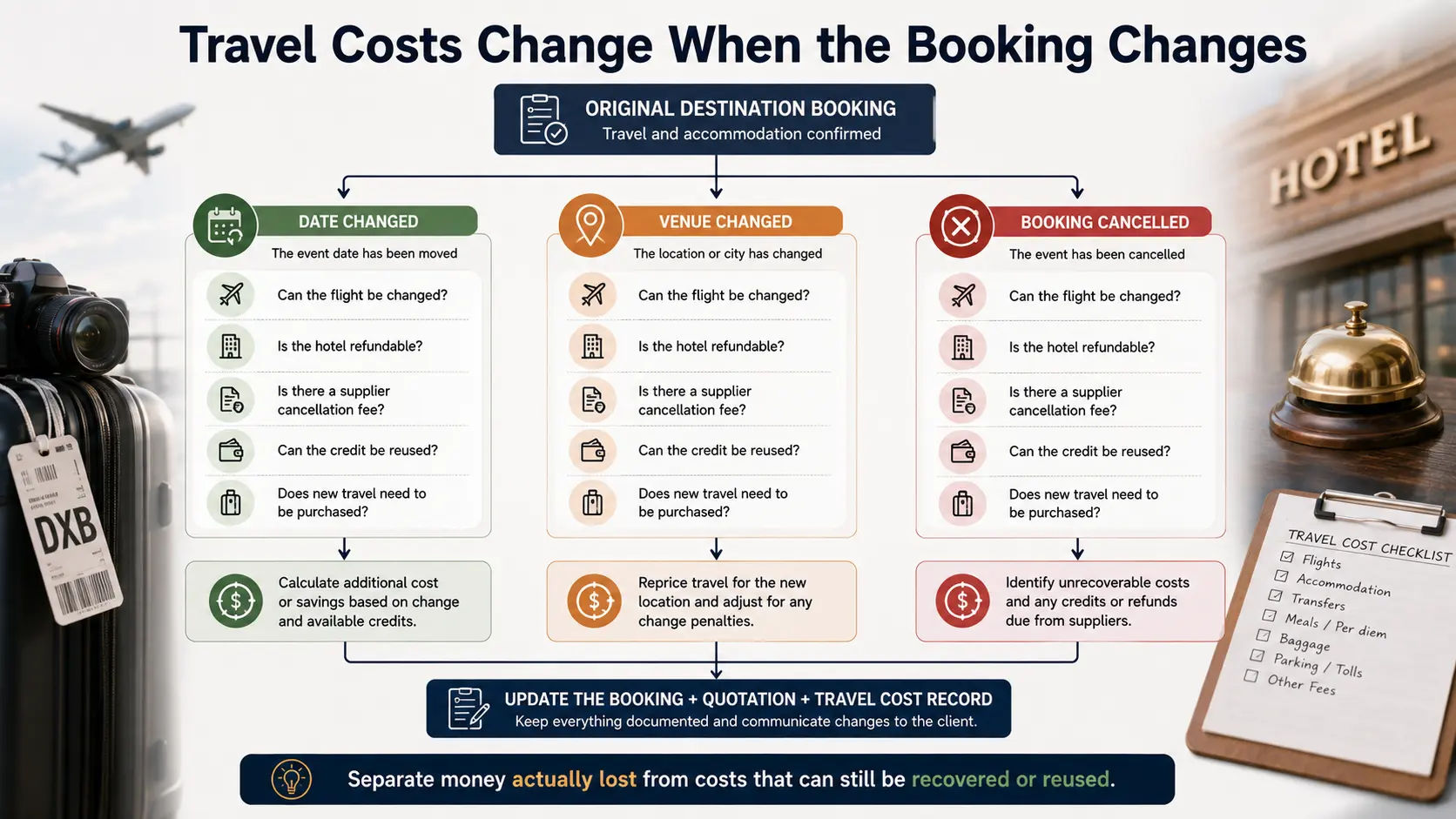
A client may move the wedding date. A corporate event may be postponed. The venue may change from one city to another. Flights may be non-refundable, hotels may charge cancellation fees, or the new date may require completely different bookings.
The studio should decide in advance what happens to money that has already been committed to third parties.
This does not mean treating every travel payment as automatically forfeited. It means distinguishing actual incurred costs from future costs that can still be avoided. If an airline provides a usable credit, that situation is different from a non-refundable ticket that has no remaining value. If a hotel cancels without charge, there is no accommodation loss to recover.
Your cancellation and rescheduling wording should explain this before money is spent, and any contractual language should be reviewed for the jurisdictions in which you operate. Our detailed guide to photography cancellation and rescheduling policies covers how to handle travel expenses alongside advances, date changes and other booking costs.
Price the journey as deliberately as the shoot
A photography business does not earn its margin only while the shutter is being pressed. It also has to move people and equipment to the place where the work happens.
For local assignments, that may require nothing more than a sensible included radius and a clear rule beyond it. For destination work, the calculation can involve airfare, hotel rooms, baggage, local transportation, meals, crew expenses and multiple days that cannot be sold to another client.
The useful distinction is between what you spend to travel and what your time is worth while travelling.
Once those are separated, photography travel fees become much easier to quote. The client can see why the destination changes the price, your studio can see what the assignment really costs, and the booking does not become less profitable every time another hotel night, vehicle or travel day appears after the original quote was accepted.