What Should a Corporate Photography Quotation Include?
Learn what a corporate photography quotation should include, from shoot hours and deliverables to licensing, overtime, travel, retouching, payment terms, cancellation and taxes.

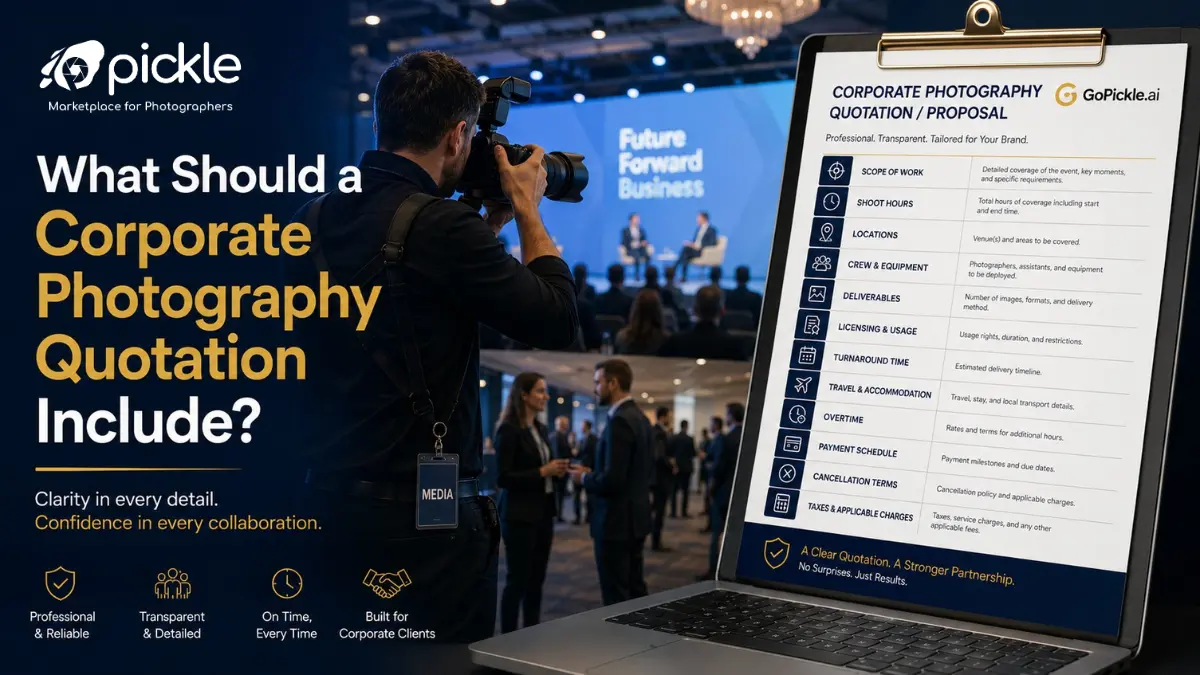
A corporate photography quotation has to do more than tell a procurement team what your studio charges for eight hours of coverage. Business clients often need photographs for several purposes, several departments and several deadlines. A photographer may be covering an annual conference in the morning, executive portraits during a break, sponsor interactions in the afternoon and an awards ceremony in the evening. The client may then expect 20 photographs the same night for social media, another 100 for press and marketing, and a complete edited gallery later.
If those expectations are not defined before the job is confirmed, even a well-priced assignment can become commercially weak.
At GoPickle, we recommend treating a corporate photography quotation as a scope document as much as a price document. It should make it clear what you are photographing, how much coverage the client is buying, what they will receive, what usage is permitted, what costs extra and when payment is due.
Start With the Assignment Scope, Not the Price
The opening section of a commercial photography quote should describe the project in language both the photographer and the client can understand later.
Instead of:
Corporate event photography – ₹60,000
write something closer to:
Annual leadership conference photography covering registration, keynote sessions, networking, sponsor activations and evening awards at [venue] on [date], from 9:00 AM to 8:00 PM.
That one paragraph establishes considerably more context.
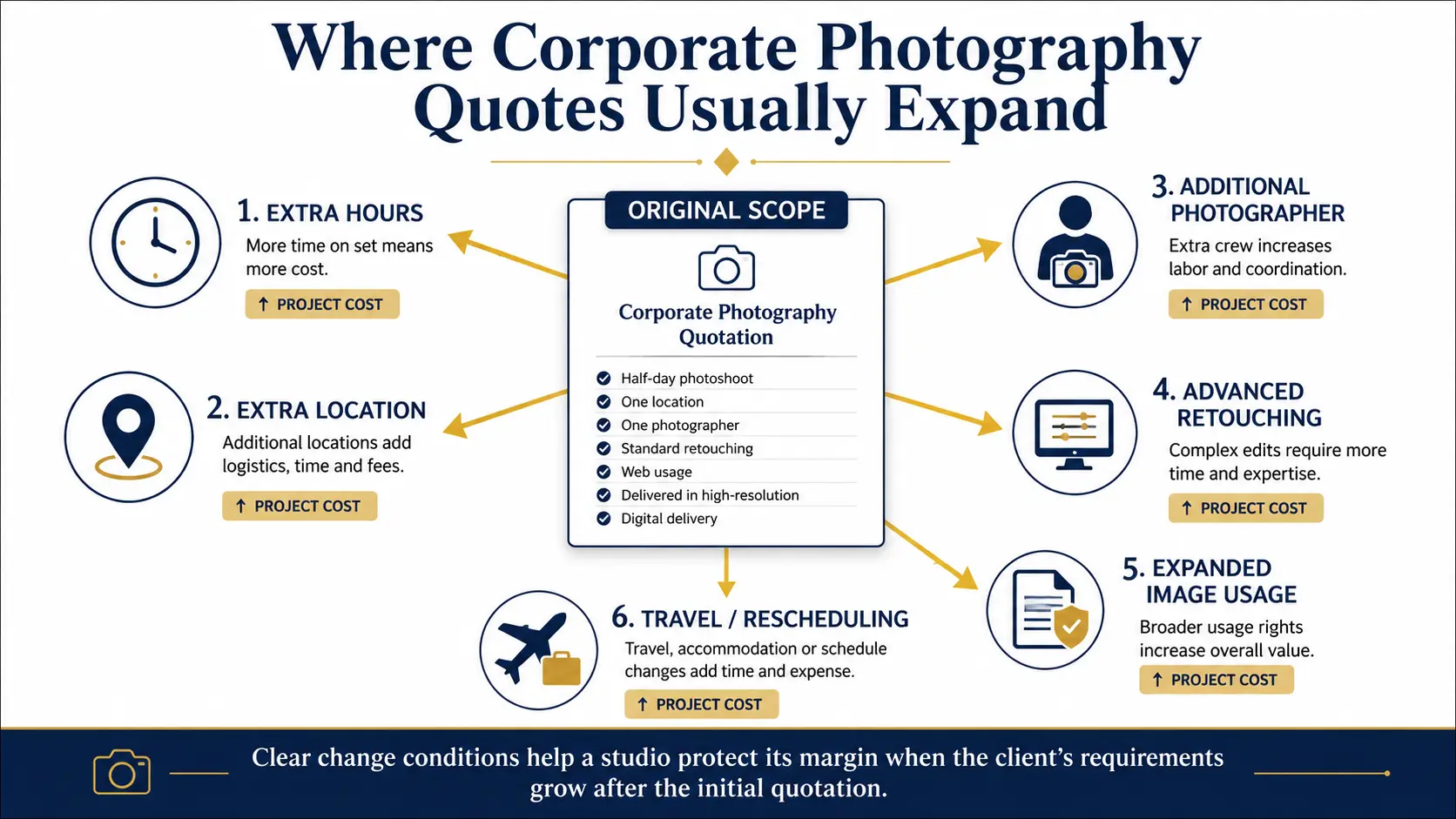
For larger assignments, also specify whether the quotation covers one event, multiple days, executive portraits, office interiors, employee headshots, product photography or another separate requirement. Corporate clients frequently add requirements during planning, so separating each part of the scope makes revisions easier to price.
GoPickle's Photography Quotation & Proposal Software is built around this idea: the proposal can carry event-specific scope, services, deliverables, pricing, terms and portfolio references together rather than reducing the project to generic accounting line items.
Define Shoot Hours and the Coverage Window Precisely
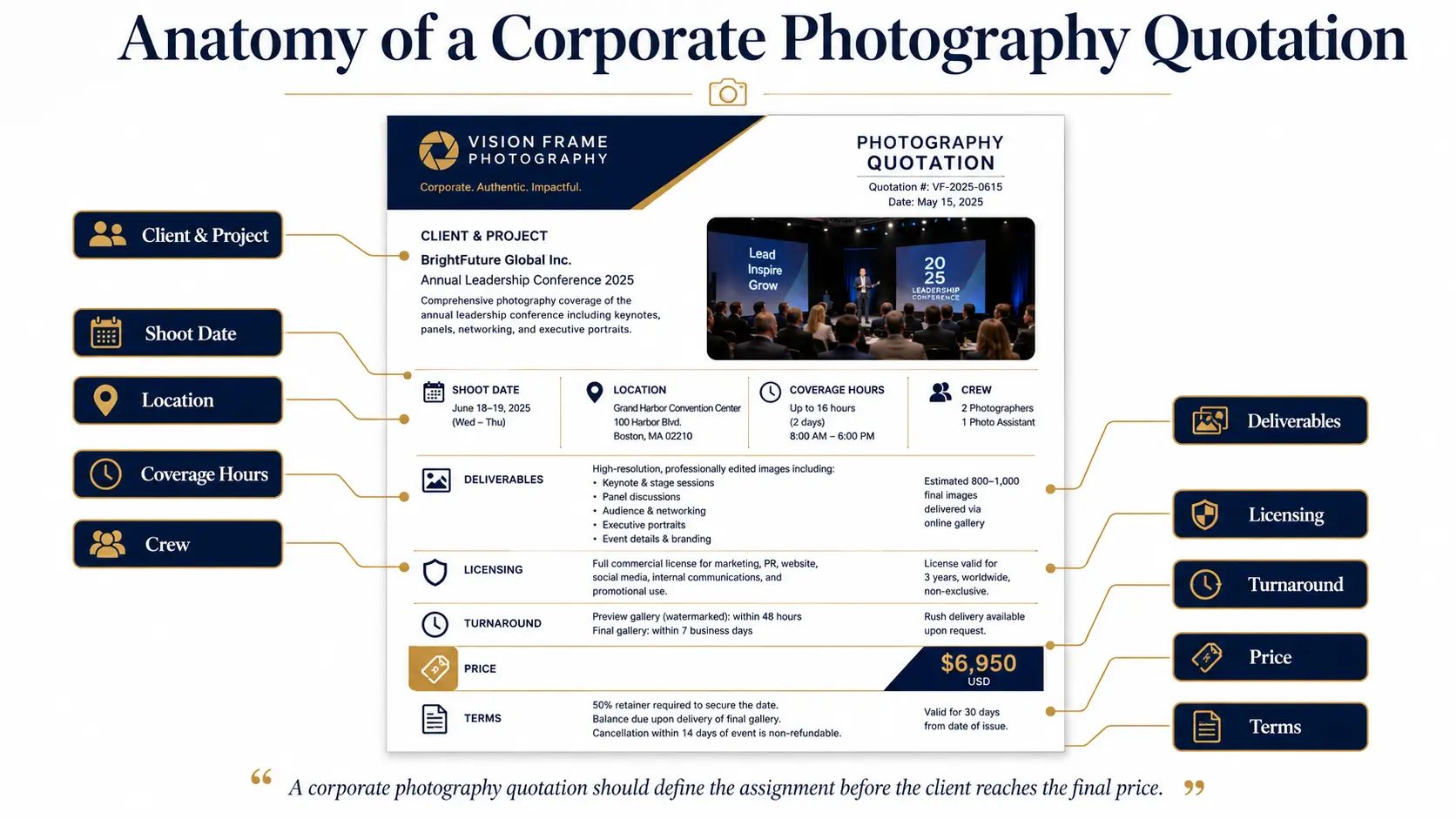
Corporate assignments should state both the expected coverage duration and the actual coverage window.
For example:
Photography coverage: 9:00 AM–6:00 PM, up to nine consecutive hours.
This avoids ambiguity around phrases such as "full day", which can mean very different things to a photographer and an event organiser.
If the photographer needs to arrive before guests for venue photographs, setup documentation or executive portraits, include that time. If coverage pauses for several hours between sessions, decide whether the crew remains booked during that period.
The quotation should also state how additional time will be charged.
For example:
Additional coverage beyond the agreed schedule: ₹X per photographer per hour, subject to crew availability.
The actual amount should come from your own cost structure rather than an arbitrary industry rate. The important part is agreeing on the overtime mechanism before the event runs late.
Specify the Number and Type of Photographers
"Event photography" does not tell the client how much coverage they are buying.
A 150-person seminar may need one photographer. A large conference operating across a main stage, breakout sessions, sponsor booths and networking areas may require several.
Your quotation should identify the proposed crew clearly:
Lead photographer – 1
Additional photographer – 1
On-site editor – 1, if required
If the assignment includes video, drone, lighting assistants or other specialists, separate those roles.
This also gives the client a clearer basis for comparing competing quotations. Two quotes that appear very different in price may not contain the same crew or coverage.
For studios managing several people across an event, GoPickle's Crew Management for Photographers can keep crew assignments connected to the booking rather than maintaining a separate staffing spreadsheet.
Describe Exactly What Will Be Delivered
Deliverables are one of the biggest sources of quotation ambiguity.
"Edited photos included" is too vague for most commercial work.
A better scope might state:
Approximately 250–350 professionally edited high-resolution JPEG photographs
20 priority photographs delivered during or within two hours of the event
Complete gallery delivered within five working days
Web-resolution versions included
If the quantity cannot reasonably be guaranteed, use an estimated range and explain that final numbers depend on the event.
For corporate events, turnaround can be commercially important. A communications team may need keynote photographs while the conference is still taking place. GoPickle's guidance on what corporate clients expect from event photography delivery recommends agreeing on priority images, turnaround, folder organisation and usage expectations before the event rather than discovering them at delivery.
Separate Standard Editing From Retouching
Corporate clients may use "editing" to describe anything from exposure correction to removing objects from a photograph.
Define the difference.
Standard post-production might include colour correction, exposure adjustment, cropping and general image optimisation. More involved work such as skin retouching, object removal, background replacement, compositing or extensive image manipulation can be quoted separately.
For example:
Standard colour correction and image optimisation included. Advanced retouching requested after selection will be quoted separately at ₹X per image or based on the required work.
This protects the studio from receiving a spreadsheet containing 80 detailed retouching requests after the original price has been accepted.
Clarify Image Licensing and Usage
This is one of the most important differences between consumer and commercial photography.
A business does not simply want photographs to remember an event. It may use them on its website, LinkedIn, press releases, brochures, recruitment materials, investor presentations or advertising campaigns.
Your business photography proposal should therefore state what image usage is included.
A practical licensing section might specify:
- who is receiving the licence;
- whether usage is internal, editorial, marketing or advertising;
- which media are covered;
- geographical territory, where relevant;
- duration, where relevant;
- whether third parties such as sponsors or agencies may use the images;
- whether paid advertising is included.
Do not use licensing language you do not understand simply because it appeared in another photographer's contract. Copyright and licensing rules vary by jurisdiction and assignment, so commercial photographers should use terms appropriate to their market and obtain professional legal advice where necessary.
Current corporate-event pricing guidance also identifies usage rights as a significant part of commercial photography pricing because the value of an image can change depending on where and how the business intends to use it.
Put Travel and Production Expenses in Writing
Corporate assignments often introduce costs that are easy to underestimate.
Your quotation should state whether the price includes:
- local transportation;
- intercity flights or trains;
- accommodation;
- airport transfers;
- parking;
- permits;
- equipment transport;
- location fees;
- meals or per diem for long assignments.
For destination or multi-city projects, separating professional fees from reimbursable expenses can make the quotation easier for a corporate finance team to review.
If actual travel costs will be billed later, explain the basis of reimbursement rather than leaving the client to discover another invoice after the shoot.
Create a Clear Payment Schedule
Corporate clients may not follow the same payment behaviour as wedding clients.
Some require purchase orders. Others operate on 15-, 30- or 45-day payment cycles. Some will pay an advance, while larger organisations may have fixed procurement procedures.
Ask before sending the final quotation.
A payment section might state:
40% booking advance
60% due within 15 days of final delivery
or whatever structure is appropriate for your business and client.
Also specify whether the date is reserved only after written approval, purchase order or advance payment.
GoPickle quotations can include advance, balance, taxes and payment stages, and an approved proposal can continue into the booking and invoicing workflow rather than forcing the studio to reconstruct what was agreed.
Include Cancellation, Rescheduling and Overtime Terms
Commercial events move. A conference may shift by a week. An executive portrait session may be postponed. A launch can be cancelled.
Your quotation should explain what happens in each case.
Cover issues such as notice periods, non-refundable booking amounts where lawful, rescheduling availability, already incurred travel expenses and cancellation close to the shoot date.
Keep these terms proportionate. The purpose is not to make the proposal threatening. It is to establish what happens when the studio has reserved crew and rejected other work for a date that the client later changes.
Show Taxes Separately
Corporate buyers need numbers they can process internally.
Show the professional fee, additions, applicable discount, tax and final payable amount clearly.
For an Indian studio, for example, this may include GST where applicable. International work may involve different tax treatment depending on the supplier, customer, place of supply and jurisdiction.
Avoid hiding tax inside an unexplained total. Finance teams generally need to see how the final amount was calculated.
Use This Corporate Photography Quotation Checklist
Before sending a quotation, check that the client can find:
Client and project name → Shoot date → Location → Coverage hours → Crew → Scope → Deliverables → Turnaround → Retouching → Licensing → Travel → Overtime → Payment schedule → Cancellation terms → Taxes → Quotation validity → Approval step
That may look like a long list, but the final proposal does not need to feel complicated. Good structure makes detailed information easier to understand.
Our broader guide on creating photography quotations clients can understand covers presentation, portfolio, packages and client clarity in more detail.
Further Reads for better clarity on building quotations for photographers
How GoPickle.ai Helps Photographers Send Better Price Estimates and How GoPickle.ai Quotations Help Photographers Close More Clients
A Corporate Quote Should Protect the Margin as Well as Win the Job
The cheapest corporate photography quotation is not necessarily the strongest one, and the longest is not necessarily the most professional.
The useful quotation is the one that allows both sides to understand the same assignment.
A marketing manager should know how many hours and photographers are included. Procurement should know the cost and payment schedule. The communications team should know when photographs will arrive. Your studio should know what requires additional payment.
At GoPickle, that is why we treat quotations as part of the operating workflow rather than isolated PDFs. The proposal that wins the assignment should carry the agreed scope forward into the booking, crew, invoice and delivery stages. GoPickle's Quotation Management supports branded proposals with project scope, portfolio, services, pricing, terms, payment stages and client approval, including a dedicated Corporate Clean template for commercial work.
A good corporate photography quotation does not merely answer "How much?" It makes clear exactly what the business is buying.