Photography Deliverables Tracking: Keep Galleries, Teasers, Reels, Highlights and Albums in One Booking
Track wedding photo and video deliverables in one booking, including galleries, reels, teasers, highlight films and albums, with clear owners, dependencies and delivery states.

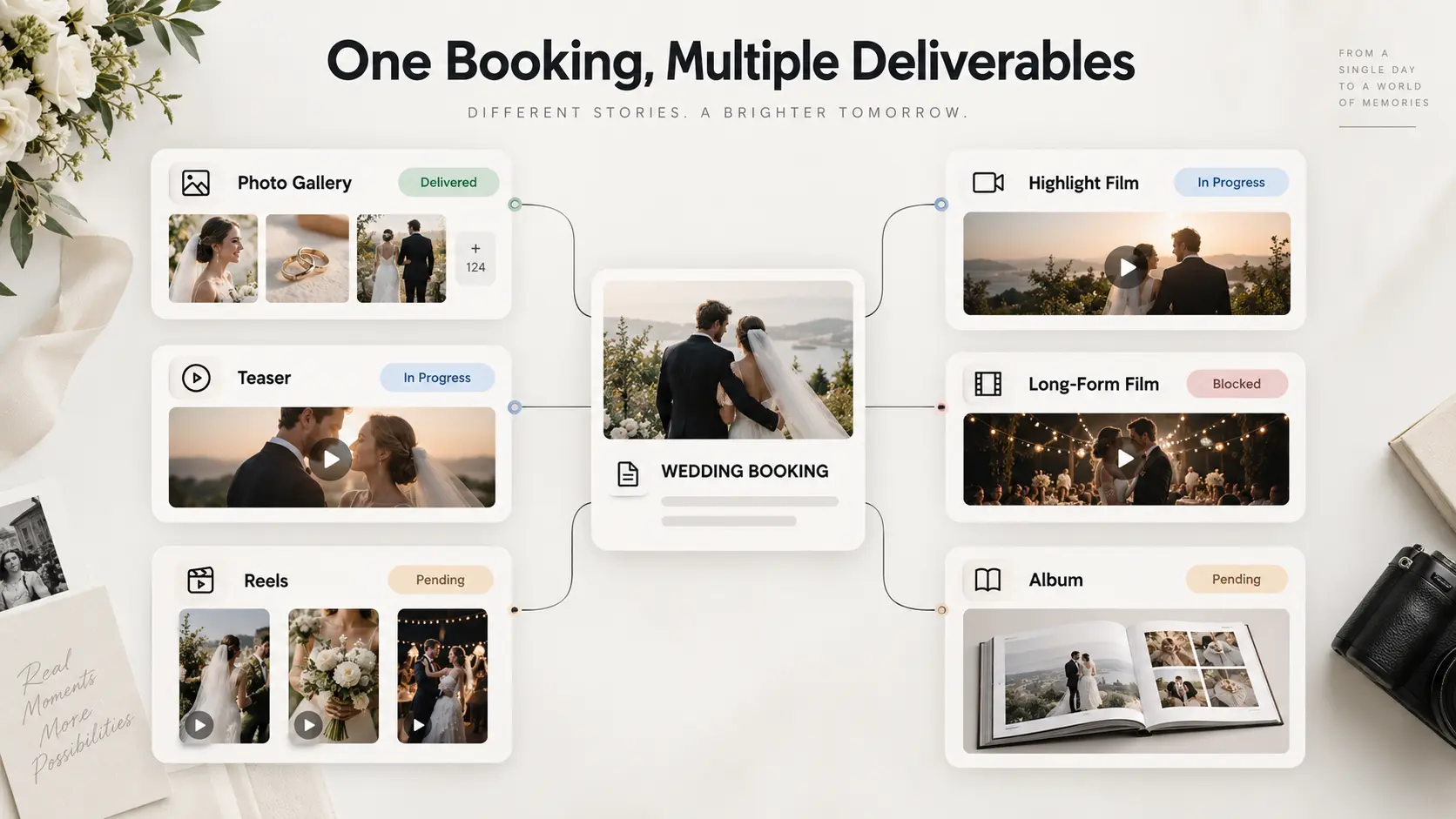
A hybrid wedding or event studio can finish the shoot and still have six different jobs open. The edited photo gallery may be with one editor, a teaser may be due first, short social reels may be handled by another team member, the highlight film may be waiting for organised footage and audio, and the album cannot begin until the client selects photographs. All of those outputs came from one booking, but they do not move through production together.
This is where photography deliverables tracking becomes more useful than a single “editing” status. The studio needs to know what was promised, who owns each output, what it depends on, when it is due and what “delivered” actually means. Otherwise a job can look nearly complete because the gallery has gone out while an album, reel or film remains open.
For photo-video studios, the booking should remain the parent record and each deliverable should have its own path to completion.
List deliverables before assigning production
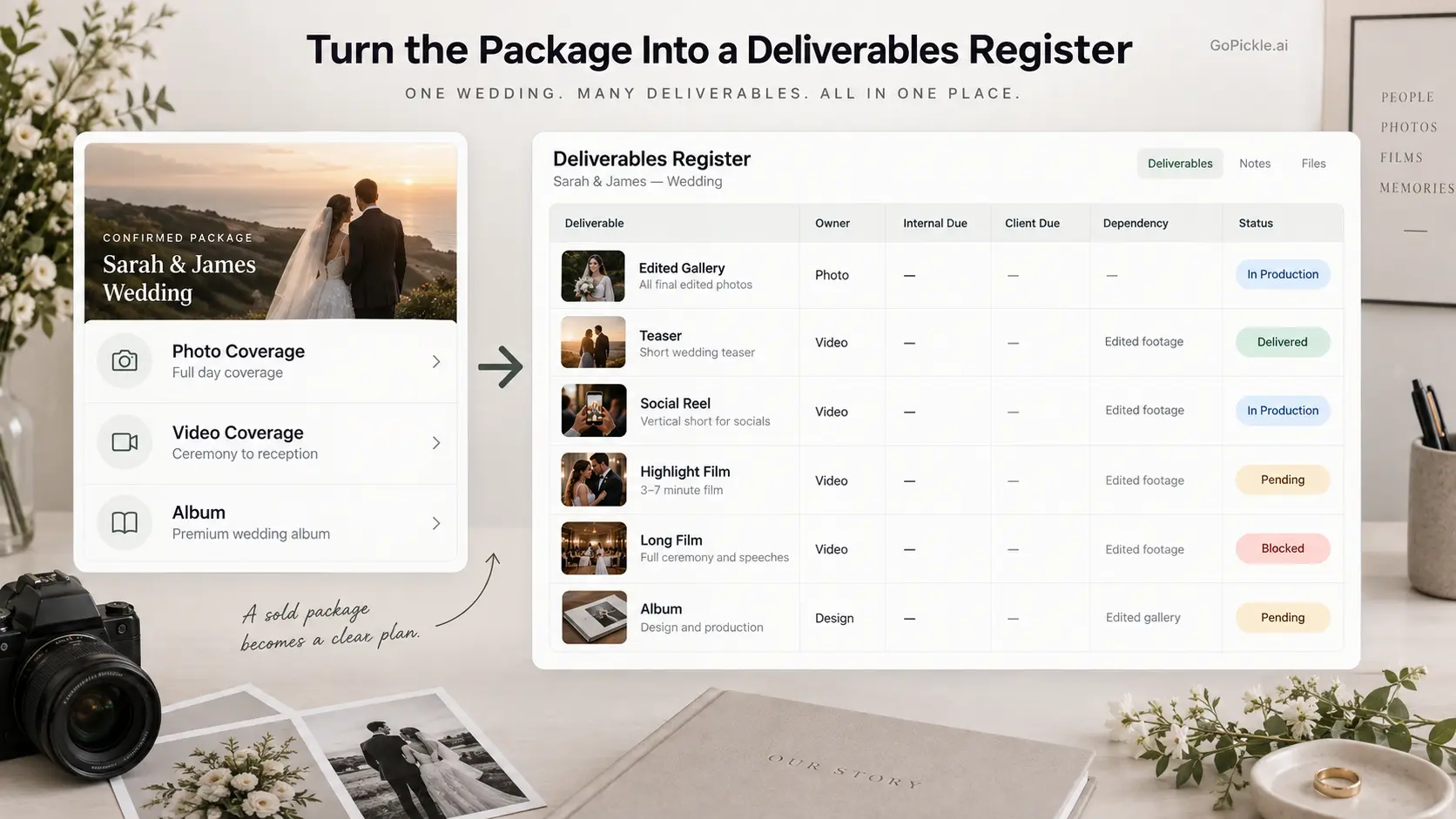
Start with the commercial agreement, not the editing queue. Before files are assigned to photographers, filmmakers, editors or album designers, turn the sold package into a definitive deliverables list.
A wedding package might include an edited photo gallery, a preview set, two vertical reels, a short teaser film, a highlight film, a long-form film and a printed album. Another booking may contain only photographs and an album. A corporate event could require a priority press set on event day, a full gallery later and several short clips for social channels. These are different outputs, and recording them individually gives the studio something concrete to manage.
A useful deliverables register can contain:
| Deliverable | Source coverage | Owner | Internal due | Client due | Dependency | Client action | Status |
|---|---|---|---|---|---|---|---|
| Edited gallery | Photo coverage | Photo editor | Set internally | Agreed date | Cull complete | None | In production |
| Teaser | Video coverage | Video editor | Set internally | Agreed date | Priority footage ready | None | Pending |
| Social reel | Selected clips | Reel editor | Set internally | Agreed date | Clip handoff | Maybe approval | Pending |
| Highlight film | Video + audio | Film editor | Set internally | Agreed date | Full ingest / sync | As agreed | Pending |
| Album | Final photos | Album designer | Set internally | Agreed date | Client selection | Selection / approval | Blocked |
The exact fields can vary by studio. What matters is that the team can answer “what remains?” without reopening a quotation, searching messages or asking the person who sold the package.
GoPickle Booking Management for photographers keeps client details, events, services, deliverables, crew, documents and delivery context connected to the confirmed booking. That structure becomes particularly useful when one wedding creates several outputs instead of one final file handoff.
Separate the capture service from the final deliverable
“Photography” is not the same record as “edited photo gallery.” “Cinematography” is not the same as “highlight film.” The first describes work performed during the event; the second describes something the studio owes the client afterward.
That difference matters when a package says “Photography + Cinematography + Album” and the operations team has to infer what should actually be delivered. Does cinematography mean one highlight, a complete ceremony edit, a teaser and three reels? Does photography include a preview? How many albums were sold? Is a parent album separate from the couple’s album? If those answers live only inside package copy or sales conversations, production begins with ambiguity.
A cleaner wedding studio workflow keeps services and deliverables related but distinct. Capture services tell the crew what must happen at the event. Deliverables tell production what must leave the studio afterward. If a client adds another reel or upgrades an album, the team can identify a new output rather than treating the entire booking as vaguely “updated.”
The same logic applies outside weddings. A commercial shoot might produce retouched campaign images, web-resolution exports and a restricted proof gallery. An event studio may owe a client gallery, speaker portraits and priority media files. Photography project deliverables should be specific enough that completion can be verified.
Assign an owner and due date to every deliverable
One booking owner is useful for client communication, but it does not solve production ownership. The person accountable for the final gallery may be different from the person cutting the teaser. An album designer may be blocked by client selection. A video editor may be waiting for a file handoff from an assistant. If the studio records only one booking deadline, these handoffs become invisible.
Give each deliverable one responsible owner and distinguish the internal production date from the client-facing commitment. If the client has been promised a gallery on a particular date, the internal edit and quality-control stages need to finish before that handoff. The buffer is a studio decision based on workload and risk; there is no useful universal number.
Ownership should survive handoffs. “Video team” is weaker than knowing who currently has the next action. If one editor prepares a cut and another person performs QC, record the current responsibility at the task or production stage rather than relying on a group chat.
This is where crew management for photographers becomes part of photography delivery management rather than merely shoot-day scheduling. GoPickle connects photographers, cinematographers, editors and other team members with real bookings and events, helping the studio keep responsibility close to the work that created it.
Map dependencies between teasers, reels, highlights and long-form work
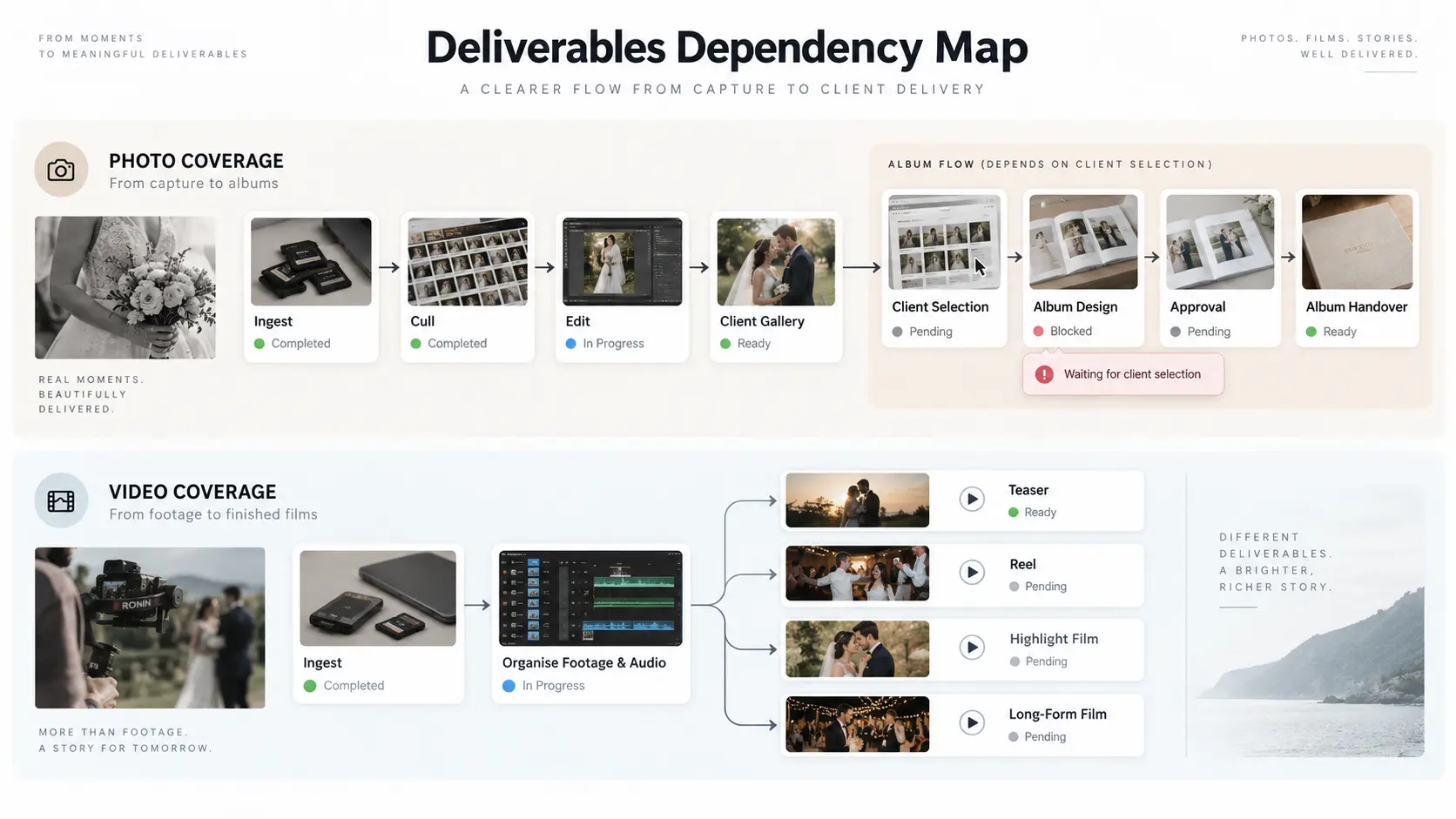
A deliverables list tells you what exists. A dependency map tells you what can move. Some outputs can begin early; others depend on a previous production step, a client decision or another deliverable being completed.
A photo-video booking might contain several paths:
Photo coverage → Ingest and backup → Cull → Edit → Client gallery
Selected photo set → Preview gallery
Video ingest → Organise footage and audio → Teaser → Highlight film
Selected clips → Vertical reel
Final gallery → Client selection → Album design → Client approval → Production / handover
These are workflow examples rather than rules about how every photographer or filmmaker should edit. A reel might be produced independently by a dedicated content creator and have no dependency on the main film edit. Another studio may deliberately use footage already prepared during its highlight workflow. The operational question is simply: what must be true before this deliverable can start or finish?
That distinction prevents misleading statuses. If an album is waiting for the couple’s confirmed selection, it is not “late in design”; it is blocked on a client dependency. If a teaser cannot start because files have not reached the editor, the next action belongs upstream.
Treat client selection and album work as dependencies, not vague follow-ups
Albums expose weak photography deliverables tracking because the studio can finish its photo edit while the booking remains far from finished. The common path is straightforward: photographs become available for review, the client makes an album selection, the selection is confirmed, the designer creates the layout, revisions or approval happen according to the studio’s policy, and only then can production and final handover take place.
The dangerous status is simply “album pending.” It does not explain whether the studio is waiting for the client’s first selection, whether the designer is working, whether a revision is with the client or whether an approved design is waiting for production. Each state has a different owner and next action.
For studios collecting selections through online galleries, the client decision should remain connected to production instead of becoming screenshots or filenames sent through chat. Our guide to client photo selection software for photographers explains an important distinction here: favourites are useful while a client is browsing, but production needs a stable, confirmed selection before downstream work begins.
GoPickle Client Galleries support organised photo delivery with collections, favourites, access controls, downloads and sharing. The operational principle is larger than the gallery itself: a client action should lead to a clear next production action rather than another manual follow-up.
Allow partial delivery without closing the booking
Hybrid studios rarely deliver everything at once. The teaser may go first, a few reels follow, the photo gallery is delivered later, the highlight film remains in production, and the album cannot begin until the couple makes its selection. If the booking has only two meaningful states, open and delivered, its status becomes misleading as soon as the first output reaches the client.
Track delivery at the deliverable level. A studio should be able to say, in operational terms, “the gallery and teaser are delivered; the highlight is in QC; the album is waiting for selection.” That tells the team much more than a single “delivered” badge on the wedding.
Partial delivery also affects client communication. When one output is sent, tell the client what that delivery contains and what remains. A gallery delivery should not accidentally imply that the album or video work is complete. Likewise, a teaser should not create an approval workflow unless client approval was intentionally designed into that deliverable.
The booking remains active until the remaining obligations have a resolved state. This is one reason photography workflow software becomes more useful as a studio adds video, albums, social content and physical products. The studio is no longer tracking only shoots; it is controlling several open production loops behind every confirmed project.
Define when the booking is truly delivered
“Photos sent” is not a reliable definition of project completion for a hybrid studio. Define a close condition that matches the package you actually sell. Production may be considered complete only when every contracted client-facing deliverable has been delivered or formally resolved, required client selections and approvals are complete, physical products have reached the agreed handoff point, and accepted scope changes have been incorporated.
Financial closure can sit alongside production closure without treating them as the same status. A studio may have finished every deliverable while a balance remains due, or payment may already be complete while album production is still open. Both states matter, but they represent different obligations.
Before closing a booking, check:
- Were all deliverables in the confirmed scope accounted for?
- Does each deliverable have a meaningful final state rather than a vague “pending” note?
- Have required client selections or approvals been completed?
- Have galleries, films, reels and physical products reached the intended handoff point?
- Can another team member understand immediately why the booking is still open?
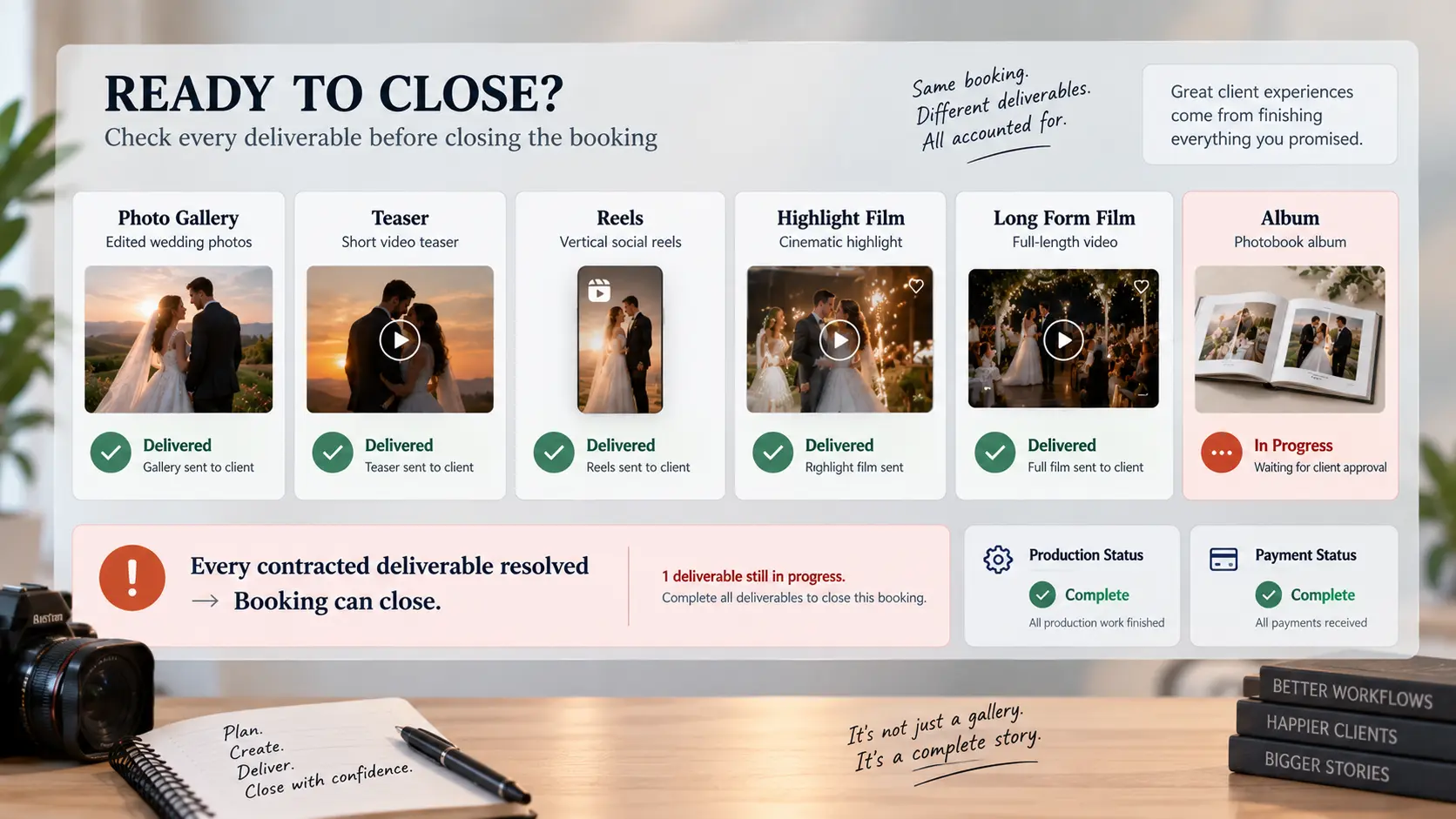
For growing wedding and event businesses, this is the practical goal of photo video deliverables tracking: one booking should give the studio a reliable picture of everything it still owes.
GoPickle’s wedding photography workflow keeps bookings, teams, payments, galleries, client activity and delivery context around the same wedding operation. That structure becomes more valuable as a studio moves beyond one photographer producing one gallery. Once several specialists and several deliverable types are involved, the booking needs to become the common operational reference.
A well-run project does not end when the first gallery link is sent. It ends when the studio can look at the original commitment, account for every output and close the booking without wondering what might still be hiding in an editor’s queue, a client conversation or an album designer’s folder.