Photography Lead-to-Booking Conversion Rate: Measure the Funnel Without Fooling Yourself
Learn how to calculate photography lead conversion rate correctly across enquiries, qualified leads, quotations and bookings without misleading averages.

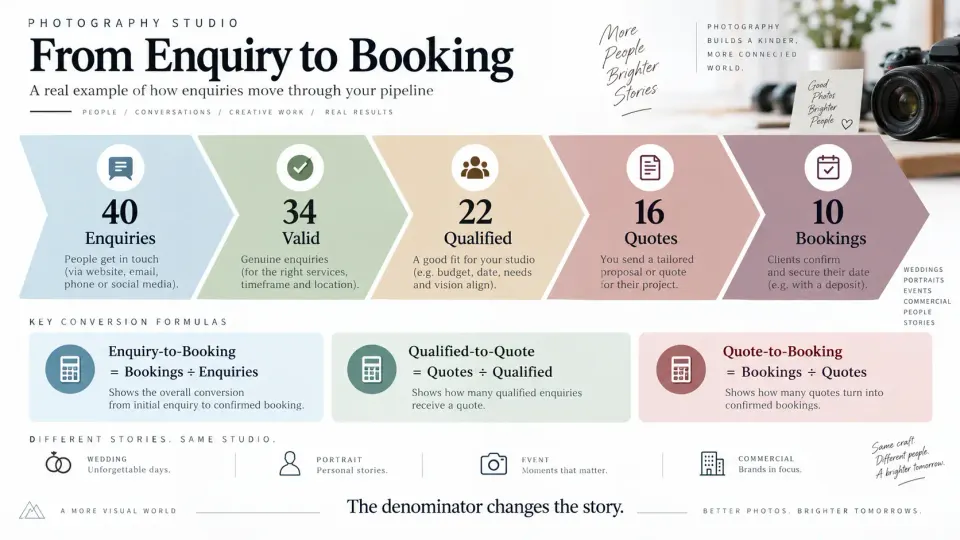
A photography studio receives 40 enquiries and books 10 assignments. Its photography lead conversion rate is 25%, right?
Possibly.
Now suppose eight of those enquiries were outside the studio's service area, four were requests for dates that were already unavailable, and six disappeared before providing enough information to establish whether there was a real photography requirement. The studio actually qualified 22 enquiries, sent 16 quotations and won 10 bookings.
Suddenly there are several perfectly valid numbers: 25% of all enquiries became bookings, 45.5% of qualified enquiries became bookings, and 62.5% of quotations became bookings.
None of those figures is necessarily wrong. The problem starts when a photographer calls all of them the photography lead conversion rate and compares one month, salesperson, service or marketing channel against another without checking which denominator was used.
For us at GoPickle, this is the useful way to think about photography sales funnel metrics, do not begin by asking whether your conversion rate is good. Begin by establishing exactly what converted into what.
Define Each Conversion Stage Before You Calculate Anything
A photography enquiry is not automatically a qualified sales opportunity. Someone asking “price?” in an Instagram DM, a previous client requesting availability for a family shoot, a couple submitting a complete wedding enquiry form and an agency sending a commercial brief are four very different starting points.
A practical studio funnel might look like this:
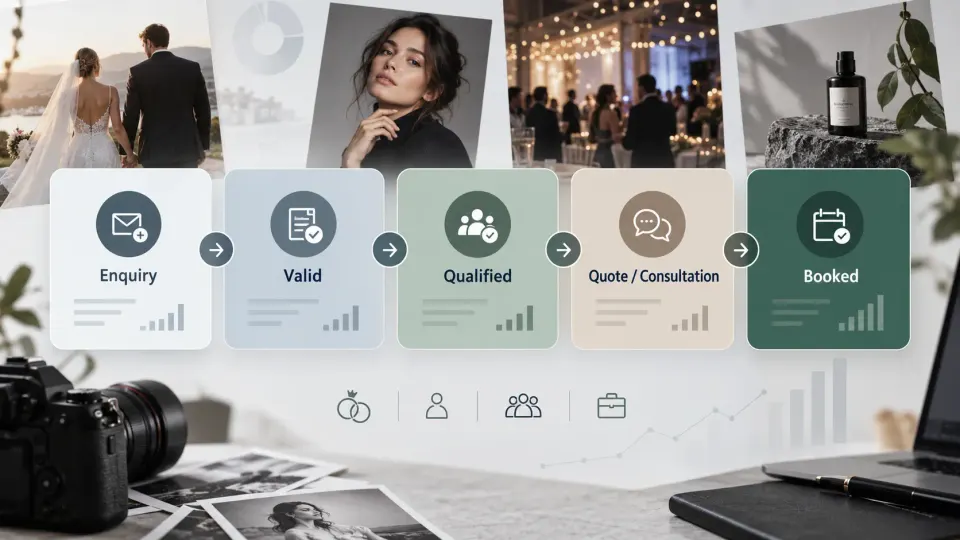
Enquiry → Valid Enquiry → Qualified Requirement → Quotation / Consultation → Booking
The terminology matters less than having one definition that everybody in the studio uses consistently.
| Stage | Practical definition |
|---|---|
| Enquiry | A new request or expression of interest captured by the studio |
| Valid enquiry | A genuine photography enquiry with usable contact information |
| Qualified requirement | The studio understands enough about the job to decide whether it is a realistic opportunity |
| Quotation / consultation | A serious sales action has happened: quotation sent, proposal presented or consultation completed |
| Booking | The client has completed whatever your studio defines as confirmation |
For one studio, “booked” might mean an approved quotation and signed agreement. Another may require an advance payment before protecting the date. Pick the operational definition that actually represents a confirmed job and keep it unchanged.
This is one reason a structured lead management system for photographers becomes more useful than keeping an informal list of names. The useful photography CRM metrics come from preserving the movement between stages, not merely counting contacts.
Measure Enquiry-to-Qualified Before Blaming Your Sales Process
Your photography enquiry conversion rate starts telling an interesting story before a quotation has even been created.
Calculate:
Enquiry-to-qualified rate = Qualified requirements ÷ valid enquiries × 100
Suppose 50 genuine enquiries arrive and 20 become sufficiently qualified to quote. Your enquiry-to-qualified rate is 40%.
That does not automatically mean the other 60% were handled badly. Some clients may need a date you cannot cover. Some may be looking for a service you do not provide. Some enquiries may have budgets or requirements that make the assignment unsuitable. Others may simply stop responding.
What matters is separating those causes.
If enquiry volume rises sharply while qualified requirements remain almost unchanged, investigate where those additional enquiries are coming from. A campaign producing large numbers of weak enquiries may look impressive in a marketing dashboard while contributing little to the booking calendar.
This is why we recommend comparing lead sources beyond their raw enquiry count. Our guide to which lead sources work best for photography studios explains the broader channel question; for conversion reporting, the important extension is to follow each source all the way from enquiry to qualified requirement and ultimately to booking.
Measure Qualified-to-Quote Separately
Once a requirement is genuinely qualified, another question becomes useful:
Qualified-to-quote rate = Quotations sent ÷ qualified requirements × 100
This stage can reveal operational problems that an overall lead-to-booking number hides.
Imagine your studio qualifies 25 opportunities but sends only 14 quotations. Why did the other 11 stop progressing?
Perhaps pricing decisions take too long. Perhaps nobody owns quotation preparation. Perhaps the team keeps waiting for one missing detail instead of arranging a call. In a commercial studio, the delay may be caused by incomplete briefs, licensing questions or production costs. In weddings, the bottleneck might be finalising functions, crew requirements, albums or cinematography coverage.
A low qualified-to-quote rate therefore deserves a different response from a low enquiry-to-qualified rate. Buying more leads will not repair a quotation bottleneck.
There is another complication: not every photographer sells through a formal quotation. Portrait photographers may use fixed packages and booking pages, while wedding or commercial studios may rely heavily on consultations and customised proposals. If consultation is your real decision stage, measure qualified-to-consultation and consultation-to-booking instead.
The funnel should represent the way clients actually buy from you, rather than forcing every photography business into the same CRM vocabulary.
Quote-to-Booking Rate Shows What Happens Near the Buying Decision
The photographer booking conversion rate closest to revenue is often:
Quote-to-booking rate = Bookings resulting from quotations ÷ quotations sent × 100
If 20 quotations eventually produce eight confirmed assignments, the quote-to-booking rate for that group is 40%.
Notice the word eventually.
Do not automatically divide this month's bookings by this month's quotations. A wedding enquiry received near the end of one month may be quoted in the next and confirmed several weeks later. Commercial procurement can take even longer. Mixing unrelated calendar totals can create a conversion rate that appears precise but does not describe a real group of leads.
A better method is cohort-based: take the enquiries or quotations created during a particular period and follow what ultimately happened to them.
Your quotation itself also deserves attention. If qualified clients regularly disappear immediately after receiving one, inspect what they received rather than assuming price was the only issue. A professional photography quote should make the scope, deliverables, pricing and next step easy to understand. Our guide on how to create a professional photography quotation covers that part of the workflow in detail.
Segment Conversion Rate by Lead Source and Photography Service
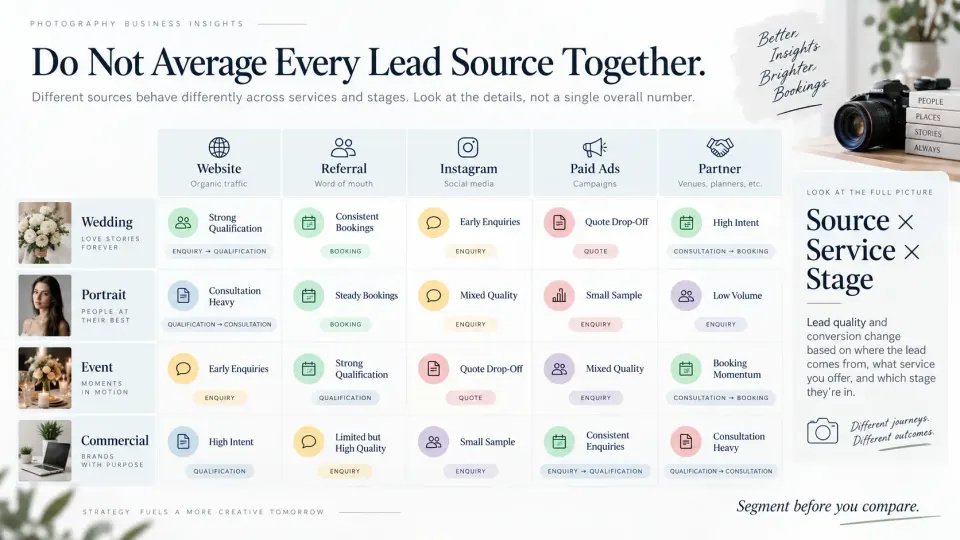
A single studio-wide percentage can hide more than it reveals.
Consider a photographer who shoots weddings, corporate events and family portraits. A referral from a previous wedding client has different context from a paid-ad enquiry for a portrait session or an agency brief for a commercial production. Putting all three into one denominator makes it difficult to understand what is actually working.
At minimum, compare conversion by lead source and service type.
A useful report could look like this:
| Lead source | Enquiries | Qualified | Quotes / consultations | Bookings |
|---|---|---|---|---|
| Website | ||||
| Referral | ||||
| Paid advertising | ||||
| Partner / planner |
Then run the same analysis for weddings, portraits, events, newborn photography, commercial work or whichever services materially differ in your studio.
This prevents a common mistake: deciding that a source is “bad” because its overall booking rate is lower. The source may be excellent for one service and poor for another. Equally, a channel bringing fewer enquiries could still deserve more attention if those enquiries consistently reach qualification, quotation and booking.
Track Lost, Unqualified and Invalid Leads Separately
A studio can improve its reported conversion rate instantly by deleting weak leads. It can also destroy the usefulness of its data at the same time.
Do not make unsuccessful enquiries disappear.
Instead, distinguish between outcomes such as:
- invalid or spam enquiry;
- duplicate enquiry;
- unavailable date;
- outside service area;
- requirement not offered;
- budget mismatch;
- quotation declined;
- competitor selected;
- postponed or cancelled requirement;
- stopped responding;
- lost reason unknown.
The exact labels should fit your business, but the distinction between invalid, unqualified and lost after qualification is particularly useful.
An invalid phone number says something about lead capture quality. An unavailable wedding date says something about capacity. A serious prospect declining after quotation says something about a later stage of the sales process. Treating all three as “lost” removes the information you need to decide what to fix.
We have covered this more deeply in why tracking lost leads helps photography studios. For funnel measurement, preserving these outcomes also lets you report two different numbers when necessary: raw enquiry-to-booking conversion, which reflects everything entering the studio, and qualified lead-to-booking conversion, which reflects how effectively genuine opportunities are being closed.
Use Your Own Trends Instead of Chasing a Universal “Good” Conversion Rate
Search for “good photography lead conversion rate” and you will find percentages presented with surprising confidence. We would be careful with them.
A destination wedding studio selling high-value, multi-day coverage through consultations does not have the same sales cycle as a headshot photographer offering standard sessions through an online booking page. Referral-heavy studios should not expect the same funnel shape as studios buying large volumes of social-media leads. Commercial photography introduces another layer of briefs, approvals, production estimates and procurement.
The more useful benchmark is usually your own comparable history.
Look at:
Enquiry → Qualified
Qualified → Quote / Consultation
Quote / Consultation → Booking
Then compare those stage rates month to month, quarter to quarter and year over year where seasonality matters. Break them down by lead source and service before drawing conclusions.
Also track the volume alongside the percentage. Moving from one booking out of two enquiries to two bookings out of ten is technically a falling conversion rate even though bookings doubled. Percentages without counts can mislead just as easily as counts without percentages.
A Better Photography CRM Report Answers “Where Did the Funnel Change?”
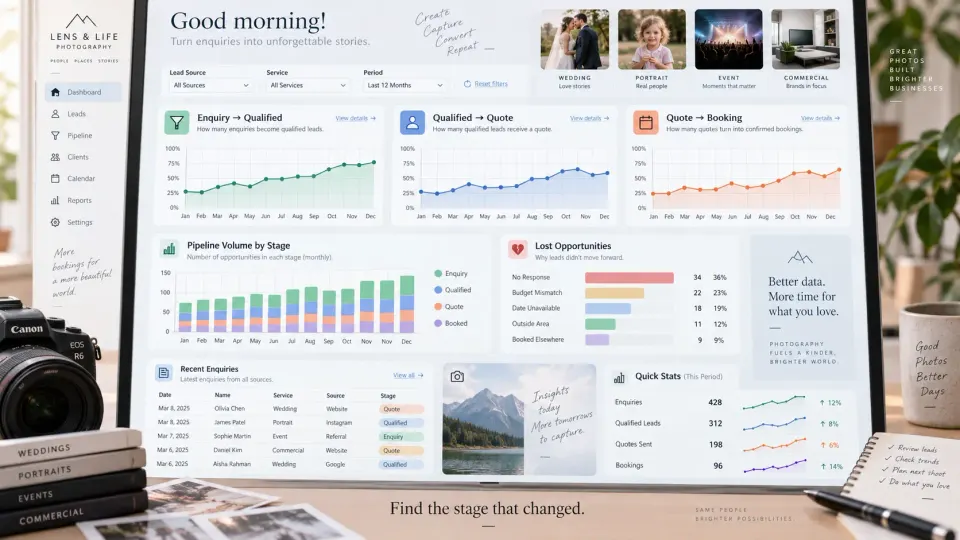
The purpose of measuring photography lead conversion rate is not to produce one impressive percentage for a dashboard. It is to make the next business decision easier.
If enquiries are falling, you have an acquisition problem to investigate.
If enquiries are rising but qualification is not, inspect source quality and targeting.
If qualified requirements accumulate without quotations, examine response ownership and quotation preparation.
If quotations are being sent but fewer clients are confirming, inspect pricing, scope, presentation, follow-up and the type of prospects reaching that stage.
If one source converts well but produces very little volume, consider whether it can be expanded.
Those are considerably more useful photography sales funnel metrics than “we converted 28% this month.”
At GoPickle, this is also how we think about the relationship between CRM data and the rest of a photography studio. GoPickle Lead Management is designed to keep the enquiry, requirement, source, follow-up and path toward quotation and booking connected, while the broader photography workflow continues that context through confirmed work.
The goal is not to make photographers spend more time reporting. It is to make the information already created during normal sales work useful enough to answer a much better question:
Not “What is our conversion rate?” but “At which stage are we gaining or losing the next booking?”