Should Photographers Show Prices on Their Website? A Decision Framework for Different Business Models
Should photographers show prices on their website? Compare full prices, starting prices, ranges and custom quotes for weddings, portraits and commercial work.


Should photographers show prices on their website? For most studios, we think the answer is yes, but not necessarily every price.
A client visiting a photography pricing website usually needs enough information to decide whether your studio is financially realistic for them before they spend time filling out an enquiry form, calling you or arranging a consultation. That does not mean a wedding photographer has to publish every possible combination of coverage hours, albums and crew, or that a commercial photographer should put a fixed price against work whose production requirements have not even been discussed.
The better question is: how much pricing information can you publish accurately before you know the client's actual requirement?
For a portrait photographer selling a repeatable 60-minute session, that may be the complete package price. For a wedding studio, a starting investment may be more useful. For corporate events, a range or minimum booking can establish budget fit. For an advertising campaign involving production costs and image licensing, asking for a brief before preparing a custom photography quote may be the only responsible option.
At GoPickle, we would treat the website and the quotation as two different parts of the sales process. The website should establish whether there is likely to be a fit. The quotation should price the actual work.
What a visitor really needs from a photography pricing page
A good photography pricing page does not need to answer every possible pricing question. It does need to prevent the client from entering the enquiry process with completely different expectations from the photographer.
Suppose someone is searching for a wedding photographer with a budget of ₹70,000 while your studio's wedding coverage normally begins at ₹2,00,000. If nothing on your website indicates your price level, that person may browse your portfolio, send an enquiry, wait for your response, discuss dates and requirements and only then discover that the two sides were never commercially compatible. The studio has not created a better sales opportunity by hiding the number. It has simply moved the qualification step further down the funnel.
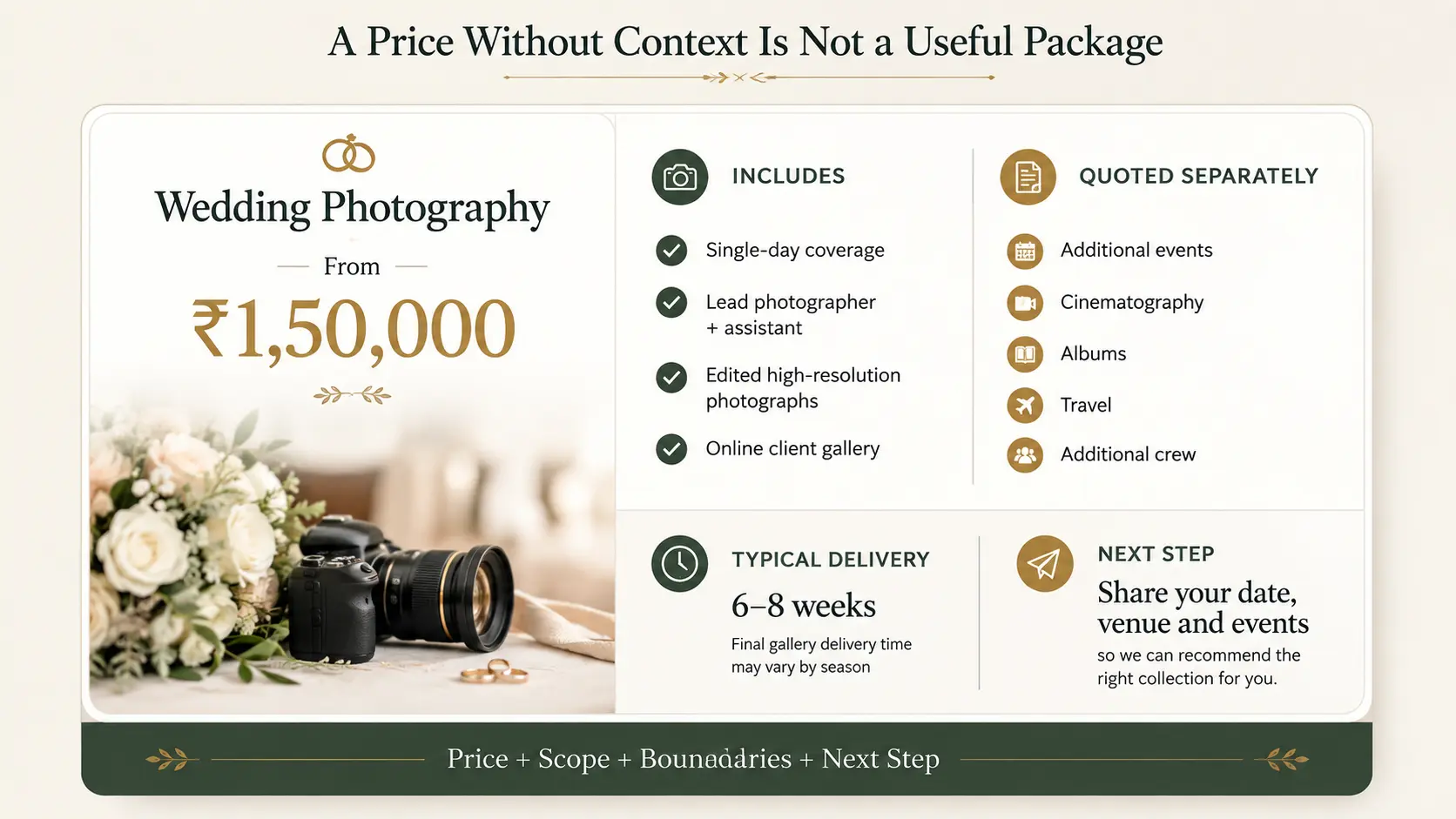
The opposite problem is publishing a price without enough context. Showing “Wedding photography: ₹1,50,000” tells a client very little if they cannot see whether that includes one event or three, traditional photography or candid coverage, one photographer or a team, an album, cinematography, travel or any other substantial deliverable.
A useful pricing page should therefore answer four practical questions:
- What type of photography service is this?
- What does the displayed price broadly cover?
- What commonly changes the final price?
- What should the client do next?
That is photographer pricing transparency in a useful form. Transparency does not mean turning your website into a spreadsheet containing every possible add-on.
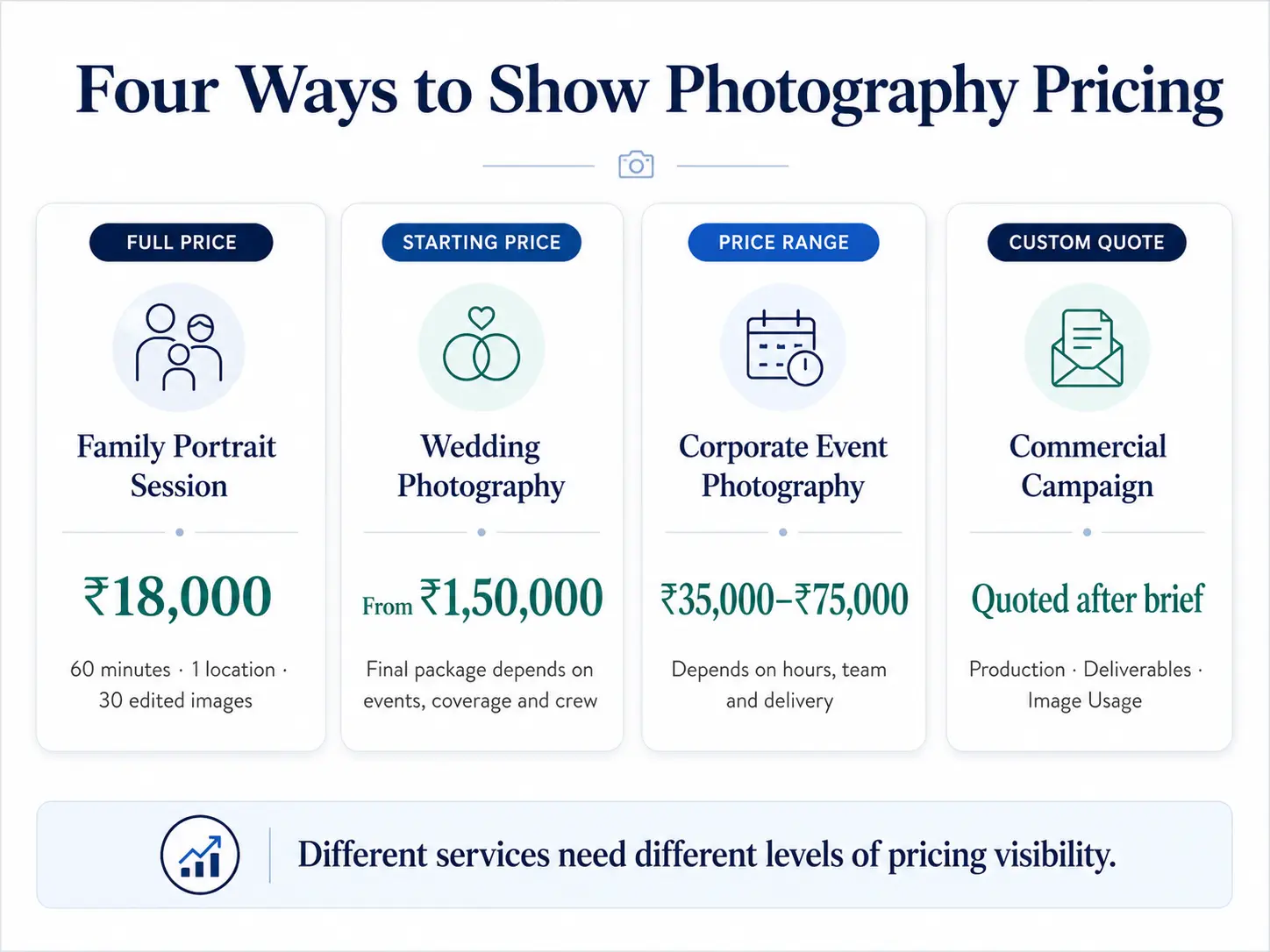
Four ways to show photography prices on your website
There are four pricing-visibility models we would consider before designing a photography pricing page: full pricing, starting prices, realistic ranges and custom quotations. The right choice depends mainly on how repeatable the service is and how much of the scope is known before the client contacts you.
| Pricing approach | Works best when | Example | Main risk |
|---|---|---|---|
| Full package price | Service is highly standardised | Portrait session - ₹15,000 | Price becomes misleading when clients regularly customise the package |
| Starting price | There is a clear minimum but scope can grow | Weddings from ₹1,50,000 | Unrealistically low starting prices create sticker shock later |
| Price range | Most assignments fall inside a meaningful band | Corporate events typically ₹40,000-₹80,000 | A very wide range does not help the buyer |
| Custom quote | Scope, production or usage varies substantially | Commercial campaign - quoted after brief | No pricing context can result in unnecessary enquiries |
Full photography package pricing
Exact package prices make sense when the studio has intentionally standardised the product. A family portrait photographer might sell a 60-minute session with one location, 30 edited photographs and online delivery for ₹18,000. If nearly every client receives essentially the same service, hiding that figure creates an enquiry step without adding much useful information.
The same logic can apply to mini sessions, basic headshots, maternity sessions, newborn sessions and other controlled services. Clients searching for photography packages and prices in these categories are often trying to compare both affordability and inclusions. A clear package helps them make that comparison without requiring your studio to manually send the same information repeatedly.
Photography starting prices
Starting prices are often a stronger fit for wedding photography because there may be a recognisable minimum service even though the final booking changes according to events, coverage hours, crew, cinematography, albums, travel and other requirements.
Current wedding marketplaces use this model extensively. The Knot, for example, displays starting prices while still allowing photographers to offer customised collections and personalised quotes. Its listings also warn users that starting prices may not represent every eventual fee.
The important part is making the starting price genuine. If your website says “Wedding photography starts at ₹75,000” but almost no real client can book a meaningful wedding service for anything close to ₹75,000, you have created an anchor that your quotation will later have to undo.
A stronger version would be:
Wedding photography collections begin at ₹1,50,000 for single-day coverage. Multi-day weddings, additional crew, films, albums and travel are quoted according to the requirement.
The client understands both the entry point and why the final amount can change.
Showing a photography price range
A range can work when the studio has enough historical experience to know where most assignments land but cannot honestly publish a single starting package.
For example:
Corporate event photography typically ranges from ₹35,000 to ₹75,000 per day depending on coverage hours, team size, location and delivery requirements.
The range is useful because the difference between the lower and upper end can be explained. A range such as ₹20,000 - ₹3,00,000 is much less useful. Almost any client could technically fit inside it, which means the page has done little qualification.
Custom photography quotations
Some photography should remain custom quoted.
Commercial photography is the clearest case. A brand may need one photographer shooting executive portraits at its office, while another assignment requires models, styling, assistants, rented equipment, location production, advanced retouching and several years of advertising usage. Professional Photographers of America treats production budgeting, deliverables and image usage as important parts of commercial bidding, which is exactly why a generic website package cannot represent many commercial projects accurately.
A commercial photography pricing page should still give the visitor useful information. Instead of writing only “Contact for price”, explain what determines the estimate:
Commercial projects are quoted according to shoot scope, production requirements, deliverables and intended image usage. Send us the brief, location, required assets, usage and delivery date so we can prepare an accurate quotation.
The price is private, but the pricing process is not mysterious.
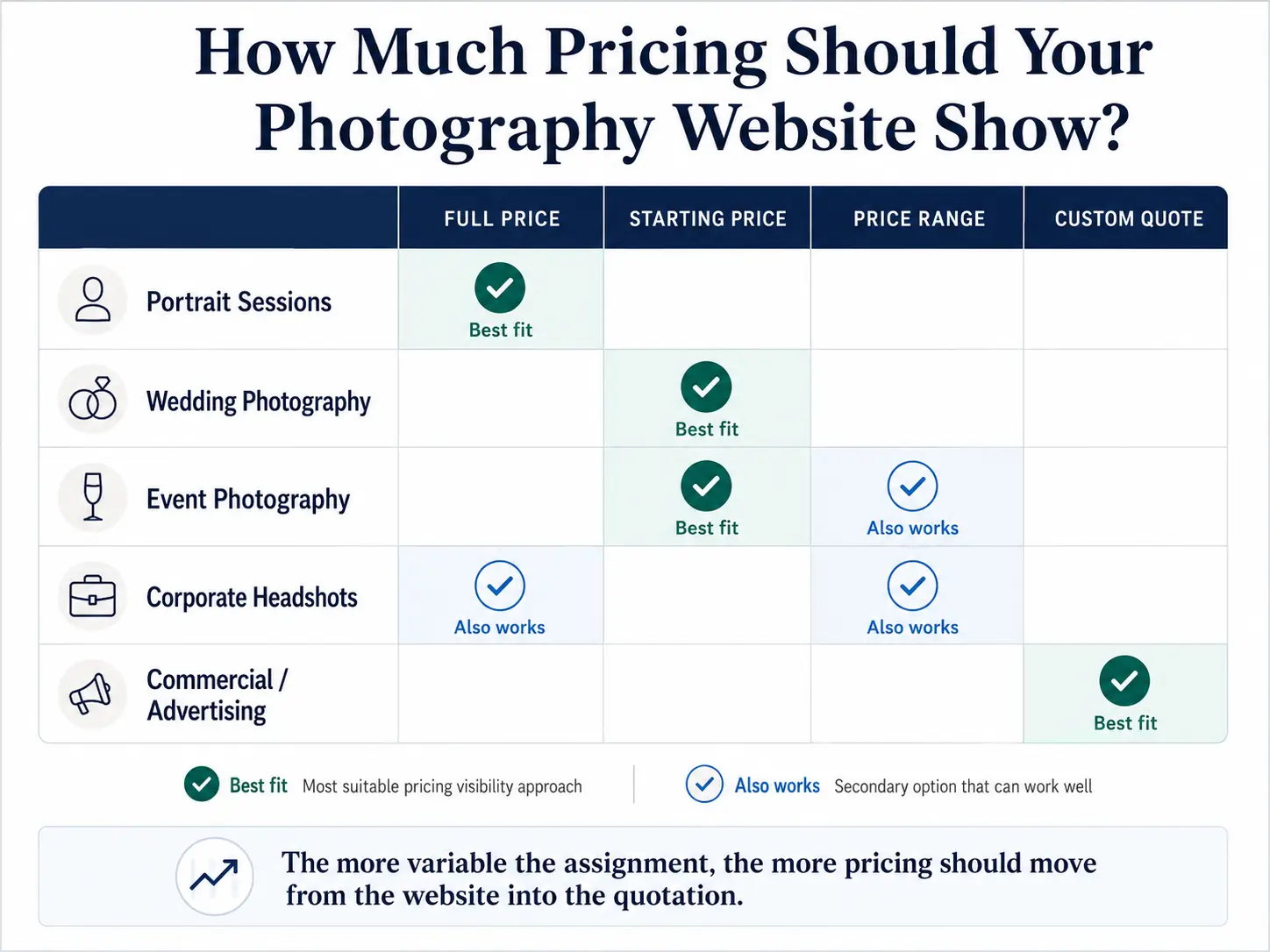
Which approach fits weddings, portraits, events and commercial photography?
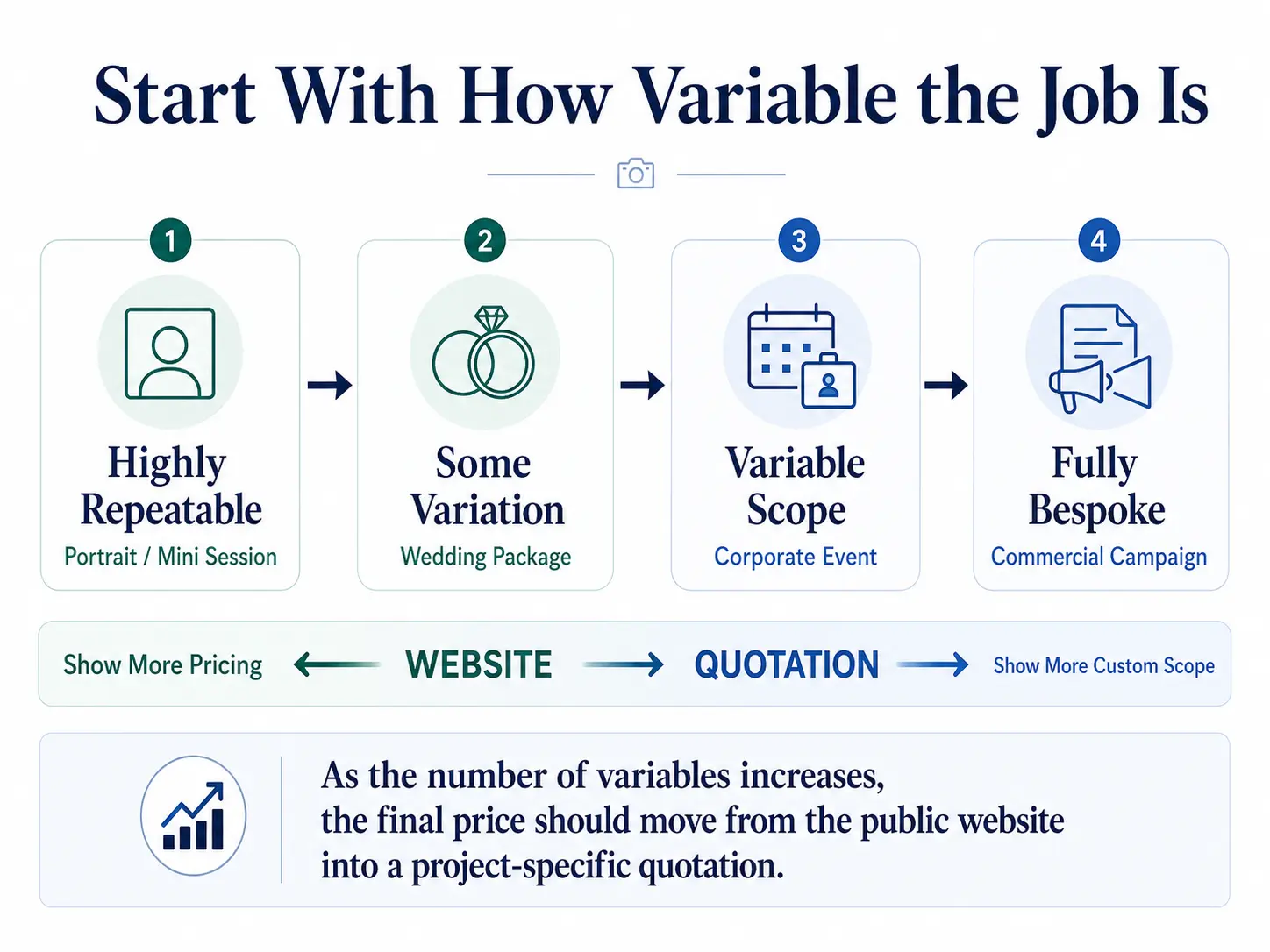
The simplest framework is to ask how much the requirement can change after the enquiry arrives.
For portrait photography, exact packages usually work well when session duration, location and deliverables are controlled. If the studio sells extensive wall art, albums or post-session product collections, it may make more sense to publish the session fee plus a realistic product starting point rather than suggesting that the session fee is the client's total investment.
For wedding photography, starting prices or a small number of photography packages tend to offer a better balance. Couples can understand whether your studio fits their broad budget before enquiring, while you retain enough flexibility to quote multi-day events, additional photographers, cinematography, destination travel and albums correctly. Current photographer websites commonly combine starting prices with clear descriptions of what is included and an invitation to request a customised proposal.
For event photography, either a minimum booking, day rate or price range can work. A photographer covering a two-hour private event should not necessarily use the same pricing model as a studio covering a three-day conference across several stages with multiple photographers and rapid-turnaround requirements.
For commercial photography, we would generally move toward custom quotation as complexity rises. The website can establish the type of assignments the studio accepts and perhaps a minimum project value, but the actual quotation should reflect the brief, production and usage rather than forcing every client into a pre-existing photography package.
Premium positioning does not change these fundamentals. A premium photographer may deliberately avoid publishing detailed packages because the service is consultative and highly customised, but hiding prices by itself does not create premium positioning. If the studio wants to reduce poor-fit enquiries without presenting a rate card, a minimum investment can often achieve the same qualification more elegantly.
What to show besides the price
The number gets attention, but the context determines whether that number is understood correctly.
If you publish photography starting prices or package prices, state the major inclusions beside them. For a wedding package, that might mean the number of events, coverage hours, crew, photographs or films delivered, album inclusion and expected delivery format. For a portrait session, it might mean session duration, location, edited-image quantity and whether prints or albums are included. For commercial work, explain which factors are quoted separately rather than implying that one figure covers production and usage.
Exclusions matter when they can materially change the final bill. Travel, accommodation, additional hours, extra photographers, album upgrades, urgent editing and commercial image licensing are all examples of items that should not unexpectedly appear after the client has mentally committed to the headline price.
Read More about Usage Rights, Licensing and Buyouts in Commercial Photography Quotes
Turnaround should also appear somewhere near the offer. A client comparing two photographers may care that one delivers the complete gallery within a defined window while another does not specify delivery expectations at all. Pricing is part of the purchase decision, but it is not the entire purchase decision.
Finally, give the client a sensible next step. “Contact us” is weaker than “Tell us your wedding date, venue and events so we can recommend the right collection.” The second instruction tells the client why you need the enquiry.
If you regularly find yourself explaining why one photography package costs more than another, our guide on how to explain photography pricing without sounding defensive is the more appropriate next read. That article deals with communicating value after the pricing conversation begins rather than deciding what belongs on the website.
Measure qualified enquiries, not just enquiry volume
One reason photographers hesitate to publish prices is the fear that enquiries will fall.
They might.
That does not automatically mean the pricing page is performing badly.
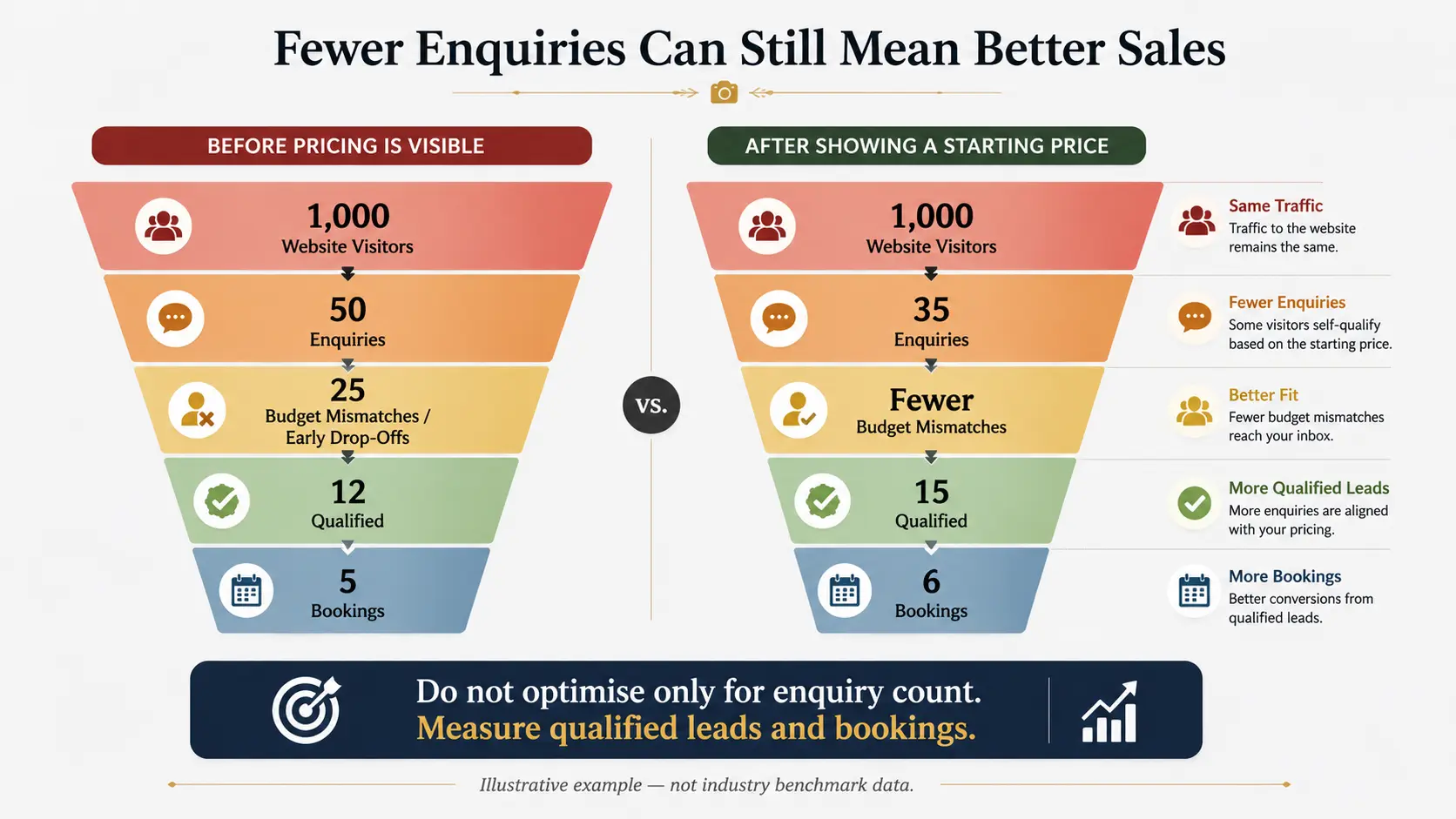
Imagine a studio receives 50 enquiries in one month with no price information on its website. Twenty-five disappear immediately after receiving the package rates, twelve are outside the studio's normal budget or requirement, and five eventually book.
The studio then publishes a realistic starting price. The following month it receives only 35 enquiries, but far fewer disappear after the first pricing conversation and six eventually book.
Enquiry volume has fallen from 50 to 35.
Bookings have increased from five to six.
The metric that matters is therefore not simply:
Website visitors → enquiries
It is:
Website visitors → qualified enquiries → quotations → bookings
Google Analytics even provides recommended lead-generation events including generate_lead, qualify_lead, disqualify_lead and close_convert_lead, allowing businesses to distinguish a submitted enquiry from one that actually becomes qualified or converts.
Inside the studio, track at least the enquiry source, service requested, expected budget where appropriate, whether the lead was qualified, why it was lost, whether a quotation was sent and whether it became a booking. This is also where photography lead management becomes more valuable than counting enquiries in an inbox. A lower number of better-qualified conversations can produce a healthier sales pipeline than a large volume of price-shopping leads.
Search Console should be used separately to understand whether the page is earning impressions and clicks for relevant pricing queries. Google provides query, click, impression and CTR reporting, so over time you can see whether your photography pricing page is appearing for the searches you actually intended to target.
When the website should hand the client to a quotation
The pricing page has finished its job once the client understands your broad offer and you need information specific to their assignment before you can price it properly.
A wedding enquiry may now need event dates, venues, crew requirements, albums and cinematography. A corporate assignment may require employee count, shoot location and turnaround. A commercial campaign may need a brief, shot list, production requirements, deliverables and image usage.
That is the point where the workflow should move from:
“What does this photographer generally cost?”
to:
“What will my specific requirement cost?”
The next step is a structured photography quotation, not another generic package page. GoPickle's Quotation Management is designed for this part of the workflow: the studio can take the actual enquiry and present the relevant scope, packages, add-ons and price as a client-facing proposal rather than trying to make the public website account for every possible variation.
This also keeps your photography pricing website maintainable. The website carries information that stays reasonably stable: starting prices, standard packages, typical ranges, inclusions and the factors that affect price. Your quotation carries information that changes client by client.
For studios handling many enquiries, the complete workflow becomes:
Pricing page → Enquiry → Lead qualification → Requirement → Quotation → Booking
That is also why we would not recommend deciding whether to show photography prices based only on whether competitors publish theirs. Start with your own service model. Decide what can be priced accurately before the enquiry, what needs more information and what your clients need to know to judge whether they should continue.
If your service is standardised, show the price.
If there is a reliable entry point, show the starting price.
If most projects sit within a meaningful band, consider a range.
If every assignment genuinely requires scoping, explain the variables and ask for the information required to quote properly.
The goal is not to show as many prices as possible. It is to remove the right amount of uncertainty before a serious client enters your sales process.
For photographers who want to connect that enquiry, qualification and quotation process instead of managing it across messages and files, GoPickle brings Lead Management and Quotation Management into the same photography business workflow. You can review the available plans on the GoPickle Pricing page before deciding whether that workflow fits your studio.