AI Guest Gallery Privacy Checklist: Consent, Access and Retention Questions Photographers Should Ask
Use this AI guest gallery privacy checklist to review face recognition consent, guest access, biometric data retention, deletion, minors and jurisdiction-specific risks.

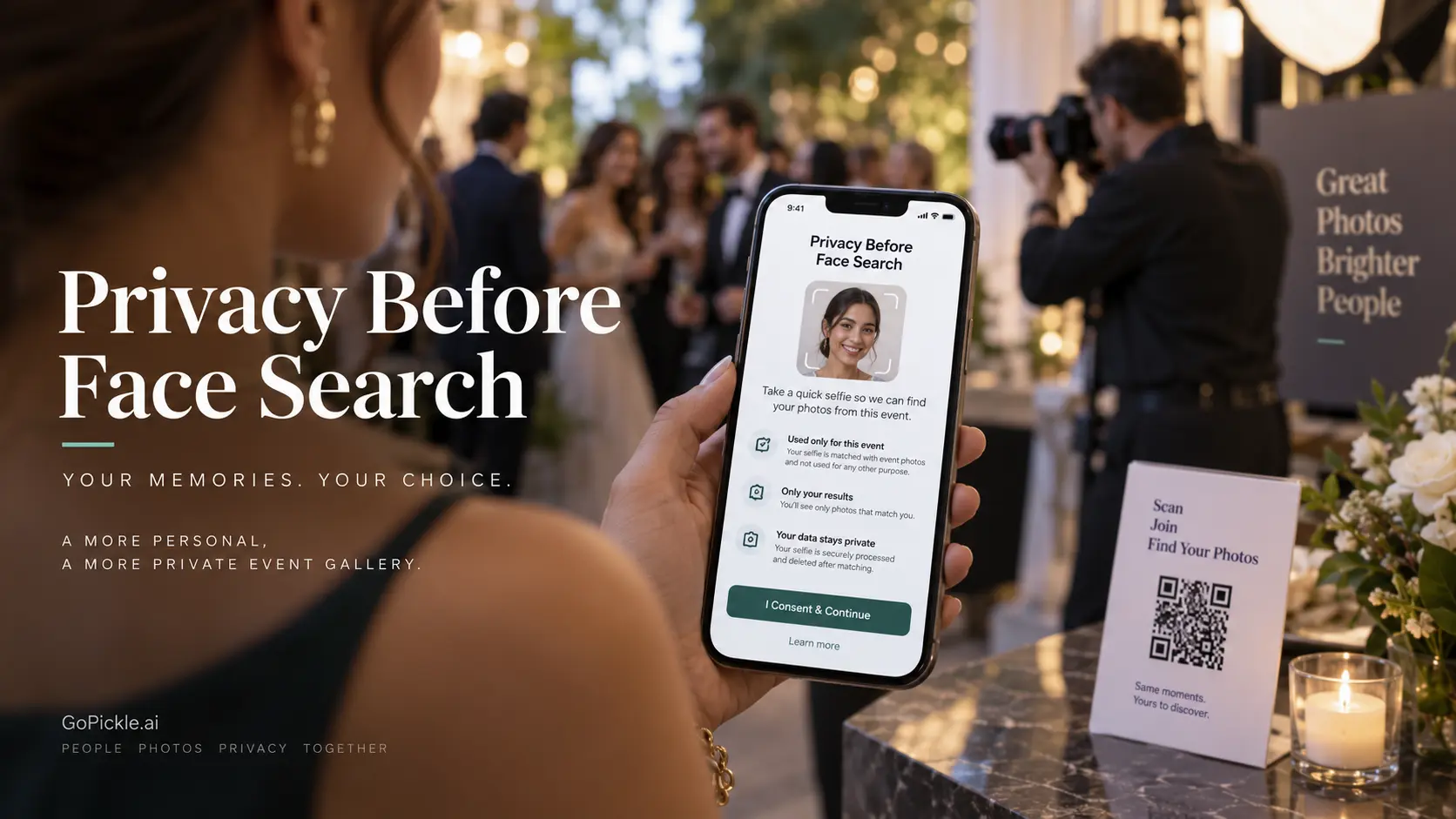
AI guest galleries can solve a genuine event-photography problem. Instead of asking hundreds of people to browse the same wedding, conference or sports gallery, a guest can open an event link or scan a QR code, provide a selfie and use face matching to find photographs in which they appear.
The convenience is obvious. The privacy questions are less visible.
A photographer choosing AI photo sharing software is no longer evaluating only image quality, matching accuracy, upload speed and guest limits. You also need to understand what happens to the guest's selfie, what facial data is produced during matching, who can see the results, whether the information is reused, how long it survives and what happens when somebody wants it removed.
That makes AI photo gallery privacy part of the delivery workflow rather than something to leave entirely to a software vendor's legal page.
At GoPickle, we think the simplest way to approach this is to start with purpose. An AI Guest Gallery has a narrow, understandable job: help an event attendee find photographs in which they appear. Everything you collect, expose and retain should make sense against that job.
Privacy laws differ between countries and sometimes between states or provinces, so this is an operational checklist rather than universal legal advice. Where biometric or facial-recognition rules apply to an assignment, the studio should review the applicable requirements before deploying the gallery.
Define the matching purpose clearly
Before asking which consent checkbox to show, write down exactly what the face-matching system is being used for.
A useful description might be:
Use a guest-provided selfie to search photographs from this event and return photographs that appear to contain the same person.
That is considerably clearer than saying the studio is collecting data "for AI purposes."
Purpose matters because it gives you a boundary. If the purpose is photo discovery inside one event, the guest should not have to assume that the same facial information will automatically become a permanent identity profile, be searched across unrelated events, train an AI model, enrich a marketing database or be used for another purpose that was never explained.
This is also a useful question when comparing face recognition software for event photographers. Ask whether facial matching is isolated to an individual event and whether the provider uses submitted selfies, facial representations or event photographs for anything beyond providing the service. If another use exists, understand it separately instead of treating it as a technical detail hidden inside the face-search process.
For studios, this gives you a practical rule: every piece of information requested from a guest should have a defensible reason for being there. A selfie needed for photo face search is easy to explain. A phone number may make sense if the guest wants to be notified when edited photographs become available. A date of birth, address or unrelated profile information is harder to justify if it does nothing to help deliver the photographs.
Tell guests what data is being used
"Upload a selfie" is not a complete privacy notice.
The guest should be able to understand, before proceeding, that the photograph they provide will be technically processed for face matching against photographs from the relevant event. If the platform generates a facial representation, embedding, template or similar machine-readable information as part of that process, the handling of that information deserves attention as well.
There is an important legal distinction here. Under the EU GDPR, biometric data includes personal data resulting from specific technical processing that allows or confirms unique identification. Article 9 gives additional protection to biometric data processed for the purpose of uniquely identifying a person. The UK Information Commissioner's Office similarly explains that an ordinary photograph is not automatically biometric data merely because it contains a face; specific technical processing for biometric recognition changes the analysis.
For photographers, the operational lesson is simpler than the legislation: do not describe the process as though the system is merely "looking at a photo." Face recognition photography privacy needs to account for the technical matching operation behind the gallery.
A useful guest notice should answer, in plain language:
- Why is the selfie being requested?
- What will it be compared against?
- Is facial information generated from it?
- Who processes that information?
- Will it be used for anything besides this event's photo matching?
- How long will the relevant information be retained?
- How can the guest ask questions or exercise applicable privacy rights?
A guest standing at a wedding reception should not need to read a legal dissertation before finding a photograph. The goal is meaningful notice, not maximum text.
Separate photo matching from marketing consent
This is one of the easiest privacy boundaries for photography businesses to blur.
Imagine a guest scans your event QR code because they want the photograph taken with their family. They provide a selfie and perhaps an email address so the system can tell them when the gallery is ready.
That does not automatically answer a completely different question:
"Would you like this photography studio to send you future promotions?"
Photo matching and marketing have different purposes. Treating participation in a face recognition gallery as blanket permission for future sales communication can undermine the trust created by an otherwise excellent guest experience.
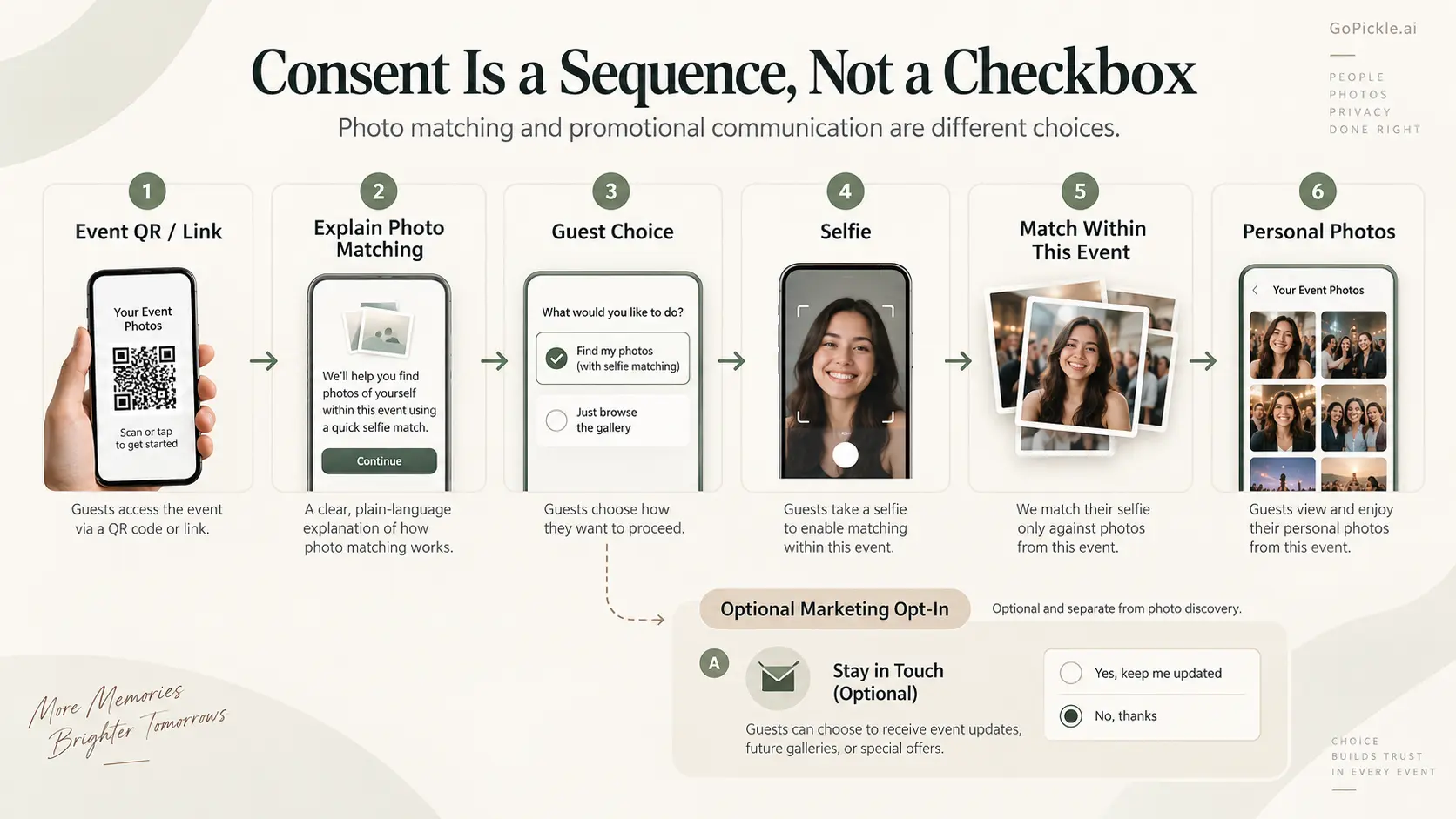
A cleaner flow keeps the essential guest-gallery action separate from optional marketing:
Open event → understand face matching → consent where required → provide selfie → find photographs
Then, if the studio legitimately wants to offer future communication:
Optional: receive studio news, offers or future photography communication
The applicable legal requirements for marketing consent vary by jurisdiction and communication channel, but separating these decisions is good operational design even before legal analysis begins. It makes the guest's choice understandable and gives the studio a cleaner record of why particular contact information exists.
GoPickle's own photography-software guidance follows the same principle: guest registration should not be casually treated as unrestricted marketing permission. Photographers evaluating this area can also review our broader face recognition software buyer's guide.
Limit who can access results
Privacy is not solved merely because a platform correctly matches a face.
Ask what a successful match actually unlocks.
A guest who searches for themselves at a corporate conference may need their photographs, not unrestricted access to every attendee in the full event archive. A wedding client may want relatives to discover their own images without exposing private preparation photographs or sensitive family moments. A school, private celebration or closed corporate event may need considerably tighter access than a public festival.
Access controls should therefore be evaluated at several levels: who can open the event, who can initiate face search, what a matched guest can see, what can be downloaded, whether personal result links can be forwarded, and who inside the photography studio or event organisation has administrative access.
The safest workflow is not automatically the workflow with the most passwords. Excessive authentication can make an event gallery unusable. What matters is matching the level of access to the sensitivity of the assignment.
This is also where a standard client gallery and an AI guest gallery should not be confused. GoPickle uses Client Galleries for curated final delivery to the paying client, while AI Guest Galleries are designed around individual attendee discovery. If you are deciding how clients, relatives, vendors and guests should access the finished collection itself, our guide to client album privacy and access covers that broader delivery problem.
Create a retention and deletion policy before the event
"How long is the gallery available?" is only one retention question.
An AI photo sharing workflow can involve several kinds of information with different purposes:
| Information | Why it may exist | Question to resolve |
|---|---|---|
| Event photographs | Client and guest delivery | How long should the event remain hosted? |
| Guest selfie | Reference for face search | Is it stored, or only processed temporarily? |
| Facial representation or template | Matching | Is it retained after matching, and for how long? |
| Match results | Personal photo discovery | When do personalised results expire? |
| Email or phone number | Notification or registration | Is it still needed after delivery? |
| Marketing permission | Optional future communication | Is the consent record stored separately? |
| Technical/security logs | Reliability and security | What is logged and when is it removed? |
Do not assume all of these records share the same lifecycle.
A photographer may reasonably keep the finished event gallery available for the client while having no operational reason to keep a guest's matching selfie for the same period. Likewise, deleting an original selfie does not necessarily tell you whether a derived facial template still exists.
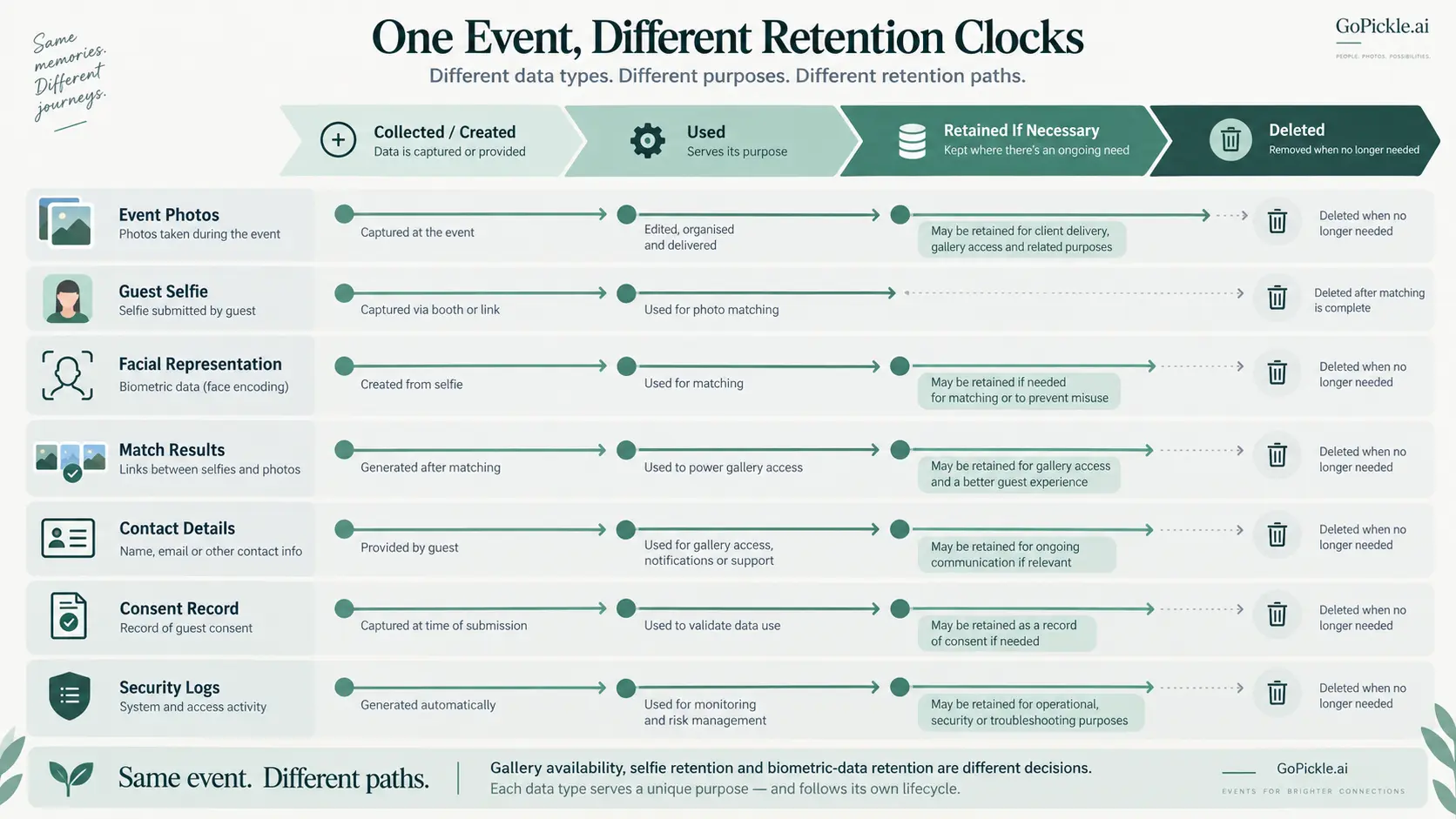
This is why retention should be discussed with an AI gallery provider before purchase, not after a guest asks for deletion. Ask what is deleted automatically, what the studio controls, what happens when the event itself is deleted, whether backups follow a different deletion schedule and how applicable access or deletion requests are handled.
Where local law imposes a particular retention requirement, that requirement takes precedence over a studio's convenience.
Take special care with minors and sensitive events
A workflow that feels reasonable at a public industry conference may be inappropriate at a school function.
Events involving children deserve a deliberate review of who can provide valid consent, how access is controlled and whether face recognition is necessary at all. Rules concerning children's data, parental responsibility and age of consent vary substantially between jurisdictions. Do not copy an adult wedding-gallery flow into a school, youth sports event or children's activity without examining those differences.
The event itself can also change the privacy risk. Private religious ceremonies, confidential corporate gatherings, employee events, healthcare-related functions, shelters, closed community events and other sensitive environments may reveal more about a person than an ordinary social gathering.
Photography businesses already make editorial decisions about which photographs should be published publicly. AI guest galleries require another decision: should face-based discovery be offered in this context at all?
Sometimes the better privacy control is not another checkbox. It is choosing a conventional restricted gallery instead of facial recognition.
Review the jurisdiction where the gallery will actually be used
There is no single worldwide rule called "AI guest gallery consent."
A few examples show why photographers should resist global templates.
European Union and EEA
Under the GDPR, biometric data generated through specific technical processing that allows or confirms unique identification falls within the biometric-data definition. Article 9 addresses biometric data processed for unique identification as a special category of personal data and permits processing only where an applicable condition is satisfied, including explicit consent in appropriate circumstances.
United Kingdom
The ICO states that biometric recognition systems process special-category biometric data because their purpose is to uniquely identify someone. Organisations need an appropriate lawful basis and a separate condition for processing special-category data. The ICO says explicit consent is likely to be the most appropriate condition in many biometric-recognition cases and also says organisations using biometric recognition systems must carry out a data protection impact assessment. Its current biometric guidance is under review following changes introduced by the Data (Use and Access) Act, so UK deployments should be checked against the current guidance rather than an old privacy template.
Illinois, United States
Illinois' Biometric Information Privacy Act defines a scan of face geometry as a biometric identifier. Covered private entities must satisfy specific requirements around written notice, the purpose and duration of collection and a written release before collecting or obtaining covered biometric information. The statute also requires a publicly available retention-and-destruction policy and specifies destruction when the original purpose has been satisfied or within three years of the individual's last interaction with the private entity, whichever occurs first.
Australia
The Office of the Australian Information Commissioner treats biometric information used for automated biometric verification or identification as sensitive information under the Privacy Act for entities covered by that Act. OAIC guidance says regulated entities should have a clear lawful basis and generally need consent when collecting sensitive biometric information, subject to applicable exceptions.
These examples are deliberately not a compliance map for the rest of the world. Other national, state and sector-specific privacy laws may apply, and the photographer, event organiser and software provider can have different responsibilities depending on the arrangement.
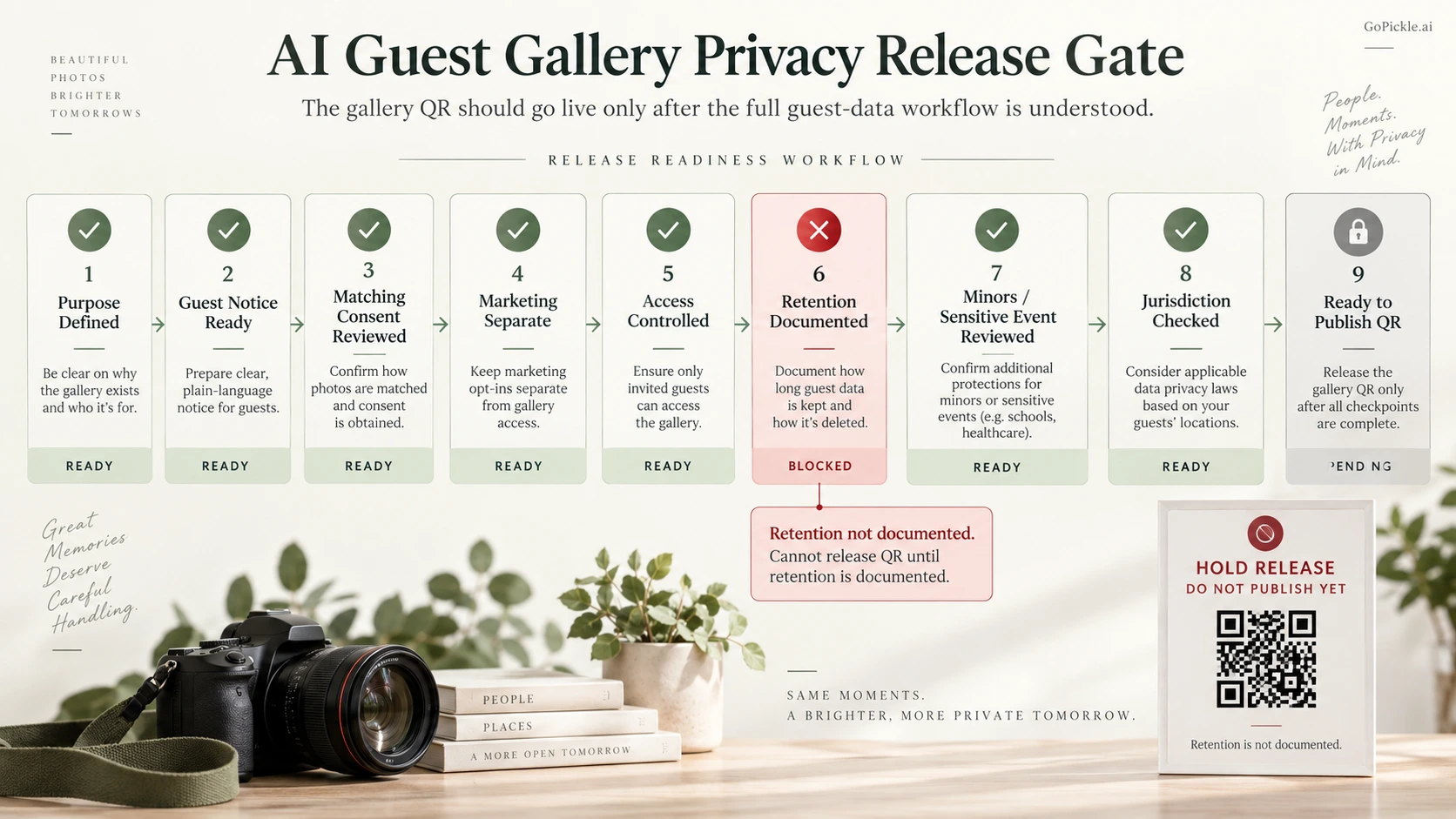
Run this AI guest gallery privacy checklist before publishing the QR code
Before the event goes live, the studio should be able to answer these questions without guessing:
- What exactly is face matching being used for?
- What will the guest see before submitting a selfie?
- What data is created from that selfie?
- Is matching limited to this event?
- Are selfies or derived facial representations retained?
- Are photographs or facial data used to train models or for another secondary purpose?
- Who can view the guest's matched results?
- Can a personal gallery link expose photographs to somebody else if forwarded?
- Are downloads appropriate for this particular event?
- Is marketing permission separate from photo-discovery consent?
- What happens to all guest-related data when the event expires or is deleted?
- Is there a workable process for applicable access, correction, objection or deletion requests?
- Are children or other potentially vulnerable participants involved?
- Has the studio identified which jurisdiction-specific rules apply?
- Does the contract with the AI photo gallery provider clearly explain its role, subprocessors, security and data handling?
The point is not to turn photographers into privacy lawyers. It is to prevent software convenience from hiding decisions the studio is still responsible for making.
Privacy should be part of the AI gallery buying decision
The most impressive face-search demo is usually the moment a selfie finds the correct photographs in seconds. That tells you the technology works. It does not tell you enough about the product.
Before purchasing AI photo sharing software, test the full journey: notice, guest choice, selfie processing, matching, result access, downloads, retention and deletion. Ask what happens after the exciting part of the demo is over.
GoPickle's AI Guest Galleries are designed around QR or link access, selfie-based face matching and personalised photo discovery for event guests. Studios considering any facial-recognition workflow should also read the current GoPickle Privacy Policy and establish the additional notices, consent process and legal review appropriate to their own events and jurisdictions.
AI photo gallery privacy works best when the guest can understand the exchange immediately: "I am providing this selfie so I can find my photographs from this event."
If the actual data flow is significantly more complicated than that sentence, the studio should understand why before asking a guest to participate.