Average Booking Value for Photographers: Calculate It, Segment It and Improve It
Learn how to calculate photography average booking value, segment it by service, source and package, and use ABV with margin, conversion and capacity.

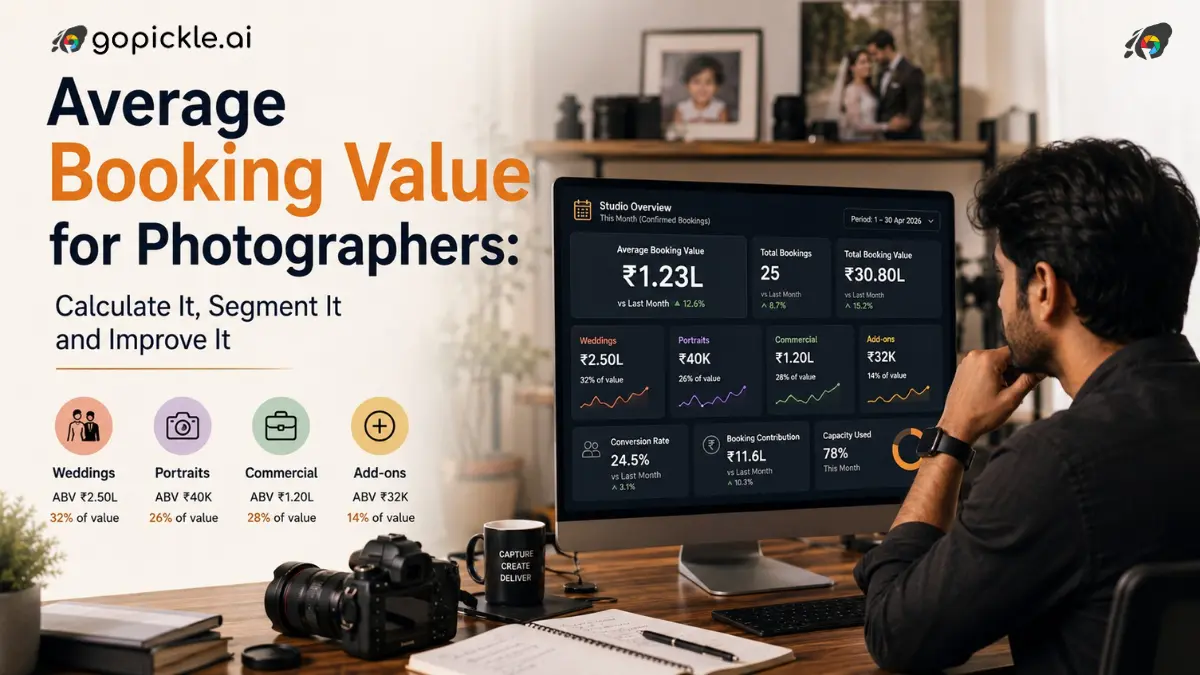
A photography studio finishes the quarter with 30 confirmed bookings worth ₹36 lakh. Divide the value by the booking count and the studio's average booking value is ₹1.2 lakh.
That calculation takes a few seconds. Understanding what the ₹1.2 lakh actually tells you takes more work.
Perhaps weddings account for most of the revenue while family portraits pull the average down. Perhaps referral bookings average far more than enquiries coming from paid advertising. Perhaps the average increased only because the studio happened to book more weddings and fewer portraits this quarter. Or the headline number may have risen because clients are buying albums and additional coverage rather than because the base package itself became more valuable.
This is why average booking value for photographers should be treated as a diagnostic metric, not a scoreboard. Used properly, it helps a studio understand what clients are buying, which services and lead sources produce valuable work, and how much revenue the calendar can support. Used without segmentation, the same number can hide changes that matter far more than the average itself.
How to calculate photography average booking value
The basic formula is:
Average Booking Value = Total confirmed booking value ÷ Number of confirmed bookings
Suppose a studio confirms 12 bookings during a month with a combined booking value of ₹18,00,000.
₹18,00,000 ÷ 12 = ₹1,50,000 average booking value
The first decision is what you mean by “booking value.”
For management reporting, we recommend using the agreed value of confirmed work after discounts, using a consistent treatment of taxes. If you compare figures excluding tax one month and including tax the next, the trend becomes unreliable. Cancelled bookings should normally be separated rather than left inside the confirmed-booking calculation.
Most importantly, do not calculate ABV from cash collected during the period.
A ₹2,00,000 wedding may be confirmed this month while the client pays only a ₹50,000 advance. The photography booking value is still ₹2,00,000. The ₹50,000 belongs in collections reporting.
GoPickle's guide to monthly photography studio reports explains why booked revenue, expected collections and money actually received need to remain separate. ABV measures the commercial value of the work you are winning; collection metrics tell you when that money reaches the business.
There is another related metric photographers sometimes call average sale per client. Do not assume it is identical to ABV. A returning client might make three separate bookings during a year. Average sale per client can aggregate those transactions around the person, while average booking value treats each confirmed assignment as a transaction. Decide which question you are trying to answer before choosing the denominator.
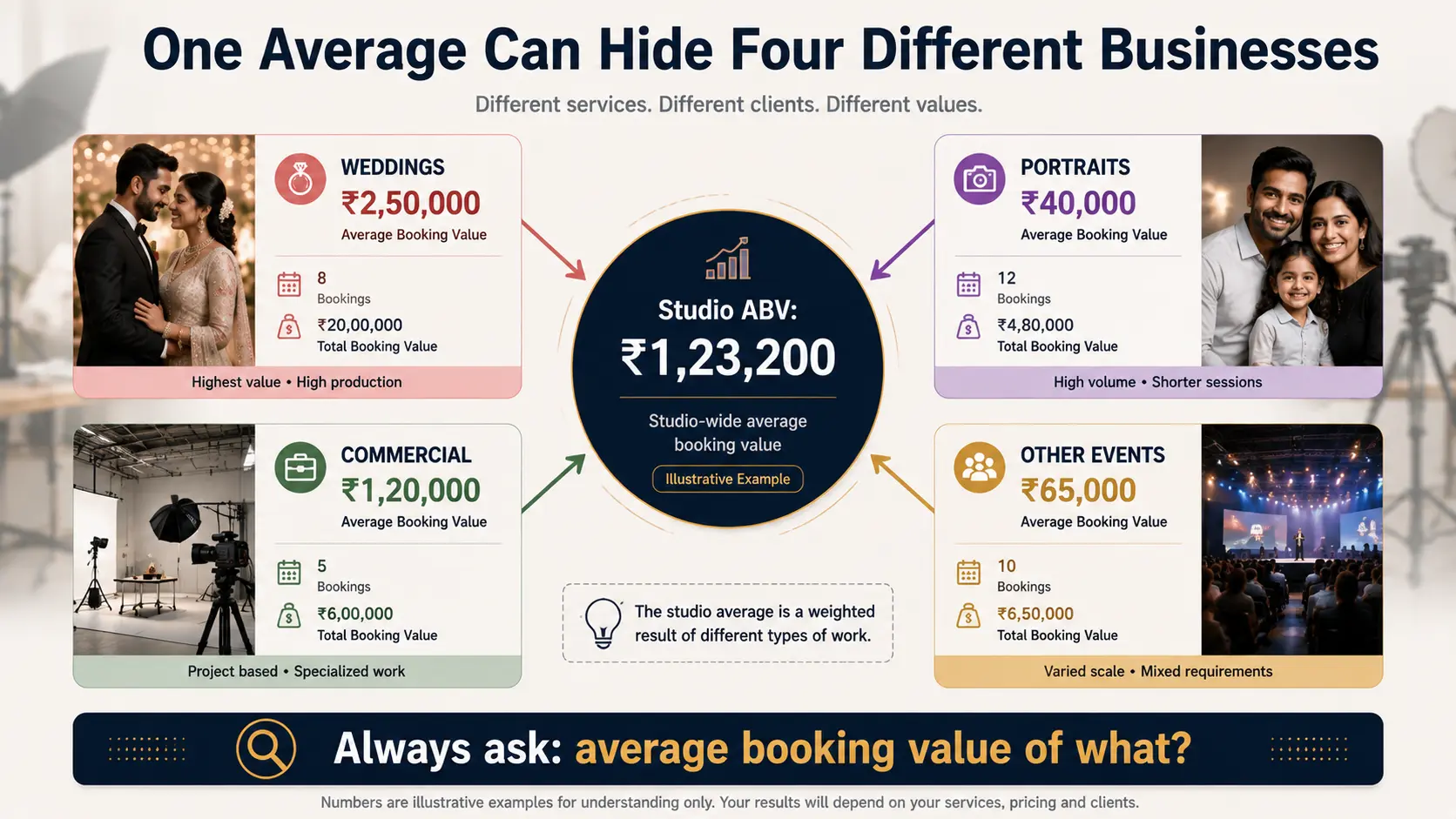
Why one studio-wide average can hide problems
Imagine that your studio-wide ABV rises from ₹95,000 to ₹1,20,000.
At first glance, that sounds excellent.
Now imagine the underlying numbers show that wedding pricing did not change at all. Instead, you photographed fewer family sessions and happened to confirm three destination weddings during the period. The overall average increased because the mix of bookings changed, not because each type of booking became more valuable.
The reverse can happen too. Your studio may add a successful lower-priced portrait service that produces healthy margins and fits into weekday capacity. Overall ABV falls because those sessions now make up a larger percentage of bookings. Declaring that deterioration based only on the headline average would be a mistake.
This is a common weakness in photography studio revenue metrics: averages compress different types of work into one number.
The studio-wide figure is still useful for high-level planning. If you have 40 realistic booking slots and a historical ABV of ₹1 lakh, it gives you a rough sense of the revenue capacity associated with those bookings. But it should always be followed by another question:
Average booking value of what?
Segment ABV by weddings, portraits and commercial work
The first useful segmentation is by service line.
Consider this illustrative dashboard:
| Service | Bookings | Confirmed value | ABV |
|---|---|---|---|
| Weddings | 8 | ₹20,00,000 | ₹2,50,000 |
| Portraits | 12 | ₹4,80,000 | ₹40,000 |
| Commercial | 5 | ₹6,00,000 | ₹1,20,000 |
| Studio total | 25 | ₹30,80,000 | ₹1,23,200 |
The studio-wide ABV is ₹1,23,200, but almost nobody actually buys a ₹1,23,200 package. The number is a weighted average of three very different businesses.
Wedding photography may consume multiple dates, larger crews and heavier post-production. A portrait photographer might complete several sessions in the capacity required for one wedding. Commercial photography may have fewer bookings but different licensing, production and retouching economics.
This is why ABV becomes far more useful alongside booking-level photography profit margin. A ₹2.5 lakh wedding is not automatically more commercially attractive than a series of ₹40,000 portrait sessions if the wedding requires much greater crew, album, travel and editing costs.
Segment further where the data is useful. Wedding studios might compare local weddings, destination weddings and smaller events. Portrait studios could separate maternity, newborn, family and corporate headshots. Commercial photographers might separate catalogue, corporate event and campaign work.
The objective is not to produce dozens of tiny reports. It is to stop commercially different services from disappearing inside one average.
Separate the base package from add-ons
ABV can increase for two very different reasons.
Reason one: clients are buying a more expensive core package.
Reason two: the original package is roughly unchanged, but clients are buying more around it.
That distinction matters.
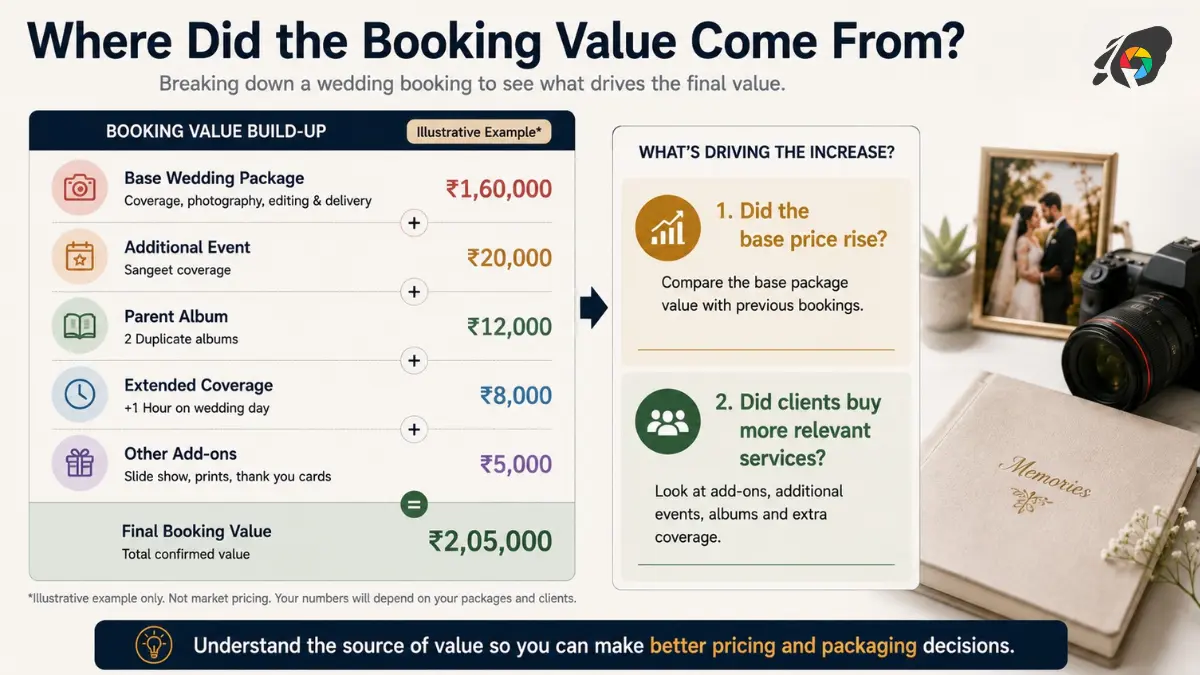
Suppose your standard wedding booking begins at ₹1,60,000. Over a quarter, the average confirmed wedding value reaches ₹2,05,000 because clients regularly add parent albums, pre-wedding coverage, an extra event and longer cinematography coverage.
The additional ₹45,000 is telling you something about purchasing behaviour.
Track:
Base package value
- upgrades
- additional events or hours
- albums / prints
- special delivery or other add-ons
= final booking value
This lets you calculate an add-on contribution such as:
Add-on value per booking = Total add-on revenue ÷ Relevant bookings
You may discover that a package described internally as your “₹1.6 lakh wedding package” actually produces a much higher average sale because the package creates a natural path to services that clients genuinely want.
This information can improve package design. If almost every client adds the same service, perhaps it belongs in a higher package tier. If an add-on is rarely selected, the problem might be relevance, presentation or pricing rather than the existence of the service itself.
Do not turn this into compulsory upselling. Increasing photography average booking value by loading every quote with unnecessary products can hurt trust and conversion. The better objective is to make the complete requirement visible and give clients sensible choices.
Use ABV with conversion rate and capacity
A higher ABV is not automatically a healthier photography business KPI.
Consider two periods.
Period A:
100 qualified enquiries
30 bookings
₹1,20,000 ABV
₹36,00,000 booked value
Period B:
100 qualified enquiries
18 bookings
₹1,60,000 ABV
₹28,80,000 booked value
ABV increased by a third, but confirmed revenue fell because fewer opportunities converted.
That does not automatically mean Period B was worse either. The 18 bookings may have much better margins and consume significantly less production capacity than the 30 bookings in Period A. You need another layer.
ABV becomes much more useful when reviewed with:
- lead-to-booking conversion rate;
- gross booking value;
- contribution or profit margin;
- bookings completed;
- available production capacity;
- average crew requirement;
- lead source;
- collection status.
Capacity is particularly important for photographers because inventory is partly time.
A studio cannot simply sell unlimited weddings because demand rises. There are only so many Saturdays, crews and editing hours available. If your calendar is close to capacity, increasing the value generated by each suitable booking can be more useful than pursuing additional volume. If you have plenty of unused capacity, rejecting profitable lower-ABV work simply to protect an average may make little sense.
The related GoPickle article on photography business break-even explains why booking contribution and required booking volume need to be considered together.
Segment average booking value by lead source
Lead source is another valuable cut.
Suppose your results look like this:
| Lead source | Confirmed bookings | ABV |
|---|---|---|
| Referrals | 14 | ₹1,85,000 |
| Website | 9 | ₹1,55,000 |
| 12 | ₹1,10,000 | |
| Meta Ads | 8 | ₹82,000 |
That does not prove referrals are always better or advertising is poor. It shows what happened inside your studio during the period.
Now connect ABV with conversion.
Perhaps Meta Ads brings a much larger number of qualified leads, so the total booked value remains attractive despite the lower ABV. Perhaps website enquiries produce fewer leads but higher-value commercial assignments. Perhaps referrals combine strong conversion with high booking value and deserve a more deliberate referral programme.
Our guide to which lead sources work best for photography studios makes the same point from the sales side: enquiry volume alone does not tell you which channel produces valuable business.
This is also why a photography CRM becomes more useful when the lead source survives the transition into the confirmed booking. GoPickle's Lead Management for Photographers keeps the source attached to the opportunity so studios can eventually judge channels by the work they produce, not only by how many messages arrive.
What actually improves average booking value
There are only a few durable ways to increase what clients spend per booking, and none requires forcing random extras into the quotation.
You can improve the value of the core service by changing positioning, scope, experience or pricing. You can design clearer package tiers so clients can see meaningful differences instead of three versions that appear almost identical. You can make relevant add-ons visible at the right stage: additional event coverage for a wedding, album copies for parents, an extra image set for a commercial assignment, or extended usage where the client's campaign actually requires it.
You can also improve requirement discovery.
Sometimes a studio has a low booking value because it never asks enough questions to discover the complete assignment. A client asks for wedding photography, receives the entry package immediately and later sources film coverage somewhere else because nobody asked. A corporate client asks for executive portraits but also needs conference photography the following morning. Better discovery can increase booking value without manipulating the client because the studio is simply quoting the real scope.
What should not be done is raising ABV in isolation.
If an expensive new package increases average booking value but causes conversion to collapse, review the full outcome. If a premium album pushes up revenue but contributes almost no margin after production and design costs, revenue alone is misleading. If adding services makes each booking so operationally heavy that the studio can complete fewer profitable jobs, ABV has again hidden the trade-off.
What an ABV dashboard should actually show
A useful dashboard should let the owner move from the headline number into the explanation behind it.
At minimum, we would want to see:
Studio ABV: What is the current average confirmed booking value?
ABV by service: Are weddings, portraits and commercial work moving differently?
ABV by package: Which package tier is actually being purchased?
Base vs add-on value: Is growth coming from pricing or additional services?
ABV by source: Which enquiry channels produce higher-value confirmed work?
Conversion rate: Are higher values being achieved without losing too many suitable bookings?
Booking contribution: Does higher revenue leave more money after direct costs?
Capacity: How many bookings can the studio realistically fulfil at the current service mix?
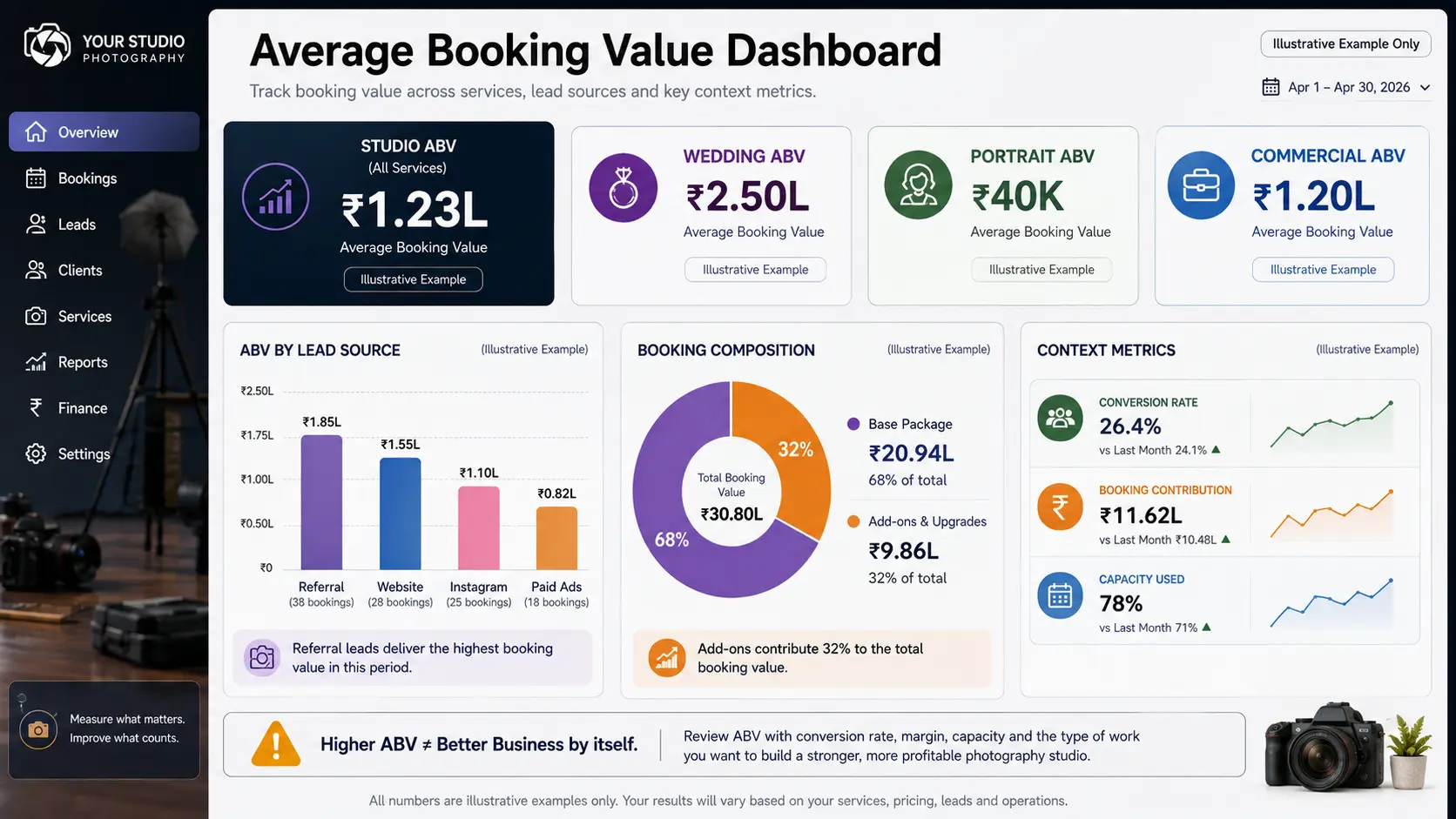
The quality of the dashboard depends on the booking records underneath it. GoPickle's Booking Management for Photographers keeps the client, events, services, deliverables, crew, quotation, invoice and payment context connected around confirmed work. That structure makes metrics such as booking value more useful because the number remains attached to what was actually sold.
Average booking value deserves a place among photography studio revenue metrics, but not because there is a universal number photographers should aim for.
A ₹30,000 portrait booking, ₹2 lakh wedding and ₹5 lakh commercial project can all be excellent work for the right business model. What matters is whether the studio understands which services produce its revenue, what each booking costs to fulfil, where those bookings come from, and how much capacity they consume.
Calculate the average. Then segment it until it explains something useful.