Commercial Photography Estimate vs Quote vs Proposal: What the Client Actually Needs
Commercial photography estimate, quote or proposal? Learn what each document does, what to include, when to send it and how approval should flow into invoicing.

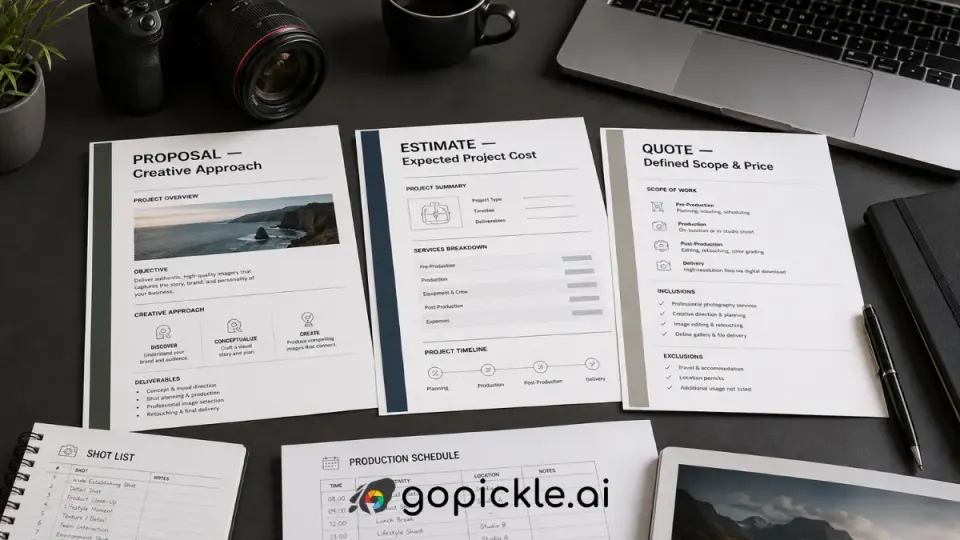
A client emails asking for a “commercial photography quote.” Another asks for an estimate. An agency wants a photographer bid, while a marketing team asks for a proposal before it has even confirmed the number of shoot days. These requests sound similar, but they are not always asking for the same thing.
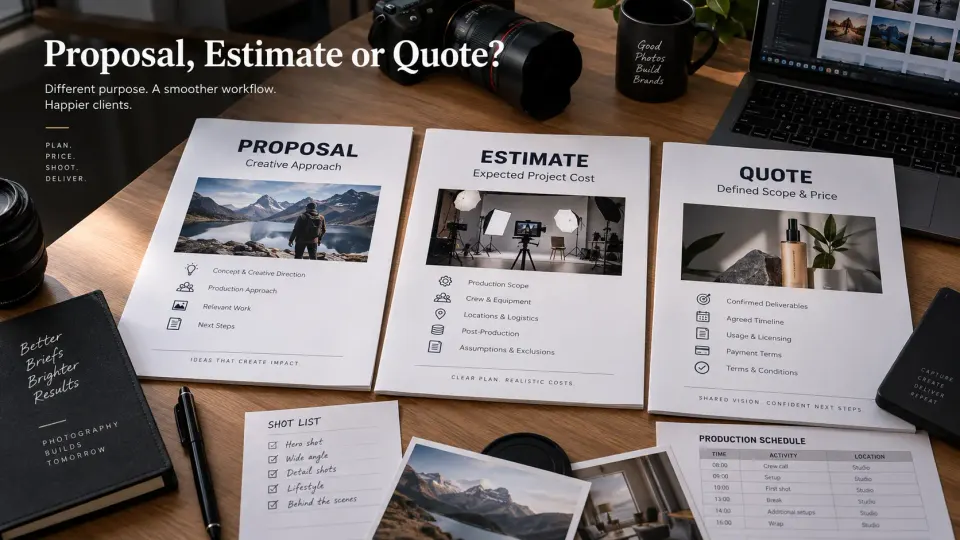
A commercial photography proposal explains your creative approach and why you are suited to the assignment.
A commercial photography estimate shows what the project is expected to cost based on the scope and assumptions currently known.
A commercial photography quote is more appropriate when the scope is defined well enough for you to offer a firm price.
A commercial photographer bid may combine the proposal, production estimate, licensing terms and other information required by a competitive procurement process.
Not every assignment needs three separate documents. A smaller corporate shoot may move from enquiry straight to a detailed quotation. A large advertising campaign may require a treatment, estimate, revisions, agency approval, purchase order and contract before anybody picks up a camera. The important part is not the document name. It is whether the client can clearly see what you will produce, what it will cost, what assumptions the price depends on and what happens if the brief changes.
Why terminology matters in commercial photography
Commercial photography pricing contains more moving parts than simply multiplying a photographer’s day rate by the number of shoot days. Pre-production, crew, equipment, locations, styling, talent, travel, post-production, retouching and image licensing can all affect the final project cost. That makes the document you send part of production risk management.
Consider a company asking for photographs of its leadership team. If it needs one photographer, one office, 20 portraits and internal corporate use, a firm quotation may be realistic after a short briefing. If the same company wants executives photographed across six cities, with location scouting, local assistants, travel and photographs licensed for an international advertising campaign, several costs may still be unknown when the first budget conversation happens. Presenting every number as fixed would create certainty on paper without certainty in the production.
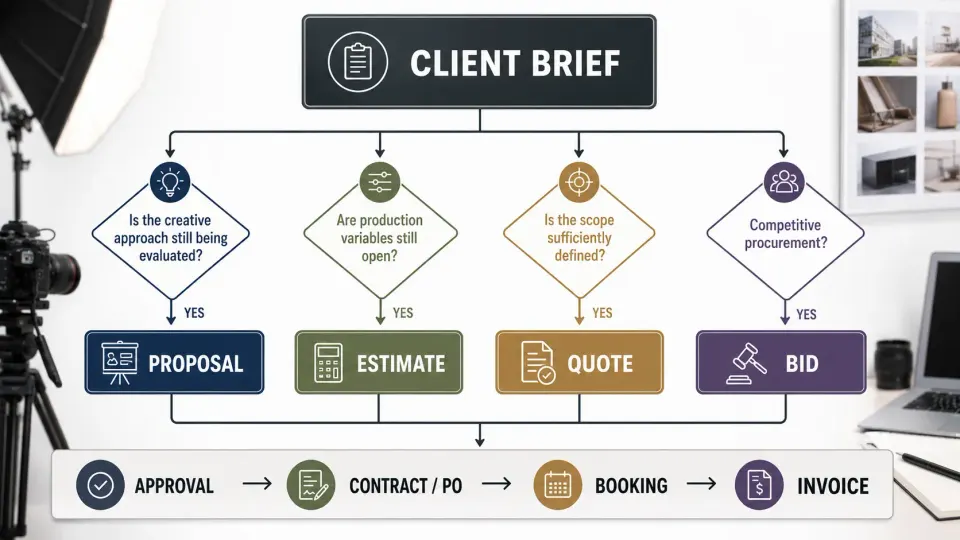
A useful way to distinguish the documents is by the question they answer.
| Document | The question it answers | Usually appropriate when |
|---|---|---|
| Proposal | How would you approach this assignment? | Creative approach or photographer selection is still being evaluated |
| Estimate | What is this assignment likely to cost? | Production variables or expenses are still being confirmed |
| Quote | What will you charge for this defined scope? | Deliverables and major cost assumptions are sufficiently clear |
| Bid | What are you offering in response to our brief or procurement request? | The photographer is competing for a commercial assignment |
These are working distinctions rather than universal legal definitions. Terminology varies between countries, clients and industries. A document titled “estimate” can also contain contractual terms, while some businesses use “quote,” “proposal” and “bid” interchangeably. Your contract, acceptance wording, purchase order and applicable local law matter more than the heading at the top of the PDF.
Proposal: sell the creative approach before reducing the job to a price
A commercial photography proposal becomes valuable when the client has not yet chosen how the assignment should be executed.
Imagine a hotel group preparing a new campaign. It may know that it needs approximately 30 finished photographs, but it is still deciding between photographers. At this stage, the buyer is not comparing only numbers. The marketing team may want to understand your visual direction, lighting approach, use of talent, proposed locations, production method and whether your previous work fits the brand. That is proposal territory.
A strong commercial photography proposal should show that you understand the brief rather than filling pages with a generic biography. Explain the intended visual approach, the important production decisions, expected deliverables and broad schedule. Include relevant work where it helps the client evaluate your suitability. If the assignment needs pre-production, casting, scouting, styling or specialist crew, explain enough of that approach for the client to understand how the work will be produced.
Pricing can still appear inside the proposal. In fact, many photographers send one combined document containing the creative treatment followed by an estimate or quotation. Separating the concepts does not mean you need to create separate PDFs for every job.
The distinction matters because a proposal should help answer “Why this photographer and this approach?”, while the pricing section answers “What are we buying and what will it cost?”
For a simple catalogue shoot with repeatable specifications, a ten-page creative proposal would probably slow the buying process rather than improve it. For a campaign where the client is choosing between different creative interpretations, sending only a spreadsheet of rates may leave the most important part of your offer unexplained.
Estimate: show the expected cost and the assumptions behind it
A commercial photography estimate is most useful when you understand the assignment well enough to model its cost but some variables remain open.
The word “estimate” should not be treated as permission to send a vague number. A useful estimate gives the client enough information to understand what has been costed and gives the photographer a baseline against which later changes can be measured.
What should a commercial photography estimate include?
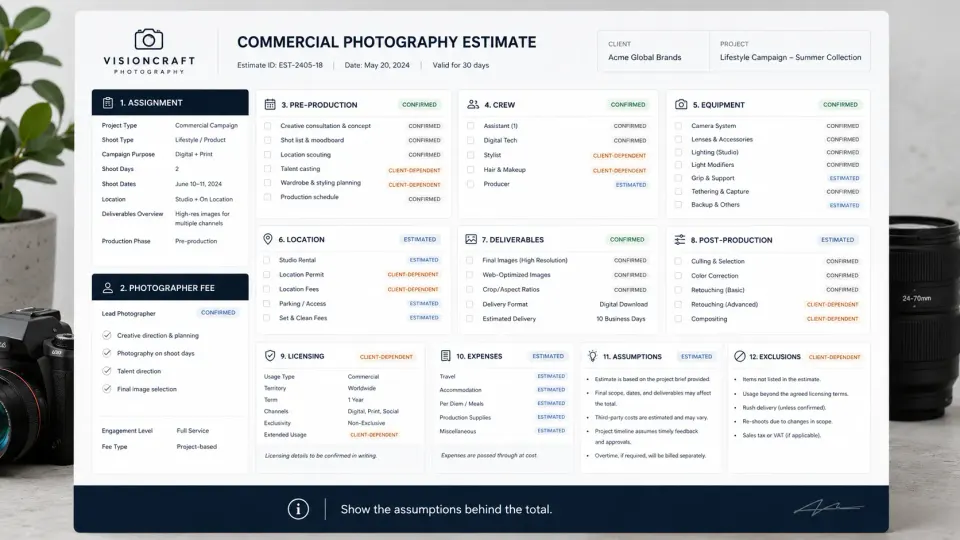
A photography estimate template for commercial work will usually need more detail than a consumer portrait price sheet. Depending on the project, it may include:
| Estimate area | What should be clear |
|---|---|
| Assignment | What is being photographed and for whom |
| Shoot scope | Dates, hours or days, locations and planned setups |
| Photographer fee | Creative, shoot or project fee |
| Pre-production | Meetings, scouting, planning, testing, casting or coordination |
| Crew | Assistants, digital technicians, producers, stylists or other specialists |
| Equipment | Included equipment and additional rentals |
| Location / studio | Studio hire, permits or location-related costs |
| Deliverables | Approximate or confirmed number and type of finished photographs |
| Post-production | Editing, colour work, compositing and retouching allowance |
| Licensing | Media, territory, duration, exclusivity and other usage conditions |
| Expenses | Travel, accommodation, transport, props, couriers or other production costs |
| Assumptions | Conditions on which the estimate was prepared |
| Exclusions | Work or costs that are specifically not included |
| Payment | Deposit, milestones, balance and applicable taxes where relevant |
| Validity | How long the pricing or underlying assumptions remain current |
This is where commercial photography estimates differ substantially from a basic photography quotation template found online. A generic template might provide fields for quantity, rate and total, but commercial production often needs to explain why those costs exist and what could change them.
Licensing is a particularly important example. A photographer may quote one fee for creating the photographs and a separate fee or component for how those photographs may be used. Website use, organic social media, paid advertising, packaging, retail displays, international campaigns and third-party use can represent materially different commercial requirements.
If you regularly price advertising, product or corporate assignments, read our detailed guide to usage rights, licensing and buyouts in commercial photography quotes. It covers the variables that should be discussed before an apparently simple “all usage” request becomes part of the price.
An estimate should also identify uncertain production costs rather than hiding them. If airfare has not been booked, a location fee is awaiting confirmation or the final retouching requirement depends on the client’s image selection, say so. The client can then distinguish a known fee from a variable production expense.
Quote: use a firm price when the scope is firm enough
A commercial photography quote is easier to stand behind when the assignment has clear boundaries.
Suppose a company books quarterly employee headshots at the same office. The lighting setup is known, the session runs for one day, the maximum number of employees is agreed, each employee receives two retouched files and the company has a defined usage requirement. There are relatively few unknowns. A firm project quotation can make buying easier because the client knows exactly what the approved scope will cost.
Compare that with an advertising shoot where the agency has not finalised the location, talent, shot count or usage territory. A fixed commercial photography quote at that stage may force the photographer to absorb later costs or repeatedly explain why the original price no longer applies.
Firm pricing still needs boundaries. Your commercial photography quotation should identify the scope being priced, deliverables, shoot duration, included retouching, licensing, payment terms and the treatment of work outside the agreed scope. Where relevant, address overtime, travel, additional images, reshoots, cancellation and client-driven production changes.
For corporate assignments, our guide to what a corporate photography quotation should include goes deeper into coverage windows, deliverables, crew, travel, usage, payment terms and procurement requirements.
The goal is not to add clauses until the quotation becomes difficult to read. It is to make the commercial boundaries understandable before the work begins.
What is a commercial photographer bid?
“Bid” is common when several photographers or production companies are being considered for the same assignment. An agency, brand or procurement department may issue a creative brief, request for proposal or another structured invitation and ask photographers to submit bids by a deadline.
A commercial photographer bid can therefore be broader than a quotation. The requested package might include your creative treatment, production approach, photographer fee, usage fee, estimated production expenses, crew plan, schedule, portfolio, insurance information or vendor documentation.
Follow the client’s bid instructions rather than forcing your normal proposal template onto their process. Procurement teams may need costs separated into specific categories, while agencies may need photographer fees and production expenses presented independently so competing submissions can be compared.
This is also why competing only on the final total can be misleading. Two commercial photography estimates can have different totals because one includes production, retouching and licensing that another photographer has left outside the headline fee.
What changes after the client changes the scope?
Scope changes are normal in commercial photography. What creates problems is allowing them to happen without updating the commercial record.
Assume the approved assignment covers:
One shoot day → one location → 15 final photographs → website and organic social use.
During pre-production, the client adds a second location and another 10 finished photographs. The marketing department then confirms that the images will also be used for paid advertising.
Three parts of the assignment have changed. Production may require more time or resources, post-production now covers more photographs, and the licensing requirement is broader.
Do not simply edit the original number and send a new total without context. Preserve the approved version and show the change. Depending on the client and jurisdiction, this might be handled through a revised estimate, change order, variation, addendum, approved email or updated purchase order.
The revised record should make five things easy to identify: what changed, which costs changed, whether delivery timing changed, whether usage changed and who approved the revision.
This approach is particularly useful when several people are involved. The photographer may be discussing the shoot with an art director while procurement approves costs and accounts payable later receives the invoice. Six weeks after production, “Sarah said it was fine on the shoot” is a poor financial record.
How approval should flow into booking and invoicing
An approved photography proposal or estimate is not the end of the workflow. It is where sales information begins turning into production information.
A typical commercial sequence might look like this:
Brief → Proposal if needed → Estimate or Quote → Approval → Contract / PO → Booking → Production → Approved Variations → Invoice
The exact sequence will vary. An agency might contract the photographer before issuing a purchase order. A small business might approve a quotation and pay a booking amount immediately. A large corporation may require vendor registration before it can issue a PO. There is no universal sequence that applies to every client worldwide.
What should remain consistent is the underlying scope.
If the approved quotation says two shoot days, three locations, 25 finished images and a defined licence, those details should not have to be reconstructed manually when the assignment becomes a booking. The invoice should not introduce a completely different description of the job. Additional costs should be traceable back to approved changes.
This is one reason we think photographers should treat quotations as part of the studio workflow rather than disposable PDFs. With GoPickle Photography Quotations, photographers can present project scope, services, pricing and portfolio references for client review and approval, then carry the approved work into Booking Management. When it is time to bill, GoPickle Invoicing keeps advances, balances and invoice status attached to the financial side of the assignment.
Software does not replace a commercial contract, licence, purchase order or the documentation your client requires. Its job is more operational: keeping what was proposed, what was approved, what was scheduled and what was billed from becoming four different versions of the same job.
Proposal vs estimate vs quote: which should you send?
If you are unsure what the client means when they ask for “pricing,” work backwards from the decision they are trying to make.
Send a proposal when the client still needs to evaluate your creative approach, production thinking or suitability for the assignment.
Send an estimate when the broad scope is understood but some costs or production conditions remain variable.
Send a quote when the scope is sufficiently defined for you to offer firm pricing subject to the terms stated in the document.
Submit a bid when the client is running a structured or competitive procurement process and has asked you to respond to a defined brief.
Sometimes one document can do several of these jobs. A commercial photography proposal may contain an estimate. A bid may contain both a treatment and detailed production costs. A quotation may include portfolio images and project notes.
The client does not need three documents merely because three terms exist. They need enough creative, production and commercial information to approve the assignment without guessing what they are buying.
Frequently asked questions about commercial photography estimates and proposals
Is a photography estimate the same as a quote?
Not necessarily. A commercial photography estimate generally communicates the expected cost of a project based on known scope and assumptions, while a quote is often used when the photographer is prepared to offer firmer pricing for a defined scope. However, terminology and legal treatment vary by country and business, so the actual wording and terms of the document matter.
What should a commercial photography estimate include?
At minimum, identify the assignment scope, photographer fee, deliverables, production costs, post-production, licensing or usage rights, relevant expenses, assumptions, exclusions, payment terms and any conditions that could change the estimated total. More complex productions may also require detailed crew, equipment, studio, travel, talent and pre-production costs.
Should I send a photography proposal or estimate first?
Send a proposal first when the client needs to evaluate your creative solution or production approach before approving the project. If the creative requirement is already clear and the client mainly needs pricing, you may be able to move directly to an estimate or quotation.
Can a photography proposal include the price?
Yes. A proposal and pricing do not need to live in separate documents. Many commercial photography proposals include the creative approach, scope, deliverables and an estimate or quotation in the same presentation.
Is a commercial photography estimate a contract?
Do not assume that the document title alone determines whether an agreement is legally binding. Acceptance language, incorporated terms, contracts, purchase orders and local law can all affect the legal position. Commercial photographers should use appropriate agreements for the markets and clients they serve.
What happens if the client changes the brief after approving the estimate?
Record the change before carrying out significant additional work whenever practical. Compare it with the approved scope, calculate any effect on production, deliverables, licensing, schedule and price, and obtain the form of approval required by your agreement or the client’s procurement process.
A good commercial photography estimate does more than tell a client what a shoot costs. It gives everyone involved a common definition of the assignment. Once that definition is clear, choosing between a proposal, estimate or quote becomes much easier.