Instagram DM to CRM: A Workflow for Photography Enquiries That Start in Social
Learn when an Instagram DM should become a photography CRM lead, what context to save, how to assign ownership and move enquiries toward quotes and bookings.

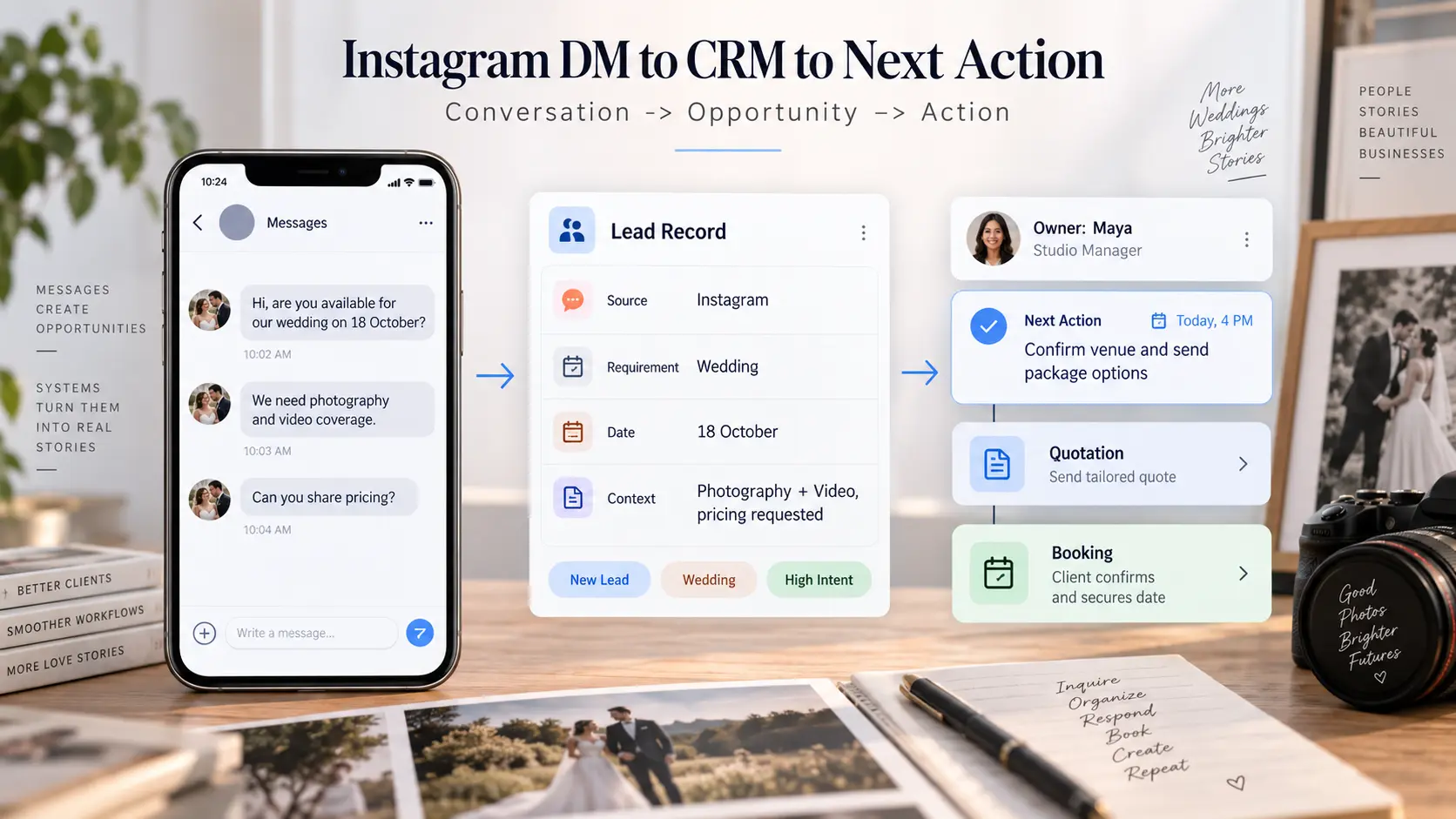
Instagram is often where the relationship starts, but it is rarely where a photography studio should manage the entire sales opportunity.
A prospective client may reply to a wedding Reel, ask for pricing in a DM, send an event date two messages later and disappear while your team is covering another shoot. Three days after that, they return asking whether the date is still available. Meanwhile, another team member may have already spoken to them on WhatsApp or received a call from a family member.
The problem is not Instagram. It is expecting a conversation inbox to behave like a sales system.
A practical workflow for Instagram leads for photographers should preserve the convenience of social messaging while moving commercially meaningful enquiries into a CRM before the context becomes difficult to recover. Instagram can remain the conversation channel. The CRM becomes the place where the studio records what the person needs, who owns the opportunity and what must happen next. That handoff is the part many studios miss.
When an Instagram DM becomes a real photography enquiry
Not every Instagram interaction deserves a CRM record. Someone reacting to a Story with a heart, asking where a photograph was taken or commenting “beautiful work” is engagement. Even a message saying “price?” may still be casual browsing. Creating lead records for every social interaction fills the pipeline with noise and makes genuine opportunities harder to see.
The threshold should be commercial intent.
A DM has usually become a real enquiry when the conversation gives your studio a reason to take a sales action. The person may ask about availability, mention a wedding or session, share a date, request a package, ask whether you cover a particular location or explain what kind of photography they need.
You do not need a complete brief before creating the lead.
Consider this conversation:
“Hi, we found your wedding work on Instagram. Are you available around 18 October? We have the ceremony and reception on the same weekend.”
You may not know the venue, budget, guest count or exact services yet. But somebody in the studio now needs to respond, check the requirement and move the conversation forward. That is enough reason to stop treating the DM as something that can safely remain inside an inbox.
A useful operational rule is:
If the studio expects another action because of the message, create or update the lead.
This also keeps the distinction between an enquiry and a qualified opportunity clear. The Instagram DM can enter the CRM while important information is still missing. Qualification happens afterwards.
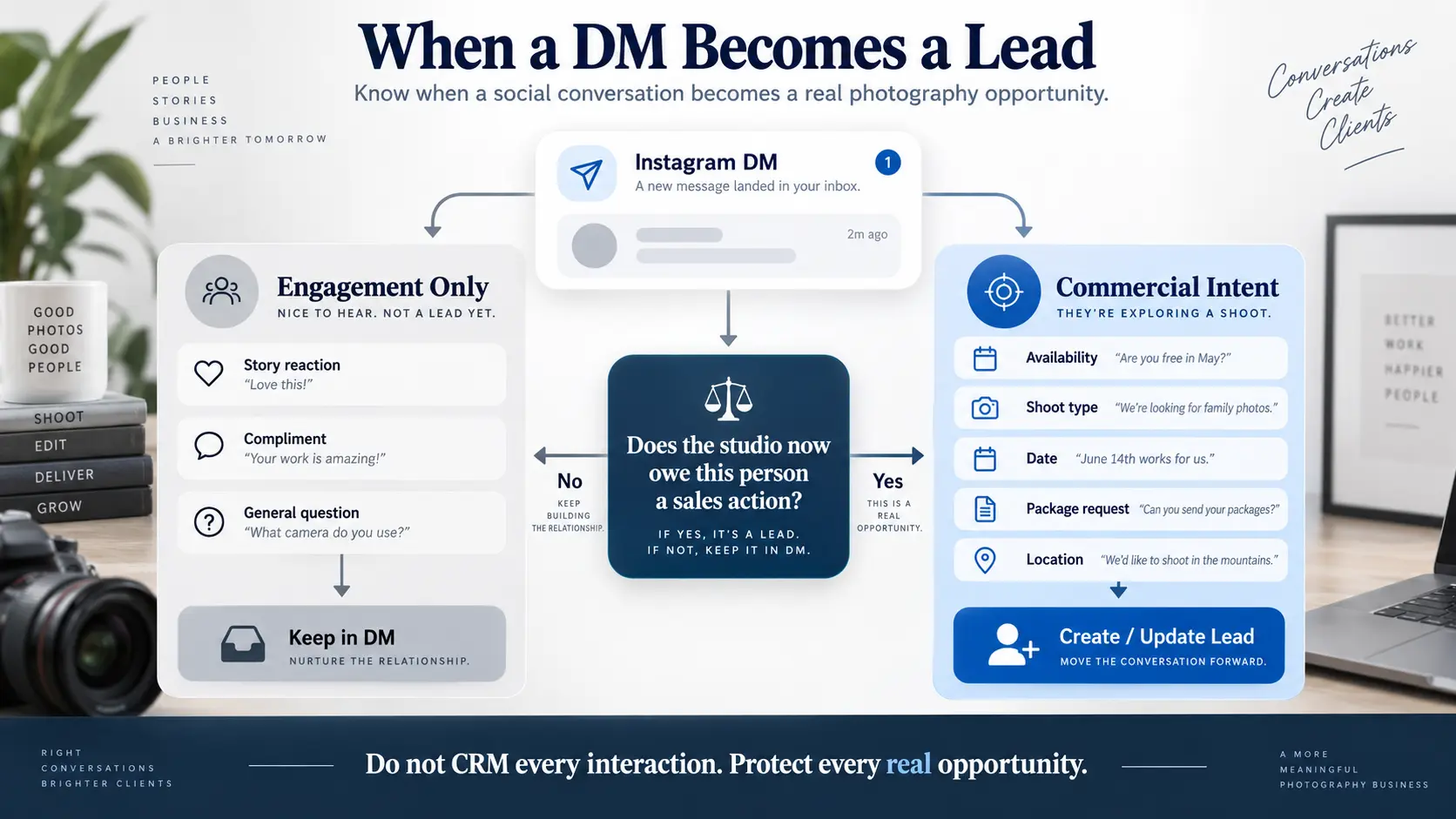
This is different from lead-generation strategy. You are not trying to convert every follower into a sales prospect. You are protecting genuine Instagram photography leads once they reveal enough intent to deserve follow-through.
Move the minimum useful information into the CRM
The common mistake at this stage is going to one of two extremes.
The first is recording almost nothing: Instagram lead — wants wedding package.
The second is refusing to create the lead until the prospect answers a full questionnaire.
Neither works particularly well.
The CRM needs enough information for somebody else in the studio to understand why the record exists and what should happen next. For most photography DM enquiries, start with:
| CRM information | What to capture from the DM |
|---|---|
| Person | Name, if known, plus useful contact details or Instagram handle |
| Lead source | |
| Requirement | Wedding, portrait, family session, event, commercial shoot, etc. |
| Date or timeframe | Exact date, month or approximate period if mentioned |
| Location | City, venue or travel requirement if known |
| Services discussed | Photography, video, album, headshots, reels or other requested work |
| Budget | Only if the client volunteered it or you have already discussed it |
| Conversation context | Short summary of what has happened so far |
| Current stage | New enquiry, requirement pending, consultation needed, quote ready, etc. |
| Owner | Person responsible for progressing the opportunity |
| Next action | The specific thing that should happen next, ideally with a date or time |
That is enough to turn an Instagram conversation into an actionable sales record without forcing the prospect through unnecessary questions.
The principle is similar to building a good photography inquiry form: collect what helps the studio make the next decision, then gather deeper production information later. A DM is naturally less structured than a website form, so the CRM has to provide the structure after the conversation begins.
Keep the original conversation context without copying everything
Moving a lead into a CRM does not mean copying an entire Instagram thread line by line.
The goal is continuity, not transcription.
Imagine a client has already told you that the wedding is outdoors, they mainly like candid photography, the reception venue is still undecided and their family wants traditional video coverage. If another person from your studio calls tomorrow, those details should not disappear simply because they were mentioned casually halfway through a DM conversation.
Record the information that changes the next conversation.
A useful CRM note might read:
Wedding enquiry from Instagram. Ceremony 18 October; reception likely 19 October. Client prefers candid-heavy photography. Family has asked about traditional video. Reception venue still pending. Client wants package options after date availability is confirmed.
That tells another team member considerably more than “spoke on Instagram.”
It also preserves uncertainty correctly. The venue has not magically become confirmed simply because somebody needed to fill a CRM field.
Keep the original communication channel attached to the opportunity as well. The studio may continue talking to the client through Instagram, move to email for a formal proposal, or shift to another messaging channel if the client prefers. The CRM does not have to replace the conversation platform. It needs to preserve the business state of that conversation.
For studios operating across different jurisdictions, apply the same privacy discipline you would use for any client system: keep business-relevant information, avoid unnecessary personal data and follow the privacy and retention requirements applicable to your market.
Set an owner and a real next action
Recording the enquiry is only half the handoff.
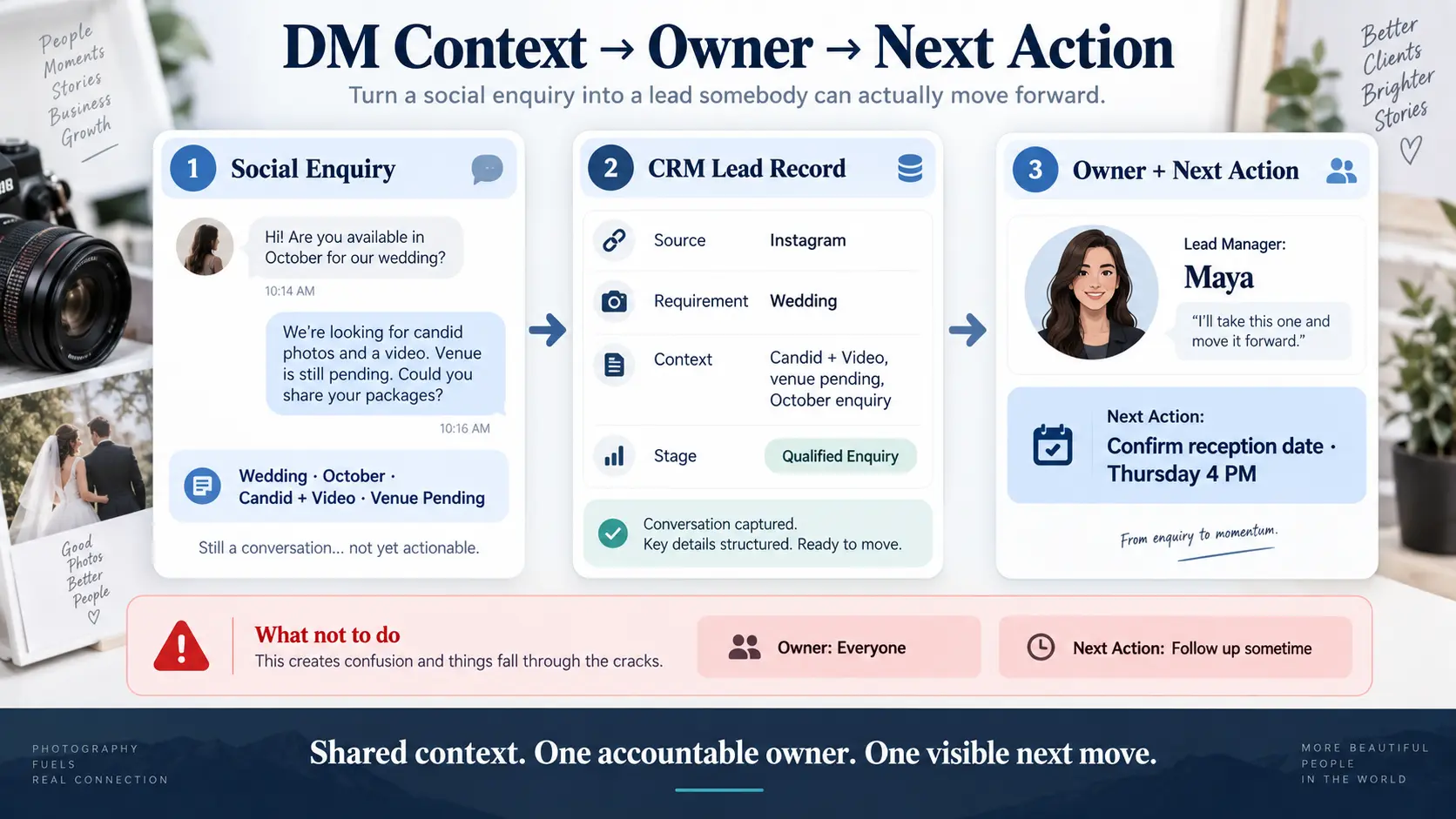
A CRM containing 70 Instagram leads with no assigned responsibility is just a more sophisticated inbox. Every active photography enquiry should answer two separate questions:
Who is responsible for making sure this opportunity moves?
What exactly needs to happen next?
The owner might be the studio manager, photographer, sales coordinator or another team member. Several people can contribute to the enquiry, particularly when somebody needs to check crew availability or clarify cinematography requirements, but one person should remain accountable for its overall progress.
Then give the enquiry a next action that can actually be completed.
Follow up is weak.
Message client Thursday to confirm reception date is actionable.
Send package is better than nothing.
Send the two-day wedding package after confirming whether cinematography is required preserves the reason behind the task.
For a photography studio handling a meaningful volume of social media leads, this distinction is more important than adding more pipeline stages. The stage tells you where the opportunity is. The next action tells somebody what to do.
GoPickle's Lead Management for photographers is built around this structure: source, requirement, ownership, follow-up and the path from enquiry toward quotation and booking. An Instagram enquiry does not need to leave Instagram immediately; it needs to stop depending on one person's memory.
If follow-up itself is the weak point in your process, keep that as a separate workflow problem rather than making the DM-to-CRM procedure unnecessarily complicated. Our photography lead follow-up system covers the stages after capture in more detail.
Handle multiple requirements from one person correctly
Social conversations make duplicate records particularly easy to create.
Suppose Maya first messages your studio about her sister's wedding. Six months later she returns through the same Instagram account asking about a family portrait session. A year after that, she asks for coverage of a company event. That is one person, but three different commercial opportunities.
Combining all three into one permanently changing lead creates problems. The wedding date, portrait budget and corporate-event follow-up have nothing to do with each other. If the wedding is marked booked, that should not automatically make the later corporate enquiry look complete. If one enquiry is lost, Maya herself has not become a “lost client.”
The cleaner model is:
One person → separate requirement → separate lead
Each real requirement can then have its own dates, source, value, stage, next action, quotation and outcome while remaining connected to the same client history.
We cover this distinction in more detail in Why One Person Can Be Multiple Leads in a Photography Business.
There is an equally important opposite rule. Several functions sold together as one wedding requirement do not necessarily need separate leads. A three-day wedding covering welcome dinner, ceremony and reception may still be one commercial opportunity containing several events.
The CRM should model the business opportunity, not mechanically create a new record for every date mentioned in a DM.
Move qualified Instagram enquiries toward quotation and booking
The handoff is working when the studio can stop reopening Instagram simply to remember what the prospect asked for.
Once enough of the requirement is understood, decide what the next sales step should be. For a standard portrait session, that may be a package or booking option. For a wedding, event or commercial assignment, the next step may be a discovery call before you can quote accurately.
A useful path can look like:
Instagram DM → Lead created → Requirement clarified → Consultation or package → Quotation → Follow-up → Booking
Do not rush every photography DM enquiry directly into a quotation.
If dates, functions, services or deliverables are still unclear, the quote will either become generic or require repeated revision. A better approach is to preserve what you already know, identify what is missing and collect only the information required to make the commercial decision.
For more complex enquiries, a structured photography discovery call can turn an incomplete social conversation into a requirement your studio can confidently price.
Once the prospect confirms, the same context should continue into the booking rather than being rebuilt manually from old DMs.
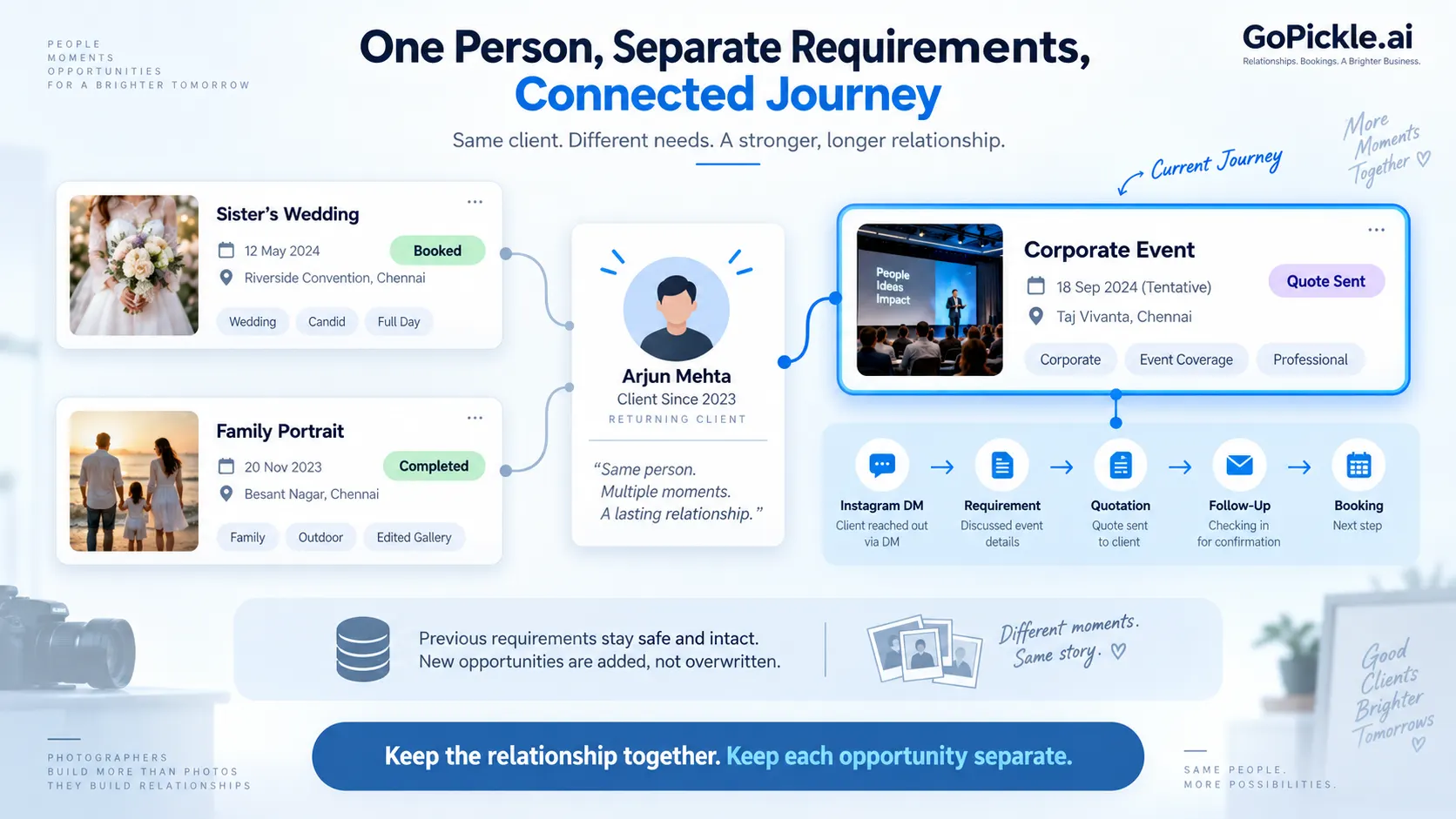
This is where the distinction between messaging and lead management matters most. Instagram is excellent at starting conversations. It is not designed to tell a photography studio which enquiries are waiting for quotations, which team member owns the next response, which client returned with a new requirement or which opportunities are close to becoming bookings.
The best Instagram-to-CRM workflow does not interrupt the conversation
A photographer CRM for Instagram leads should not make the client feel that they have suddenly entered a corporate sales process. The client can continue talking naturally. The structure happens behind the conversation.
At GoPickle, that is how we think about social enquiries. The first message may arrive through Instagram, WhatsApp, a website form, referral or phone call. Once it becomes commercially meaningful, the studio should be able to keep the source, requirement, owner and next action visible, then carry that context into quotation and booking.
The broader Get More Photography Bookings workflow connects that lead-management step with quotations and confirmed work.
You do not need to move every Instagram follower into a CRM. You do not need to paste every DM into a database. And you do not need to abandon the communication channel your clients already like using. You need a clear handoff.
When the DM becomes an opportunity, record enough context to understand it, give somebody responsibility, decide the next action and let the CRM protect what Instagram was never meant to manage.