Photography Booking Statuses: Draft, Tentative, Confirmed, Ongoing, Completed, Delivered and Closed
Define Draft, Tentative, Confirmed, Ongoing, Completed, Delivered and Closed photography booking statuses with clear entry and exit rules for studios.

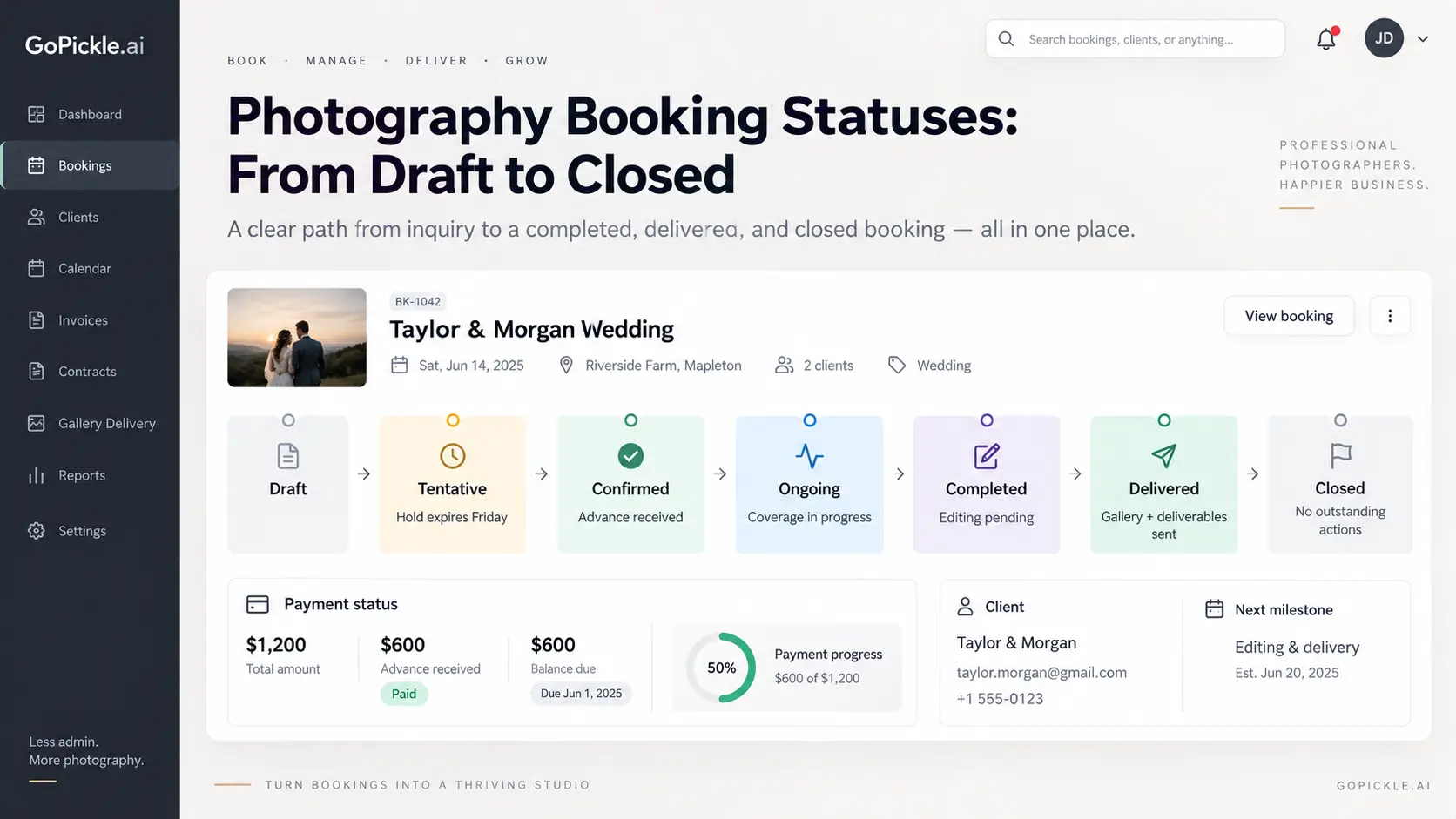
A photography booking can remain active for far longer than the shoot itself. A portrait assignment may move from confirmation to delivery in a few weeks, while a wedding booking can stay open for months as dates are reserved, payments arrive, events take place, photographs are edited, albums are approved and final deliverables are handed over.
Calling every one of those jobs simply “booked” hides too much information.
A useful photography booking status should tell the studio what is true about the job right now and what kind of work can happen next. The status should not depend on somebody remembering the latest WhatsApp message, checking whether the event date has passed or opening several payment records to work out what stage the booking has reached.
For most studios, a practical lifecycle is:
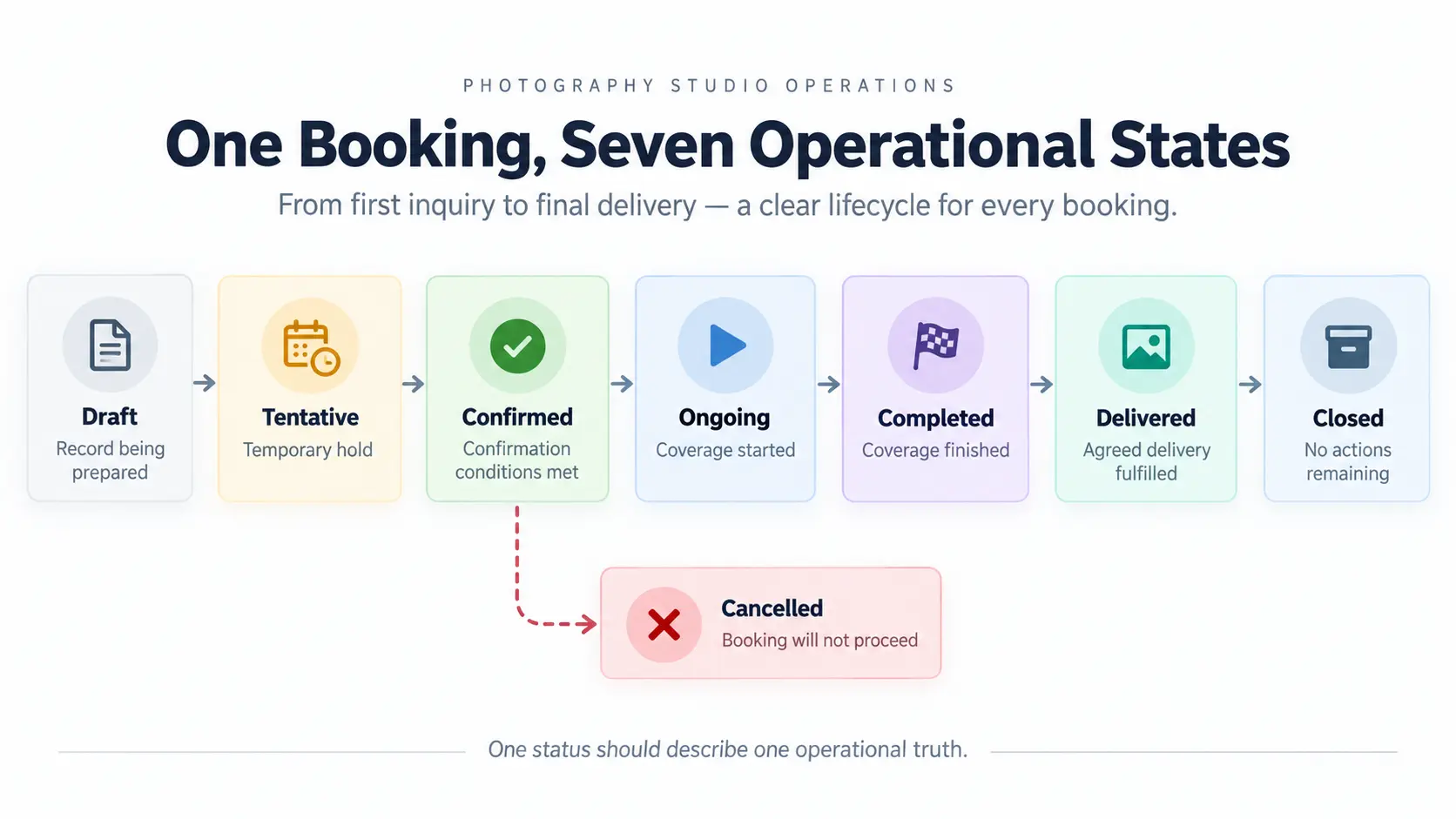
Draft → Tentative → Confirmed → Ongoing → Completed → Delivered → Closed
Cancelled work should leave this normal lifecycle and enter its own terminal state. Rescheduling, payment progress, editing progress and individual deliverable status usually need to be tracked separately rather than overloaded into the main booking status.
This article begins after an enquiry has progressed far enough to become a booking record. Lead stages such as New Enquiry, Qualified, Quote Sent, Follow-Up or Lost belong in the sales pipeline, not in the photography booking workflow.
Why one “booked” status is not enough
Consider five wedding clients shown as “Booked” on the studio dashboard.
One couple has verbally agreed and asked the photographer to hold the date until Friday. Another has accepted the quotation and paid the required booking advance. A third wedding starts today. The fourth was photographed last month and is being edited. The fifth has received its final gallery but still has an album and outstanding balance pending.
Those bookings demand completely different actions even though a simple calendar may show all five as booked.
This is why photographer booking management needs lifecycle states with clear boundaries. A status should represent an operational condition, not a vague impression of progress.
| Booking status | What it should mean | Typical trigger to leave |
|---|---|---|
| Draft | Booking record exists, but it is not ready to reserve resources | Enough information and client commitment exist to place a temporary hold |
| Tentative | Studio is holding the opportunity provisionally under defined conditions | Confirmation requirements are met, hold expires or client withdraws |
| Confirmed | Studio's defined booking requirements have been satisfied | Photography coverage begins |
| Ongoing | At least one booked event or coverage period is actively being fulfilled | Final scheduled photography coverage finishes |
| Completed | Coverage is finished, but post-production or deliverables remain | Agreed client-facing deliverables are completed and handed over |
| Delivered | The contracted delivery milestone has been fulfilled | Financial and operational obligations are fully resolved |
| Closed | No remaining action is expected on the booking | Terminal state |
The exact terminology can change between studios. The important part is that everybody uses the same definition and that each transition has a measurable trigger.
Draft and tentative are different kinds of uncertainty
Draft means the booking record is being assembled
Draft should be an internal working state. It can be useful when a studio has decided to create the booking record but still needs to verify dates, transfer agreed services from the quotation, add event information, confirm the correct client details or prepare the record before a date is treated as reserved.
A Draft booking should not silently block scarce capacity unless that is an intentional studio rule. Otherwise a partially created record can make the calendar look unavailable even though the client has made no commitment.
The exit criterion should therefore be concrete: the booking contains enough information and client intent for the studio to grant a provisional hold.
Draft also should not become a replacement for the lead pipeline. A prospect who has merely requested pricing is still a lead. Creating Draft bookings for every enquiry fills the booking system with work that was never genuinely close to being reserved.
Tentative means there is a real hold, but confirmation is incomplete
Tentative is stronger than Draft because the date or production capacity is now being treated as provisionally occupied.
A wedding client may have approved the broad package but still need to sign the agreement or make the required booking payment. A commercial client may have authorised the project while waiting for an internal purchase order. A portrait client may ask the studio to hold a session until a defined deadline.
Every Tentative booking should therefore have an expiry rule.
Without one, soft holds accumulate until the studio no longer knows which dates can safely be offered to somebody else.
A useful Tentative record should answer:
- What is being held?
- Until when?
- What must happen for the booking to become Confirmed?
- What happens if that requirement is not completed?
The specific legal and financial conditions depend on the studio's agreement and jurisdiction. The operational principle is universal: a tentative hold needs a defined decision point.
For the information that should be settled before accepting the work, see GoPickle's guide to what photographers should confirm before accepting a booking.
Confirmed should mean operationally and financially secured
Confirmed is one of the most important photography booking statuses because other decisions begin depending on it. The studio may reject another enquiry for the same date, allocate crew, arrange travel, reserve equipment or start production planning.
The studio should therefore decide exactly what earns the word “Confirmed”.
For many photographers, that may include an accepted quotation or agreement, required booking information and receipt of the agreed retainer, advance or booking fee. Other businesses may use different contractual or payment arrangements. Whatever the rule is, it should be consistent enough that staff do not confirm one client after a message saying “we are going ahead” while requiring another client to complete several additional steps.
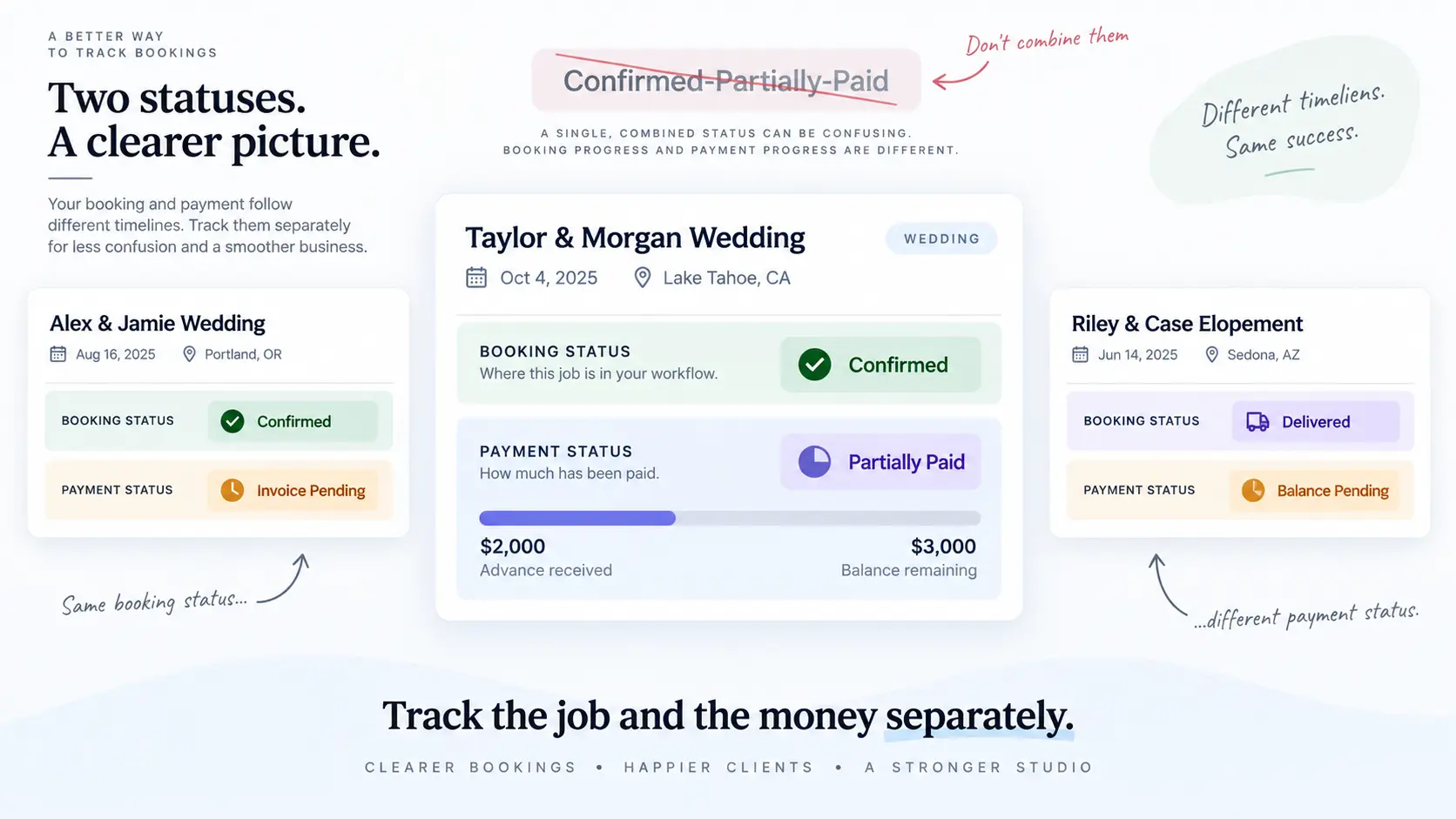
Importantly, Confirmed does not mean Paid in Full.
Booking status and payment status answer different questions:
- Booking status: What stage has the photography job reached?
- Payment status: What has been invoiced, received and left outstanding?
A wedding can legitimately be Confirmed + Partially Paid. A corporate booking may be Confirmed + Invoice Pending under agreed credit terms. Trying to combine both concepts into one status produces awkward labels and unreliable reporting.
GoPickle's Photography Booking Management workspace keeps the booking connected with events, services, deliverables, crew, invoices and payments, while its invoice management workflow for photographers tracks advances, balances and payment progress separately.
Ongoing should begin when photography coverage actually starts
A booking should not become Ongoing merely because the event is approaching or the studio has started planning.
Those are tasks within a Confirmed booking.
Ongoing becomes useful when execution has begun: the portrait session has started, the commercial production is underway or the first event within a multi-event wedding is being covered.
For a wedding containing a welcome dinner, ceremony and reception across several days, repeatedly moving the entire booking between Confirmed and Ongoing would add noise. Once the first contracted coverage begins, the booking can remain Ongoing until the final scheduled coverage is finished.
Individual events can still have their own operational state if the studio needs more detail. The booking-level status should continue describing the overall client commitment.
This also prevents an important calendar mistake. A wedding being Ongoing does not mean every associated event is happening at that moment. Studios coordinating several photographers still need event-specific dates, venues, reporting times and crew assignments underneath the parent booking.
Completed and delivered are not the same thing
This distinction becomes especially valuable after shoot day.
A photographer may finish coverage at 11:30 p.m., back up the files the next morning and begin culling later that week. The studio has completed the photographic coverage, but it has clearly not delivered the booking.
That is what the Completed state is for.
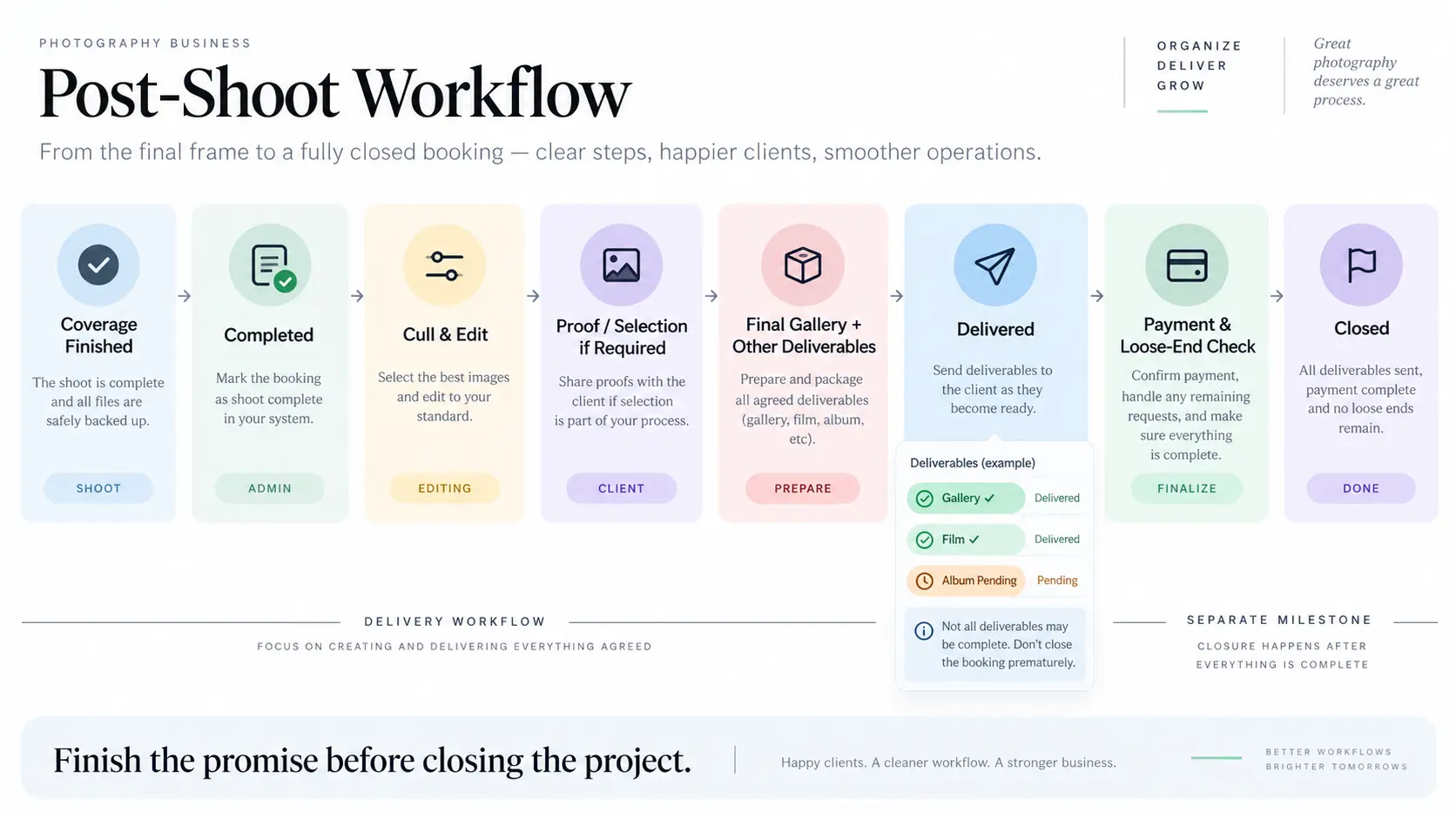
Completed should mean that the scheduled photography or production coverage is finished and the job has moved into post-production or fulfilment.
Depending on the service, there may still be substantial work remaining:
- backup and ingest;
- culling;
- editing or retouching;
- film editing;
- client proofing or selections;
- album design;
- revision approvals;
- gallery preparation;
- final file export.
Delivered should only follow when the deliverables that define the agreed delivery milestone have actually reached the client.
This is also why publishing a gallery does not automatically mean a booking is Delivered. A proofing gallery may be asking the client to choose photographs for retouching, while a final gallery exists to hand over finished work. Our guide to photo proofing vs final client galleries explains that distinction in more detail.
For a portrait package, Delivered might mean the final purchased photographs have been released. For an event client, it may mean the finished gallery has been provided. A wedding package that includes photographs, film and a physical album should not normally be treated as fully Delivered simply because the photograph gallery went live while other contracted outputs remain unfinished.
Studios with several deliverable types should track each deliverable separately and let the booking status represent the overall promise.
GoPickle's Client Galleries for photographers can form part of this final handoff while remaining connected to the booking rather than becoming an isolated delivery link.
Closed, cancelled and exceptional states need their own rules
Delivered is a client-facing milestone. Closed is an internal operational milestone.
A booking is ready to close when the studio expects no further routine action from the job. That normally means the required deliverables have been completed, financial records have been reconciled, outstanding client issues have been resolved and any remaining administrative work has been dealt with.
This distinction prevents apparently finished bookings from disappearing while a final balance, album correction or promised deliverable is still pending.
Closure criteria will vary by studio, but the team should be able to run a “Delivered but not Closed” report and immediately see jobs that still contain loose ends.
Cancelled should be a separate terminal state
A cancelled job did not travel successfully through the normal lifecycle, so moving it through Completed, Delivered and Closed creates misleading operational data.
Use Cancelled as an exceptional terminal status and record the information needed to understand the outcome, such as cancellation date, reason, payments or refunds to reconcile and any remaining administrative action.
Cancellation, refund and rescheduling terms should follow the photographer's written agreement and applicable local law. GoPickle's guide to photography cancellation and rescheduling policies covers the operational questions that should be defined before a dispute occurs.
Rescheduled usually should not replace the booking status
If a confirmed wedding moves from October to January, it is still fundamentally a Confirmed booking once the new arrangement has been agreed. “Rescheduled” describes what happened to it, not necessarily where it sits in the booking lifecycle.
A reschedule flag, event history or change record is usually more informative than replacing Confirmed with Rescheduled indefinitely.
The same principle applies to exceptional pauses. If a client decision genuinely prevents the project from progressing, an On Hold state may be useful, but it should have an owner, reason and next review date. Otherwise “On Hold” becomes a permanent storage area for forgotten work.
Status-change rules make the workflow reliable for a team
Status names only become useful when the whole studio applies them consistently. A six-person studio cannot have one manager interpreting Confirmed as “client said yes” while another interprets it as “advance received and agreement complete”.
A practical studio booking workflow should establish a few rules:
- Give every status an entry condition. Write down exactly what must be true before somebody moves the booking into that state.
- Give every active status an exit trigger. Tentative needs an expiry or confirmation action. Ongoing needs a final coverage event. Completed needs a delivery milestone.
- Separate lifecycle, money and fulfilment. A booking can be Confirmed while partly paid and can be Completed while editing is still in progress. Separate statuses preserve that information instead of forcing one label to answer everything.
- Record who changed the status and when. This becomes increasingly useful when studio managers, photographers, editors and accounts staff all touch the same booking.
- Avoid manual status changes when the system already knows the trigger. If all required delivery work is complete, an operational system may be able to prompt the appropriate transition rather than relying on someone remembering to update a dropdown.
- Make exceptions visible. Cancelled, expired tentative holds and genuinely paused jobs should not disappear inside the normal active-booking list.
A strong photography booking workflow is ultimately less about finding perfect terminology and more about removing interpretation. Anyone opening the booking should be able to understand where the job stands, what remains unresolved and what should happen next.
A booking status should tell the team what happens next
The most useful photography booking status is one that changes the team's behaviour.
Draft tells the studio that the record is not ready. Tentative protects capacity without pretending the job is fully secured. Confirmed authorises the studio to plan against the commitment. Ongoing signals that coverage is being executed. Completed hands the work into post-production. Delivered records that the client has received the agreed output. Closed confirms there is nothing meaningful left to finish.
That structure works for a solo photographer managing a handful of portrait sessions and for a studio coordinating multi-day weddings, commercial productions, several crew members and long delivery cycles. The complexity beneath each booking may change, but the lifecycle remains understandable.
GoPickle is built around this broader idea of connected photography operations. Its booking workflow keeps clients, events, services, deliverables, crew, invoices, payments and gallery delivery connected so a photography booking can remain a usable operational record from confirmation through final handoff rather than becoming another date on a calendar.
For studios that are beginning to outgrow chats, spreadsheets and disconnected tools, start by defining the statuses before choosing the software. Once the team agrees on what each state actually means, photographer booking management becomes much easier to standardise.