Photography Editing Revisions: Set Client Expectations for Basic Edits, Retouching and Extra Requests
Define basic edits, retouching, revision limits and extra client requests before disputes begin. A practical guide for photographers and studios.


The phrase “edited photos” sounds simple, but it can create one of the most common expectation gaps between photographers and clients. A photographer may use it to mean colour correction, exposure balancing, cropping, sharpening and the finishing style shown in the portfolio. A client may interpret the same phrase as skin retouching, body reshaping, removing distracting people, replacing backgrounds, fixing clothing, changing expressions or making any other requested alteration.
Neither interpretation is necessarily unreasonable. The problem is that both sides may believe the scope is obvious when it has never actually been defined.
Photography editing revisions with a client become much easier when the studio explains three things before the work begins: what normal editing includes, what counts as detailed retouching or advanced manipulation, and what happens when the client requests something outside the original scope.
A clear photo editing revision policy is not about making the client feel restricted. It gives the client confidence about what they are buying while protecting the photography business from unlimited, undefined post-production work.
Define editing, retouching and compositing in client language
Photographers often use words such as editing, retouching, colour grading, cleanup and compositing differently. Clients may use all of them interchangeably. Instead of assuming that everyone understands the terminology, define the outcome in simple language.
Basic editing generally refers to the normal finishing applied to photographs before delivery. Depending on the studio, this may include exposure correction, white balance, colour treatment, contrast adjustments, cropping, straightening, lens correction, sharpening and noise reduction.
The exact process will vary between photographers. A documentary wedding photographer, commercial product studio and beauty photographer may all have very different ideas of what standard editing includes.
Retouching usually involves more detailed work on individual photographs. This might include removing temporary blemishes, cleaning flyaway hairs, reducing clothing lint, removing product dust, correcting small distractions or performing more precise skin work.
Advanced retouching or compositing changes the construction of the image itself. Examples include replacing backgrounds, removing large objects or people, combining multiple photographs, swapping expressions between frames, reconstructing damaged areas or creating a final image from several source photographs.
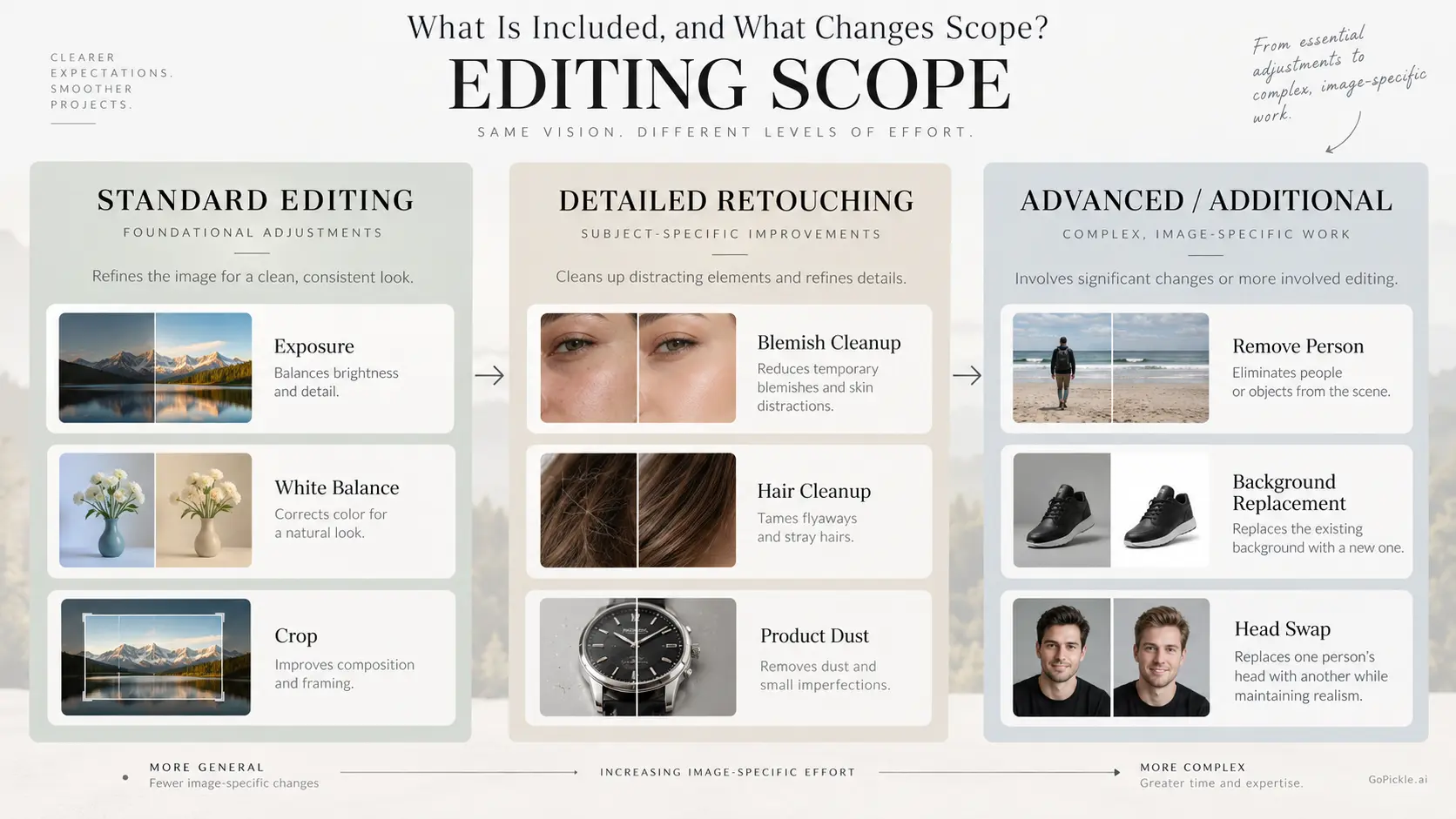
A simple client-facing distinction might look like this:
| Client request | Standard editing | Detailed retouching | Advanced or additional work |
|---|---|---|---|
| Exposure and white balance correction | Usually included | ||
| Colour consistency | Usually included | ||
| Crop or straighten | Often included | ||
| Temporary blemish cleanup | Often | ||
| Hair or clothing cleanup | Usually | Sometimes | |
| Product dust removal | Usually | ||
| Remove a person from the background | Usually | ||
| Replace a background | Usually | ||
| Combine multiple photographs | Usually | ||
| Head or expression swap | Usually | ||
| Apply an entirely different editing style | Usually |
There is no universal industry rule that says every request belongs in a particular category. Your studio should define its own boundaries based on the type of photography you provide, your workflow and what is included in your packages.
The important part is making those boundaries visible before the client assumes everything is included.
State what is included before the booking is confirmed
Many photography disputes begin with a sentence such as:
“All final images will be professionally edited.”
It sounds reassuring, but it does not explain what “professionally edited” actually means. A better approach is to describe the editing scope inside the quotation, proposal, booking terms or package description.
For example:
“All selected final images receive the studio’s standard colour, exposure and tonal finishing. Detailed portrait retouching is included for 10 selected photographs. Background replacement, extensive object removal, body reshaping, image compositing and additional retouched photographs can be quoted separately where required.”
The wording does not need to be complicated. It simply needs to reflect the service you actually intend to deliver.
If different packages include different levels of post-production, make that difference visible during the buying process. One package may include standard editing only, while another includes a defined number of fully retouched hero images.
This is one reason we recommend documenting post-production scope in the quotation rather than leaving it buried inside chat messages. GoPickle Quotations allow photographers to keep packages, deliverables, pricing, add-ons and terms within the same client-facing workflow.
Sometimes the final amount of retouching cannot be known before the shoot. That is fine too. What matters is defining when that decision will be made. A portrait photographer might provide a proof gallery first and allow the client to select 10 images for detailed retouching.
A product photography studio might include routine cleanup for catalogue images but price complex hero-image compositing separately after the client chooses the final photographs. The scope can remain flexible without becoming undefined.
Use examples without overpromising
Clients often understand visual examples faster than written definitions. If your studio provides several levels of editing, showing before-and-after examples can make the difference immediately understandable.
You might show examples labelled:
- Standard edit
- Detailed portrait retouch
- Product cleanup
- Advanced composite
- Background replacement
These examples should come from work that accurately represents the level of editing you normally provide.
The purpose is not to promise that every image can be transformed in exactly the same way. Some retouching requests depend heavily on the original photograph.
Removing a small object against a plain wall may be straightforward. Removing several people standing directly behind a wedding couple may require considerably more reconstruction. Replacing a background behind clean product edges may be manageable, while rebuilding hair against a complex background may require much more work.
Avoid statements such as “we can remove anything” or “unlimited retouching included” unless your service genuinely supports that promise. Examples also help communicate creative style.
If your portfolio consistently shows natural skin texture, restrained colour grading and documentary-style photography, the client should not discover after delivery that they expected aggressive beauty retouching or a completely different colour treatment. Photography revision expectations begin with showing clients what your finished work normally looks like.
Give clients one clear channel for edit requests
Even a good revision policy can become difficult to manage when client feedback arrives through five different places.
One request comes through WhatsApp.
Another appears in an email.
A family member sends screenshots.
Someone calls the photographer.
A commercial client’s marketing team sends a spreadsheet.
The retoucher is then forced to work out which request is current, which person has approval authority and whether two instructions contradict each other.
Choose one written channel for final photography retouching requests and tell the client where revisions should be submitted.
For larger assignments, ask clients to provide one consolidated request list containing:
- the image filename or gallery reference;
- the exact requested change;
- a visual reference where genuinely useful;
- the person authorised to approve changes;
- confirmation that the request list is complete for that revision round.
For commercial photography, having one authorised approver can be particularly important. Several stakeholders may have opinions, but production should ideally begin only after those comments have been consolidated into one approved direction.
If the workflow starts with client selections before detailed retouching, GoPickle Client Galleries can help clients favourite or shortlist photographs without identifying every file through screenshots or separate messages.
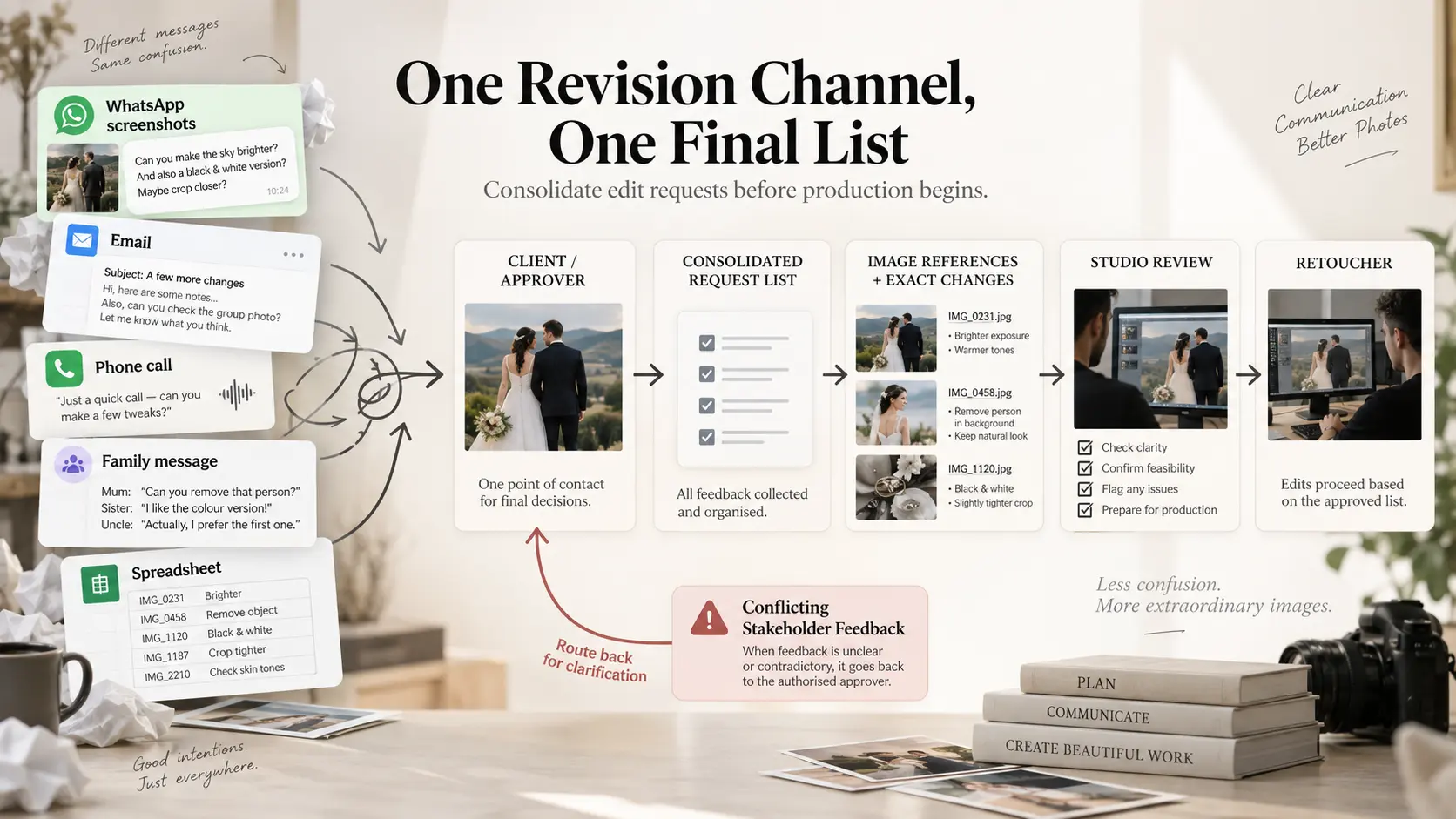
One request channel also creates a reliable record of what the client actually asked for. If the job later reaches a disagreement, both sides can refer to the same revision list rather than reconstructing the conversation from several communication platforms.
Separate a correction from new creative work
One of the most important parts of a photo editing revision policy is distinguishing between a correction and a new request. Not every client revision should become an additional fee. If the studio agreed to remove a blemish and missed it, completing that work is a correction. If the wrong crop was exported, a requested adjustment was overlooked or one image clearly does not match the agreed final treatment, the studio should review the issue as part of the work already promised. The situation changes when the delivered image meets the agreed brief but the client now wants something different.
A practical distinction looks like this:
| Client request | How to treat it |
|---|---|
| “The blemish we asked you to remove is still visible.” | Correction if it was already included |
| “This photograph looks much warmer than the rest of the approved gallery.” | Review as a consistency issue |
| “Can you retouch another 20 photographs?” | Additional quantity and likely new scope |
| “Can you remove the person standing behind us?” | Advanced retouching unless already agreed |
| “Can you make the entire gallery brighter and more pastel?” | New creative direction unless the original editing missed the agreed brief |
| “Can you replace this expression using another photograph?” | Compositing and usually additional scope |
| “Can we have another version in a completely different colour style?” | Additional creative output |
This distinction keeps the conversation fair.
Clients should not be charged again for work that the photographer already promised. At the same time, a photographer should not be expected to provide unlimited new creative directions simply because the client describes them as revisions. There may also be requests that the studio does not want to perform at all.
A request may conflict with the photographer’s style, documentary principles, ethical standards or technical feasibility. Your terms can explain that advanced retouching is subject to review rather than promising that every requested image alteration will automatically be accepted.
Price added scope transparently
There is no single retouching pricing structure that works for every photography business.
Simple, repeatable work may suit per-image pricing.
Mixed client changes may be easier to price by the hour.
A defined revision round can be quoted as a fixed amount.
Complex commercial compositing may require inspection of the source photographs before the photographer can estimate the work accurately.
The pricing model matters less than the approval process.
A clean additional-work workflow looks like this:
Client request → Studio reviews scope → Price and revised timeline confirmed → Client approves → Retouching begins
This sequence matters because clients should know the financial impact before additional work starts.
Avoid completing several hours of unexpected retouching and then introducing the additional charge on the final invoice.
If the request changes the approved scope, document the change first.
Our guide to keeping the photography quote and final invoice aligned explains why additions should be approved while the work is still being discussed rather than appearing unexpectedly at billing.
For commercial studios, the pricing model may also depend on the type of image. Routine catalogue cleanup and complex hero-image manipulation should not automatically carry the same production cost. Our product photography pricing guide covers this distinction in more detail.
Additional work can also change the delivery date.
If the client adds 30 retouched photographs or requests multiple composites after the original delivery schedule has been agreed, confirm the revised turnaround at the same time as the additional price.
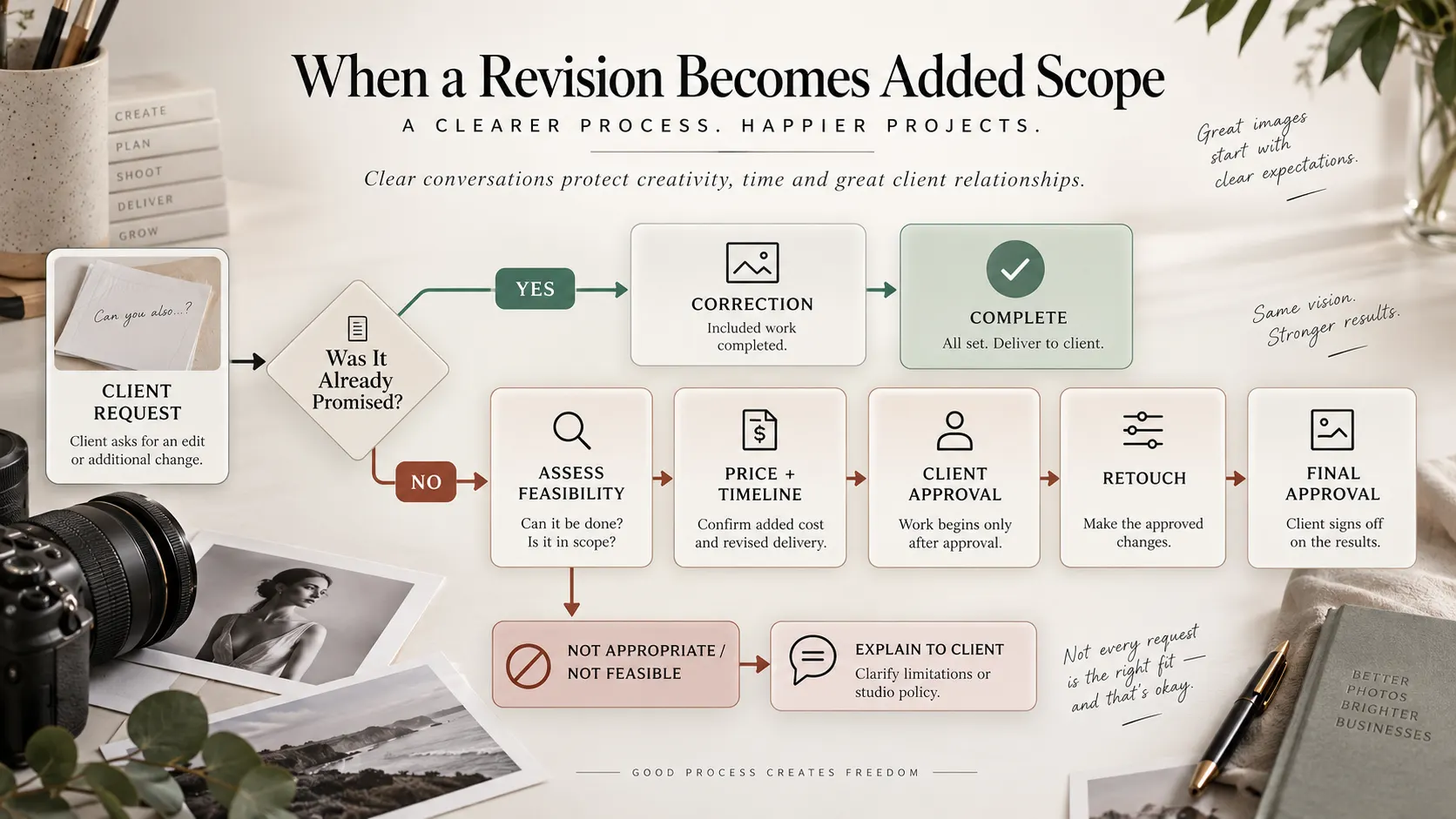
The client should therefore approve two things whenever the editing scope changes:
the additional cost and the revised delivery expectation.
Confirm completion and approval so the project actually ends
Revision work needs a clear finishing point.
Without one, a project can remain informally open for weeks because small requests continue arriving after each delivery.
When the agreed revisions have been completed, identify the updated files clearly and ask the client to confirm that the requested changes have been addressed.
For commercial assignments, keep a record of:
- the approved final version;
- the person who provided approval;
- the approval date;
- any remaining agreed deliverables.
Once approval has been given, future changes can be evaluated as a new request instead of silently reopening the previous revision round.
The final delivery workflow should also be clear to the client.
For example:
Proof gallery → Client selections → Detailed retouching → Revision review → Client approval → Final gallery
This prevents proof photographs from being mistaken for fully retouched finals and makes it easier for both the photographer and client to understand which stage the project has reached.
Clear photography revision expectations do not make a client relationship rigid. They remove the uncertainty that usually causes revision disputes in the first place.
The client knows what level of editing they are buying.
The photographer knows which work is included.
Both sides know how corrections should be submitted.
And when a new request genuinely changes the scope, the additional price and delivery impact can be agreed before more work begins.
That is a much better client experience than trying to define the rules after the photographs have already been delivered.