Photography Quote to Invoice Workflow: Keep the Final Invoice Aligned With Approved Scope
Build a photography quote-to-invoice workflow that carries approved scope, extras, deposits and payments forward without creating invoice mismatches.

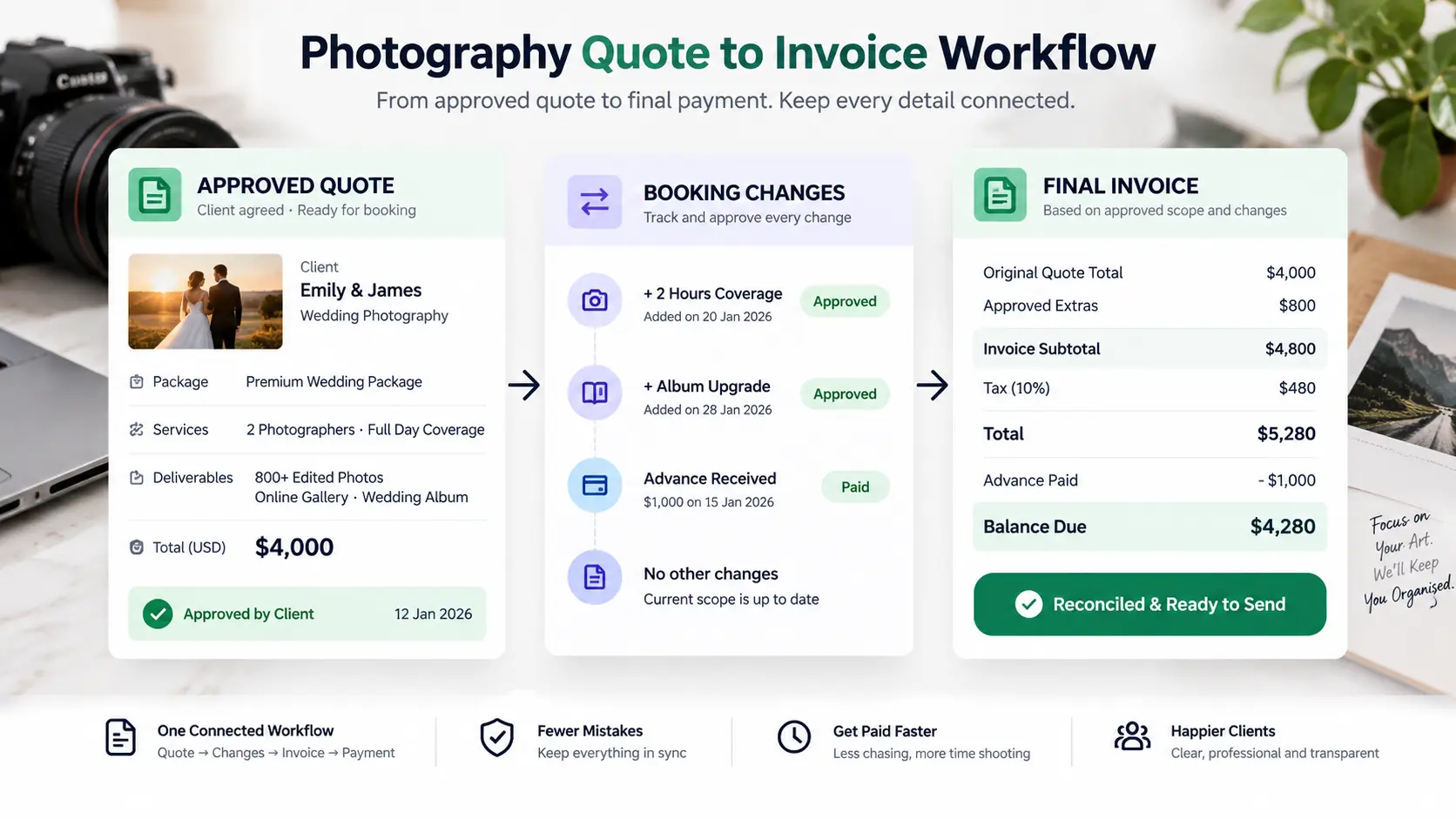
A client approves a photography quote, pays an advance, changes part of the requirement before the shoot, adds a deliverable afterwards, and eventually receives an invoice. This is where many studios accidentally create a second version of the commercial agreement. The quotation says one thing, the booking evolves elsewhere, a payment sits in a message thread, and the invoice is rebuilt from memory.
A reliable photography quote to invoice workflow should preserve the approved quote as the billing baseline, record legitimate changes, carry forward payments already received, and reconcile the invoice before it is sent. The goal is not to make the quotation and invoice identical. It is to make every difference explainable.
The approved quote is the billing baseline
An approved quotation records what the client agreed to buy: the assignment, services, deliverables, quantities, rates, discounts, applicable taxes, payment terms and total price. If you need to improve that document itself, our guide to creating a professional photography quotation covers the earlier stage. The handoff starts once approval happens.
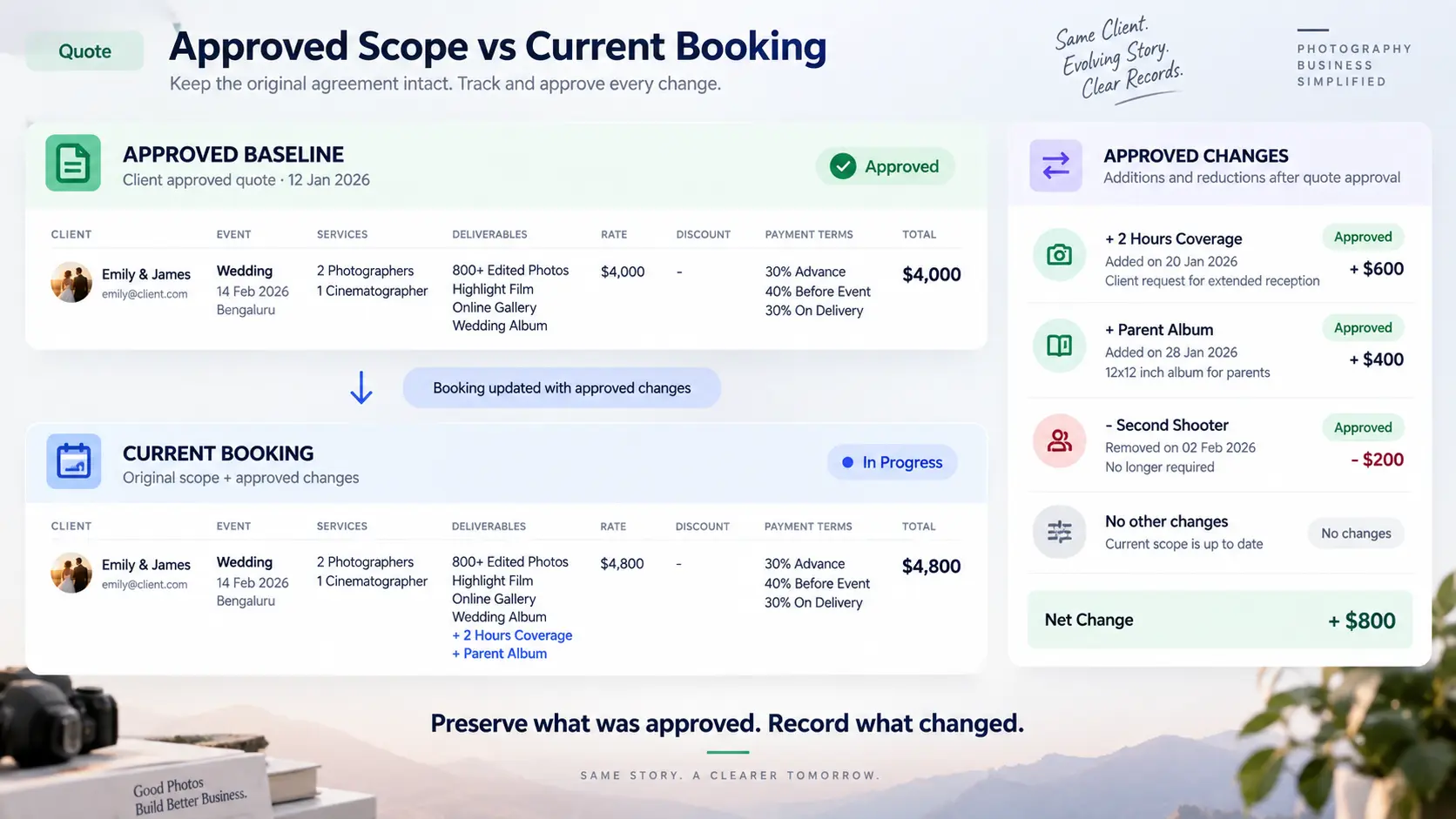
At that point, freeze a reference version. If a client accepted a wedding package with two photographers, one cinematographer, an album and an agreed total, the studio should still be able to see that exact version months later even if the live booking changes.
Bookings can and do change. Weddings run late. Corporate clients expand usage. Event organisers add coverage. Portrait clients add products. The important distinction is between approved original scope and approved subsequent changes. When those become indistinguishable, a photography quote invoice mismatch becomes difficult to diagnose because no one can tell whether the invoice changed legitimately or somebody simply re-entered the wrong information.
Fields that should carry forward unchanged
Most information on an approved quote should not be manually recreated when the job reaches invoicing. A clean photography quotation to invoice handoff carries the commercial identity of the booking forward.
| Approved quote data | Invoice-stage treatment |
|---|---|
| Client or billing entity | Carry forward unless the client formally changes it |
| Booking/project reference | Keep connected to the same assignment |
| Services, package lines and rates | Carry forward from the approved scope |
| Deliverables | Remain connected even if invoice presentation is condensed |
| Discounts | Retain unless a later approved revision changes them |
| Currency | Keep consistent unless both parties agree otherwise |
| Payment schedule | Use it to determine what is due now |
| Approved total | Keep as the reconciliation baseline |
| Quote version/reference | Preserve for audit and client questions |
The invoice still needs invoice-specific information such as its own number, invoice date, due date and locally required billing fields. That is different from rebuilding the package.
This is why connected records are more useful than isolated PDFs. GoPickle Quotations is designed to structure the commercial offer, while GoPickle Smart Invoicing keeps invoicing and payment context tied to the photography workflow instead of starting from a blank document.
Deposits and payments already received must survive the handoff
An invoice can match the quote perfectly and still be wrong if it ignores money the client has already paid.
Suppose the approved booking value is 4,000 in your billing currency and the client has paid a 1,000 advance. The studio needs to preserve three facts: the booking value is 4,000, 1,000 has been collected, and the next amount due depends on the agreed payment schedule.
The document structure varies. Some businesses issue an advance or deposit invoice and later bill the remaining stages. Others show the full invoice value and apply received payments or credits. Tax and accounting treatment differ by jurisdiction, so the correct method should follow local requirements and professional accounting advice.
The operational principle is universal: a payment already received must not disappear when the next invoice is created.
Keep booked value, invoiced amount, collected amount and outstanding balance separate. That prevents a team member from seeing a 3,000 balance and assuming the booking itself was worth 3,000. Our guide to booked revenue vs collected revenue explains these financial states in more detail.
GoPickle's invoicing workflow supports advances, instalments, partial payments and final balances. The Get Paid Faster workflow continues that payment trail from booking advance through final collection.
Approved extras after the quote should be added, not silently folded in
The approved quote is a baseline, not a restriction against legitimate change. A wedding client may add another event. A commercial client may request extra retouching, broader usage rights or rush delivery. An organiser may extend coverage. A portrait client may order an album after the shoot.
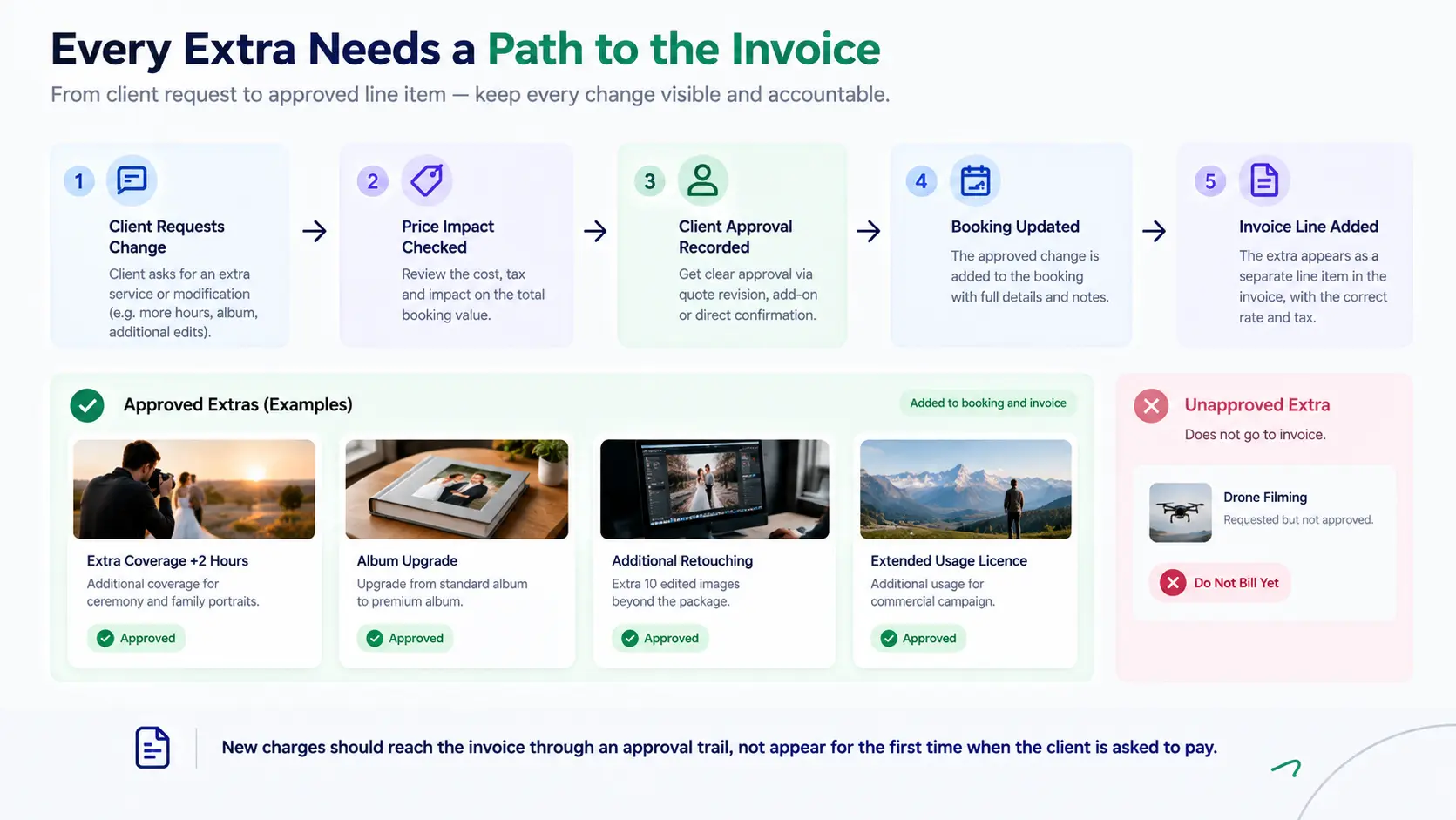
Those are valid invoice changes when the client has approved them. The problem is allowing the invoice to become the first place the client sees the charge.
Treat post-quote extras as change records. Each one should answer four questions: what changed, who approved it, when it was approved, and what it does to the price. Depending on the value and complexity, approval might be captured through a revised quotation, change order, add-on approval, email or another method appropriate to the business and jurisdiction.
For a small addition, one clearly approved line item may be sufficient. For a substantial change in coverage or deliverables, a revised quotation is usually cleaner because it establishes a new commercial position before more work is done.
The reconciliation should be easy to follow:
Approved quote + approved additions - approved reductions = current booking value
Only then should recorded payments be applied to determine the amount due.
Tax and invoice-date differences need a deliberate review
The quotation date and invoice date may be weeks or months apart. Invoice numbering, tax-point rules, tax rates, required fields and the treatment of advance payments can depend on local law.
For example, UK VAT guidance distinguishes among the time a service is performed, the date an invoice is issued and advance payments when determining the tax point. Other jurisdictions apply their own VAT, GST, sales-tax or e-invoicing rules. There is no safe worldwide rule that says an invoice should always copy the tax treatment shown on an earlier quotation.
The practical approach is to revalidate tax when the invoice is created. If the applicable rate, registration status, client billing entity, client location or place-of-supply treatment has changed, the invoice may legitimately differ from the quote. If that changes what the client owes, check the accepted terms and local requirements before sending it. High-value or cross-border assignments deserve an accountant's review rather than an assumption based on software defaults.
Final reconciliation before sending
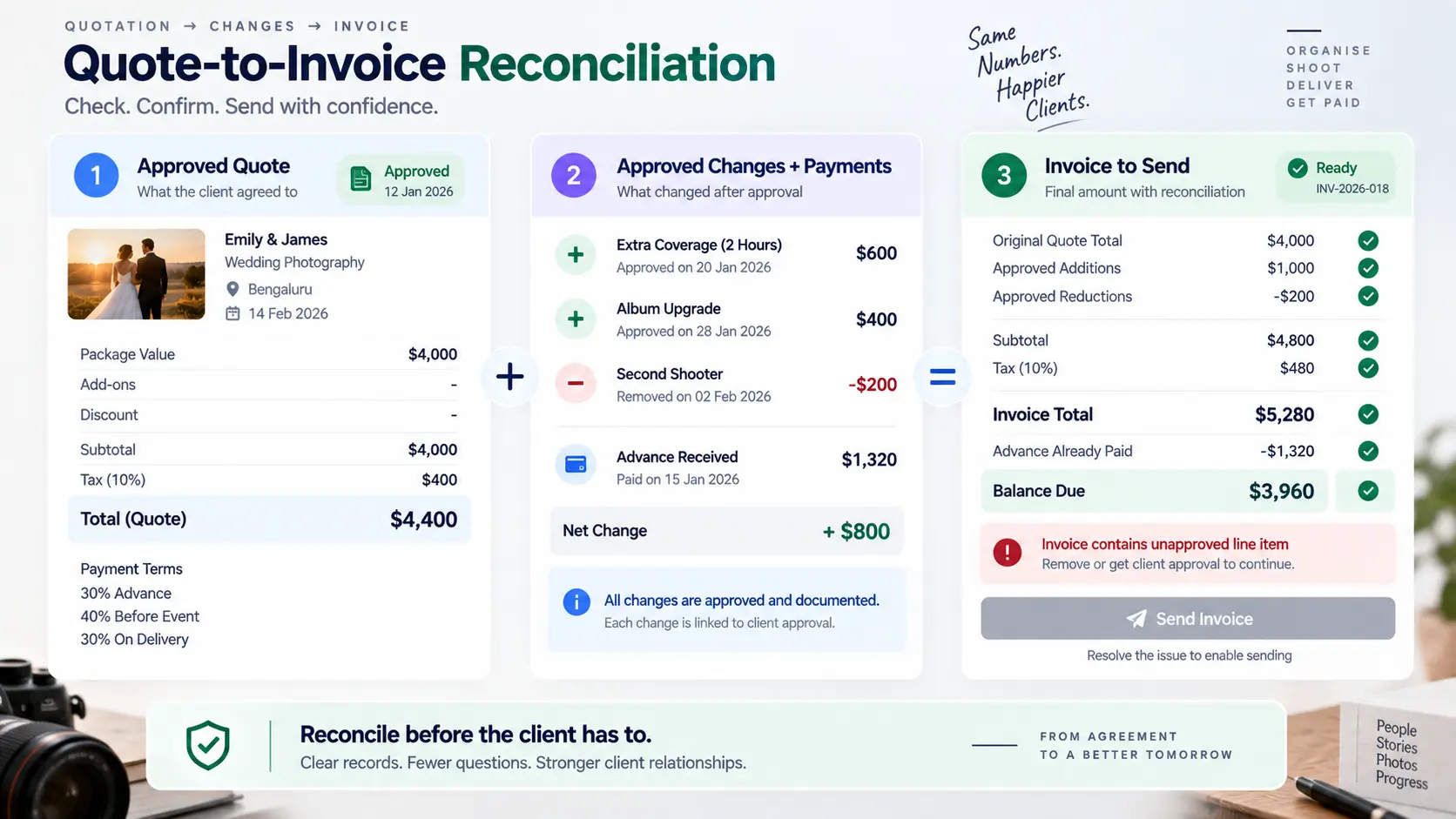
Before the invoice leaves the studio, compare three things side by side: the approved quotation, the current booking scope and the payment history. A short review prevents the client from becoming the person who discovers the mismatch.
- Open the approved quote version, not an editable working draft.
- Confirm the client or billing entity.
- Compare quoted services, deliverables, quantities, rates and discounts with the current booking.
- Identify every addition, removal or change and verify client approval.
- Check deposits, instalments, refunds, credits and partial payments already recorded.
- Recalculate subtotal, discounts, tax, total and amount due.
- Confirm invoice number, invoice date, due date and payment instructions.
- Make sure the amount requested matches the payment stage actually due.
- Keep the quote reference and change history accessible if the client asks how the figure was reached.
This is where software should reduce re-entry without eliminating review. When you convert a photography quote to an invoice, the system can carry forward what is stable; the studio still needs to verify what may have changed.
If the document itself needs work, see our guide to photography invoice basics. This workflow is deliberately focused on the data feeding the invoice rather than repeating invoice-format advice.
Preserve quote and invoice history instead of overwriting the past
A damaging shortcut in a photography invoice workflow is editing the original quotation until it matches what finally happened. That creates a neat current document but destroys the evidence of what the client originally approved.
Keep the accepted quotation as a historical record. If scope changes, create a revision, amendment or clearly logged change. If an issued invoice later needs correction, follow the mechanism required in your jurisdiction rather than silently replacing the old document. Depending on local rules, that may involve a revised invoice, credit note, debit note, cancellation or reissue.
History becomes especially valuable on long wedding, commercial and event assignments where several people may touch the booking. A salesperson may win the job, a studio manager may coordinate changes, and a finance team member may prepare an invoice months later. None of them should need to reconstruct the agreement from memory.
The record should remain chronological:
Quote approved → Booking confirmed → Changes approved → Payments received → Invoice issued → Balance collected
That sequence gives the studio a defensible answer to the two questions behind most invoice disputes: What did we agree? and What changed afterwards?
A good quote-to-invoice workflow automates the handoff, not the judgement
There is an important difference between automation and autopilot. A strong system should carry forward the information that should not change, including the client, scope, services, deliverables, rates and payment context. It should make later changes visible as well. The final invoice still deserves review because dates, tax, approved extras, credits and payment status can legitimately change.
That is the photography billing workflow we believe studios should aim for: one commercial thread from quotation through booking and into payment.
GoPickle connects quotations, bookings, invoices and payments so the studio does not have to rebuild the job at every stage. Smart Invoicing keeps advances, instalments, balances and payment status attached to the underlying booking, while Get Paid Faster continues the process from invoice sent to money received.
The purpose is not to make every invoice identical to the approved quote. It is to make the final bill traceable to the promise the client accepted, the changes they approved and the money they have already paid.