Product Photography Pricing: Per Image, Per SKU, Per Day or Per Project?
Compare product photography pricing per image, SKU, day and project, including styling, retouching, revisions, rush work and commercial usage.


Ask four product photographers to quote the same catalogue and you may receive four completely different pricing structures. One studio charges per finished image. Another quotes per SKU. A commercial photographer gives the client a full-day rate, while an advertising studio sends a single project fee covering pre-production, photography, styling and post-production.
None of those methods is automatically right or wrong. The better question is whether the pricing unit matches the work the photographer is taking responsibility for.
A white-background e-commerce shoot involving 100 similar boxes is highly repeatable. A cosmetics campaign involving reflective bottles, liquid splashes, custom surfaces, props and ten carefully retouched hero photographs is not. Trying to price both with the same product photography rate usually means either overcharging the simple assignment or absorbing hours of unpaid work on the difficult one.
For photographers building their own rate cards, we think product photography pricing should start with the production process and deliverables, then choose the pricing model that makes those costs understandable to the client.
Per-image pricing works when every finished image is reasonably predictable
Charging per image is straightforward: the client pays a defined amount for each photograph selected and delivered. It works particularly well for repeatable e-commerce product photography where the lighting, background and editing standard remain consistent across a batch.
Imagine a brand sending 40 packaged food products and requesting three standard angles of each item against white. That produces 120 final images. Once the first lighting setup is approved, much of the remaining production can follow the same workflow, so a per-image rate gives both sides a simple way to calculate the job.
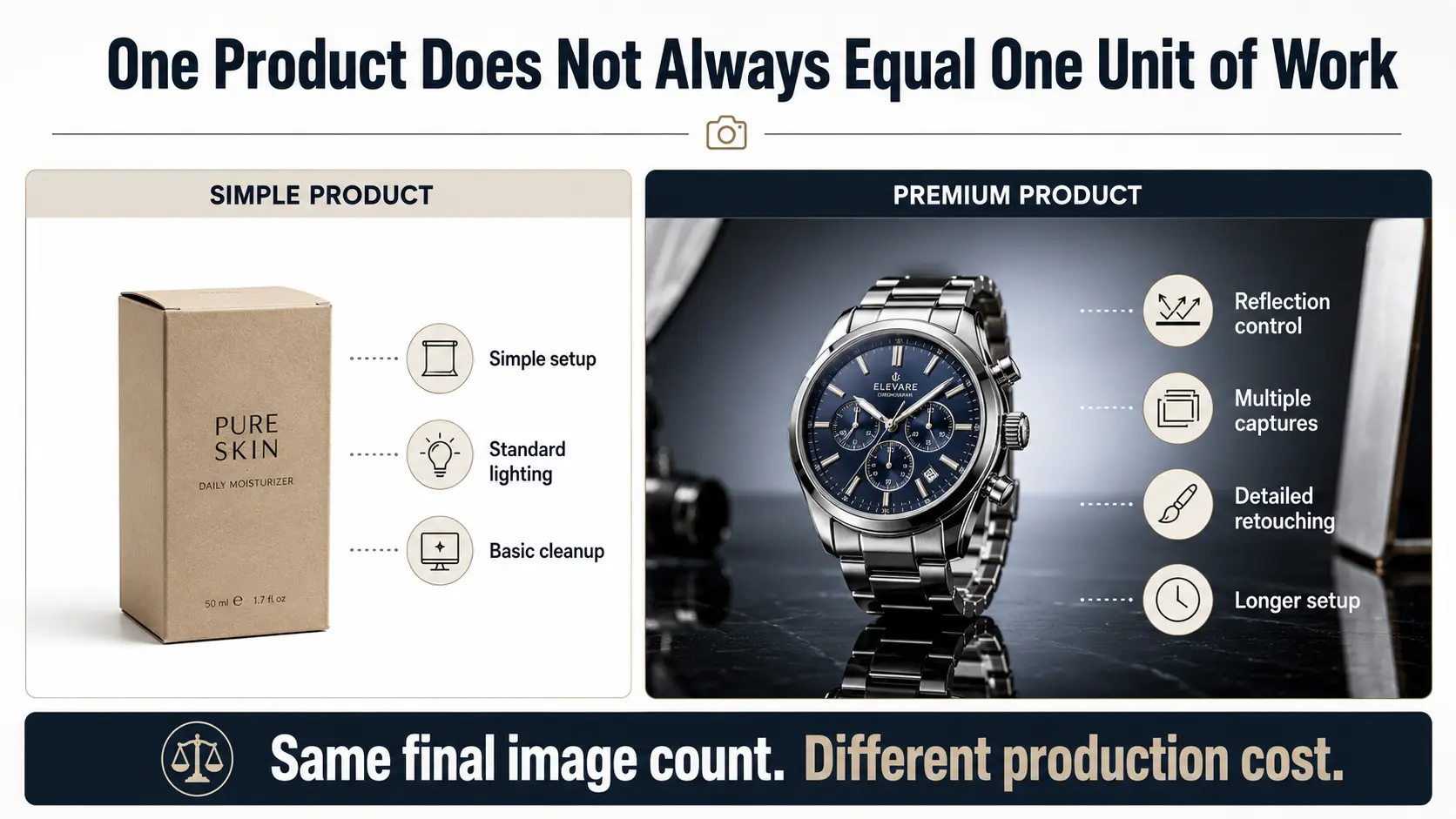
The danger is treating every photograph as equivalent. Photographing a matte cardboard box is not the same production task as photographing a chrome watch, transparent perfume bottle or highly polished piece of jewellery. Reflective and translucent products may require additional flags, diffusion, compositing and considerably more retouching. A photographer who charges the same flat rate for all of them can quickly turn a busy shoot into an unprofitable one.
If you publish product photography rates per image, define the category clearly: what type of product qualifies, how much preparation is included, whether background removal is included, the level of retouching, minimum image quantity and what happens when a product falls outside the standard workflow.
Per-SKU pricing is often clearer for e-commerce catalogue work
For e-commerce photography pricing, per SKU can be more useful than per image when every product needs a standard set of views.
Suppose each SKU receives one front photograph, one side view, one back view and two detail images. Rather than telling the client that photography costs ₹X per image and making them calculate five images across 80 products, the studio can quote a price per SKU for a defined five-image set.
That makes purchasing easier, but only if “SKU” is properly defined. A red shoe, black shoe and blue shoe may be three SKUs even though they share the same design. Photographing all three could require little additional setup, or each colour may require separate lighting and colour correction. Similarly, one SKU containing a six-piece cookware set may take far longer to arrange than a single bottle.
A useful per-SKU quotation therefore states the number and type of images included. Extra angles, colour variants, group compositions, close-up details, 360-degree sequences and lifestyle photographs should have their own rules rather than quietly expanding the original package.
Marketplace requirements matter here too. An Amazon-oriented shoot, for example, may require a specific main-image workflow in addition to secondary listing images. Current Amazon guidance continues to require a pure-white background for qualifying main product images, which means background preparation and cleanup should be included in the production plan rather than treated as an afterthought.
Day rates make more sense when the client is buying production capacity
A day rate changes the unit being sold. Instead of promising a fixed number of images, the photographer is reserving production time, equipment and usually a crew for the client.
This works well for styled product shoots, large catalogues, fashion e-commerce, food photography, interiors with products, model-based work and assignments where the number of finished compositions cannot be predicted accurately before production starts. It can also suit an agency or brand that wants to arrive with an extensive shot list and prioritise as much as possible during the available studio time.
A proper day rate should specify what a “day” means. Eight hours on set is not the same as eight hours including equipment load-in, styling, lunch, teardown and file transfer. Overtime should also be stated in advance.
More importantly, the photography day rate should not automatically swallow every other cost. Studio rental, assistants, digital technicians, stylists, models, makeup artists, specialised equipment, props, set materials and extensive post-production may need separate line items.
The client is paying for a production day, not unlimited production.
Project pricing is strongest when the photograph is only one part of the assignment
Some commercial product photography simply cannot be reduced sensibly to a photograph count.
Consider a beverage company commissioning six launch images. The photographer may spend a day discussing creative direction, another period testing surfaces and lighting, money sourcing glassware and ingredients, several hours building each composition, a full shoot day and substantial time compositing and retouching the final six files.
Dividing the total by six might produce a very high “cost per image,” but that number hides what the client is actually buying: a small commercial production.
This is where per-project pricing becomes useful. The quotation can account for pre-production, creative development, photography, crew, styling, props, equipment, studio, post-production, deliverables and agreed image usage as one defined scope. Our guide to photography packages versus custom quotations explains the same principle more broadly: repeatable requirements can be packaged, while unusual commercial assignments usually need a custom quote.
Setup and styling should influence the price before the first photograph is taken
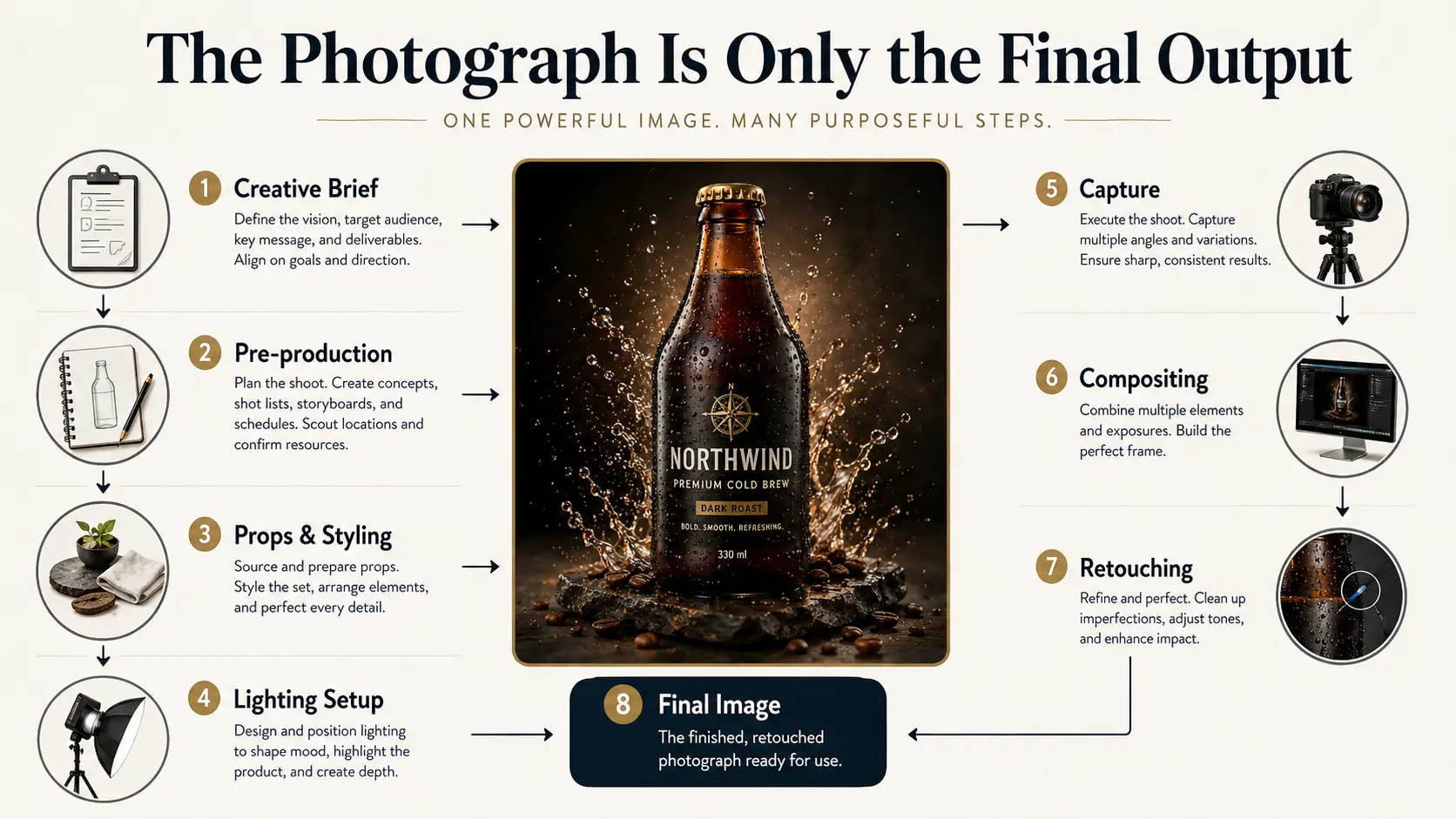
Product photography has a cost that exists even if the client ultimately wants only one image.
Lights have to be positioned. Surfaces must be prepared. Products may need cleaning, assembly, steaming, pinning, polishing or arranging. Test frames need to be made. Colour and reflections may need approval before the production batch begins.
That is why minimum charges matter.
If a client ships one watch and asks for two photographs, charging only twice your normal bulk per-image rate may not cover the studio preparation required to produce those photographs. A minimum shoot fee, setup fee or small-project minimum protects this work without forcing the studio to artificially inflate its advertised per-image price.
Styling should be treated similarly. Simple product placement is very different from food styling, wardrobe preparation, cosmetic smears, liquid work, elaborate flat lays or advertising sets built around a product. Props may require purchasing, renting, transporting, returning and sometimes replacing. Quote those responsibilities before production rather than trying to recover them after the client has approved the price.
Retouching needs a definition, not just the word “editing”
“Retouching included” is one of the easiest ways for a product photography quotation to become ambiguous.
Basic e-commerce post-production might cover exposure, colour correction, cropping, dust cleanup, straightening and background preparation. Advanced commercial retouching can involve reconstructing reflections, removing manufacturing imperfections, replacing labels, combining several captures, cleaning jewellery surfaces, correcting perspective, extending backgrounds or creating complex composites.
Those are different services.
Your quotation should say what standard processing includes and identify advanced retouching separately. The same applies to background removal and clipping paths. If every one of 300 catalogue images requires a precise cut-out, that is production work and needs to exist somewhere in the cost calculation.
This is also where photographers should check whether apparently attractive product photography rates are actually profitable. Our guide to calculating photography profit margin on individual bookings shows why revenue alone can hide editing, outsourcing, equipment, payment and rework costs.
Define revisions before the client starts reviewing files
A reasonable correction is not the same thing as a new creative direction.
If the agreed photograph has a small retouching issue, fixing it may reasonably fall within the original scope. If the client approves a white-background catalogue, receives the completed work and then decides that every image should have a dramatic shadow, the production requirement has changed.
State how many review rounds are included, who consolidates feedback and what constitutes additional work. For agency assignments, having one nominated approver is particularly useful; otherwise the photographer may receive conflicting comments from brand, e-commerce and marketing teams across several rounds.
Reshoots caused by a photographer's error should also be distinguished from reshoots caused by replacement products, incorrect samples, packaging changes or a client changing the brief.
Rush delivery should be priced around disruption, not emotion
A rush fee is not a punishment for clients with urgent deadlines. It compensates for what has to change inside the studio to deliver the work faster.
A next-day request may require rescheduling another edit, paying an editor overtime, bringing in additional post-production support or keeping staff working beyond the normal production day. The appropriate surcharge depends on the disruption.
Define normal turnaround first, then specify what qualifies as expedited delivery. This makes rush pricing much easier to defend because the client can see the standard workflow and the faster alternative rather than encountering an unexplained premium.
Commercial usage can change the economics of the same photograph
A product image made for a catalogue listing and the same image used for a national paid-advertising campaign do not necessarily represent the same commercial assignment.
Usage can involve media, territory, duration, advertising, packaging, retail displays, third-party use and exclusivity. These issues are especially relevant for campaign and advertising imagery rather than high-volume commodity catalogue work. Our detailed guide to usage rights, licensing and buyouts in commercial photography quotations explains how those variables can be documented.
Photographers working in India should be particularly careful about importing contract language from US or European photography templates. Section 17 of India's Copyright Act contains specific provisions concerning photographs commissioned for valuable consideration, subject to agreements between the parties. Ownership and licensing therefore deserve explicit contractual treatment and, for significant commercial work, appropriate legal advice rather than assumptions about who automatically owns what.
A practical product photography quote can combine pricing models
There is no requirement to force an entire job into one billing method.
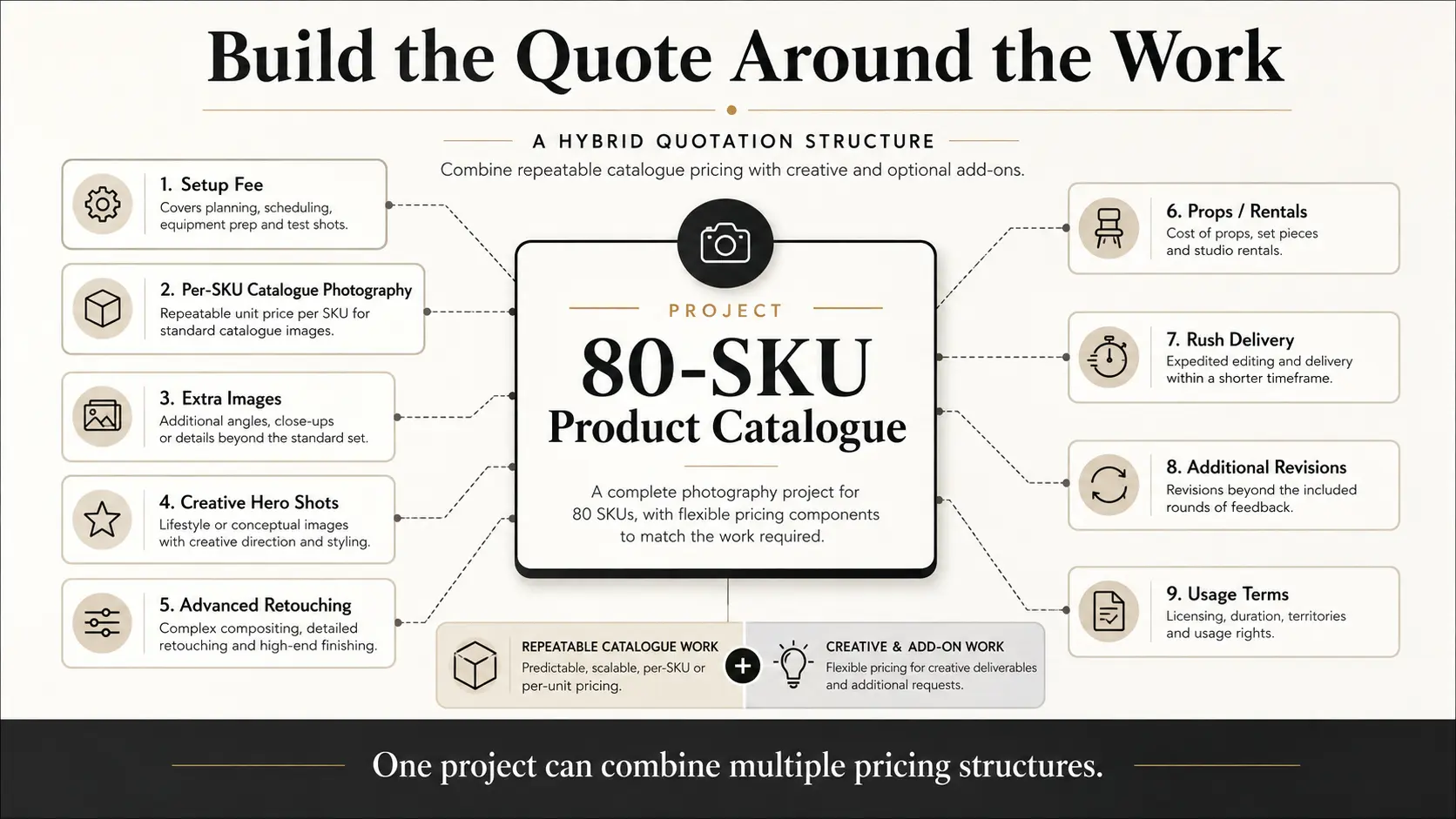
A studio might quote:
| Scope | Pricing method |
|---|---|
| Initial studio setup | Fixed setup fee |
| 60 standard e-commerce SKUs | Per SKU |
| Additional angles | Per image |
| Creative hero photographs | Per project |
| Photographer and crew for campaign day | Day rate |
| Advanced retouching | Per selected image or estimated scope |
| Props and specialist rentals | Actual or quoted production cost |
| Rush delivery | Defined surcharge |
| Additional revisions | Per hour or per round |
| Commercial usage | As agreed for the assignment |
This hybrid structure often reflects the real cost of production much better than searching for one perfect product photography price.
Before sending it, make sure the client can see the product count, required angles, backgrounds, image dimensions or formats, retouching standard, deadline, revision allowance, exclusions, payment schedule and any applicable usage terms. The broader GoPickle guide to creating clear photography quotations covers how to present those details without turning the proposal into an unreadable contract.
The best pricing model is the one that stays profitable when the brief becomes real
For simple catalogue work, per-image or per-SKU pricing can make buying remarkably easy. For production-heavy shoots, a day rate gives the studio room to work without promising an unrealistic image count. For advertising and custom commercial work, project pricing is usually better at capturing everything that happens before and after the shutter is pressed.
Whichever model you use, the important number is not the cheapest product photography rate you can advertise. It is the rate at which the agreed setup, styling, photography, post-production, revisions and delivery can actually be completed to the promised standard while leaving the studio with a sustainable margin.
That becomes much easier when the quotation records the real scope instead of reducing an assignment to “50 products × ₹X.”
At GoPickle, we think commercial photography workflows benefit from keeping the enquiry, quotation, booking and payment history connected rather than rebuilding the project scope across messages and spreadsheets. If your studio is formalising that process, see how GoPickle quotations help photographers structure and track proposals or review the GoPickle plans for photography businesses.