Photography Enquiry Response Workflow: Set an SLA for Busy Studios
Build a photography enquiry response workflow with business-hour targets, clear ownership, urgency rules, SLA pauses and escalation for busy studios.

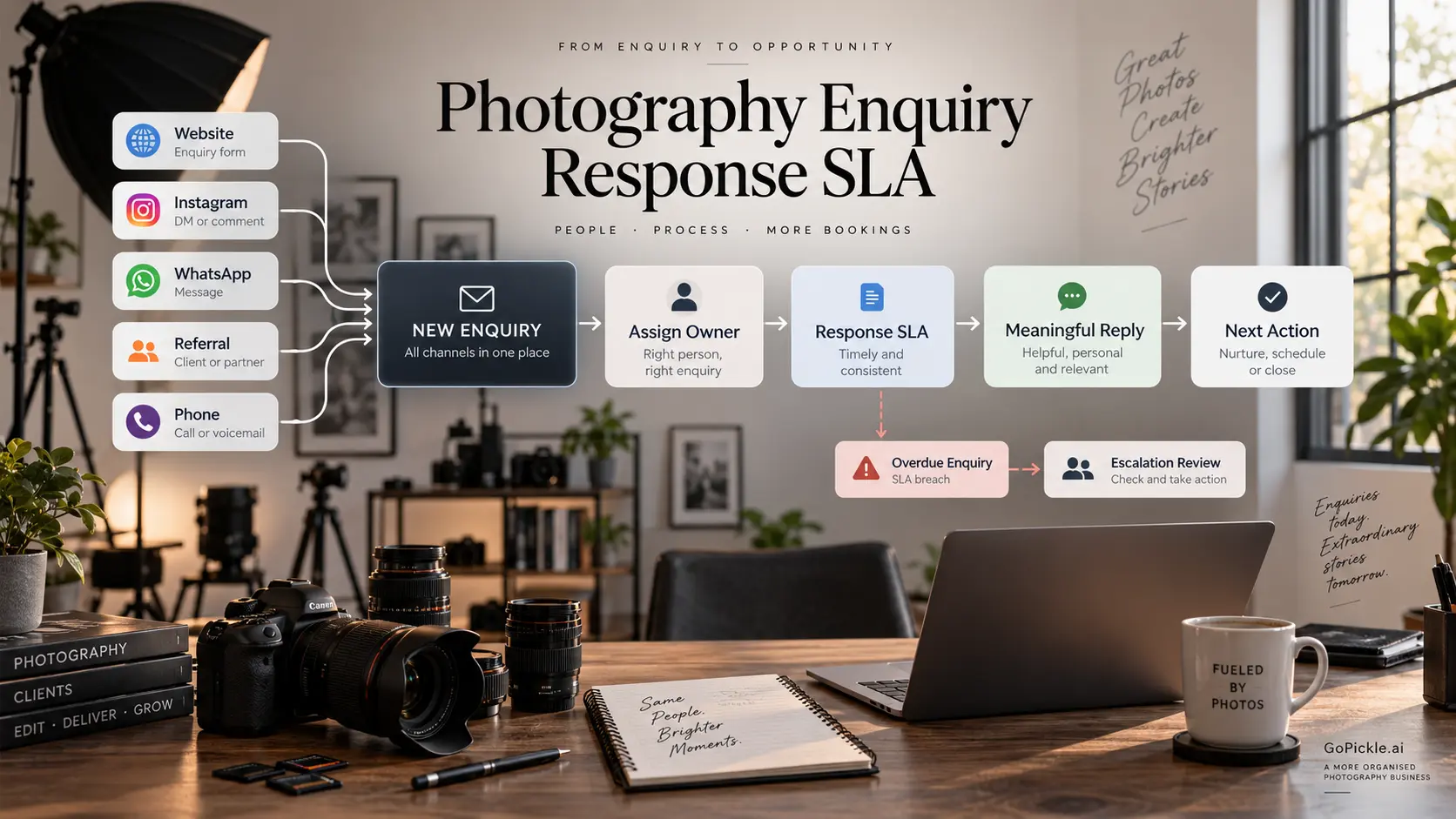
A new enquiry rarely arrives when a photography studio is sitting quietly waiting for it. It lands while the owner is photographing a wedding, while a coordinator is on another call, while the team is travelling between venues, or after business hours when nobody should be expected to watch a phone continuously.
That is why “reply quickly” is weak operating advice on its own. A busy studio needs a photography enquiry response workflow that answers more useful questions: when does the response clock start, what counts as a real response, who owns the enquiry, which leads deserve faster attention, and what happens if the responsible person cannot act in time?
An internal enquiry SLA, or service-level rule, gives those questions a consistent answer. It does not need to become a public promise to every prospect. Its purpose is to help the studio respond reliably without expecting photographers to interrupt shoots or stay online around the clock.
Why “reply quickly” is not a process
Fast replies can be useful while a prospective client is actively comparing photographers, but speed alone does not create a dependable sales process.
Suppose a wedding enquiry arrives through the website at 7:40 PM on Saturday while the team is covering events. One person notices it, forwards a screenshot into a staff group, and assumes somebody else will reply. Another sends a generic acknowledgement the next morning. The owner plans to check availability later, but no follow-up task exists. By Monday, the enquiry has technically received a reply and still has no owner, no qualification and no next action.
For SLA purposes, separate receipt acknowledgement from meaningful sales action. An automated message can confirm that the enquiry reached the studio and state when a reply is likely. It should not usually stop the internal response clock. A meaningful response is the first useful human action that moves the enquiry forward: confirming availability, requesting missing details, recommending the next step, arranging a consultation, or explaining that the studio cannot take the assignment.
A workable photography sales response process therefore needs four things on every genuine enquiry: a clock, an owner, a response condition and an escalation rule.
Define business-hour response targets
Do not copy somebody else’s “five-minute rule” or promise an arbitrary response window. A solo commercial photographer, a portrait studio and a wedding company with a dedicated sales desk have very different operating realities.
Start with your actual business hours. Define the days, local time zone and periods during which somebody is expected to handle new enquiries. If you serve several regions, decide whether one studio calendar is sufficient or different teams need separate coverage.
Then define when the clock starts and stops. An enquiry received inside the service window starts counting immediately. One received outside it can receive an automatic acknowledgement, while the human-response clock begins at the next staffed period unless your studio deliberately runs an evening or weekend rota.
The SLA should also cover channels that are not captured automatically. A website form may enter the queue immediately, while a phone call, WhatsApp message, planner introduction or Instagram conversation may require manual capture. The clock should begin when the studio receives the genuine enquiry, not when somebody eventually enters it into a CRM.
| SLA element | Studio rule to define |
|---|---|
| Business hours | Days, hours and time zone during which the target runs |
| Clock start | When a genuine enquiry reaches the studio |
| SLA completion | First meaningful human response with a clear next step |
| Owner | One accountable person responsible for the response |
| Pause condition | Waiting on a specific action or answer from the prospect |
| Breach | Target expires without the required action |
| Escalation | Who reviews, assists or reassigns after breach |
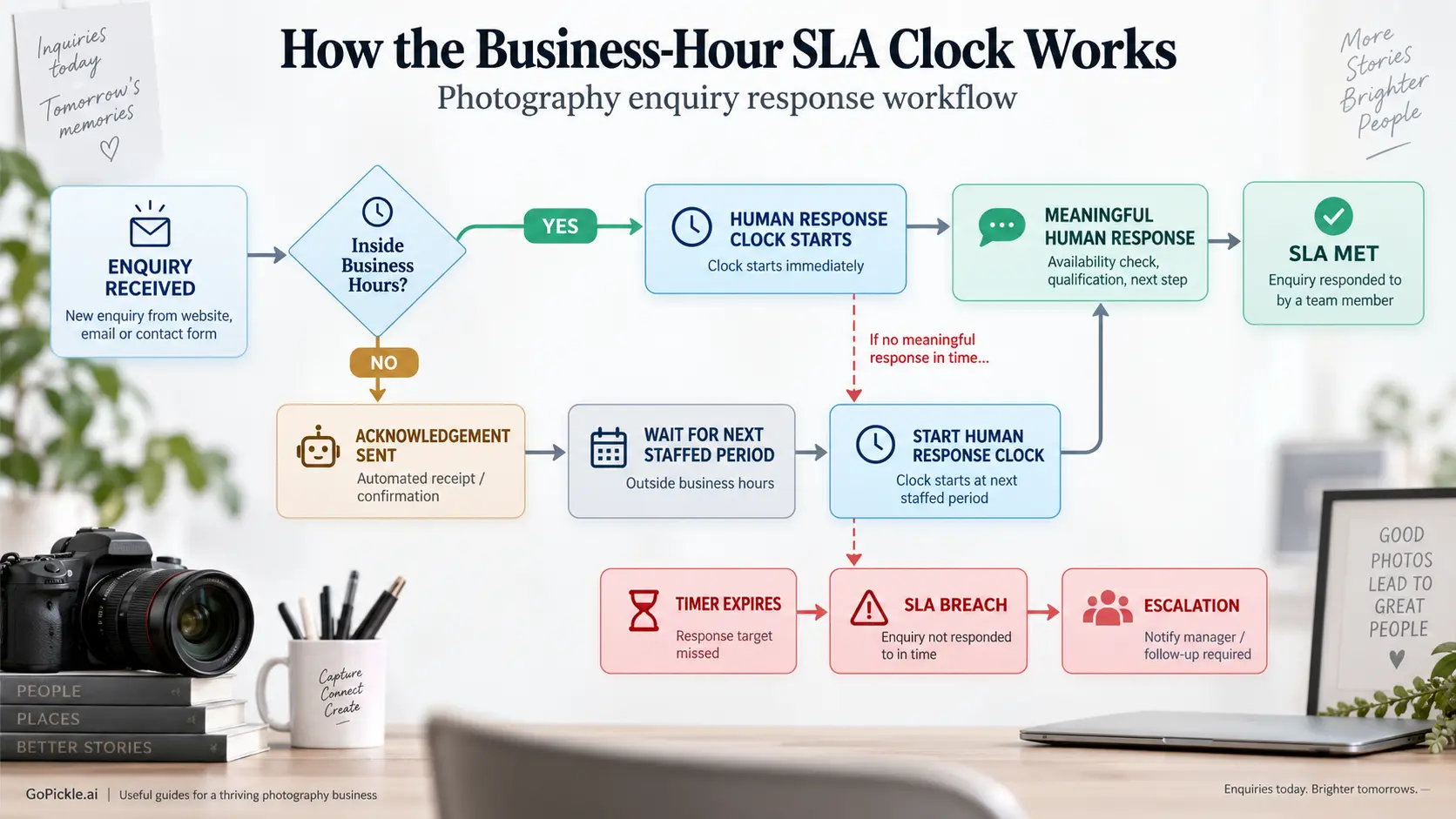
Set a target your studio can meet during a normal busy week. If the team regularly breaches it during peak season, review the service window, staffing, routing logic or target before blaming individual response speed.
Differentiate urgent-date and long-horizon enquiries
Not every new lead belongs in the same queue position.
A client asking for an event next week has a different decision window from a commercial client researching a campaign several months away. A corporate prospect that says, “We need a quotation by tomorrow afternoon” has also given you an explicit deadline. A repeat client asking about a high-demand date may deserve earlier attention than a vague request with no confirmed schedule.
Expected booking value can help with prioritisation, but it should not become the only urgency signal. A small portrait session tomorrow may require an immediate availability decision, while a large brand project may still be at an early research stage.
A practical priority rule can consider the event or shoot date, any stated decision deadline, existing client or referral context, completeness of the requirement and expected value. An incomplete lead should not be ignored; it should receive a response that collects enough information to qualify it.
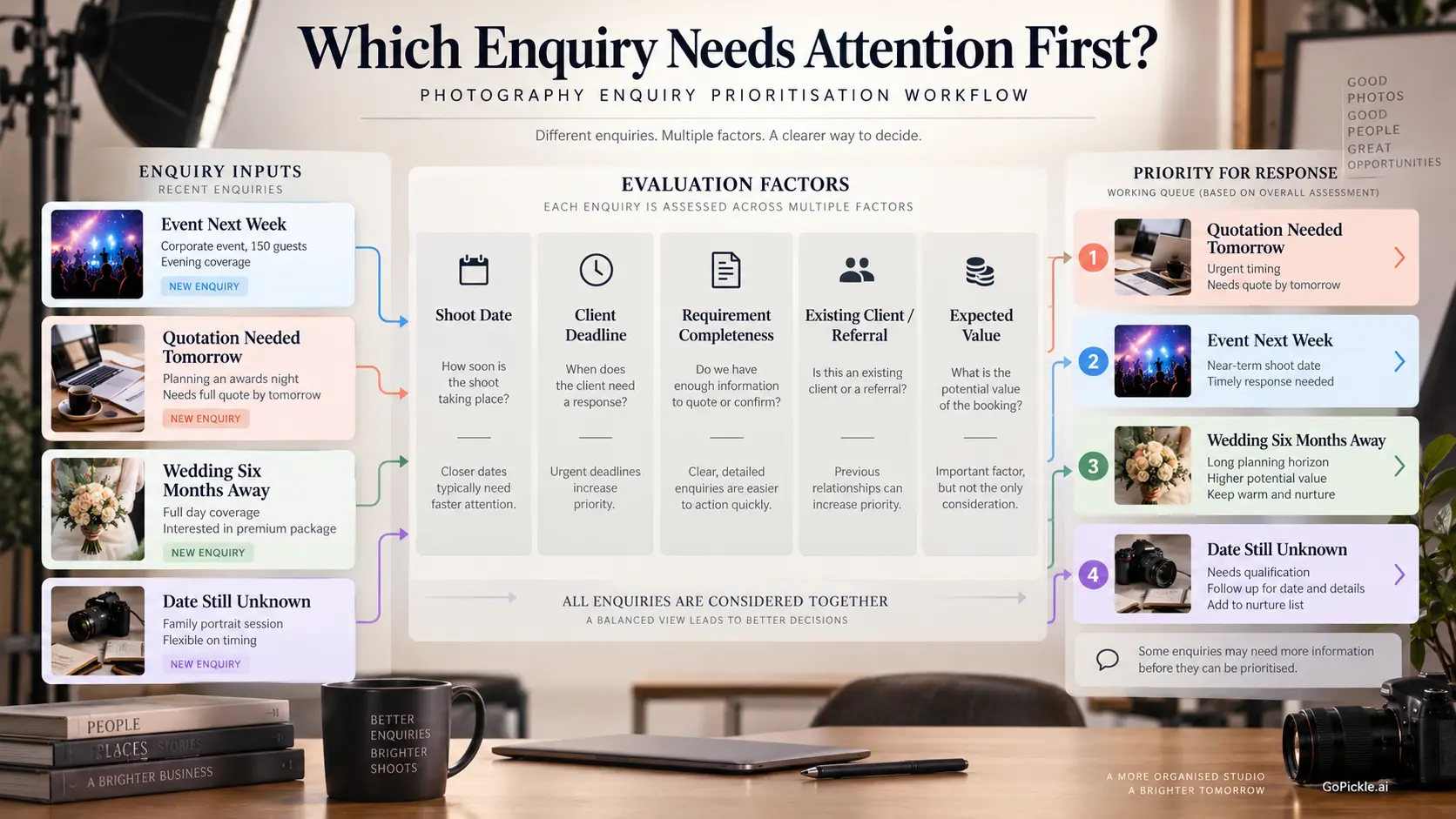
This is where a photography lead management workflow becomes more useful than a chronological inbox. The studio can make deliberate choices using date, source, requirement, stage and value instead of treating the oldest unread message as automatically the most important.
Assign ownership automatically or explicitly
A response target is meaningless if the lead belongs to “the team.” Every genuine enquiry needs one accountable owner. Other people may contribute, but somebody must be responsible for ensuring the next action happens.
For a solo photographer, that is straightforward. For a studio, routing can depend on service type, geography, language, lead source, existing client relationship or sales-team availability. A commercial enquiry may go to the owner, wedding enquiries to a coordinator, and repeat clients to the person who already knows the account. The exact rule matters less than eliminating ambiguity.
GoPickle’s lead workflow keeps enquiry context, assigned members, a Lead Manager and individual follow-up ownership together. The broader Lead Management for photographers flow also keeps source, requirement and next action visible as the opportunity moves toward quotation and booking.
Ownership should be set when the enquiry enters the working queue, not after the response target is close to expiring. If automatic routing is not possible for a particular source, make manual assignment part of intake.
Collaboration should not create duplicate client conversations. A second team member can check availability, production requirements or pricing without independently contacting the prospect. When an owner must change, use a separate photography lead assignment workflow so the conversation history, requirement, commitments and next action travel with the lead.
Escalate untouched enquiries without creating duplicate replies
Escalation should make a neglected enquiry visible. It should not create a second salesperson.
A simple ladder works well: warn the current owner before breach, alert the Lead Manager or studio manager when the SLA expires, then decide whether the original owner can still respond or whether an intentional reassignment is required.
That decision step matters. If a manager immediately messages the prospect while the assigned person is already preparing a quotation, the studio has solved one timing problem by creating a client-experience problem.
The escalation record should make five things obvious: current owner, last client interaction, response due, reason for delay and next accountable action. If reassignment becomes necessary, transfer the context before changing the client-facing owner so the prospect does not have to repeat the date, location, coverage requirements or previous conversation.
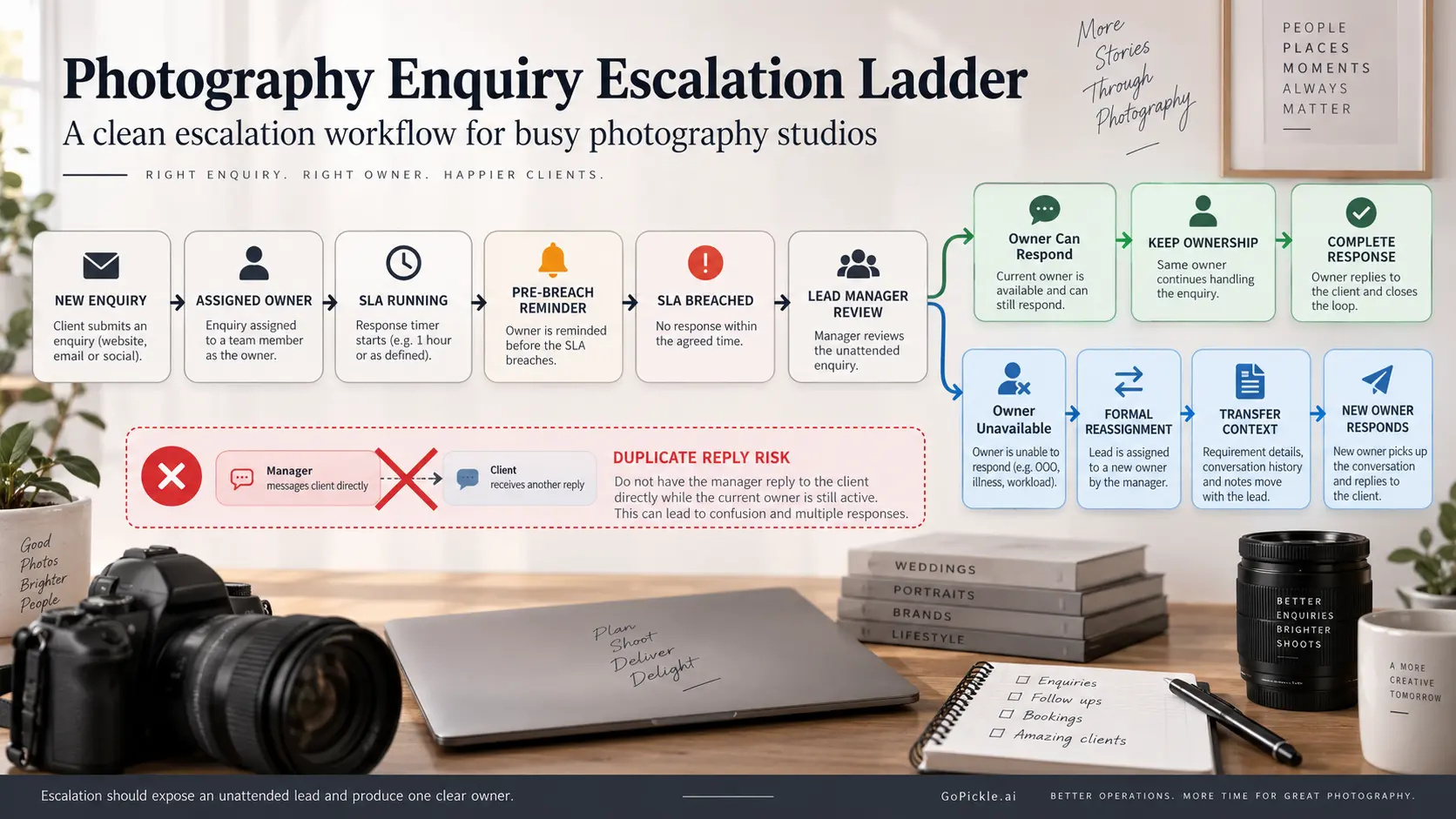
One breach may be an exception. Repeated breaches from the same source, time period or routing rule usually point to a workflow issue worth fixing.
Pause the SLA when waiting on the prospect
A good SLA measures the time your studio controls. If you reply asking for the event date, location or required coverage and cannot meaningfully proceed until the prospect answers, the response timer can move into a waiting-on-prospect state. The same principle is used in service-management systems: a clock can pause while the requester must provide information and resume when they respond.
The pause needs a clear reason. “Waiting on client” should mean the studio has already sent a specific request and the next meaningful action genuinely depends on the answer. It should not become a holding status for leads the team has not had time to handle.
Internal work usually should not pause the client-response SLA. If somebody is checking crew availability, building a custom quote or seeking approval, the prospect may still be waiting on the studio. Either keep the response due or send an honest interim update explaining what is being confirmed and when they should hear back.
Keep first-response SLA separate from follow-up cadence. Once the prospect has received a useful reply, the workflow moves into consultation, quotation, negotiation, decision and follow-up. If follow-up discipline is the problem, use a defined photography lead follow-up system rather than stretching the meaning of the first-response clock.
Measure consistency, not vanity speed
The fastest response of the month tells you almost nothing about whether the system works.
Track the percentage of genuine enquiries answered within your own SLA, median business-hour response time, number and age of breaches, and how many leads spent time unassigned. Break the results down by source and operating period. If website enquiries are handled consistently but Instagram enquiries are missed, capture or routing may be the problem. If Saturday leads breach while weekdays do not, staffing or business-hour policy may be the issue.
Do not turn the metric into a leaderboard that rewards rushed replies. A two-minute generic message with no next step is not better than a thoughtful response inside the agreed target. The purpose of the SLA is predictable handling.
Keep response performance separate from sales outcomes as well. Booking results can change because of seasonality, pricing, availability, lead quality or service mix. Measure conversion with a consistent funnel definition rather than assuming faster replies caused every improvement. Our guide to photography lead-to-booking conversion rate shows how to keep enquiry, qualified-lead, quotation and booking denominators separate.
The strongest photography enquiry handling process is not the one that forces everyone to answer instantly. It is the one that makes responsibility visible. Every genuine lead enters a queue, receives an achievable business-hour target, has one accountable owner, follows a clear escalation path when attention is late, and stops the clock only when the next move genuinely belongs to the prospect.
That is what turns “we try to reply quickly” into a system a busy photography studio can actually run.