Photography Lead Assignment: How to Hand Off Enquiries Without Duplicate Replies
Build a clear photography lead assignment workflow with one accountable owner, collaborators, next actions and handoff rules that prevent duplicate client replies.


A photography studio can have excellent photographers, a capable sales coordinator and a well-organised manager, yet still mishandle a promising enquiry because two people believed they were responsible for it at the same time. One replies from WhatsApp while another calls. A third team member changes the quotation after hearing a different version of the requirement. At the other extreme, everyone can see the enquiry but assumes somebody else is handling it, so the client hears nothing.
This is the real purpose of photography lead assignment. It is not merely putting a team member's name against a CRM record. A useful assignment system establishes who is accountable for moving the opportunity forward, who else may contribute, who owns the immediate next action, and what must happen when responsibility changes.
For growing photography businesses, that distinction becomes increasingly important. Enquiries may arrive through Instagram, WhatsApp, website forms, referrals, phone calls and email while different people handle consultations, quotations, production questions and accounts. A photography lead management system should give all of those people visibility without turning visibility into permission for everyone to contact the client independently.
The operating principle we recommend at GoPickle is straightforward: many people may help with a lead, but there should be one clear accountable path to the next client action.
Why shared inboxes create duplicate ownership
Giving a team access to the same inbox or CRM fixes one problem: information is no longer trapped inside one person's phone. It does not automatically fix ownership.
Imagine that a couple enquires about three days of wedding coverage. The studio manager sees the message and begins checking availability. A sales coordinator sends the package brochure. Meanwhile, the lead photographer recognises the client's name and replies personally because they were referred by a previous customer.
Nothing about those individual actions looks unreasonable. Together, however, they can produce three separate conversations with different assumptions about availability, package scope or price.
Shared visibility therefore needs a second layer: who is responsible for the client-facing conversation at this moment?
The same problem appears when studios rely heavily on messaging apps. Our guide on whether photographers need a CRM or can continue using WhatsApp explains the broader issue: messaging is excellent for conversation, but it does not naturally create structured responsibility around an opportunity.
Photography sales team workflow should separate these two questions:
- Who needs access to this lead?
- Who is accountable for making sure the lead moves forward?
They are not the same question.
Define the lead owner, collaborators and next-action assignee
The word "owner" can be misleading if it suggests that one employee exclusively controls a client. In practice, larger photography enquiries often need contributions from several people.
A wedding enquiry might need the sales coordinator to collect requirements, the cinematography lead to answer a technical question and the studio owner to approve an unusual commercial term. A commercial photography enquiry might involve a producer, photographer and accounts person before the assignment is confirmed.
The CRM therefore needs different levels of responsibility.
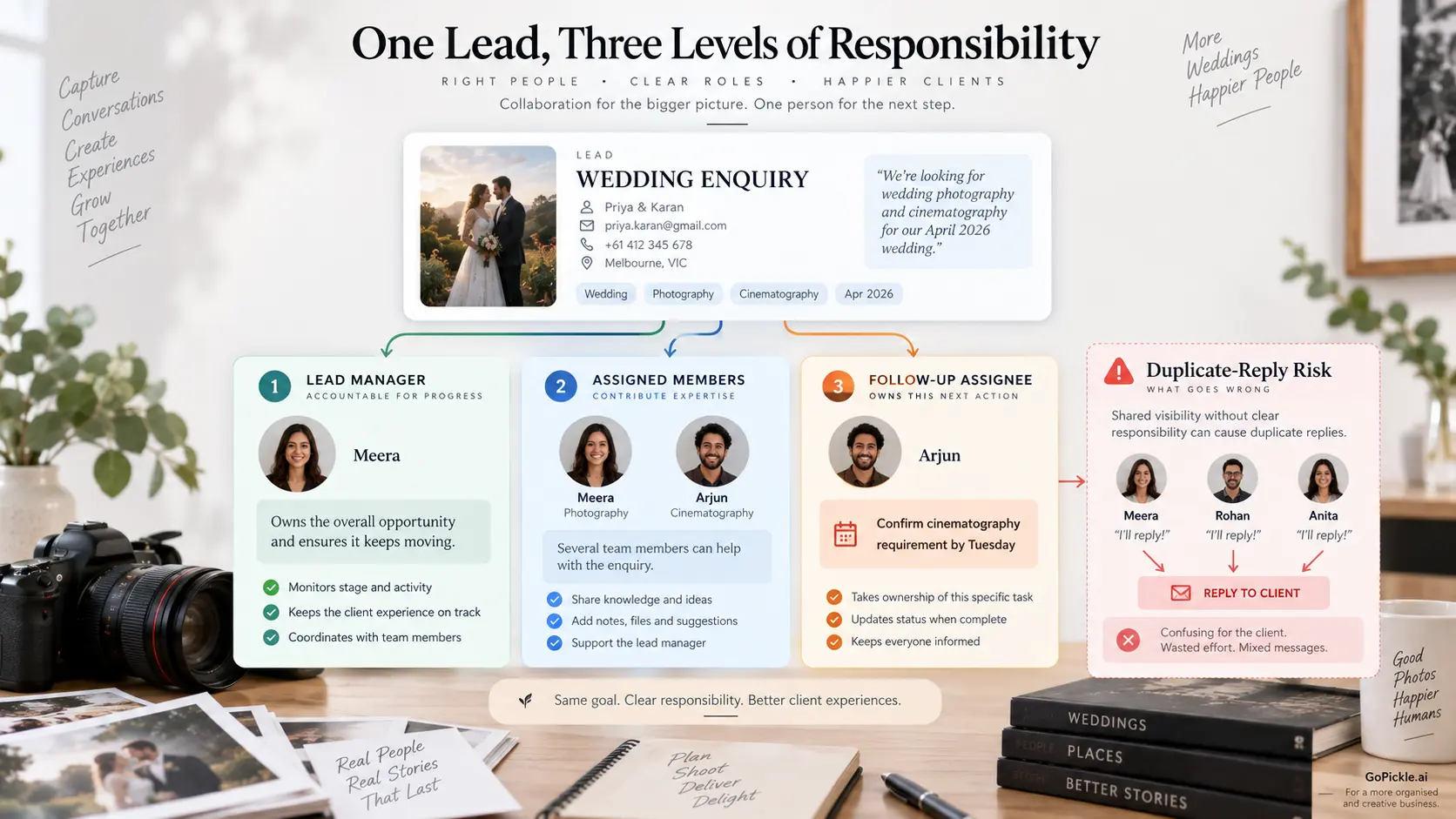
| Responsibility | What it means | Example |
|---|---|---|
| Accountable lead person | Makes sure the opportunity continues moving | Meera oversees the wedding enquiry |
| Collaborator | Contributes expertise or information | Arjun advises on cinematography coverage |
| Next-action assignee | Owns one specific action with a due point | Arjun must confirm drone feasibility by Tuesday |
GoPickle's current lead workflow reflects this distinction. A lead can have multiple Assigned Members, while one person can optionally be marked as the Lead Manager. The Lead Manager is an accountability marker rather than exclusive ownership of the client. Individual follow-ups can also have their own assignee, so another team member can own a particular action without taking over responsibility for the entire opportunity.
For example:
Lead Manager: Meera
Assigned Members: Meera, Arjun
Next action: Confirm cinematography requirement
Assigned to: Arjun
Meera still makes sure the opportunity progresses. Arjun owns the immediate task.
That structure is considerably safer than simply adding three people to the lead and expecting them to work out responsibility among themselves. You can see the same distinction in our detailed guide to managing photography leads in GoPickle.
Decide when a photography lead handoff should happen
A handoff should happen because responsibility genuinely needs to change, not because another person happens to become involved.
If the lead photographer answers one technical question about lighting a difficult venue, that does not necessarily mean the lead should be transferred away from the sales coordinator. They can contribute the answer while the existing Lead Manager continues the client relationship.
A genuine photography lead handoff is more appropriate when the person accountable for progressing the opportunity changes.
Common examples include a coordinator qualifying the enquiry before handing it to a photographer for a consultation; a salesperson escalating a custom commercial project to the studio owner; responsibility moving to another team member because the current person will be unavailable; or a confirmed sale moving from sales into the booking and production workflow.
The distinction matters because unnecessary handoffs increase the amount of context that has to be transferred and give clients more opportunities to receive inconsistent answers.
When a handoff does occur, make it explicit. "I told Rahul about it" is not a handoff. Neither is forwarding a screenshot into a team chat.
The lead record should show that responsibility changed, who now holds it and what the new person is expected to do.
Preserve the conversation and requirement context
A good photography lead handoff should allow the incoming person to continue the conversation without asking the client to repeat everything.
This requires more than storing contact details.
Suppose the CRM note says:
Wedding enquiry. Interested in package.
The next person still has to reconstruct the sale.
Compare that with:
Three-day wedding in October. Client wants candid photography for all functions and cinematic video for ceremony + reception. Venue confirmed for first two events; reception venue pending. Comparing Signature and Custom packages. Asked whether same-day edits are possible. Quotation promised Thursday. Parents will join the next discussion.
The second record changes the quality of the handoff because it preserves information that affects the next conversation.
A useful handoff record should normally preserve:
- what the client is trying to book;
- relevant dates, events and locations;
- services and deliverables discussed;
- current budget or commercial position where known;
- the latest client question or objection;
- anything the studio has already promised;
- quotation or package status;
- the next action, responsible person and due point.
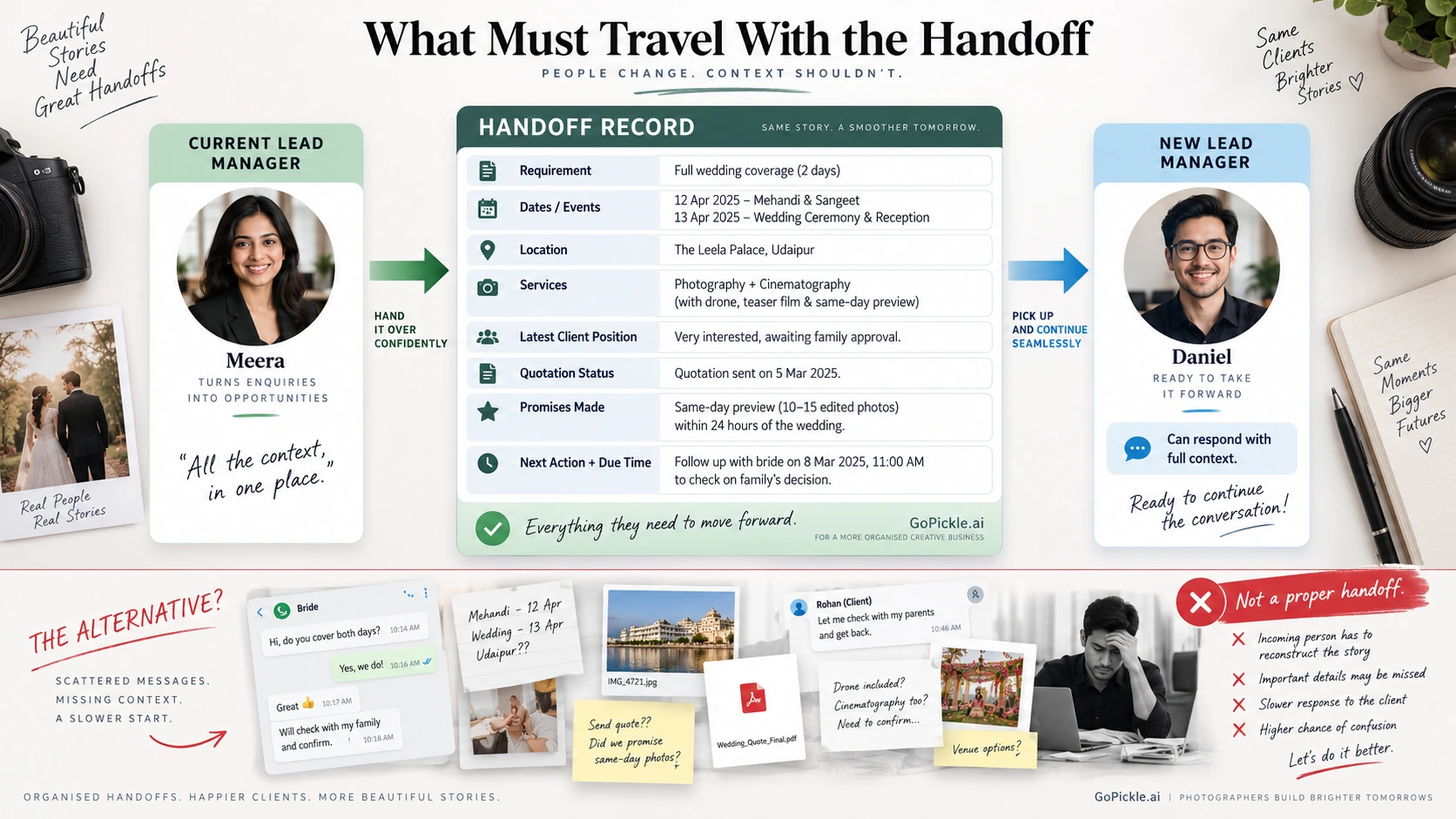
This is particularly important for multi-event weddings, commercial productions and large event assignments because requirements develop over several conversations. The person taking over should see the current requirement, not only the requirement captured on day one.
GoPickle's lead workflow is designed so requirements can be updated progressively rather than forcing the studio to know everything at first contact. Once the work is confirmed, that context can continue into the broader enquiry-to-delivery photography workflow instead of being rebuilt from scattered messages.
Set the next action before transferring the lead
A lead should never be handed over with only a new name in the assignee field.
The receiving person needs to know what they are supposed to do.
Consider these two handoffs:
Assigned to Daniel.
and:
Daniel: call client Tuesday at 14:00 to confirm commercial usage requirements before final quotation.
The first transfers visibility. The second transfers responsibility.
Every photography lead handoff should therefore end with a next action that contains enough information to act without reopening the entire conversation. Depending on the stage, that action might be to collect the remaining event details, confirm availability, conduct a consultation, revise the quotation, answer a production question or obtain a decision.
The action should also have a due point. Without one, the CRM knows who might do something but cannot tell the team when the opportunity is becoming neglected.
This is where photography CRM lead assignment becomes operationally useful. The lead's pipeline stage answers where the opportunity is. The next action answers what somebody needs to do now.
Do not collapse those concepts into one field. "Quotation Sent" is a useful stage. "Call client Friday to discuss the quotation" is a useful next action.
Escalate overdue high-value enquiries without creating chaos
Not every overdue lead requires the studio owner to intervene. If every late task produces another notification to everybody, escalation becomes background noise.
Escalation should identify leads where delay has meaningful commercial consequences.
Useful signals can include an overdue follow-up, a significant expected booking value, an approaching event date, a quotation that has been sent without a next action, or an opportunity that has remained in the same stage unusually long.
The purpose is not automatically to reassign the client.
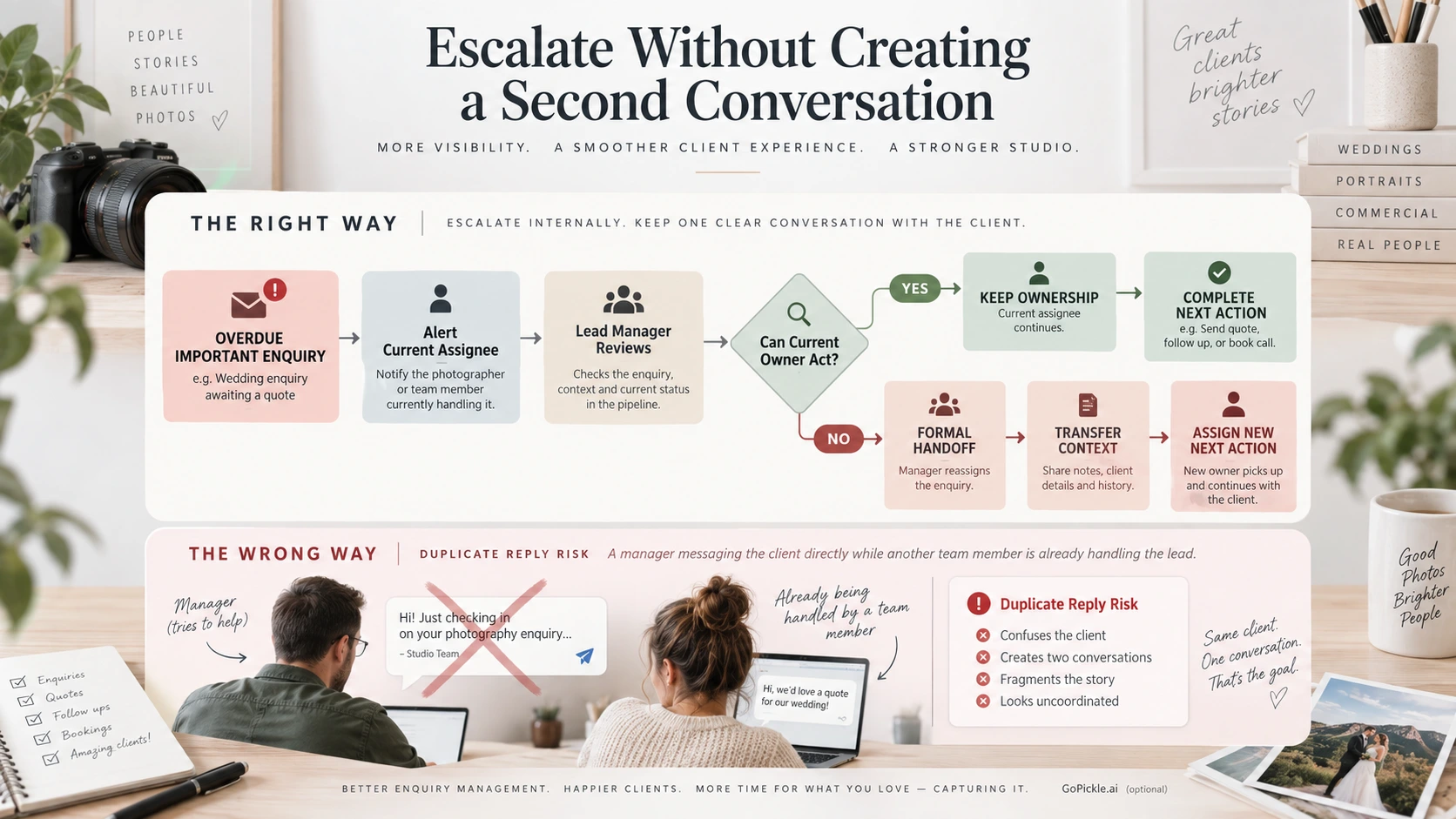
If a salesperson owns a valuable commercial enquiry and the follow-up becomes overdue, the first escalation may simply be visibility for the Lead Manager or studio manager. If the assigned person is unavailable, the studio can then make an intentional handoff. What you want to avoid is a manager contacting the client independently while the existing owner is already preparing a response.
A clean escalation path might look like:
Follow-up overdue
→ Current assignee alerted
→ Lead Manager reviews
→ Keep owner OR formally transfer
→ New owner receives context + next action
That sequence protects accountability without creating a second competing conversation.
Measure response without creating surveillance theatre
Once several people manage leads, studio owners naturally want to know whether enquiries are being handled well. The useful metrics are operational, not performative.
Knowing how many leads currently have no accountable person is useful. Knowing how many active enquiries have an overdue next action is useful. So is understanding how long genuine enquiries wait for a first meaningful response, where handoffs are becoming stuck and whether promising quotations repeatedly reach a stage with no scheduled next action.
Counting every message a salesperson sends is much less useful. So is rewarding whoever closes the largest number of CRM tasks if those tasks have little relationship to client outcomes.
Photography sales is not a call-centre typing contest. A complex commercial assignment may need several careful conversations before pricing can be finalised, while a straightforward portrait enquiry may confirm quickly. Raw activity volume does not tell you whether the client was handled well.
Use the CRM to expose workflow risk, not to manufacture the appearance of productivity.
The same principle applies after the sale. Team responsibility should continue to be clear when the enquiry becomes a confirmed job. GoPickle's crew management workflow for photographers uses defined roles, event assignments, task context and visible handoffs so responsibility remains clear when work moves from sales into production.
A good handoff should be invisible to the client
Clients do not need to understand your CRM structure.
They should simply experience a studio that remembers what they said, knows what was promised and responds consistently even when several people are involved behind the scenes.
That is the real test of photography lead assignment.
If two people need to contribute, both can be Assigned Members. If one person needs to remain accountable for moving the opportunity forward, make that responsibility visible. If somebody else owns the immediate action, assign that action specifically. When responsibility changes, transfer the context and define what happens next before the previous person steps away.
The result is not rigid sales bureaucracy. It is the opposite. Clear ownership gives a photography team room to collaborate without making the client coordinate the studio for you.
As a photography business grows, that becomes one of the most important differences between simply sharing enquiries and actually operating a studio lead management team.