Photography Expense Tracking: Separate Job Costs From Studio Overhead
Build a practical photography expense tracking system that separates booking costs from studio overhead, reconciles estimates to actuals and improves job costing.

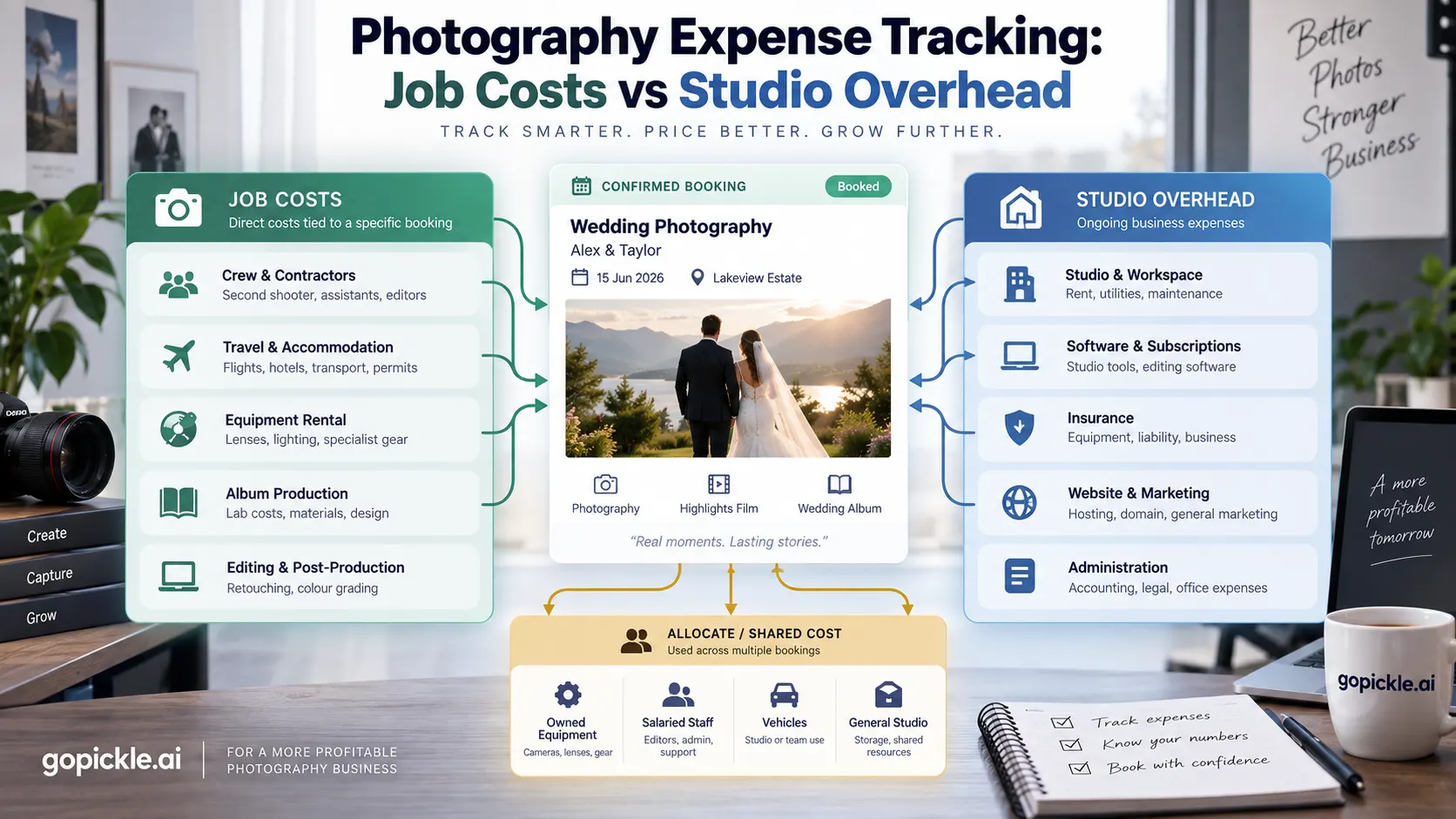
A photography studio can finish a strong month with plenty of invoices paid and still be unable to answer a basic question: which bookings actually cost more to deliver than expected?
The studio may have bank statements, supplier invoices, crew payment notes and software receipts, but everything is being treated as one pool of spending. A second photographer hired for one wedding sits beside the annual website bill. Album production sits beside studio rent. A rented lens sits beside equipment the business will use for years.
Useful photography expense tracking needs to answer two different questions at the same time: what did the business spend money on? and which booking, if any, caused that cost?
That distinction turns a receipt archive into a management system. It also gives photography profit-margin analysis much better inputs, because the studio can see what a job consumed before deciding what it earned.
Direct booking costs vs studio overhead
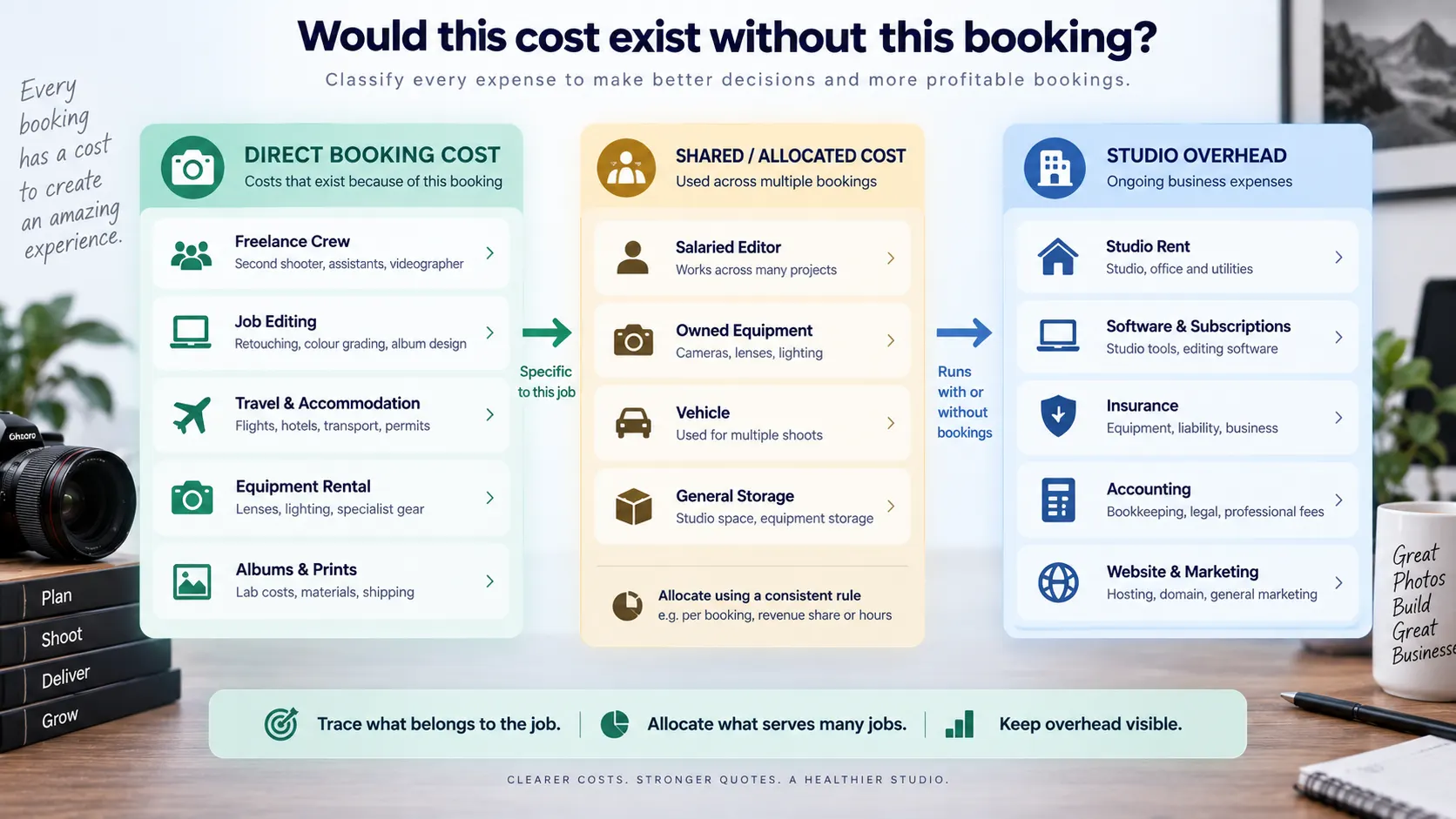
Start with a practical test: Would this cost have existed if this booking had never happened? If the answer is no, it is usually a direct booking cost. If the business would still have paid it during a month with no such job, it is usually overhead. Professional Photographers of America uses a similar managerial distinction between cost of sales and general expenses when helping photographers understand studio finances.
That gives a photography business three useful cost buckets:
| Cost type | Typical photography examples | How to track it |
|---|---|---|
| Direct booking cost | Freelance crew, job-specific editing, travel, accommodation, rented gear, albums, prints, permits, courier charges | Attach to the booking or project |
| Studio overhead | Rent, website, insurance, accounting, general software, baseline marketing, office administration | Track by recurring expense category and period |
| Shared or allocated cost | Salaried production staff, owned equipment, vehicles, general storage, mixed-use software | Apply one consistent allocation rule for internal job costing |
The third bucket matters because not every photography studio expense fits cleanly into “job” or “overhead.” A freelance editor paid specifically for one assignment is easy to trace. A permanent editor on a monthly salary may work across six bookings. For internal photographer job costing, you may choose to allocate that employee's production time across those jobs even if your formal accounts classify the salary differently.
The same principle applies to equipment. A lens rented only for one campaign is a direct project cost; a camera body used across many assignments should not make the next booking absorb the entire purchase. Formal accounting and tax treatment vary by jurisdiction, so keep those decisions with your accountant; this classification is for operating decisions.
Crew and contractor costs belong with the work they performed
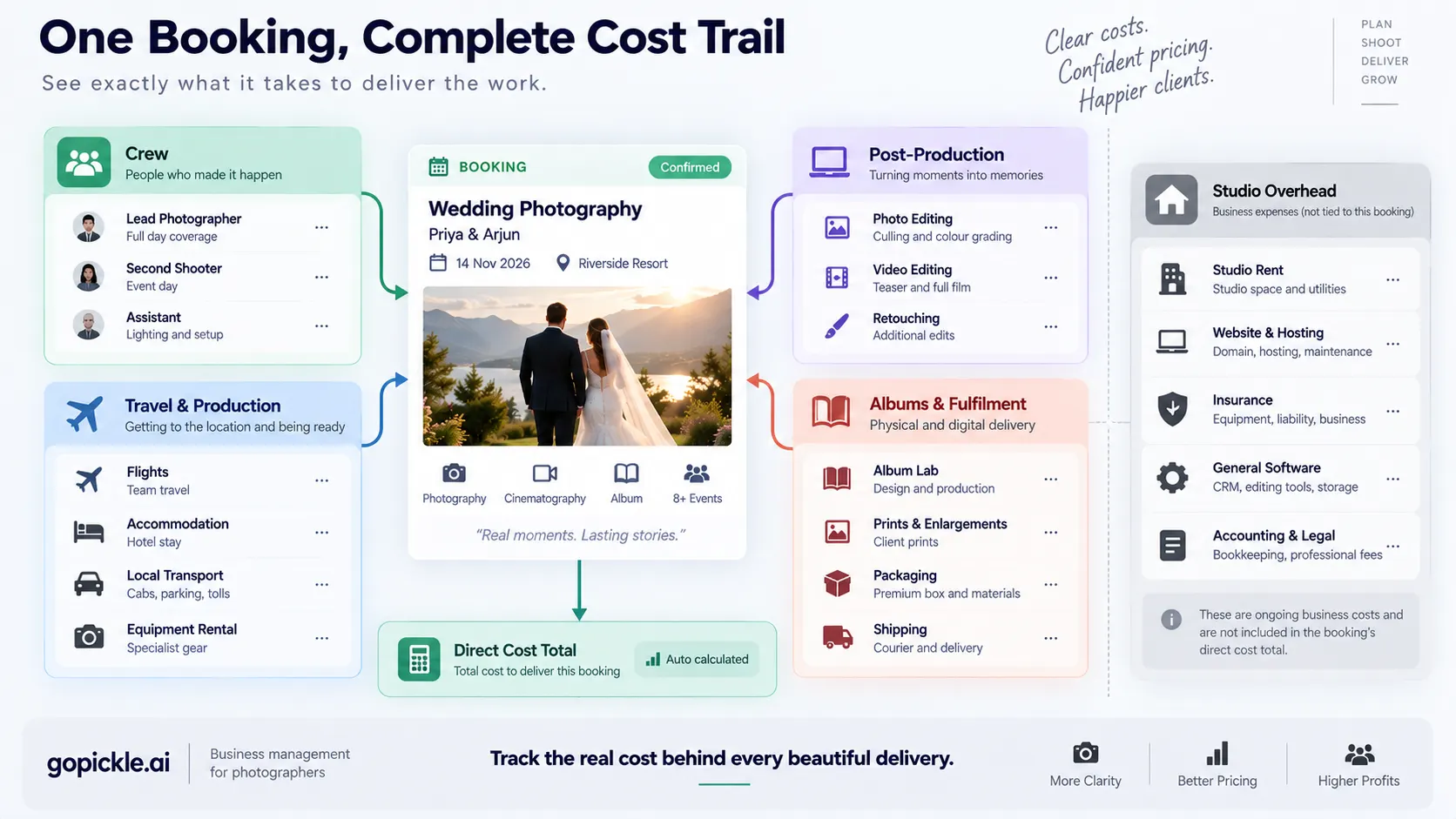
For event, wedding and commercial studios, people can be one of the largest direct costs of a booking. Track the cost at the level where the commitment was made: booking, event or production phase.
That can include second shooters, cinematographers, drone operators, lighting assistants, digital technicians, editors, retouchers, album designers and other freelancers. If a contractor works across several events within the same booking, the total can still roll up to that booking while retaining event-level detail.
Avoid recording only “crew: 1,500.” A useful record also identifies the role, assignment, agreed rate, additions such as overtime or travel, amount actually paid and payment status. That makes it possible to see whether a package consistently requires more staffing than the quotation assumed.
Salaried staff need a deliberate rule. If you want a realistic cost per booking, track attributable production time or use another repeatable allocation method. Do not change the method from job to job just to make the margin look better.
Travel and production expenses need a booking reference
Travel is where photography business expense tracking often becomes vague. The studio remembers the flight or hotel but loses smaller costs such as parking, tolls, local transport, baggage, permits or last-minute production purchases.
If the cost exists because the team had to perform a specific assignment, attach it to that booking. For destination or multi-day work, consider separating transport, accommodation and travel-day labour rather than burying everything under one “travel” line. That gives you better data when pricing the next job.
The same rule applies to production expenses. A prop purchased for one campaign, a location hired for a portrait session or a lighting kit rented for a corporate shoot can be traced directly. General vehicle insurance, routine equipment maintenance and the studio's ordinary electricity bill are broader business costs.
Good records should preserve the original transaction amount and currency when you work across borders. Your accounting system can handle the required reporting conversion according to your jurisdiction; your job-costing record should still make it obvious what the assignment actually required.
Albums, prints and fulfilment are part of the booking cost
Physical delivery can quietly erode margin because the headline lab price is only part of fulfilment. Album production may also create design fees, premium material upgrades, proofing work, packaging, shipping, customs or courier charges and occasional reprints.
Track those against the booking that generated them. If the client purchases an album upgrade after confirmation, add both the extra revenue and the extra cost to the same project history rather than treating the upgrade as a separate unexplained transaction.
Reprints deserve another field: why did this cost happen? A client-paid duplicate album is commercially different from a free reprint caused by a studio error, even though both are direct costs. Root-cause tags such as client change, supplier defect, studio error or scope addition can reveal operational problems that a simple expense total cannot.
Software and studio overhead should remain visible without distorting one job
A studio can become very disciplined about direct job costs and still underprice its work by ignoring the expenses required to keep the business operating.
Typical photography studio expenses include rent, internet, insurance, accounting, website hosting, studio-management software, editing subscriptions, general cloud storage, administration, permanent non-production salaries, baseline marketing and equipment costs applicable to the business.
Most of these should not be attached randomly to the booking that happened to occur when the bill was paid. Track them as overhead by month or another consistent reporting period. Then, when you want a fully loaded view of job profitability, allocate overhead using a method that suits your studio: for example, by booking count, revenue share, productive labour hours or project type.
No method is perfect. Consistency is more valuable than false precision. If a commercial studio allocates overhead by labour hours in January and by revenue in February, comparisons become unreliable.
Also watch for software that changes character depending on how it is charged. A fixed annual gallery subscription is normally overhead. A per-gallery processing fee incurred only because one booking used a particular service can reasonably be treated as a direct cost for internal job costing.
Keeping overhead separate also improves photography cash-flow forecasting, because the studio can distinguish recurring commitments from production costs that rise and fall with confirmed work.
Reconcile the estimate against the actual cost
Expense tracking becomes most useful when it starts before the money leaves the account.
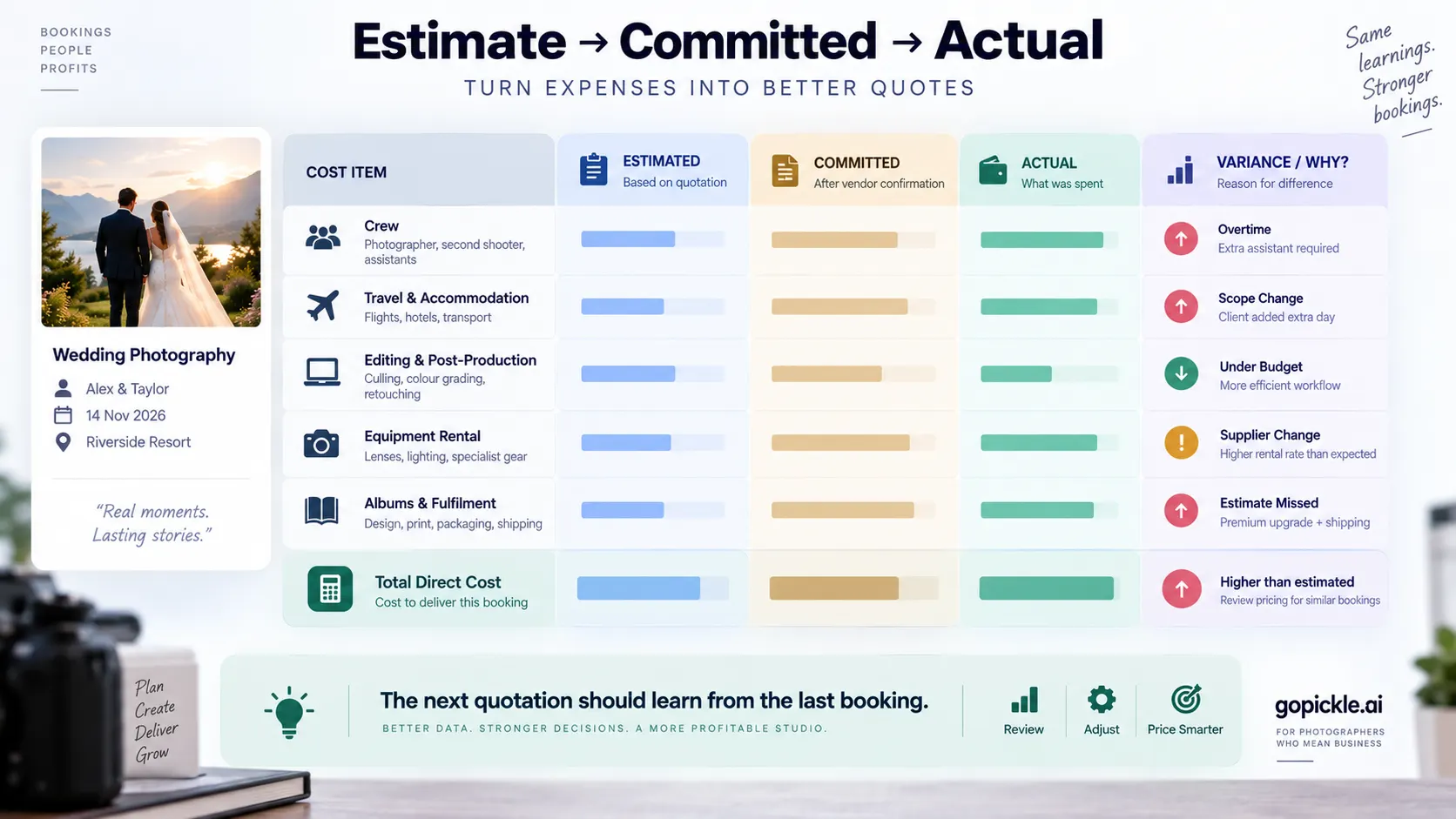
At quotation stage, create an estimated cost for significant direct items: crew, editing, travel, rentals, albums and other fulfilment. Once the booking is confirmed and suppliers or freelancers are committed, update those numbers to committed cost. As invoices, receipts and payouts arrive, record the actual cost.
That creates a simple progression:
Estimated → Committed → Actual → Variance
Suppose a booking was priced assuming two crew members, local travel and one standard album. The actual job required an extra assistant, an overnight stay and a premium album upgrade. If the client paid for those scope changes, the higher cost may be completely healthy. If the studio absorbed them without revising the price, the variance tells a different story.
Review large variances before closing the booking. Ask whether they came from inaccurate estimating, client-approved scope changes, overtime, supplier price changes, rework, poor crew planning or costs that were simply forgotten during quotation. That is the feedback loop that improves the next quote.
Use expense categories consistently across reports
A workable expense ledger does not need dozens of hyper-specific categories. It needs categories the team will use the same way every time.
For most studios, the transaction record should capture the expense category, cost type, related booking or “overhead,” supplier or payee, transaction date, amount, currency, estimated/committed/actual status, payment status and a receipt or reference where appropriate. If you operate as a team, define who is responsible for recording the expense and who reviews it.
Keep the category names stable. If one person records a second shooter under “crew,” another under “freelancer,” and a third under “production,” the studio cannot compare jobs reliably. You can add detail with subcategories or role fields without fragmenting the main reporting structure.
The same discipline applies when software is involved. Photography expense tracking software can help capture receipts, categorise spending and export records, while accounting software remains the appropriate home for formal books. The operational system has a different job: preserve the context around the assignment.
That is where GoPickle's Booking Management for Photographers can support the workflow without pretending to replace accounting software. GoPickle keeps the client, events, services, deliverables, crew, quotations, invoices and payment context around a confirmed booking. That gives the studio a clear project reference when direct costs are recorded in its expense or accounting system.
At GoPickle, we would keep those responsibilities explicit: the booking system explains what work was sold and delivered; the expense ledger explains what the work cost; the accounting system handles the business's formal financial records.
Once those records use the same booking reference and consistent categories, photography project costs become far easier to review.
Expense tracking should change the next decision
The purpose of tracking expenses is not to build a perfect archive of old receipts. It is to price and deliver future work with better information.
When direct costs and studio overhead are separated, you can see which packages need extra crew, which destinations create expensive logistics, which album options are underpriced and how much recurring overhead the business must support.
That is the level at which photography expense tracking becomes operationally useful. Do not ask only, “How much did we spend this month?” Ask, “What did this booking consume, what does the studio cost to keep open, and where did the actual result differ from the plan?”
A studio that can answer those three questions is in a much stronger position to quote the next job with confidence.