Photography Mini Session Pricing: Calculate Break-Even, Fill Rate and Profit per Day
Learn how to price photography mini sessions using fixed costs, fill rate, break-even sessions, editing time and profit per event. Includes formulas and a practical pricing worksheet.


A 20-minute photography session is not a 20-minute product.
Before the first client arrives, you may have already paid for a location, built a seasonal set, bought props, promoted the event, answered enquiries, prepared booking information, travelled to the venue and set up your equipment. After the final client leaves, there may still be culling, editing, gallery preparation, client communication, additional-image orders and payment administration.
That is why photography mini session pricing should be calculated around the economics of the entire mini-session event, not by dividing the price of a normal portrait session by the number of minutes photographed.
At GoPickle, we think the safest way to price mini sessions is to work backwards from four numbers: the total cost of running the event, the number of slots you can realistically sell, the fill rate you expect and the profit you want the event to produce.
A photographer can sell every slot and still discover that the day was poorly priced. A different photographer can sell only 75% of the available slots and make a reasonable return because the event was designed around realistic costs rather than a perfect sell-out.
The formulas below are intended to help you calculate your own numbers. The example uses Indian rupees for convenience, but the method works in any currency. All figures are illustrative rather than recommended market rates.
Why short photography sessions are not automatically profitable
Mini sessions can look unusually attractive when you calculate only shooting revenue.
Suppose you schedule eight clients at ₹6,500 each.
That creates:
8 × ₹6,500 = ₹52,000 gross revenue
If each client receives a 20-minute session, you might initially compare ₹52,000 with 160 minutes of photography and conclude that the model is extremely profitable.
It is the wrong comparison.
The business did not perform 160 minutes of work. It created and operated a mini-session event.
A proper mini session profitability calculation needs to include the work that exists once for the event, such as set preparation and marketing, as well as work created by every additional booking, such as editing and gallery administration.
This distinction also explains why mini session pricing for photographers becomes dangerous when it is based primarily on competitor prices. Another photographer may charge less because they own the location, reuse the same set several times, include fewer photographs, spend less time editing or have a completely different cost structure. You cannot see any of those economics by looking at an Instagram advertisement.
If you want the broader framework for understanding the profit left behind after a photography booking, read our guide to calculating photography profit margin on every booking. Mini sessions use the same underlying principle, but the event-day capacity and fill rate make the calculation slightly different.
Start by separating fixed event costs from per-client costs
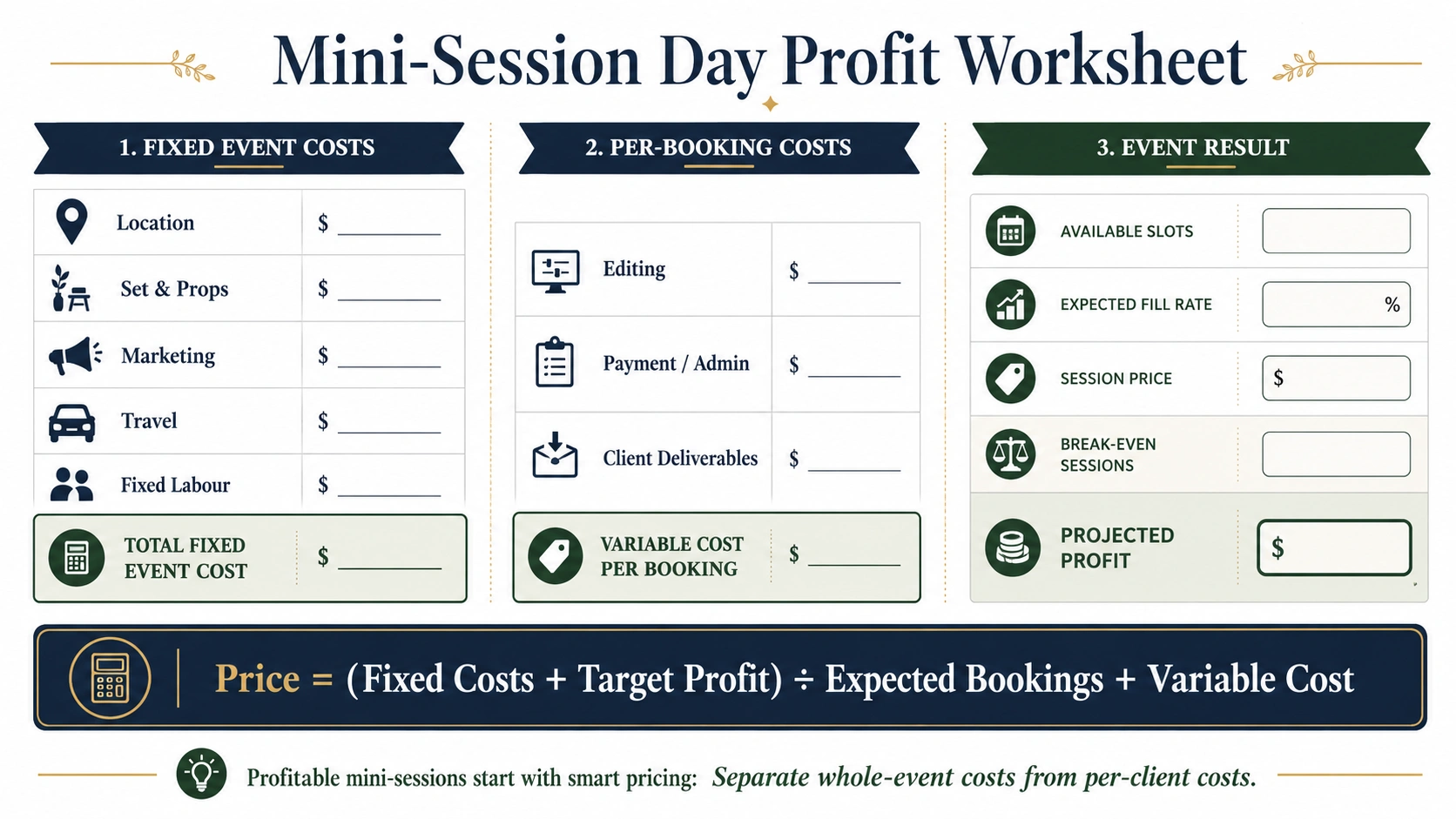
The most useful mini session pricing calculator begins with two expense groups.
Fixed event costs exist even if relatively few slots sell. Depending on your setup, they may include location rental, set construction, props, floral styling, promotional design, paid advertising, travel, equipment hire, assistant minimums and the value of the photographer's time spent planning, preparing and running the event.
Variable costs increase as clients book. Editing time is usually one of the most important. Payment-processing charges, outsourced retouching, prints, packaging, client gifts, gallery-related costs or per-client assistant costs may also belong here.
Do not ignore your own time merely because no invoice arrives for it. If you spend three hours planning, two hours setting up, five hours operating the session day and another six hours editing, the business has consumed sixteen hours of your labour. Pricing the event as though only the shooting slots existed gives you a distorted result.
For the worked example in this article, assume the photographer plans eight available sessions.
Illustrative fixed event costs
| Cost | Amount |
|---|---|
| Location | ₹8,000 |
| Set, props and styling | ₹7,000 |
| Promotion and advertising | ₹4,000 |
| Travel and miscellaneous event costs | ₹2,000 |
| Photographer's pre-event and event-day labour | ₹9,000 |
| Total fixed event cost | ₹30,000 |
Now assume each booked client creates an additional ₹1,200 of variable cost, including editing labour and other booking-specific expenses.
These are example figures only. Your worksheet should contain your actual costs.
Calculate cost per booked slot at different fill rates
This is where a photography mini session calculator becomes more useful than simply dividing total cost by the maximum number of slots.
An eight-slot day does not automatically mean eight paying clients.
First calculate:
Expected bookings = Available slots × Expected fill rate
An eight-slot event produces:
| Fill rate | Booked slots |
|---|---|
| 50% | 4 |
| 75% | 6 |
| 100% | 8 |
Then calculate the true cost attached to each sold slot:
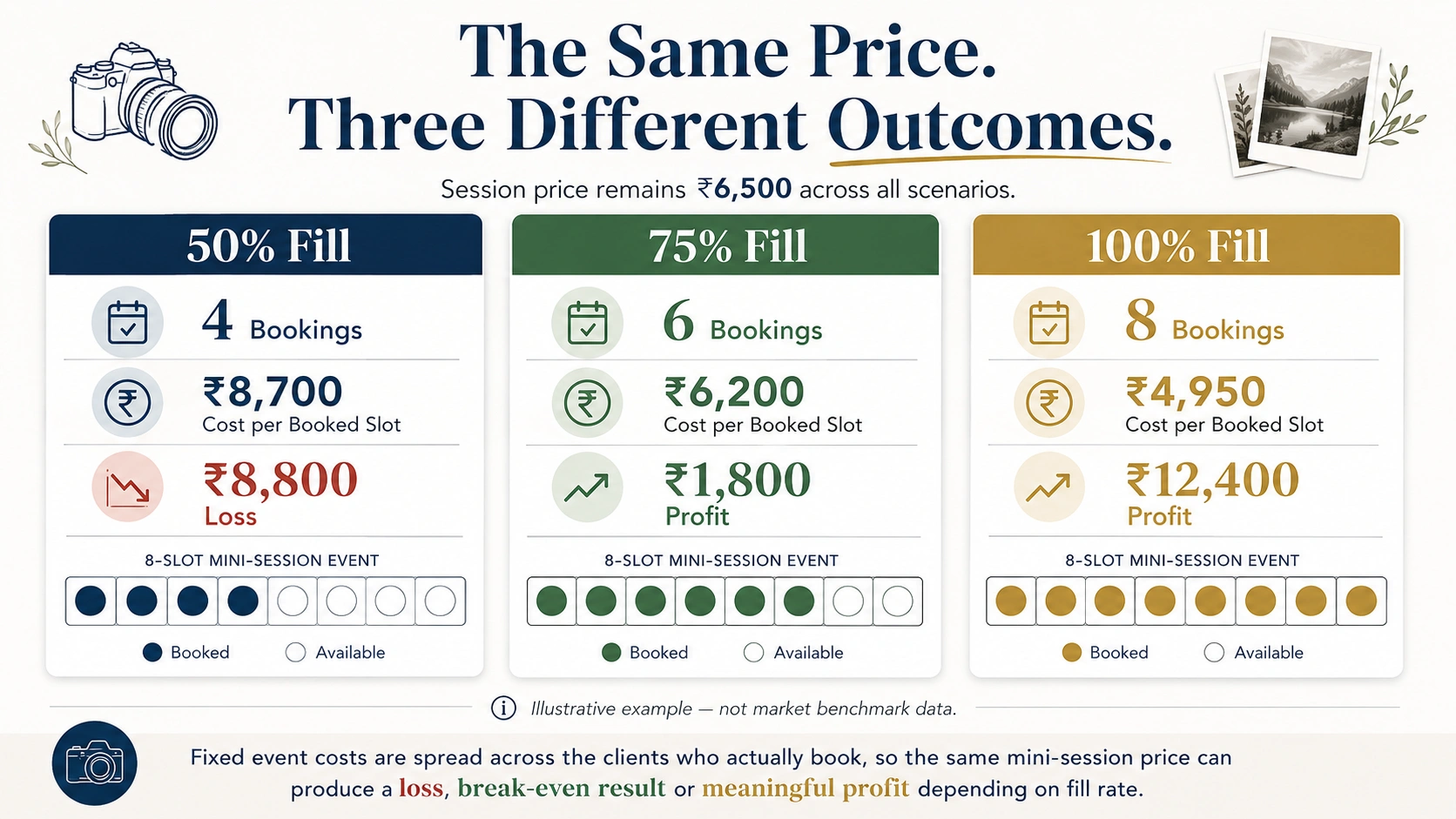
Cost per booked slot = Fixed event costs ÷ Booked slots + Variable cost per booking
Using our example:
At 50% fill:
₹30,000 ÷ 4 + ₹1,200 = ₹8,700 cost per booked slot
At 75% fill:
₹30,000 ÷ 6 + ₹1,200 = ₹6,200 cost per booked slot
At 100% fill:
₹30,000 ÷ 8 + ₹1,200 = ₹4,950 cost per booked slot
Nothing about the set, location or event-day preparation changed. The economics changed because fewer clients were available to absorb those fixed costs.
This is one of the most important points in how to price mini sessions. If your price only works when every slot sells, you have not necessarily created a profitable offer. You have created an offer that depends on a perfect fill rate.
Work backwards from the fill rate you actually expect
A more useful pricing formula is:
Required price per booking = (Fixed event costs + Target event profit) ÷ Expected bookings + Variable cost per booking
Suppose the photographer wants the event to generate ₹12,000 of business profit after the costs already included in the worksheet.
At eight bookings:
(₹30,000 + ₹12,000) ÷ 8 + ₹1,200
= ₹6,450 required price
At six bookings:
(₹30,000 + ₹12,000) ÷ 6 + ₹1,200
= ₹8,200 required price
That difference is significant.
A ₹6,500 package almost reaches the target if every slot sells. At a 75% fill rate, it does not.
Your pricing decision can now become more intelligent. You could increase the mini session price, reduce fixed production costs, increase the number of sensible slots, lower the desired event profit, create profitable add-ons or decide that the concept is too expensive to run.
What you should not do is hide the problem by assuming a sell-out.
Calculate mini session break-even and profit per event
Break-even answers a different question:
How many clients must book before the event has covered its costs?
Start with contribution per booking:
Contribution per booking = Session price − Variable cost per booking
Using a ₹6,500 session price and ₹1,200 variable cost:
₹6,500 − ₹1,200 = ₹5,300 contribution per booking
Then:
Break-even bookings = Fixed event costs ÷ Contribution per booking
₹30,000 ÷ ₹5,300 = 5.66
You cannot book 0.66 of a client, so round upward.
The event reaches mini session break even at 6 booked sessions.
Now calculate profit at different fill rates:
Event profit = Booking revenue − Fixed event costs − Total variable costs
| Fill | Bookings | Revenue | Variable costs | Fixed costs | Event profit |
|---|---|---|---|---|---|
| 50% | 4 | ₹26,000 | ₹4,800 | ₹30,000 | −₹8,800 |
| 75% | 6 | ₹39,000 | ₹7,200 | ₹30,000 | ₹1,800 |
| 100% | 8 | ₹52,000 | ₹9,600 | ₹30,000 | ₹12,400 |
The same ₹6,500 photography mini session pricing produces three very different outcomes.
This is why we would track fill rate, break-even bookings and profit per event together rather than celebrating a full calendar without checking what the event contributed.
For a deeper look at the same concept across an entire photography business, see Photography Business Break-Even Point: How Many Bookings Do You Need?.
Included images can change mini session profitability more than the shoot length
A common pricing mistake is focusing heavily on whether the mini session lasts 15, 20 or 30 minutes while treating the number of delivered photographs as an afterthought.
Post-production scales with clients too.
Eight mini sessions delivering five carefully selected images each create a different editing workload from eight sessions promising 30 edited photographs per family. The shooting block may be identical, but the second offer can create substantially more culling, retouching, exporting, uploading and client administration.
Before deciding how many photographs to include, estimate:
Editing cost per booking = Editing time per booking × Value of editing hour
If five included photographs require 45 minutes of culling and editing and you value that production hour at ₹1,000, the labour component is:
0.75 × ₹1,000 = ₹750 per booking
If increasing the package to 20 included photographs pushes editing to 90 minutes, that component becomes ₹1,500.
Across eight clients, a seemingly small deliverable change has added another ₹6,000 of production labour.
The same logic applies to upsells.
An additional-image upgrade is not pure profit if producing those images requires additional work.
Use:
Expected upsell contribution = Booked clients × Upsell purchase rate × (Upsell price − Incremental upsell cost)
Suppose 40% of eight clients purchase a ₹2,500 image upgrade and fulfilling each upgrade costs another ₹500.
Expected contribution becomes:
8 × 40% × (₹2,500 − ₹500) = ₹6,400
That can materially improve the event economics, but only if the purchase rate and incremental costs are based on your own results rather than optimism.
If this is your first mini-session event, price the base offer so it is viable without assuming that everyone will buy extras. Treat upsells as additional upside until your studio has enough historical data to forecast them reliably.
Build buffers into the schedule before calculating how many slots you can sell
Removing the gaps between sessions makes a mini session day look better in a spreadsheet than it feels in real life.
A family arrives late. A child needs two minutes to settle. One client has questions before leaving. You need to reset part of the set, change a memory card, drink water or simply move the previous family out before the next family walks in.
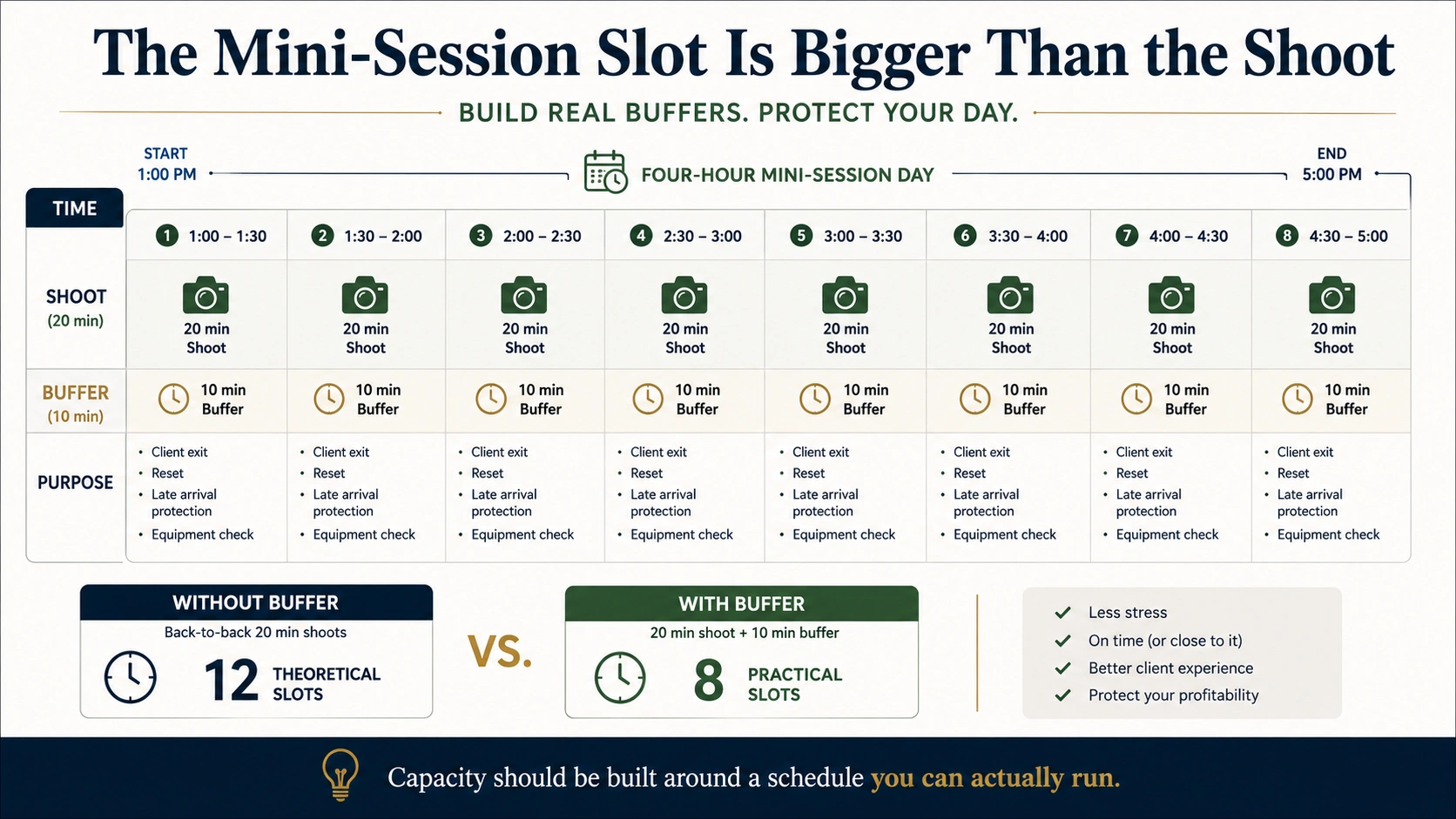
A 20-minute photography slot followed immediately by another 20-minute slot gives you no operational recovery time.
A better capacity formula is:
Slot cycle = Shooting time + Buffer time
Then:
Maximum practical slots = Available event minutes ÷ Slot cycle
For a four-hour client block:
20-minute session + 10-minute buffer = 30-minute cycle
240 ÷ 30 = 8 available slots
Without buffers, the spreadsheet might claim that twelve 20-minute sessions fit into the same four hours. Technically they do. Operationally, one delay can push every remaining client behind schedule.
Buffers are not wasted capacity. They are part of the service design.
Treat no-shows as a pricing and payment problem, not only a scheduling problem
An empty slot in a normal portrait calendar is inconvenient. An empty slot in a tightly structured mini-session event can directly damage the economics of the day because the fixed set, venue and marketing costs have already been committed.
This is why the difference between reserved slots and paid slots matters.
If your cancellation policy and local consumer rules allow it, decide in advance what payment is required to confirm the session, what happens when a client cancels, whether the payment can be transferred and what happens if weather or the photographer forces the event to move.
Current Pixieset guidance recommends collecting the mini-session fee during booking to help reduce no-shows, although the exact policy a studio should use depends on its market and terms.
Inside your own numbers, calculate fill rate using clients you reasonably expect to photograph and collect payment from, rather than counting every person who once asked for a slot.
For studios that want the operational record connected to the money, GoPickle Booking Management keeps confirmed shoots, services, invoices and payment progress connected, while GoPickle Smart Invoicing can be used to track what has been invoiced, collected and remains outstanding.
Compare mini-session profit with a normal full session before deciding the event was successful
The final comparison should not be:
Mini session revenue versus full session revenue
Compare the economics after the work required to deliver both services.
For a mini-session event, count planning, promotion, setup, photography, client turnover, admin, editing and delivery. For the normal portrait session, count consultation, preparation, travel, shooting, editing, gallery work and client communication.
Then compare:
Fully loaded profit
Total owner hours
Profit relative to those hours
Calendar capacity consumed
Number of new client relationships created
Be careful not to count owner labour twice. If you already treated your own labour as a cost in the profitability calculation, compare the fully loaded business profit remaining after that labour allowance. If you did not include owner labour as a cost, divide the remaining earnings by the actual hours worked so you can see what the day really paid you.
Using our worked example, a fully booked mini-session event leaves ₹12,400 of business profit after the costs included in the model. Whether that is better than one or two normal portrait bookings depends entirely on what your normal sessions contribute after their own costs.
The answer can also differ by objective. A seasonal mini event may create first-time clients who later return for family sessions. It may help use an otherwise quiet date. It may generate print or gallery upgrades. Those benefits are worth tracking, but they should not be used to excuse an event that loses money before any future booking materialises.
A practical photography mini session pricing worksheet
Before publishing your next mini-session offer, calculate these fields:
| Input | Your number |
|---|---|
| Available event hours | |
| Session duration | |
| Buffer between sessions | |
| Maximum practical slots | |
| Expected fill rate | |
| Expected booked slots | |
| Location cost | |
| Set / props cost | |
| Marketing cost | |
| Travel / equipment / fixed crew cost | |
| Photographer fixed labour | |
| Total fixed event cost | |
| Editing time per client | |
| Variable cost per client | |
| Planned session price | |
| Contribution per booking | |
| Break-even bookings | |
| Profit at 50% fill | |
| Profit at 75% fill | |
| Profit at 100% fill | |
| Included photographs | |
| Expected upsell contribution | |
| Target event profit |
If you want one formula to keep beside the worksheet, use this:
Mini-session price = (Fixed event cost + Target profit) ÷ Expected bookings + Variable cost per booking
It forces the pricing decision to acknowledge the part photographers cannot control perfectly: how many slots will actually sell.
Once the event is live, replace estimates with real numbers. Record which sessions were booked, which payments were collected, how much you actually spent, how long editing took and how much additional revenue came from upgrades. A mini-session calculator becomes much more useful after three events because your assumptions start turning into studio-specific evidence.
Mini sessions can be an excellent business model. They can also be a heavily marketed, completely sold-out way to work far more hours than the headline session price suggests.
The difference is in the worksheet. Price the event first. Then price the slot.