Commercial Photography Creative Fee vs Day Rate vs Licensing Fee
Understand commercial photography creative fees, day rates, production costs and licensing fees, with practical pricing structures and scope examples.

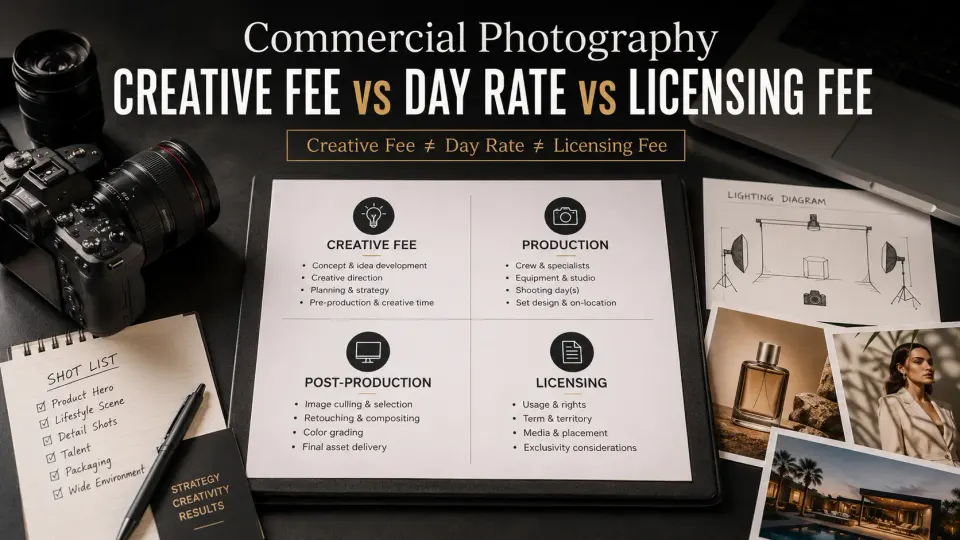
A commercial photography creative fee is easy to misunderstand because clients often see it beside a day rate, production expenses, retouching and a licensing fee and assume they all describe the same thing. They do not.
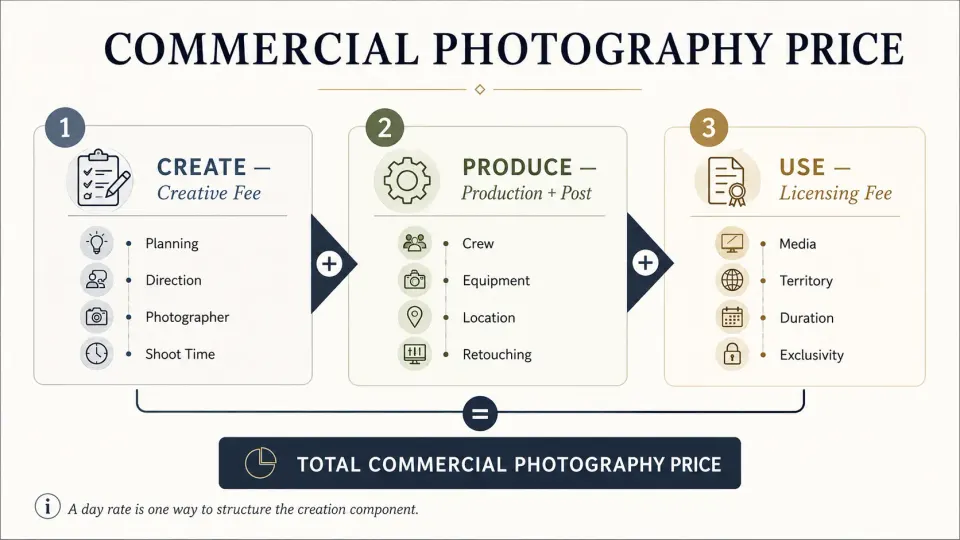
The creative fee pays for the photographer's contribution to creating the work. A day, half-day or hourly rate is one way of structuring part of that work. Production expenses pay for the people, locations and resources required to execute the assignment. Post-production pays for the work needed after capture. A photography licensing fee covers the client's agreed right to use the resulting images commercially.
Those distinctions matter because production effort and commercial usage are separate dimensions of a photography assignment. The same photograph might require one photographer, one studio and one day of production whether it eventually appears on a company's product page or becomes the hero image for an international advertising campaign. The effort required to create it may be similar; the commercial use is not.
There is no universal commercial photography rate card that works across countries, specialties, clients and assignments. Rather than publishing arbitrary benchmarks, this guide explains the pricing architecture so you can decide what each fee actually needs to pay for.
Commercial photography creative fee: what are you charging for?
A commercial photography creative fee represents the photographer's professional contribution to making the images. Depending on how a photographer structures estimates, it may account for the photographer's skill, experience, creative direction, planning, shoot time and other professional work required to execute the brief.
The terminology is not completely standardised. Some photographers use creative fee, photography fee, production fee and assignment fee for broadly similar parts of an estimate. Others use “creative fee” as a larger umbrella that combines photography and licensing. Neither label tells the client enough on its own, so the important question is: what does this fee include?
For example, suppose a brand commissions environmental portraits of six senior executives. The photographer may need to study the brief, discuss visual references with the marketing team, scout the location, determine lighting requirements, plan the schedule around executive availability, direct subjects during the shoot and supervise the final image selection. Describing that entire contribution simply as “eight hours with a camera” would hide much of the work being purchased.
A useful creative-fee description might therefore state the scope behind the number:
Creative fee: photographer's creative direction, pre-shoot planning and one scheduled production day for the approved assignment scope.
That is clearer than a bare line reading “Photographer - 1 day,” particularly when the buyer needs to compare several commercial photographer bids.
Your creative fee also has to make sense for your own business. Cost of doing business, non-billable time, equipment ownership, insurance, administration, professional experience and the number of genuinely billable assignments you can complete all influence what a sustainable photography business needs to earn. Copying another photographer's creative fee without understanding their market or operating costs gives you very little useful information.
Day rate, half-day or hourly pricing: choose the unit that fits the work
A commercial photography day rate is a billing unit, not an entire pricing system.
It can work well when production time is naturally measured in shoot days: corporate portraits across an office, architectural photography, advertising production, hospitality photography, catalogue work or campaign assignments with defined call and wrap times. A quote might therefore show a photographer creative fee based on one or more production days while listing crew, expenses, retouching and licensing elsewhere.
The phrase “day rate” still needs a boundary. Does the production day mean eight hours, ten hours or another agreed window? When does overtime begin? Is travel included? Does the rate cover pre-production? What happens if the client adds another location midway through the day? The client should not have to discover those answers after the shoot.
A half-day rate can make sense for a genuinely shorter assignment, but half a day does not automatically cost half of a full day. A four-hour shoot can still consume travel time, preparation, equipment setup, file handling and enough of the working day to prevent another booking. Set the half-day structure according to how the assignment affects your actual capacity rather than dividing your day rate by two because the arithmetic looks tidy.
Hourly pricing has its place as well. It can work for short, predictable corporate assignments, additional production time, overtime or narrowly scoped services. It becomes less useful when the project contains substantial invisible work around the shooting window. Billing a complex campaign only by shutter time can make an assignment with days of planning look deceptively small.
For product studios, the right billing unit may not be time at all. High-volume e-commerce work might be better priced per SKU or per finished image, while a styled campaign could use a project or day structure. Our guide to product photography pricing per image, SKU, day or project explains where each model becomes practical.
Production expenses are not the same as the photographer's fee
Production expenses are the assignment-specific costs required to make the shoot happen. They should not be confused with the general overhead already considered when setting your photography business rates.
Depending on the brief, commercial photography production costs can include assistants, digital technicians, producers, stylists, hair and makeup artists, talent, studio rental, location fees, permits, equipment hire, grip, props, set construction, travel, accommodation, transport, catering, couriers and specialist suppliers.
This separation becomes particularly useful on larger assignments. Imagine an estimate where the photographer's professional fee is mixed together with a studio rental, two assistants, a food stylist and several thousand worth of props. If the client later supplies its own location and stylist, nobody can easily see how much the revised job should cost because the original figure never showed which amount belonged to the photographer and which amount belonged to production.
Production expenses can also contain uncertainty. A location may not yet be confirmed, airfare might change before approval, or a stylist may be waiting for the final brief before costing materials. Marking an expense as estimated, confirmed, client-supplied or subject to approval can make a commercial photography estimate much easier to understand.
This also helps when a client asks for a lower total. Instead of immediately cutting the photographer creative fee, you can examine the production itself. Could the team be smaller? Can several setups be made in one location? Is a rented specialist lens necessary? Can the shot list be completed in one production day rather than two?
Cost discussions become conversations about scope rather than arbitrary discounting.
Post-production and retouching need their own boundary
“Editing included” sounds simple until the client and photographer discover they mean completely different things.
Basic post-production might involve ingestion, backups, culling, colour correction, exposure balancing, cropping, file preparation and exports. Detailed commercial retouching can involve skin work, product cleanup, dust removal, colour replacement, compositing, perspective correction, masking, background construction, reflective-surface work or creating multiple campaign versions from one master image.
These are different workloads.
A commercial photography pricing structure should therefore state what happens after capture. Specify how many final images are included, who makes the selection, what level of finishing is expected, how many revision rounds are included where relevant, and whether advanced retouching is priced separately.
Consider a cosmetics shoot. Producing 20 technically clean product images for a catalogue is not the same post-production assignment as producing three hero images requiring liquid compositing, packaging reconstruction and pixel-level retouching for large-format advertising. The shoot may even take the same amount of time, but the work after the shoot can be dramatically different.
Keeping post-production visible also makes later client requests easier to price. If an approved scope includes 10 retouched photographs and the client selects another 15, the additional work has a recognisable commercial starting point rather than being treated as an undefined favour.
Photography licensing fee: price the use separately from making the image
A photography licensing fee, also called a photography usage fee, concerns what the client is permitted to do with the finished images.
That is different from the labour and production required to create them.
A regional company might commission ten brand photographs for its website and organic social channels for a defined period. Another company could commission an almost identical production but use the images in paid digital advertising, packaging, retail displays and campaigns across multiple countries. The second client is obtaining broader commercial rights even if both shoots take one day.
Licensing conversations commonly consider factors such as the images being licensed, media or placement, geographical territory, duration, exclusivity and whether third parties may use the files. Campaign scale, circulation, paid-media use and the importance of the image to the campaign can also be relevant pricing considerations depending on the photographer and market.

A licensing line might therefore describe the permission rather than using an ambiguous phrase such as “commercial rights”:
Usage licence: 10 selected images, company website and organic social media, named territory, defined term, non-exclusive.
Broader requests should be defined just as carefully. “Worldwide,” “all media,” “perpetual,” “exclusive” and “full buyout” can materially change what the client receives. They should not be added casually because they appeared in another photographer's template.
Our detailed guide to commercial photography usage rights, licensing and buyouts covers media, territory, duration, exclusivity, third-party use, renewals and buyout requests in more depth.
Copyright, commissioned-work rules and the legal effect of licensing arrangements differ between countries. Photographers working internationally should use contracts appropriate to their jurisdictions and obtain qualified legal advice for significant rights transfers instead of assuming one country's template applies everywhere.
Three commercial photography pricing structures without arbitrary market rates
The easiest way to understand fee architecture is to look at assignments rather than theoretical price lists.
Example 1: Corporate leadership portraits
A company needs portraits of eight executives at its headquarters for its website, press material and professional networking profiles.
A sensible structure could include a photographer creative fee covering planning and the production session, an assistant or equipment expense if required, post-production for a defined number of selected portraits, travel if applicable and a clearly described licence covering the agreed corporate uses.
If the assignment expands to an advertising campaign, the photographer does not necessarily need to re-price the time already spent making the portraits. The discussion can focus on the expanded licensing requirement.
For a deeper breakdown of corporate scope, crew, usage and commercial terms, see our guide to what a corporate photography quotation should include.
Example 2: E-commerce product photography
A retailer needs repeatable front, side and detail photographs for 100 products.
The photography component might be priced per SKU, per final image or through a project structure rather than relying entirely on a day rate. Production could include backgrounds, specialist equipment or styling. Post-production can be defined according to the required consistency and cleanup. Licensing may be narrow if the files are intended only for the retailer's product listings, or broader if the same assets will also support advertising, marketplaces, packaging or distributors.
This is a good example of why “commercial photography day rate” and “commercial photography pricing” are not interchangeable terms. The billing method should reflect how the work scales.
Example 3: Advertising campaign
A brand commissions a campaign involving talent, a producer, multiple crew members, a rented location and a tightly controlled set of final hero images.
Here the estimate may contain a photographer creative or production fee, pre-production, crew, talent, location and equipment expenses, specialist post-production and a substantial licensing section tied to the actual campaign use. If the campaign later expands into additional territories or media, the licensing can be extended without pretending another shoot took place.
These examples deliberately contain no universal price recommendations. A reasonable fee in one city or commercial sector could be unworkable in another. Photographer experience, cost base, demand, assignment complexity, production scale, negotiating position, client requirements and licensing scope all affect the final number.
How to present creative fees, day rates and licensing without confusing the client
The photographer may understand every distinction in the estimate, but the buyer should not need a photography-business education before approving it.
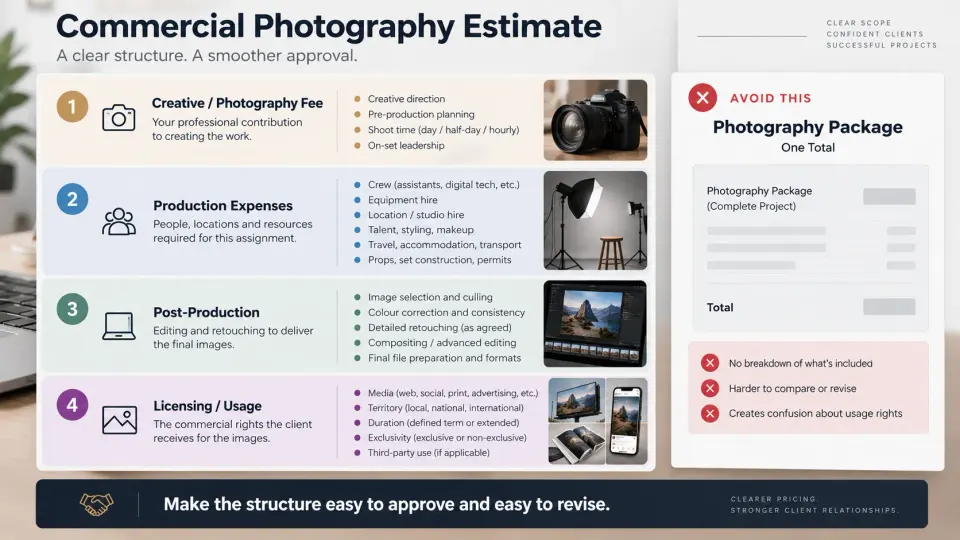
Use plain labels and make the relationship between the costs visible. For many assignments, a client-facing estimate can be organised into four understandable sections:
1. Creative / photography fee - what you charge for your professional contribution to creating the work.
2. Production expenses - the people, locations, equipment and resources required specifically for this assignment.
3. Post-production - the defined selection, processing and retouching work after the shoot.
4. Licensing / usage - the commercial rights the client receives for the finished images.
If your studio uses “creative fee” to bundle more than one of those components, say so. The objective is not to force every photographer into identical terminology. It is to prevent a client from assuming that a day rate includes an assistant, studio, extensive retouching and unlimited advertising rights simply because those exclusions were never visible.
If you are still deciding whether that pricing should be presented as an estimate, quotation or proposal, our guide to commercial photography estimates vs quotes vs proposals explains which document fits each stage of a commercial enquiry.
At GoPickle, we think the quotation should preserve this structure instead of collapsing the assignment into one unexplained total. GoPickle Photography Quotations lets photographers present the scope, services, pricing, portfolio references and terms in one client-facing proposal and keep the approved work connected to the later booking and invoicing workflow. The software is only the record. The pricing logic still belongs to the photographer.
A well-built commercial photography quote lets a client see what it costs to create the work, what it costs to produce the assignment, what finishing is included and what they are paying for the right to use the resulting images. Once those dimensions stop being hidden inside one day rate, commercial pricing becomes much easier to explain, revise and defend.