Freelance Photographer Onboarding Checklist for Growing Studios
Use this freelance photographer onboarding checklist to set rates, roles, shooting standards, file handoffs, availability, payments and first-job reviews.

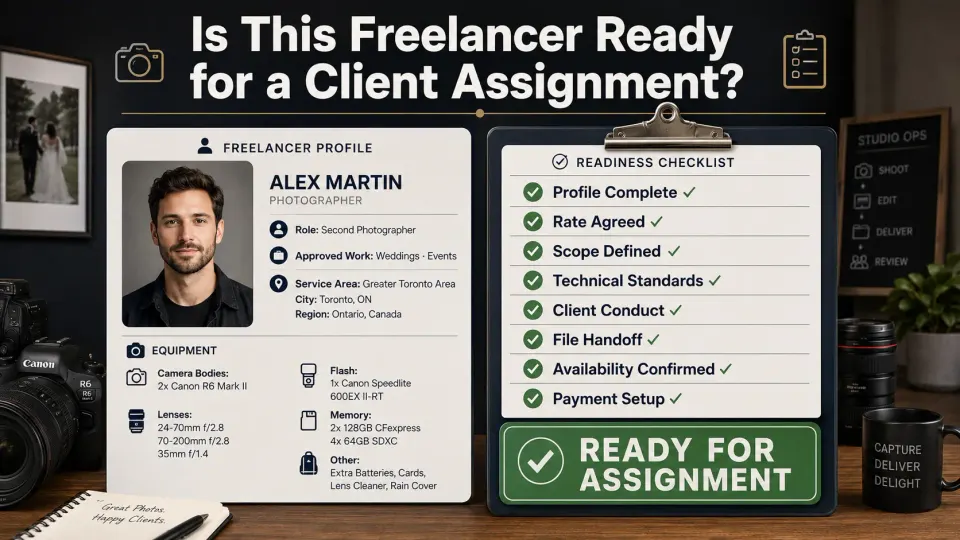
Hiring a freelance photographer is easy compared with trusting one on a live client assignment. A portfolio can show whether someone can make strong photographs, but it does not tell you how they handle a changed timeline, whether they keep memory cards safe until files are verified, how they speak to clients, what they expect to be paid for travel, or whether they understand exactly what a second shooter is meant to cover.
That operational gap is where freelance photographer onboarding matters. For a growing photography studio, onboarding should not resemble a generic employee welcome process. You need a repeatable record that answers a more useful question: is this person ready to represent the studio, capture the required work and hand everything back safely?
This freelance photographer checklist is designed for second shooters, associate photographers, event photographers, cinematographers and other freelance crew who may work under your studio name. If you are still deciding whether a role should remain flexible or become permanent, start with our guide to freelance vs full-time photographer staffing.
1. What to collect before the first assignment
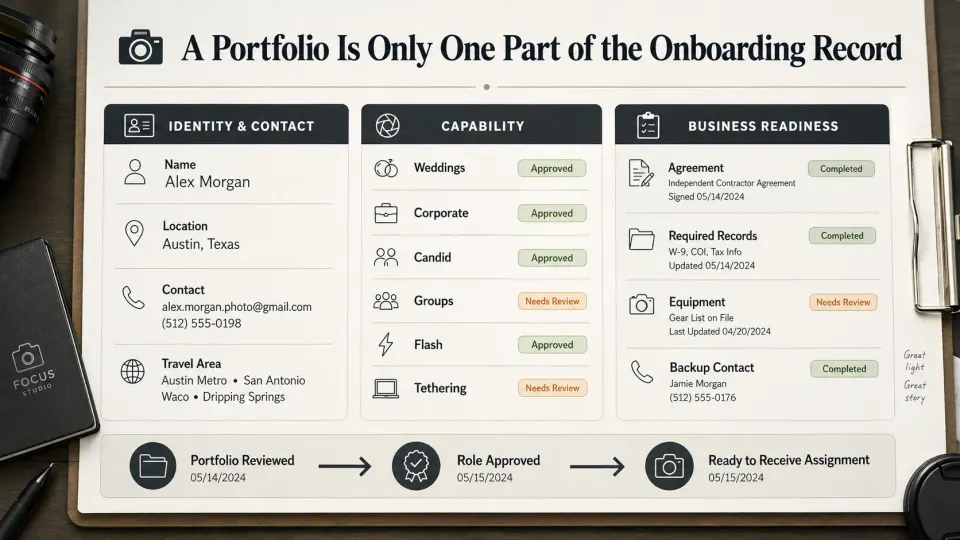
Create one onboarding record for every freelancer you may assign to client work. Collect their full name, business or trading name where applicable, contact details, location, portfolio, primary genres, equipment they normally provide, travel limits and the types of assignments they are willing to accept.
Do not stop at “wedding photographer” or “second shooter.” Record the roles the person can actually perform confidently. Someone may be excellent at candid coverage but inexperienced with formal groups, off-camera flash or tethered commercial work. Another photographer may be technically capable of leading a shoot but not comfortable managing the client directly. Good photography freelancer onboarding describes capability in operational terms rather than relying on one broad job title.
You should also collect any business, tax, insurance or permit records your studio genuinely requires. These requirements differ by country, region and type of assignment, so the correct freelance photographer onboarding process is the one built around the rules where you actually operate rather than a checklist copied from another market.
Before the first assignment, confirm:
- Identity and reliable contact details
- Portfolio and relevant recent work
- Roles they are approved to perform
- Equipment they normally provide
- Travel limits and working area
- Required business, tax or insurance records
- Agreement or contract status
- Backup contact process
2. Agree rates and assignment scope before asking for a date
A day rate alone is not enough. The rate should be attached to a defined unit of work. Record whether the freelancer is paid by hour, event, shift, day or deliverable, and make clear what happens if the assignment runs longer than planned.
For a wedding second shooter, the scope might be eight hours of coverage, one venue, RAW file handoff at the end of the assignment and no editing. A commercial photography assignment may include a pre-production call, lighting setup, tethering and file transfer to the studio's post-production team. Those are different jobs even though both people may appear in your system as freelance photographers.
Confirm overtime, travel time, mileage or transport, accommodation, meals where relevant, equipment rental, parking and other reimbursable expenses before the job is accepted. Also agree on when payment becomes due and what evidence is required for expenses. This avoids a familiar disagreement in growing studios: everyone remembers the day rate, but the studio and freelancer remember different versions of what that rate included.
Be careful with labels such as “freelancer,” “contractor,” “self-employed” and “employee.” Employment classification varies by jurisdiction and may depend on the real working relationship rather than the title written in an agreement. Keep legal and tax classification separate from this operational checklist and obtain appropriate local advice where required.
3. Set creative and technical standards without trying to clone your style
Freelance photographer onboarding should give enough direction to produce compatible work without asking another photographer to imitate the lead photographer frame for frame.
Start with the technical decisions that affect post-production: RAW versus JPEG, preferred file types, time synchronisation between cameras, dual-card expectations, flash restrictions, audio requirements for hybrid photo/video teams and any equipment standards required by the assignment. If photographs from three camera bodies will later be merged chronologically, for example, synchronising clocks before coverage begins can prevent a surprisingly messy post-production problem.
Then explain coverage priorities. To onboard a second shooter properly, tell them whether they are expected to create alternate angles, cover another location, photograph guests while the lead handles the couple, or provide backup coverage for critical moments. “Take lots of photos” is not a photography team SOP.
A small set of recent galleries or contact sheets can be more useful than a long brand document. Show what your studio considers usable coverage, then explain recurring problems you want avoided: excessive duplicates, missing establishing frames, uncontrolled flash, inconsistent exposure or hundreds of near-identical burst frames. The freelancer does not need to become a copy of your lead photographer; their files need to fit the production standard of the studio receiving them.
4. Define client-facing conduct before the freelancer represents your studio
Clients often do not distinguish between the studio owner, an employee and a freelance second shooter. Once someone joins your crew at a wedding, portrait session, conference or commercial production, their behaviour becomes part of the studio experience.
Your photography studio crew onboarding should therefore cover dress expectations, arrival time, who may discuss schedule changes, whether the freelancer may discuss pricing, how client complaints should be escalated, social-media posting rules and whether they may promote their own photography business during your assignment. These expectations are easier to discuss before the first job than after an uncomfortable conversation with a client.
Give the freelancer one clear decision-maker as well. If the venue changes the schedule, the client requests another hour, a family member changes the portrait plan or equipment fails, the crew member should know who has authority to make the call.
For multi-event assignments, connect those responsibilities to the current booking instead of leaving them inside an old message thread. A structured photography booking management workflow helps because the latest event, venue, schedule and crew context can remain attached to the job the team is actually working on.
5. Make file ownership and handoff a written production process
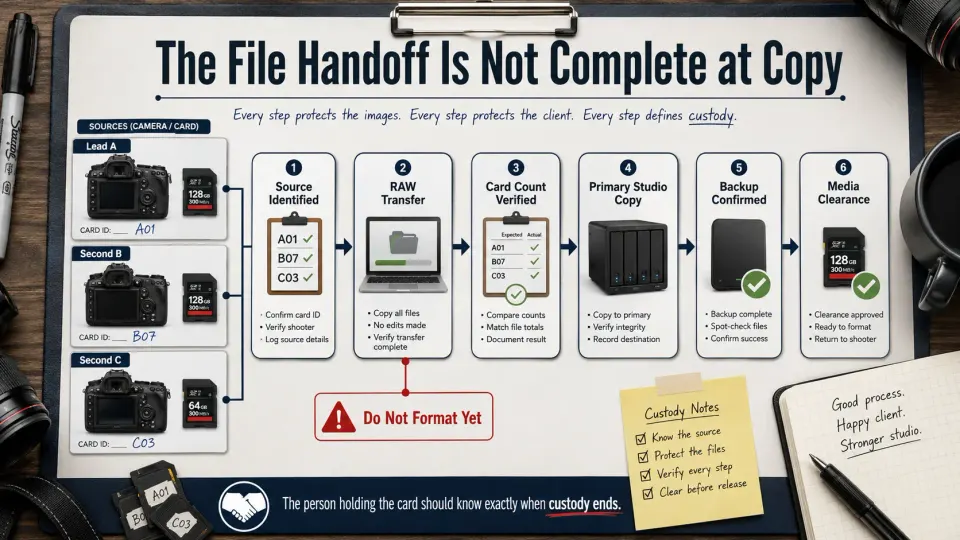
One of the most expensive onboarding failures can happen after the final frame has been taken. A freelancer leaves with the only copy of a card, formats media before the transfer is checked, sends a partial folder or assumes files can be deleted as soon as they have been copied once.
Your agreement should address intellectual property, portfolio use, confidentiality and client-data rights according to the laws and commercial terms that apply to the assignment. Your photography workflow SOP should answer a different set of questions: which files must be handed over, in what format, through which method, by what deadline, and when may the freelancer erase their copies?
Define the sequence rather than simply saying “send the RAWs.” A studio might require cameras to be synchronised before coverage, every source to use an identifiable transfer folder, all required RAW files to be copied, card counts to be checked against the transfer, the primary studio copy to be verified and the required backup to be completed before working media can be cleared under the agreed retention policy.
If several photographers are contributing files, preserve source identity long enough to diagnose missing frames, clock drift, corrupt files or technical inconsistencies. Our photography file backup workflow explains why working storage, backup, delivery and archive should be treated as separate stages instead of assuming that one copied folder has completed the job.
6. Create an availability and cancellation process that works during peak season
A dependable freelance pool is only useful if availability is visible. Record each photographer's normal working area, travel willingness, known blackout periods and preferred amount of booking notice. More importantly, define what every availability status actually means.
A useful sequence is Availability Requested → Available → Assignment Offered → Confirmed → Declined/Unavailable. “I am free that Saturday” should not automatically become “I am confirmed for your studio,” especially when you are checking possible crew before the client has completed the booking.
Set a cancellation and replacement process as well. If a freelancer becomes ill or cannot attend, who must they contact and how quickly? Can they recommend a replacement, and who approves that person? A studio should approve substitutes rather than finding out on the morning of a paid shoot that somebody it has never vetted is arriving instead.
Once the freelance pool grows beyond a few familiar names, crew management software for photographers becomes useful for keeping availability, assignments, event roles and payment context connected. The point is not to replace conversations with photographers. It is to stop the confirmed state of an assignment from depending entirely on remembering which conversation was the latest one.
7. Keep payment and expense records tied to the assignment
Record the agreed crew cost against the relevant booking or event together with overtime, approved travel, equipment rentals, reimbursements, invoice status, payment status and the date paid.
This gives the studio a more realistic basis for future staffing decisions. A photographer with a lower headline day rate can become more expensive after repeated overtime, unexpected travel charges and significant post-production correction. A more expensive freelancer whose coverage is consistently usable, files arrive correctly and client-facing work needs little supervision may produce a better operational result.
It also creates a cleaner relationship with the freelancer. They should not need to search old messages to prove what was agreed, while studio managers should not need to ask the owner whether an assignment has already been paid.
Whether you organise this through a spreadsheet or photography studio management software, keep the cost beside the assignment that created it. The same principle applies to delegated studio work generally, which we cover in how to assign work to studio members without losing accountability.
8. Review the first job before adding someone to your regular crew pool
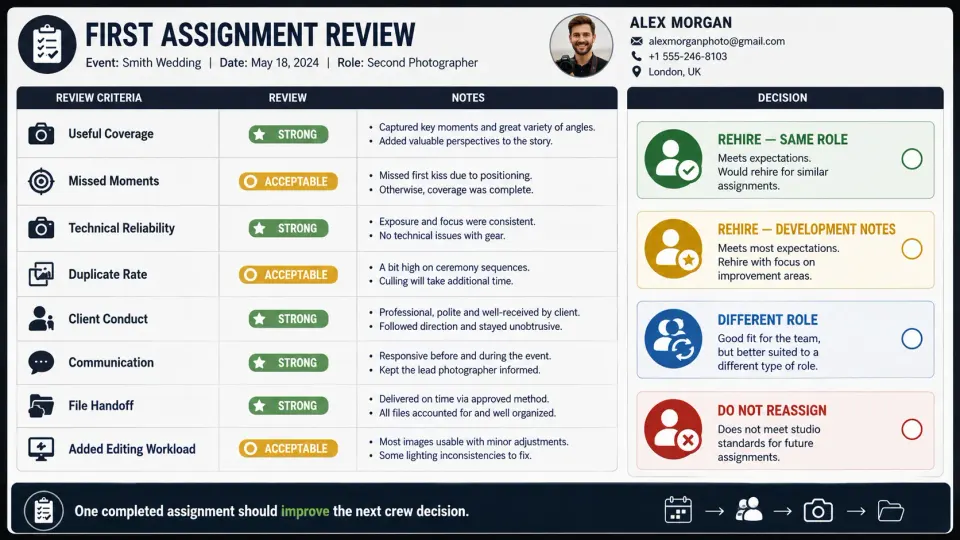
Do not decide whether a freelancer “worked out” based only on whether they were friendly or whether the client complained. Review the assignment against the role you hired them to perform.
Check technical reliability, useful coverage, missed moments, duplicate rate, ability to follow the brief, communication, punctuality, client conduct, equipment preparedness, file-handoff accuracy and whether their work created avoidable editing effort. If the person was hired specifically as a second shooter, ask whether they added meaningful coverage rather than simply creating hundreds of versions of the lead photographer's angle.
Then record the result: Rehire for Same Role, Rehire With Development Notes, Use for a Different Role, or Do Not Reassign. That turns one shoot into useful evidence for the next crew decision rather than depending on somebody remembering six months later that the photographer was “pretty good.”
A growing photography studio does not need every freelancer to work exactly like a permanent employee. It needs a dependable interface between the studio and the freelancer: the assignment is clear, the client experience is protected, files come back safely, payment closes correctly and both sides know what happens next.
That is the operational layer we built GoPickle Crew Management to support. Permanent crew and event-based freelancers can sit around the same booking workflow, with assignments, availability, responsibilities and payment context tied to the work they are actually doing. Software cannot define your shooting standards or decide who belongs on your regular crew roster, though. Start with the freelance photographer onboarding checklist above, use it on one real assignment, and improve the record after the first-job review.