Freelancer Rate Card for Photography Studios: Track Role, Day Rate, Overtime, Travel and Editing Cost
Build a freelance photographer rate card that tracks roles, day rates, overtime, travel, accommodation, editing and actual photography crew cost.

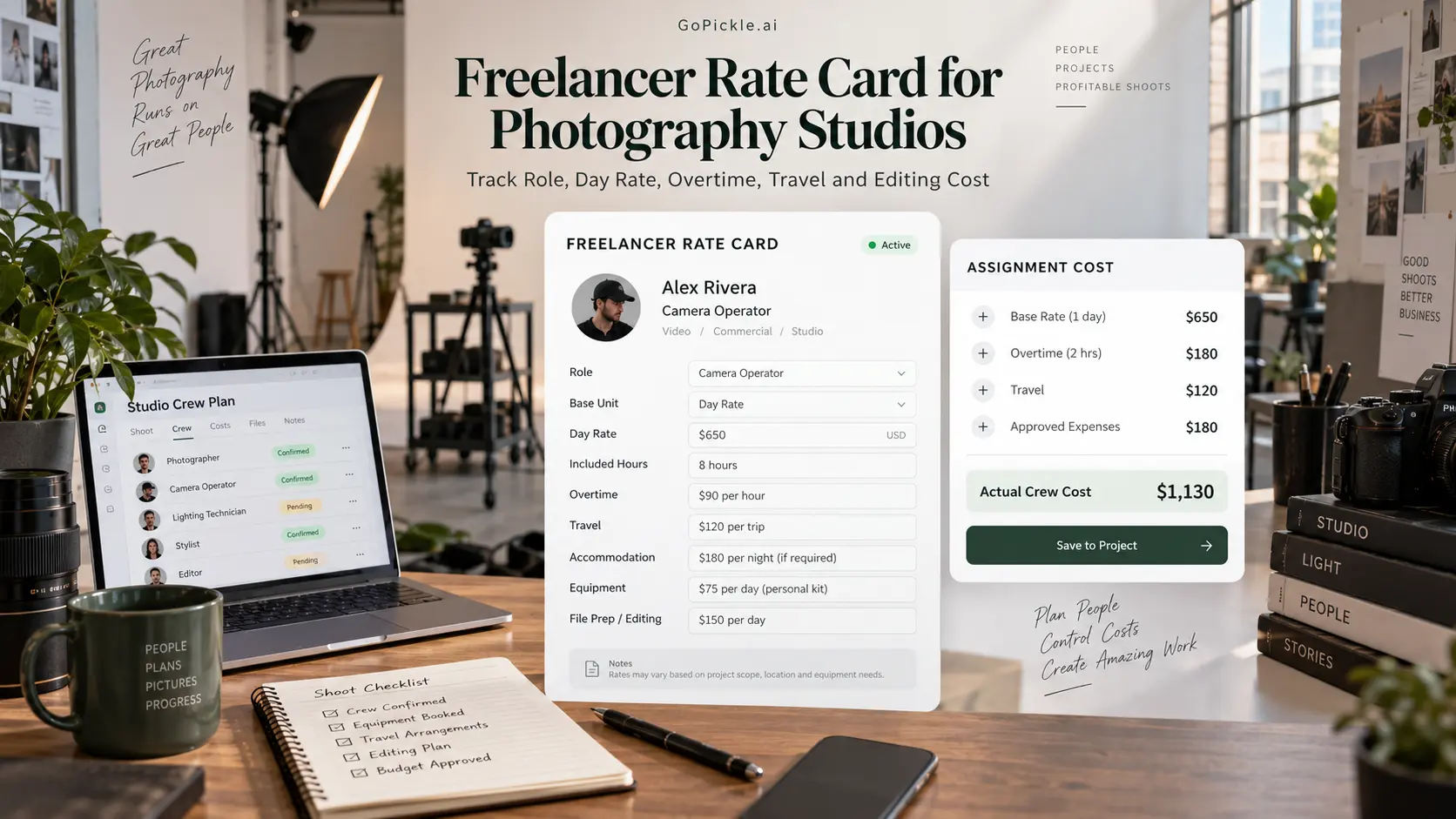
A photography studio can know exactly what a freelancer charges and still misunderstand what that freelancer costs.
Suppose a photographer has an agreed day rate. That number may cover eight hours of event photography, but the booking eventually runs longer. The venue is outside the normal working area, accommodation is needed, the photographer uses studio-supplied equipment, and the files require additional preparation before they reach the editor. By the time the assignment closes, the original day rate describes only one part of the expense.
For a growing studio, a freelance photographer rate card should therefore be an internal operating record, not merely a list of names and prices. It should tell the studio what role the person can perform, how the base rate is defined, what happens when coverage extends, which travel costs apply, whether editing or file preparation is included, and how the agreement changes for unusual assignments.
We deliberately do not publish universal photography freelancer rates in this guide. A second shooter in one city, country or photography market cannot be sensibly benchmarked against someone working under different conditions elsewhere. Experience, role, demand, currency, taxes, employment rules, equipment ownership and the actual assignment all affect photography contractor pricing. The useful goal is to build a rate structure your own studio can use consistently.
Why one flat freelancer rate is misleading
Studios often begin with a spreadsheet containing something like this:
| Freelancer | Role | Rate |
|---|---|---|
| Alex | Photographer | Agreed day rate |
| Morgan | Cinematographer | Agreed day rate |
| Sam | Editor | Agreed project rate |
That is better than keeping rates in memory, but it leaves important questions unanswered.
How many hours constitute a day? Does the photographer's rate apply when they work as lead photographer as well as second shooter? Is overtime hourly or another block of time? Does the cinematographer bring their own equipment? Is local travel included? What happens on a destination assignment? Does the editor's rate include ingest, synchronisation or revisions?
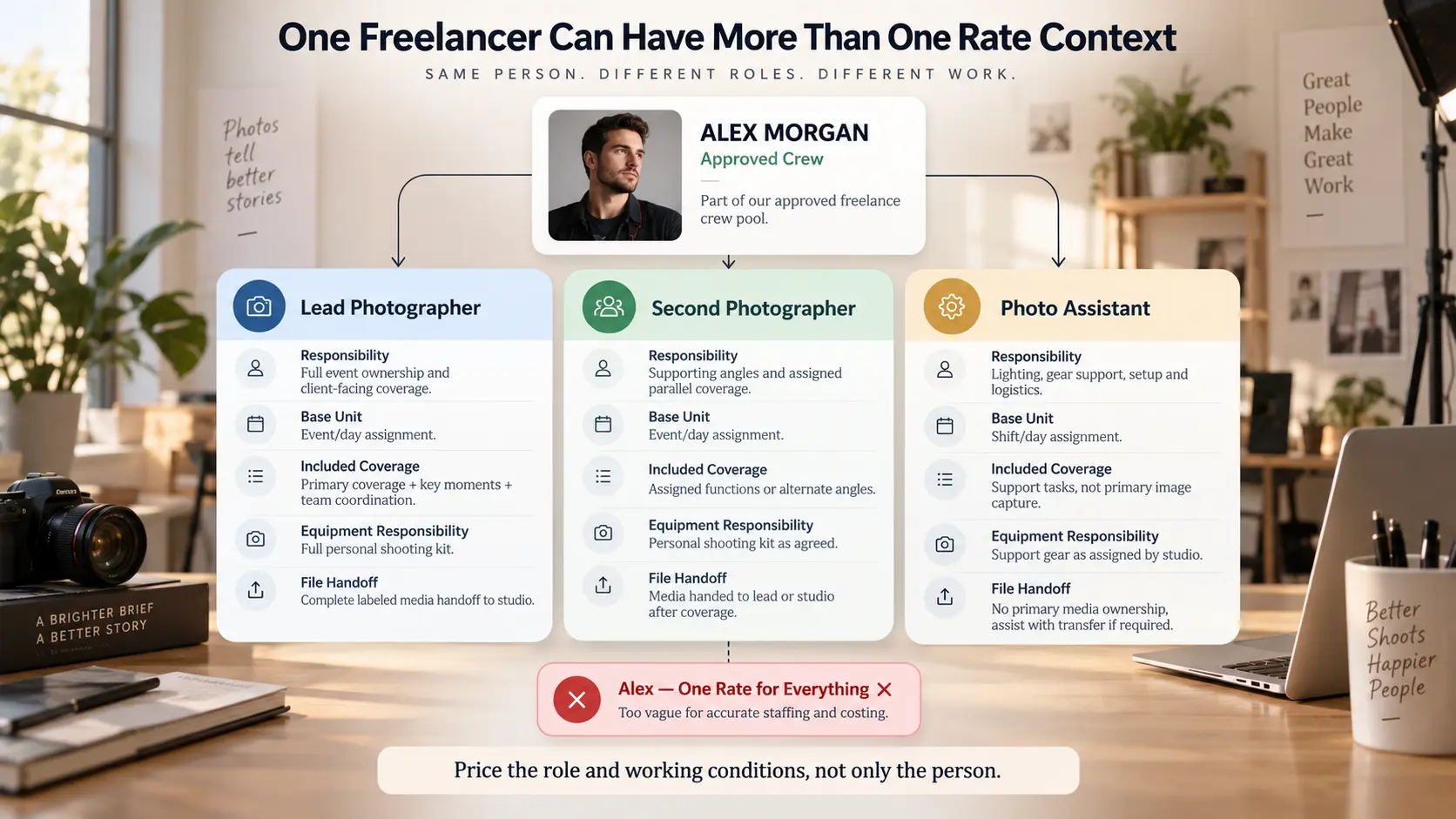
The first improvement is to stop treating a person as though they have one universal price.
The same freelancer may work for your studio in several capacities. Someone trusted to independently cover an entire ceremony as a lead photographer carries a different level of responsibility from the same person assisting another photographer for a short event. Our comparison of a second shooter and photography assistant explains why studios should distinguish the production responsibility behind those roles rather than treating every additional person at a shoot as interchangeable.
A useful internal rate card therefore begins with person + role + working conditions, not simply person + amount.
Record the role and exactly what the coverage duration means
A freelance photographer day rate is meaningless unless both sides know what a “day” contains.
For one studio, a standard event assignment may cover eight hours from reporting time. Another may use a half-day and full-day structure. Commercial teams may price photographers by production day but treat setup or travel days separately. Editors may work per project, per deliverable or by time rather than by shoot day.
The rate card should capture the terms your studio has actually agreed with that person.
A useful record might contain:
| Rate-card field | What to record |
|---|---|
| Freelancer | Person or contractor |
| Approved role | Lead, second photographer, cinematographer, assistant, editor, etc. |
| Base unit | Hour, half-day, day, event, project or deliverable |
| Included duration | The coverage included in that base unit |
| Base rate | Agreed amount and currency |
| Overtime basis | How extended time is calculated |
| Travel basis | Included area and additional travel treatment |
| Accommodation / meals | Who arranges or reimburses them |
| Equipment | Freelancer-supplied vs studio-supplied |
| File responsibility | RAW handoff, ingest, organisation or other preparation |
| Editing responsibility | None, included or separately priced |
| Rush / emergency terms | Any pre-agreed variation |
| Effective date | When these terms were agreed or last reviewed |
This also prevents a common studio mistake: comparing two freelancers only by headline rate when the scope behind those rates is different. One photographer may quote more but arrive with the required equipment, transfer well-organised files immediately and require little supervision. Another may appear cheaper until rentals, travel and corrective post-production are added.
GoPickle's Crew Management for photographers is designed around keeping roles, assignments and event-wise payment context connected to the actual photography work instead of maintaining crew as a disconnected contact list.
Define overtime before the event runs late
Photography events rarely care about the number of hours printed in your internal budget.
Ceremonies start late. Conferences overrun. Speeches continue. A portrait session expands because another executive arrives. A wedding reception scheduled to finish at one time can continue well beyond it.
If overtime is discussed only after the freelancer has already worked it, the studio creates an unnecessary payment dispute.
Your internal second shooter rate card or freelancer record should therefore state the base coverage window and what happens beyond it. The exact structure is a commercial decision between your studio and the freelancer. You might use an hourly overtime rate, fixed time blocks, another full-day threshold or a separately agreed extension. What matters is that everyone knows the rule before the booking.
The studio also needs to decide who can authorise extended coverage.
A client asking a second photographer to “stay another hour” should not automatically create an unapproved crew expense. Your crew brief can state that extensions must be authorised by the studio owner, production manager or lead photographer. The client-facing scope can then be reviewed separately from what the studio owes its freelancer.
For costing purposes, keep these numbers apart:
Base crew commitment + approved overtime = actual shoot-time crew cost
That amount can then feed into the real profitability of the booking instead of disappearing as an informal payment after the event.
Track travel, accommodation and meals separately from the day rate
Travel is another reason identical-looking freelancer rates produce very different photography crew costs.
A local photographer may reach one venue using their normal transport. Another assignment may require an airport transfer, several hours of driving, accommodation and meals. International or destination work can introduce visas, local transportation, baggage, equipment transport and additional travel days.
Do not solve this by assuming every photographer worldwide should use the same travel policy. Decide what your studio agrees to cover for each working relationship and record it clearly.
The rate card can specify whether local travel is included within a defined working area, whether mileage or transport is reimbursed, whether the studio books accommodation directly, how meals are handled and whether travel days carry a separate fee.
Keep reimbursements distinguishable from labour cost in your internal record even if they are ultimately paid together. This makes later analysis much more useful.
For example:
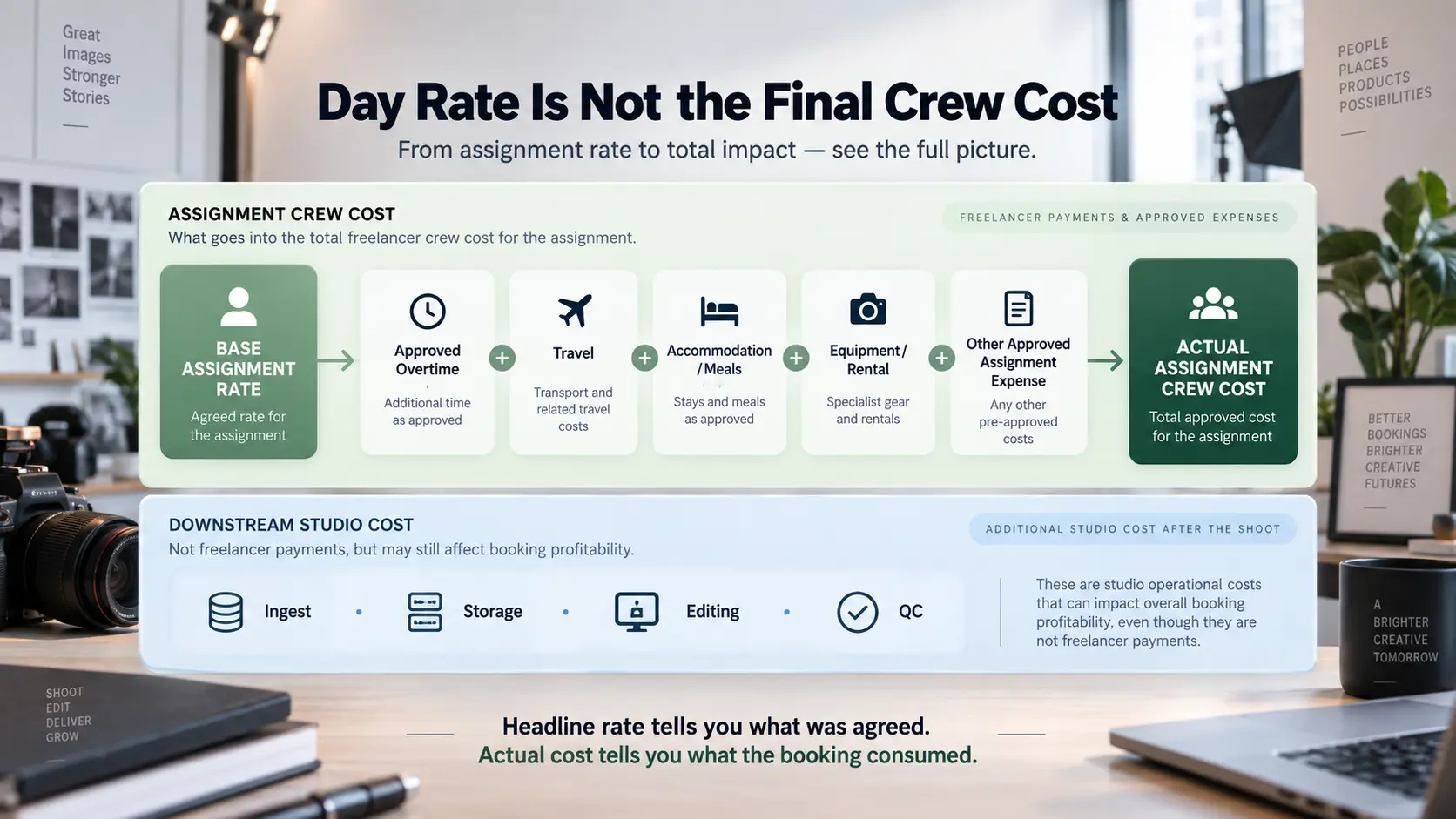
Freelancer pay
- Overtime
- Travel
- Accommodation / meals
- Equipment or approved expenses
= Assignment crew cost before downstream production
That distinction becomes particularly useful when two seemingly similar bookings take place under completely different logistical conditions.
Include editing and file-preparation responsibility
The freelancer's contribution may end when coverage ends, but it does not always end there.
A second shooter may simply hand over memory cards. A cinematographer may be responsible for preparing media in a specific folder structure. A photographer may cull their own set before transfer. An editor may receive RAW material and own the next part of the workflow entirely.
The rate card should make these boundaries visible because they affect both cost and scheduling.
If post-production is not included, say so. Do not let a shoot rate gradually absorb culling, file renaming, previews, retouching or revision work because the boundary was never documented.
If editing is included, define the deliverable well enough to price it consistently. “Editing included” can mean anything from basic selection to a complete finished gallery.
File volume also has an indirect cost even when the freelancer performs no editing themselves. More coverage creates additional ingest, backup, storage, culling, editing and quality-control work for the studio. That downstream production expense matters when deciding what a second photographer actually costs the booking.
Our guide to calculating photography profit margin on every booking goes deeper into this distinction between what the client pays and the complete direct cost required to deliver the job.
Decide how emergency and replacement assignments are priced
Not every freelancer booking happens under ideal planning conditions.
A photographer becomes unavailable the night before a wedding. A client adds a parallel function. Weather shifts a commercial shoot and the original crew cannot take the new date. A freelancer who normally works locally is asked to travel at short notice.
These assignments may carry different economics from routine scheduled work.
Studios do not necessarily need an automatic “emergency surcharge” for every freelancer. They do need to know whether the normal rate still applies when the working conditions materially change.
Record any pre-agreed rush, replacement or short-notice terms where they exist. If there is no standing agreement, flag the assignment for rate confirmation rather than assuming the standard day rate.
This is also where a trusted freelancer pool becomes operationally valuable. The studio should already know who is approved for each role, how they normally work, their availability and their commercial terms before an urgent replacement is required.
Our freelance photographer onboarding checklist covers that wider readiness layer, including approved roles, equipment, availability, payment expectations, client-facing conduct and file handoff. The rate card should live alongside that operational profile rather than become the only thing the studio knows about the person.
Review the actual photography crew cost after every assignment
The most useful rate card improves over time.
After an assignment closes, compare the expected cost with the actual cost.
Did the event run into overtime? Was unexpected transport reimbursed? Did another hotel night become necessary? Did the studio have to rent equipment? Was additional editing required because the files needed extensive correction? Did the photographer's work reduce supervision and post-production instead?
This is not about reducing every crew decision to the cheapest freelancer.
A higher-rate photographer may generate better economics if they reliably handle complex coverage, need less supervision, reduce corrective editing and make difficult assignments easier to staff. A lower headline rate may become expensive if almost every booking produces overtime, travel surprises or heavy post-production correction.
Track enough history to see the pattern:
Expected freelancer cost → Actual assignment cost → Downstream cost → Booking revenue → Contribution to booking margin
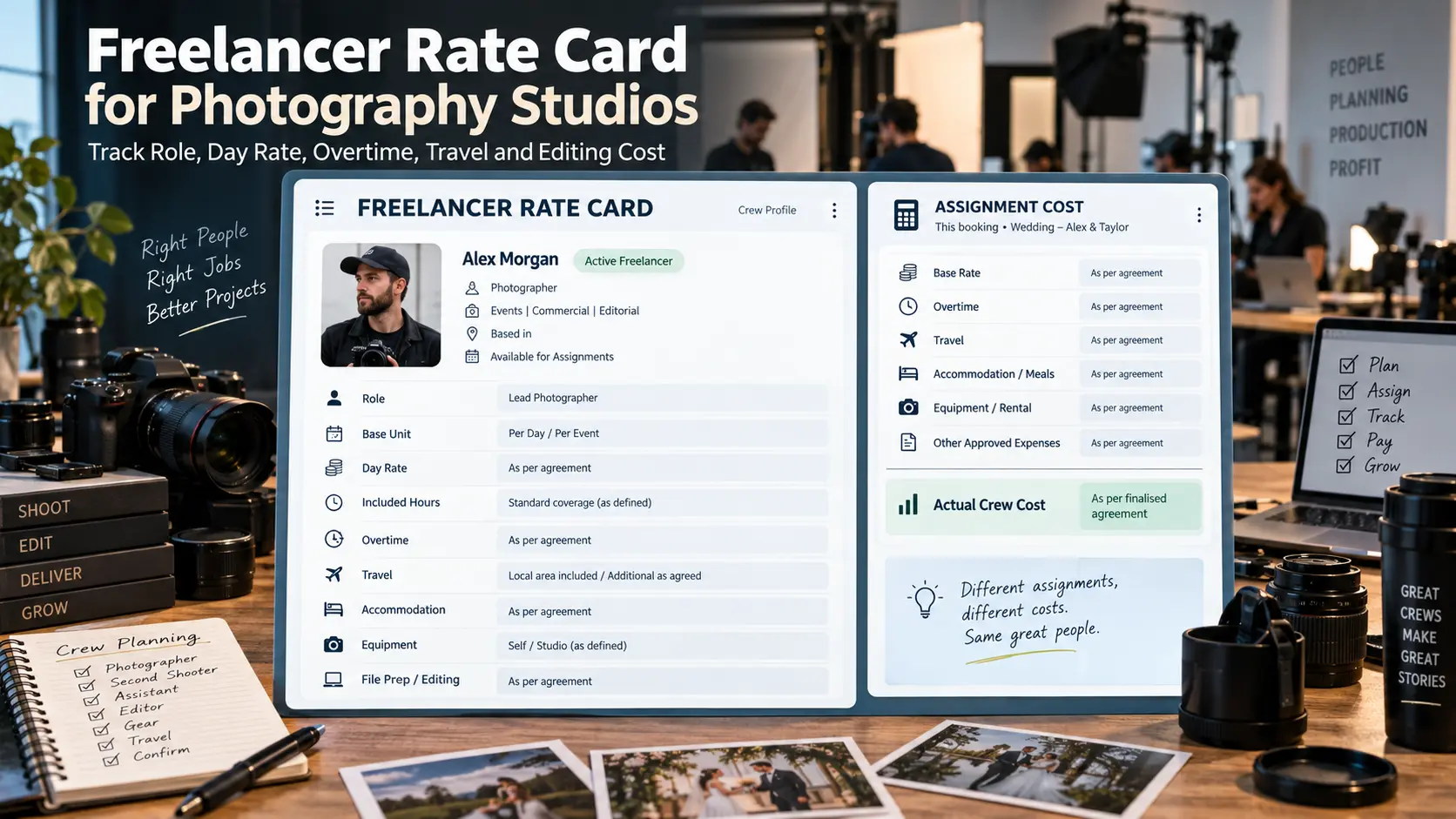
GoPickle's crew workflow keeps assignments and event-wise payment context together so studios can review freelancer payouts against the work that created them rather than reconstructing costs from chats at the end of the month. This is especially useful for studios mixing permanent employees, event-wise freelancers and editors under different payment models.
One important caution applies wherever your studio operates: calling someone a “freelancer” in a rate card does not by itself determine their legal employment or contractor status. Worker-classification, payroll, tax, insurance and employment obligations depend on local law and the actual working relationship. Studios operating across different jurisdictions should obtain appropriate local accounting or legal guidance rather than using a photography rate card as a substitute for compliant contracts or payroll decisions.
A good internal rate card ultimately answers a much more useful question than “What does this photographer charge?”
It tells you what this person costs your studio when they perform a specific role under specific working conditions.
That distinction gives the studio cleaner freelancer conversations, more accurate booking costs and better pricing decisions. The photographer knows what has been agreed. The manager knows what to budget. Finance knows what an approved payout relates to. And the owner can evaluate photography crew cost from real assignments instead of trying to remember what everybody charged last season.