Second Shooter vs Photography Assistant: Roles, Costs and When a Studio Needs Each
Compare a second shooter vs photography assistant, including duties, costs, wedding coverage, crew responsibilities and when your studio should hire each.

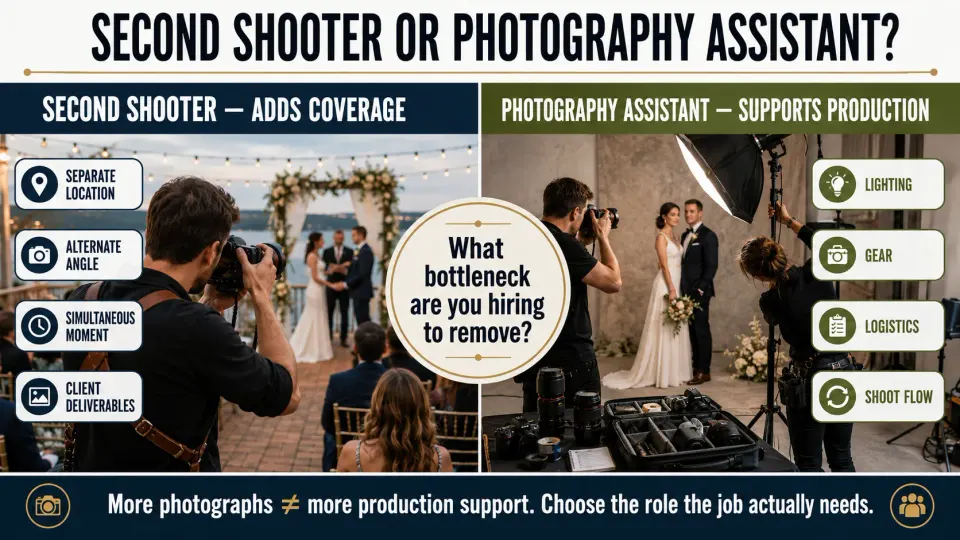
A lead photographer is moving between portraits and the ceremony space while somebody needs to light the portraits, move cases, find the missing family member and watch the equipment. At the same time, guests are arriving elsewhere and moments are already happening that nobody is photographing. Adding “one more crew member” sounds like the obvious fix, but the studio first needs to decide what is actually missing: another person capable of making photographs, or another pair of hands that lets the photographer work properly.
That distinction sits at the centre of the second shooter vs photography assistant decision. A second shooter, or second photographer, primarily adds photographic coverage. An assistant primarily supports production through lighting, equipment, logistics and practical shoot-day tasks. Experienced crew members can sometimes cross between those roles, but booking one while expecting the work of the other is where studios create coverage gaps, unclear expectations and unnecessary crew costs.
For us at GoPickle, the useful question is not, “Would another person make this shoot easier?” It is, “What specific constraint are we paying this person to remove?”
Second shooter vs photography assistant: the practical difference
A second shooter is another working photographer. The studio hires them because one photographer cannot provide all of the required coverage alone, or because two photographic perspectives have enough value to justify the additional production and post-production cost.
A wedding second shooter might photograph one partner getting ready while the lead photographs the other, remain with guests while the lead takes couple portraits, work from another ceremony position, photograph reactions during speeches or cover another room, floor or event happening at the same time. They should be capable of producing files that can sit inside the final client gallery without feeling like photographs from an unrelated photographer.
A photography assistant solves a different problem. They may carry and position lighting, move stands, manage modifiers, organise equipment, change or charge batteries, keep cases secure, help assemble groups, watch the schedule, prepare the next setup or coordinate small practical details while the photographer continues shooting. On a controlled portrait or commercial set, a good assistant can improve the photographer's output considerably without taking a single client photograph.
The distinction becomes clearer in a role comparison:
| Requirement | Second shooter / second photographer | Photography assistant |
|---|---|---|
| Photographs client deliverables | Primary responsibility | Usually no |
| Covers a separate location | Yes | Usually stays with photographer/set |
| Captures simultaneous moments | Yes | No |
| Provides alternative angles | Yes | Not the purpose of the role |
| Works independently for periods | Often | Usually works around the lead/set |
| Holds lights or modifiers | Sometimes, when coverage allows | Common responsibility |
| Moves and monitors equipment | May help | Common responsibility |
| Helps organise groups | May help | Often |
| Needs a production-ready camera kit | Normally | Depends on assignment |
| Adds files to post-production | Yes | Usually little or none |
| Main reason to hire | More or parallel photographic coverage | Faster, safer and better-supported production |
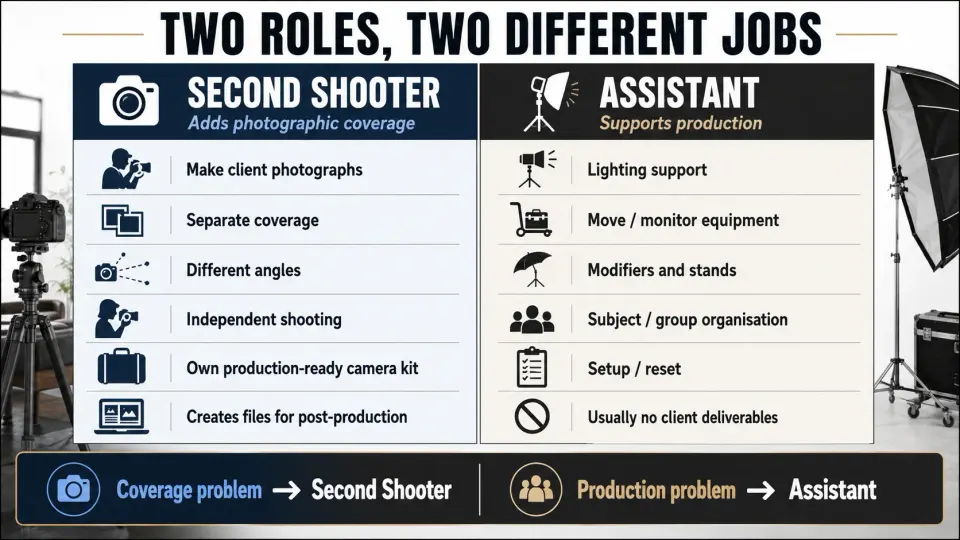
The job title matters less than the agreed responsibility. Some studios use “assistant photographer”, “second photographer”, “second shooter”, “lighting assistant” and “photo assistant” differently. Before confirming somebody, define what they are expected to produce rather than relying on the title.
Hire a second photographer when the coverage itself is the bottleneck
The strongest reason to hire a second photographer is simple: important photographs need to be made in two places, or from two genuinely useful perspectives, at the same time.
Weddings make this especially visible. Two partners may prepare in different locations. During a ceremony, one photographer may need to stay positioned for the processional while another records reactions. During couple portraits, guests may be enjoying cocktail hour elsewhere. At a large cultural or multi-event wedding, separate ceremonies, entrances, family activity and venue details can overlap to the point that a single photographer must constantly choose what not to photograph.
The same issue exists outside weddings. An event photographer covering a large conference may need keynote coverage in one hall while sponsor interactions happen elsewhere. A corporate photographer may be photographing executives while another photographer works through breakout sessions or environmental photographs around an office. Adding a second shooter makes sense when the client is buying additional photographic coverage, rather than simply additional labour.
There is little value in paying for a wedding second shooter who spends the entire day standing beside the lead photographer making near-identical frames. Before the job, divide the coverage deliberately: locations, people, focal lengths, ceremony positions, candids, details and specific moments. The second photographer should expand what the studio can deliver, not duplicate what it already has.
For larger bookings, those assignments should also be tied to the actual events and schedules rather than sitting in a generic crew chat. GoPickle's Crew Management for Photographers is built around that structure, allowing studios to connect photographers, assistants, other crew roles, availability and event assignments to the work they are actually covering.
Hire a photography assistant when the photographer is the bottleneck
There are shoots where another camera adds very little, while an experienced assistant changes the entire working pace.
Consider a location portrait session using off-camera lighting. The photographer can either compose, direct the subject and watch the light while somebody else safely positions the stand, or repeatedly stop shooting to move equipment. Outdoors, an assistant may need to hold a modifier because a stand would be unsafe in the wind. During a corporate headshot day, somebody may need to keep the next subject ready, check names, reset the shooting area and monitor equipment while the photographer maintains a consistent rhythm.
This is why photography assistant duties should be defined around the production itself. A lighting-heavy fashion shoot may require a technically experienced first assistant. A fast corporate portrait day may benefit more from somebody who can manage people and resets. A destination assignment may need practical help with cases, batteries and equipment movement. Calling all of these people simply “assistants” can hide very different levels of responsibility and therefore very different photography assistant rates.
Our corporate headshot day workflow shows the same principle at larger scale. Once dozens or hundreds of people are moving through a set, the photographer should not also become the receptionist, participant tracker and equipment coordinator unless the schedule has been designed to accommodate that work.
Sometimes one person can second shoot and assist, but define the priority
An experienced second photographer can certainly hold a light during portraits, carry a case while changing locations or help arrange a family group. A photographer who refuses to help with anything outside pressing the shutter would be an awkward crew member on many real shoots.
The problem appears when the studio plans as though one person can perform both jobs simultaneously.
If the second shooter is holding an off-camera flash during a ceremony portrait, they cannot also be across the venue photographing guests. If they are sent to another preparation location, they cannot help the lead unload lighting. If they are expected to capture cocktail-hour candids, they cannot be beside the lead organising family photographs at exactly the same time.
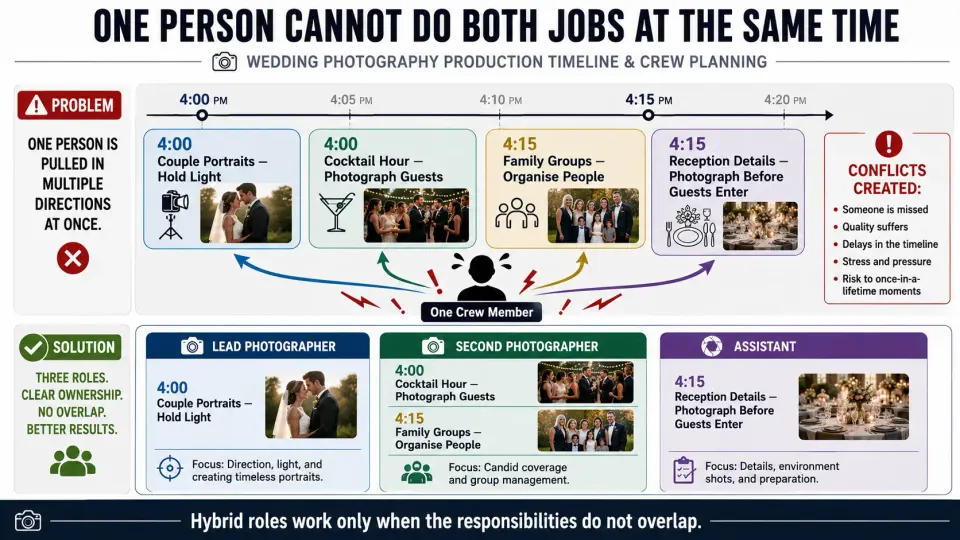
Write down the primary role first.
Primary role: Second photographer. When parallel coverage is not required, assist the lead where useful.
Primary role: Photography assistant. Only make photographs when specifically assigned and when assistance responsibilities are covered.
That one distinction prevents a surprisingly large amount of confusion.
It also helps the studio decide whether a demanding production actually needs three people: a lead photographer, second photographer and assistant. Adding headcount indiscriminately is expensive, but trying to compress three genuine jobs into two people simply hides the cost inside missed coverage, slower production or an exhausted lead.
Second shooter cost and photography assistant cost should affect the quote differently
There is no useful worldwide answer to “How much should I pay a second shooter?” Rates vary with country, city, experience, assignment type, working hours, equipment requirements, travel, employment status and how independently the person is expected to perform. A highly experienced second photographer trusted to handle part of a major wedding independently should not be costed as though the studio were hiring somebody to carry bags.
Instead of copying another photographer's day rate, calculate the fully loaded crew cost for the actual booking:
Crew cost = agreed pay + overtime + travel + meals/accommodation + equipment or rental cost + applicable employment/payroll costs + other assignment-specific expenses
For a second photographer, add another cost that studios frequently underestimate: the files they create. More photographic coverage means more ingestion, backup, culling, storage, editing and quality control. If the second shooter produces another 2,000 frames, the financial effect does not end when their shoot-day payment is made.
This matters when deciding what to charge a client for a second photographer. If the studio pays the photographer 500 in its local currency and invoices the client 500, it has not necessarily covered the cost. Travel, administration, additional post-production and business overhead still exist. The commercial calculation should be closer to:
Client price for additional coverage = direct crew cost + additional production/post-production cost + appropriate overhead and margin
An assistant may create very little additional post-production, so their economic value appears elsewhere. Perhaps an eight-hour shoot can be completed in six. Perhaps the photographer can run two lighting setups safely. Perhaps subjects move through a headshot station faster. Perhaps expensive equipment is better controlled. The assistant should therefore be evaluated against the production constraint they were hired to remove.
Studios deciding whether these roles should be permanent or booked only as required can also use our freelance vs full-time photographer staffing model to compare utilisation, availability, consistency and fixed versus variable crew cost.
Brief the second shooter and assistant before anyone reaches the venue
“See you at 8” is not a crew brief.
A second shooter needs to know what the studio expects them to photograph, which moments belong to the lead, where separate coverage is required, the shooting format, synchronised camera time, file handoff process, equipment expectations and how client interaction should work. The studio should also agree in writing on payment, expenses, cancellation, file delivery, confidentiality, image usage and portfolio/publication rights where relevant.
An assistant needs a different brief: call time, equipment list, lighting plan, expected setups, what they are responsible for carrying or monitoring, how the gear should move between locations and where they need to be during critical parts of the shoot.
Local employment, contractor, insurance, tax, copyright and image-rights rules vary considerably, so studios working with freelance crew should use agreements appropriate to their own jurisdiction rather than copying another photographer's contract from the internet.
GoPickle's article on assigning studio work without losing accountability uses a simple rule that applies well here: every important activity needs a responsible owner, a deadline, a visible status and a clear handover. The same discipline should exist on shoot day.
Evaluate the role against what you hired the person to fix
After the job, do not evaluate a second shooter and an assistant using the same criteria.
For the second photographer, review whether their images expanded the gallery. Did they capture moments the lead could not? Were their angles genuinely different? Could the files be edited consistently with the studio's work? Were exposure, focus, timestamping and file handling reliable? Did their coverage reduce risk or merely create thousands of additional near-duplicates for the editor?
For an assistant, asking how many photographs they produced misses the point. Look at whether lighting changes happened faster, equipment stayed organised, group transitions improved, the lead spent less time performing non-photographic tasks and avoidable delays or gear problems were reduced.
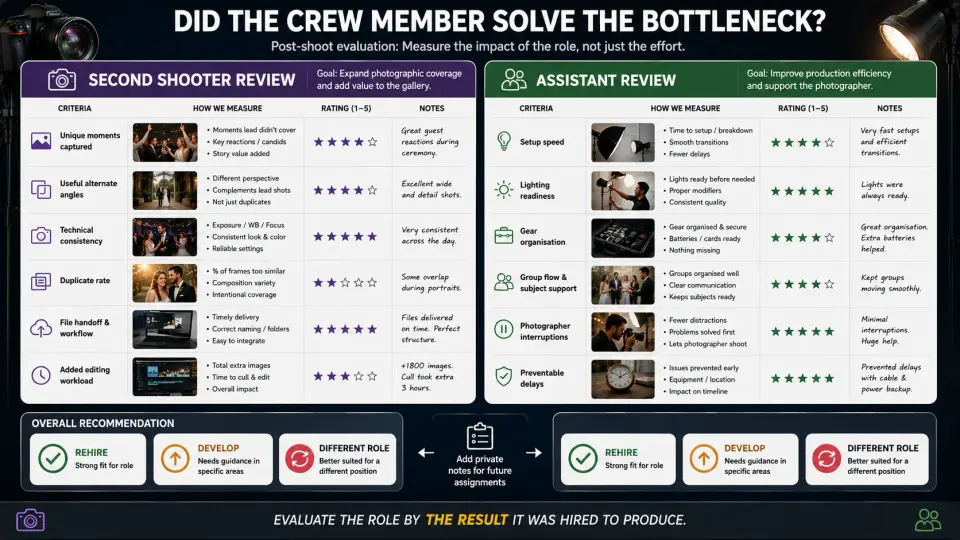
A crew member who performs well should become easier to assign the next time because the studio now knows what they are good at. Keeping that history around real bookings is one reason we built GoPickle Crew Management around assignments, roles, availability and event-wise payment context rather than treating the team as a static contact list.
The most useful staffing decision is usually visible before you start looking for names. If the assignment requires photographs from two places at once, hire a second photographer. If the photographer can cover everything but keeps losing shooting time to lighting, equipment and logistics, hire an assistant. If both problems exist at the same time, price and staff the production accordingly.
A larger photography studio crew is not automatically a better crew. The right crew is the smallest team that can cover the promised work properly, with each person solving a problem the studio has actually identified.