How to Price Overtime in Photography Quotes Without Creating Last-Minute Disputes
Learn how to set a photography overtime fee, price additional coverage hours, define approval rules and invoice extra time without shoot-day disputes.


A wedding ceremony starts 45 minutes late. The speeches run beyond schedule. The corporate awards programme that was supposed to finish at 8:30 PM is still on its third category at 9:15. Your contracted photography coverage ends at 9:00, but the client clearly expects the important moments still ahead to be photographed.
This is a poor time to start negotiating money.
Yet many photography studios enter exactly this situation with nothing more specific in the quotation than “extra hours charged additionally.” The photographer knows the original coverage has ended, the client assumes the team will stay until the event finishes, and nobody is certain what another hour costs or who is authorised to approve it. If the studio raises the charge after delivery, what should have been an ordinary scope change can feel like an unexpected bill.
A photography overtime fee works better when it is designed as a process rather than just a number. The quotation should establish when overtime starts, how it is calculated, which parts of the crew are extending, who can approve the additional coverage, and how that approval becomes an invoice afterwards.
For us at GoPickle, that is the useful way to think about photography overtime: the client is extending the agreed scope of a live assignment, and the studio needs a clean way to carry that change from the shoot into its commercial records.
What actually counts as photography overtime?
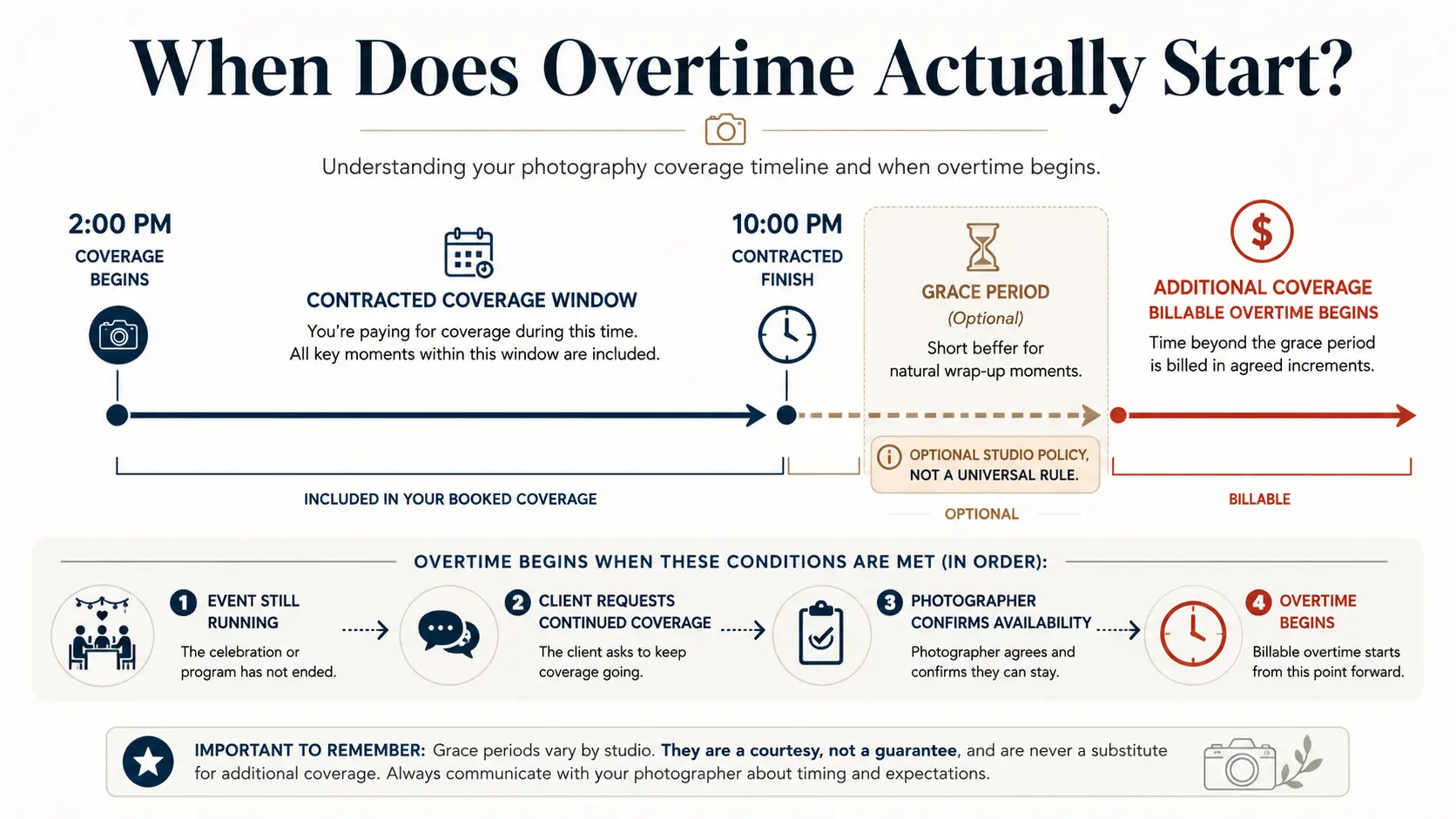
Overtime begins when the photographer continues providing chargeable coverage beyond the limit agreed for the booking. That limit needs to be clear before the shoot.
If a quotation says only “8 hours photography,” there is still room for disagreement. Does the clock start when the photographer reaches the venue, when coverage actually begins, or when the ceremony begins? Does a two-hour break between events stop the clock? Does an 8-hour wedding package allow those hours to be split across the day?
A clearer scope might say:
Photography coverage from 2:00 PM to 10:00 PM on 12 December, with continuous coverage for up to eight hours. Additional coverage beyond 10:00 PM is subject to crew availability and the stated overtime rate.
For a corporate event, the same principle could become:
Two photographers covering the conference from 9:00 AM to 6:00 PM. Coverage requested after 6:00 PM will be treated as additional time.
This is why our guide to corporate photography quotations recommends defining the actual coverage window rather than relying on phrases such as “full day.”
Studios should also decide how they handle small overruns. If the agreed end time arrives while the couple is halfway through a planned exit sequence, stopping the camera at exactly 10:00:00 may be commercially precise but practically absurd. Some studios deliberately allow a small grace period and begin billable overtime only after that. Others bill every additional 30 minutes. Either approach can work; the problem starts when the rule exists only in the photographer's head.
Why package price divided by hours can underprice the extra hour
One common way to set a photography overtime rate is to take the package price and divide it by the included shooting hours.
An ₹80,000 eight-hour package therefore appears to imply an extra hour photography price of ₹10,000.
That calculation looks logical, but the package price and the overtime hour do not necessarily contain the same cost structure. The package may include fixed items such as client consultation, planning, album design, gallery hosting or travel that do not increase with another hour. At the same time, the extra hour can create costs that were not present in the original staffing agreement: another hour for the second photographer, cinematographer or assistant, additional transport arrangements, a late-night crew allowance, more footage to back up and edit, and a larger final delivery.
For that reason, an overtime rate deserves its own calculation.
A useful internal model is:
Additional coverage cost = extra crew cost + additional post-production + incremental travel or logistics + other direct costs + required margin
That does not mean displaying your internal calculation to the client. The client can still see one straightforward photographer additional hours fee. The cost model simply makes sure that the number you quote is commercially sensible.
This becomes especially important for studios rather than solo photographers. An extra hour for one wedding photographer is one extension. An extra hour for two photographers, two cinematographers and an assistant is five additional crew-hours before the extra editing has even started.
If you are unsure whether your overtime rate actually contributes to the booking profit, our guide to calculating photography profit margin on individual bookings provides a useful framework for separating revenue from direct job costs.
Crew, travel and post-production can make one extra hour much larger than it looks
Clients experience overtime as another hour at the event. The studio experiences everything that another hour produces.
Suppose the wedding reception runs until midnight instead of 11:00 PM. The lead photographer stays, but so do the second shooter and cinematographer. Their agreed crew rates may increase. The driver or hired vehicle may exceed its planned duration. If the team had a long journey home, the later finish can alter travel arrangements. Another hour of photography and video also creates more files to ingest, back up, review, cull, colour-correct and edit.
The result is that a wedding photographer overtime fee should not automatically be identical whether the client is extending one photographer or an entire photo-and-film team.
Your quotation can handle this in several ways. You could set a rate for the full contracted team, define different overtime rates for photography and cinematography, or specify a charge per crew member where the client may extend only part of the service. What matters is that the client can tell what continues when they approve the extra time.
For example:
| Extension | Overtime treatment |
|---|---|
| Lead photographer only | Fixed additional hourly rate |
| Two-photographer team | Team overtime rate |
| Photography + cinematography | Combined team overtime rate |
| Extra editor for live delivery | Separate additional resource charge |
| Outstation event running significantly late | Overtime plus any applicable transport/stay change |
Do not introduce every theoretical charge into every quotation. Include the ones that can realistically occur on that assignment.
The broader principle is the same one we recommend when building a clear photography quotation: define what is included and what can change before the client reaches the shoot.
How to state overtime in a photography quotation
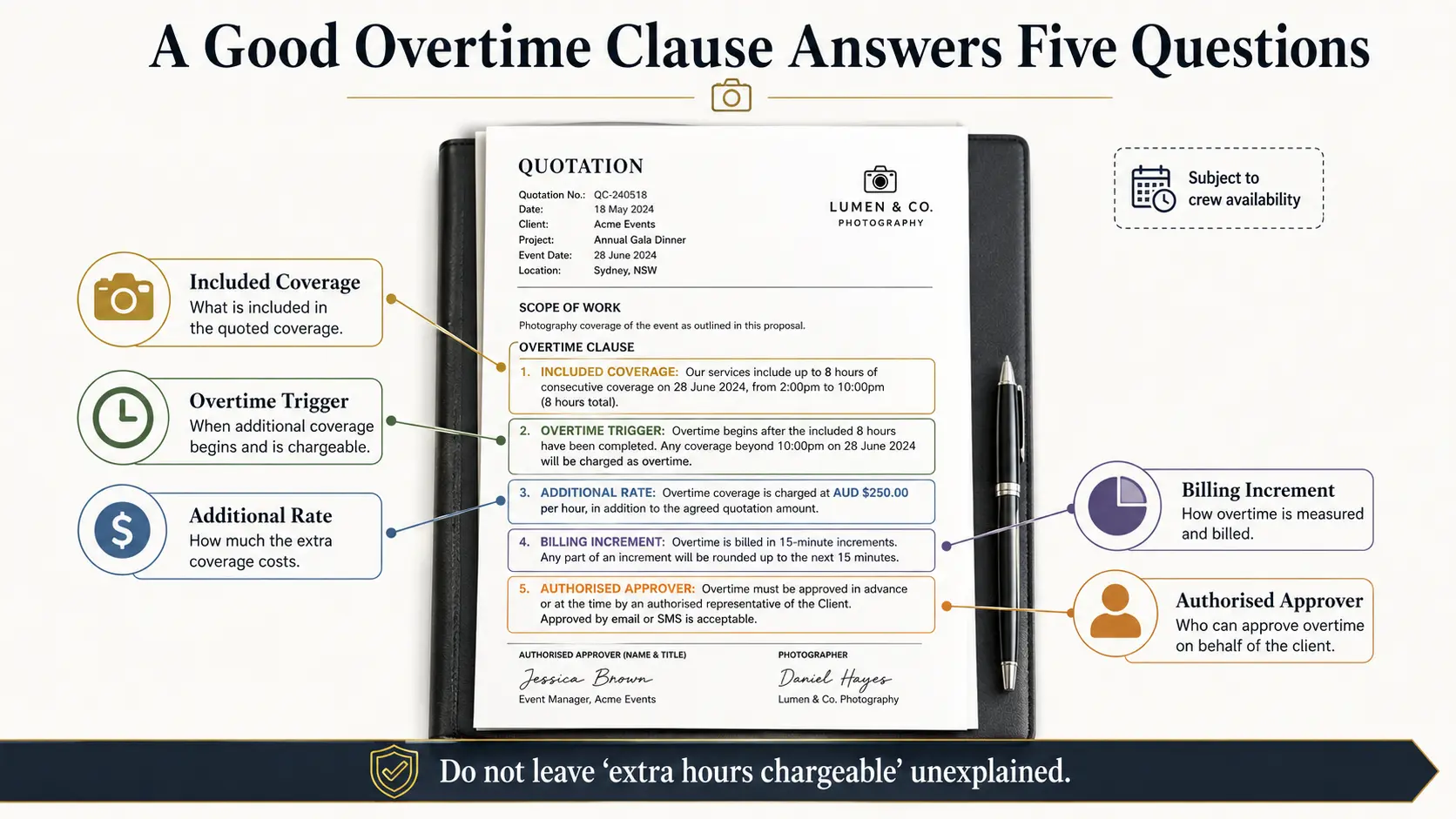
A useful photography quote overtime section should answer five questions without requiring the client to interpret legal language:
- What coverage has already been purchased?
- When does overtime begin?
- What does additional coverage cost?
- How is partial time billed?
- Who must approve the extension?
A practical quotation entry might read:
Additional Coverage: Coverage beyond the agreed 10:00 PM finish time is available subject to crew availability at ₹X per additional hour for the contracted photography team. Additional time is billed in 30-minute increments and must be approved by the client or the client's designated event coordinator before the extended coverage begins.
If photography and video have different rates, state them separately rather than relying on an ambiguous “team overtime” amount.
You should also decide whether overtime is simply an option or guaranteed availability. A photographer who has another early assignment the following morning may not be able to stay an additional three hours simply because the client is willing to pay. “Subject to crew availability” makes the practical limitation visible.
GoPickle's Photography Quotation & Proposal Software is built around keeping coverage, add-ons, pricing and terms inside the proposal rather than leaving important extras in unrelated WhatsApp conversations. Whether you use GoPickle or another system, the objective is the same: the approved quote should give your studio a reliable baseline when someone asks for more work later.
How to approve extra time on the shoot day
The photographer should not wait until the contracted end time has already passed before raising overtime.
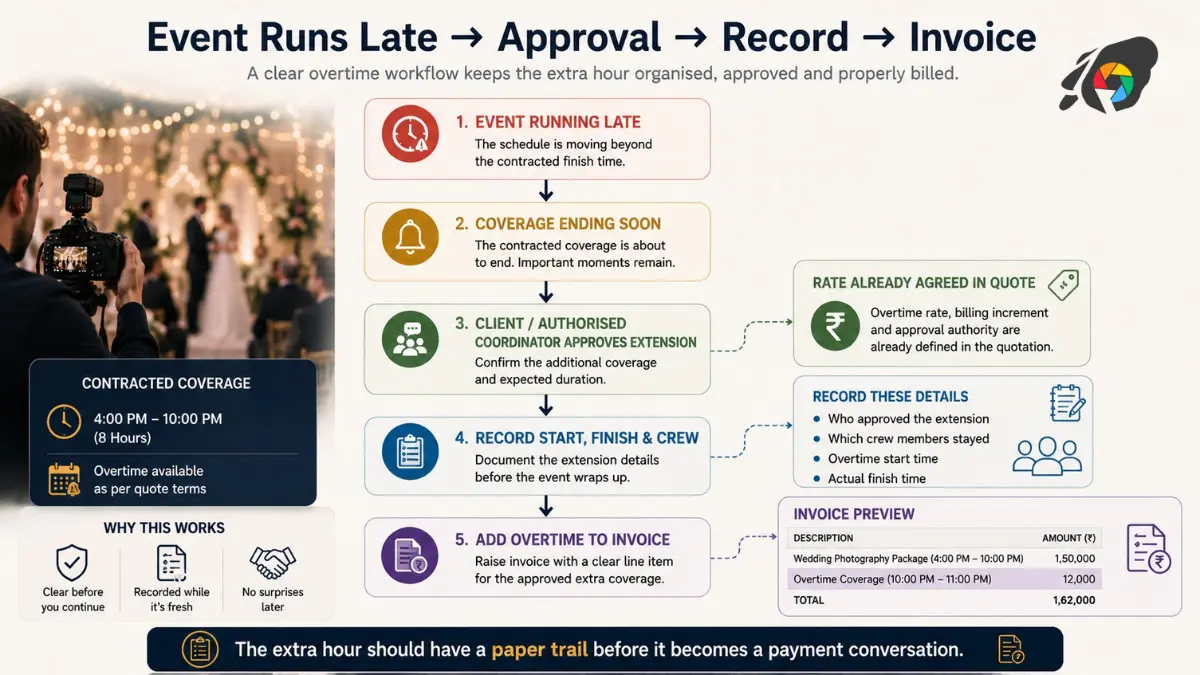
If the schedule is obviously slipping, tell the authorised person before the current coverage expires. At a wedding that could be the couple, planner or another person the couple nominated beforehand. At a conference it may be the event manager, marketing manager or production lead. The photographer should not accept an expensive two-hour extension from a random relative, guest or junior staff member who may not have authority to approve additional spending.
A simple conversation is enough:
“Our booked coverage finishes at 10:00 PM, and it looks like the final performances will run beyond that. We can extend the photography team until 11:00 PM at the additional coverage rate in your quotation. Would you like us to continue?”
Then record the answer.
For a small consumer booking, that record might be a message from the client. For a larger commercial assignment, the studio may need written approval from an authorised contact or purchase-order process. The appropriate method depends on the client and jurisdiction, which is why your contract and approval wording should be reviewed for your own market rather than copied blindly from another photographer.
The important operational rule is straightforward: approval should happen before the extra hour is worked whenever reasonably possible.
If the event runs over because of circumstances outside the client's control, that does not automatically make the additional production cost disappear. You can still choose to waive part of the charge as a relationship decision, but that should be a deliberate studio decision rather than the result of having no overtime process.
Record the extension before everyone forgets what happened
Shoot days are busy enough that “we stayed around another hour” can become difficult to reconstruct three days later.
Record the original coverage, actual finish time, approved extension, approving person and which crew members stayed. If only the photographer continued while the cinematography team packed down at the original finish time, that distinction matters when the additional charge is calculated.
A simple internal record could show:
Contracted finish: 10:00 PM
Extension approved: 9:42 PM
Approved by: Client / designated coordinator
Extended services: Two photographers
Actual finish: 11:00 PM
Additional billable time: 1 hour
Invoice action: Add approved overtime line item
This small record closes the gap between what happened on location and what the accounts team sees afterwards. In a larger photography studio, that is particularly valuable because the person generating the invoice may not have attended the event.
How to invoice photography overtime afterwards
Do not hide overtime inside a revised total.
If the original booking was ₹1,50,000 and another ₹12,000 was approved for extended coverage, an invoice that suddenly shows ₹1,62,000 without explanation asks the client to remember why the amount changed.
Show the variation as its own item:
Wedding photography package: ₹1,50,000
Additional photography coverage – 1 hour, 10:00 PM–11:00 PM: ₹12,000
Revised service total: ₹1,62,000
Then apply the appropriate tax treatment for your business and jurisdiction.
This follows the same principle we use in our photography invoice basics guide: clients should be able to understand the service, charges, amount paid and outstanding balance from the invoice itself rather than reconstructing the calculation from previous messages.
For studios using GoPickle, Smart Invoicing keeps invoices, booking context, advances, balances and payment tracking together. The useful part of that workflow for overtime is not simply producing another PDF. It is keeping the added charge attached to the assignment where it occurred.
Overtime pricing should remove the negotiation from the moment you need the camera
A good photography overtime policy does not exist to penalise an event for running late. Weddings and live events move. Ceremonies start late, speeches expand, executives arrive behind schedule and clients occasionally decide that something happening later in the evening is worth photographing.
The commercial problem is not that the schedule changed. The problem is reaching that moment without knowing what the change means.
Set the coverage boundary before the booking. Calculate an overtime rate that reflects the actual team and downstream workload. Define the billing increment. Decide who can authorise additional coverage. Get approval before continuing where practical. Record what changed, and show the extra service clearly when it reaches the invoice.
Then, when the client asks at 10:00 PM, “Can you stay another hour?”, the photographer does not have to choose between an awkward negotiation and unpaid work.
The answer is already part of the booking.