Photographer-to-Editor File Handoff: A Safe Workflow for RAW Files, Notes and Responsibility
Build a safe photography file handoff to editors with RAW backup, source identity, edit notes, receipt confirmation, returned files and QC.

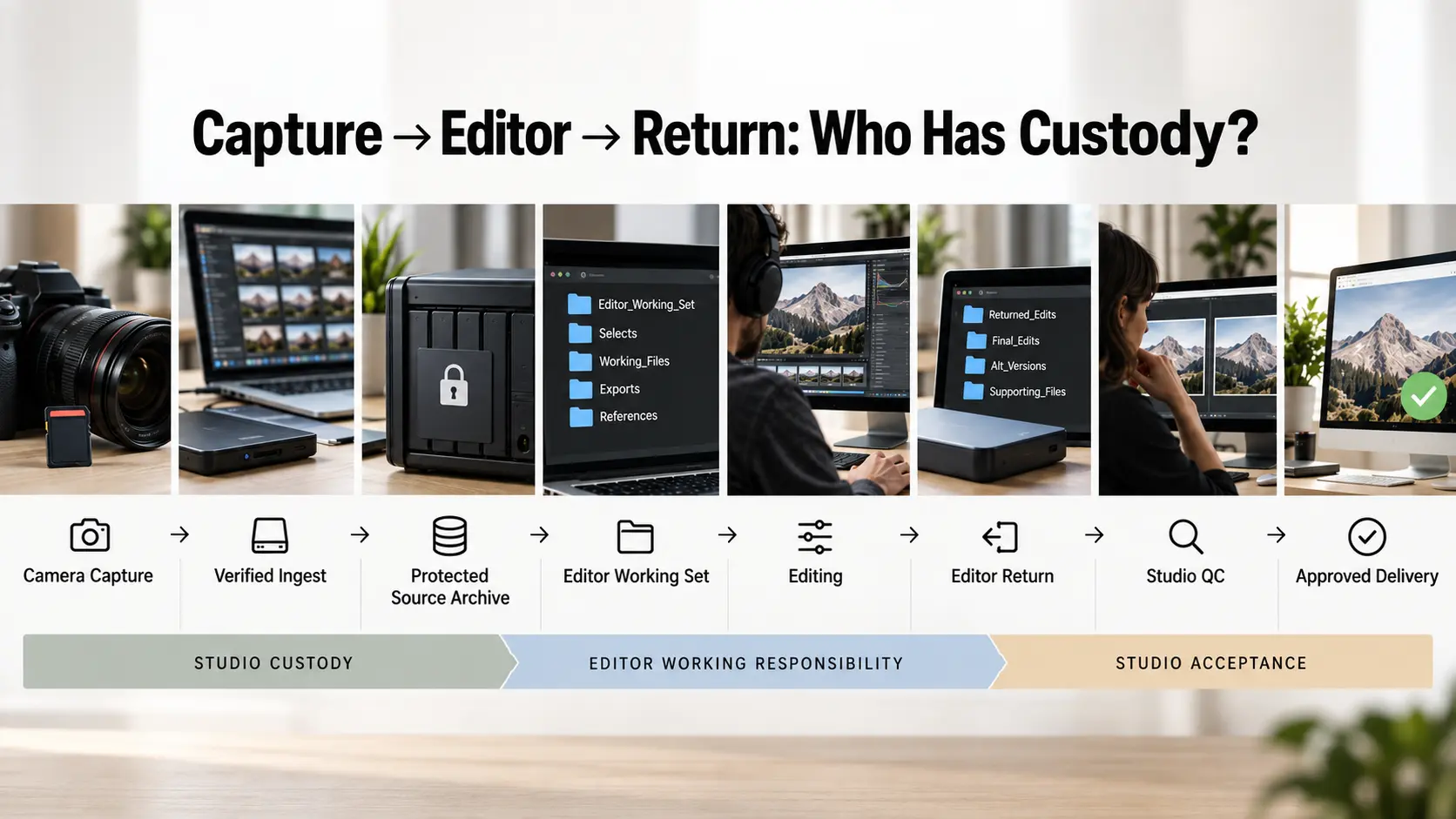
Sending photographs to an editor looks like a file-transfer job until something goes wrong. A folder is incomplete. Two cameras contain duplicate filenames. The editor assumes culling is included when the studio expected every frame to be edited. A returned Lightroom catalog no longer matches the source folders. Retouched files overwrite earlier versions. A temporary drive is erased because everyone assumes somebody else has the backup.
A reliable photography file handoff to an editor has to solve more than transfer speed. It needs to establish custody: which files exist, which copy remains authoritative, what the editor is expected to do, who currently owns the next action, and what must come back before the handoff can be considered complete.
This matters for a solo photographer outsourcing colour correction, a wedding studio working with several remote editors, and a larger team moving jobs between photographers, cullers, retouchers and album designers. The tools can differ. The operating principle should not: the original capture remains protected while a clearly defined working set moves through post-production.
1. Confirm capture is fully ingested and backed up
Do not make the editor's upload the first complete copy of the shoot.
Before a photo editor file handoff begins, ingest every card involved in the assignment and confirm that all expected sources are present. For a multi-camera wedding, that may mean files from the lead photographer, second photographer, additional camera bodies and any separate portrait or reception coverage. For a commercial shoot, it may include tethered captures as well as files recorded locally to camera media.
The studio should know which cards have been copied, where those files were copied and whether a separate verified backup exists. A copied folder on one working SSD is still vulnerable to drive failure, accidental deletion or corruption. Our 3-2-1 photography backup workflow goes deeper into the protection strategy from memory card through archive and final delivery.
Treat "ingested" and "safe" as separate states. Ingest means the files have reached the working environment. Safe means the studio has confirmed the job meets its backup policy and the original capture is no longer dependent on one card, computer or drive.
Only then should the photography post-production handoff begin.
2. Preserve originals and source identity
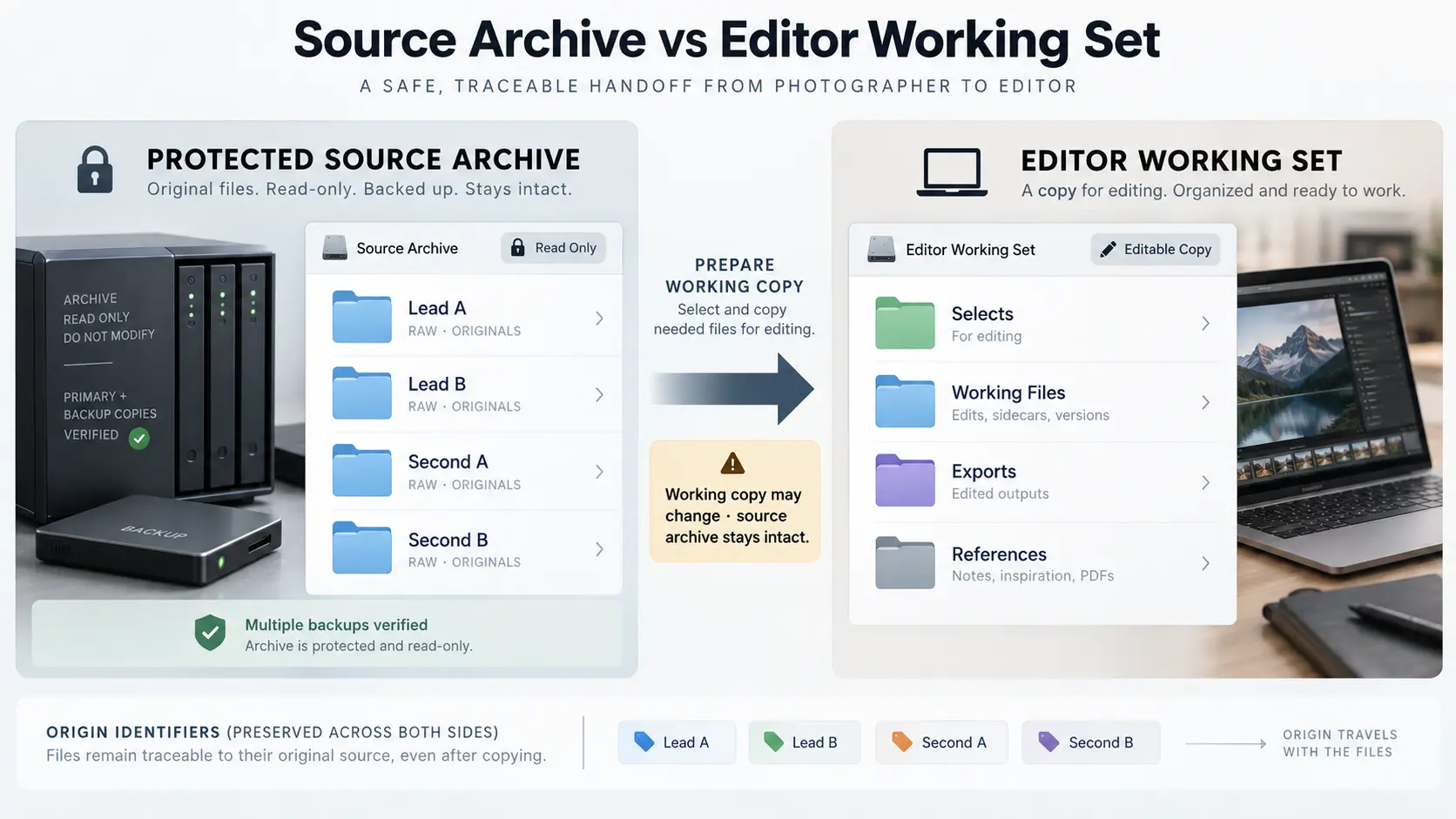
The editor does not need to receive the studio's only authoritative copy of the RAW files. Keep a protected source set that post-production cannot casually alter.
Source identity matters almost as much as the files themselves. Modern cameras routinely restart filename sequences, so two photographers can both return a file called DSC_0001, IMG_0001 or something equally unhelpful. Combining everything into one folder before establishing ownership can make later troubleshooting unnecessarily difficult.
A practical initial structure can preserve the job, photographer and camera:
Client-Booking/ ├── 01_SOURCE_ARCHIVE/ │ ├── LEAD_A/ │ ├── LEAD_B/ │ ├── SECOND_A/ │ └── SECOND_B/ ├── 02_EDITOR_WORKING_SET/ ├── 03_EDITOR_RETURN/ └── 04_FINAL_APPROVED/
The labels themselves are not important. Traceability is.
If files from several photographers must eventually become one chronological wedding sequence, correct capture-time issues and establish source identity before removing those distinctions. Our guide to merging files from multiple photographers without breaking the wedding timeline covers that process in more detail.
Renaming working copies later can be perfectly reasonable. What should disappear is ambiguity, not provenance. The studio should still be able to determine where a frame originated if an editor reports corruption, an incorrect timestamp, an unexpected colour profile or a missing sequence.
3. Create the editor working set
A safe RAW file handoff between photographer and editor does not automatically mean uploading the entire source archive.
Build the working set around the work being commissioned. If the editor is colour-correcting a culled wedding, send the confirmed selection rather than unrelated rejected frames. If the editor is responsible for culling as well, that scope needs a broader source set. If your Lightroom workflow allows the editor to work from a catalog and suitable previews, full RAW transfer may not be necessary for routine adjustments. Detailed retouching or pixel-level Photoshop work may require selected original files and a different return format.
Before transfer, decide four things:
| Decision | Define it before sending |
|---|---|
| Input | Full capture, culled RAWs, catalog/previews, JPEG references or selected retouch files |
| Editor's job | Culling, base correction, colour matching, cropping, retouching or another defined stage |
| Editable material | What may be renamed, rated, flagged, cropped or otherwise changed |
| Required return | Catalog, sidecars, layered masters, TIFFs, JPEGs, notes or another agreed package |
This prevents a common failure in the wedding photo editor workflow: the photographer and editor receive the same folder but imagine different jobs.
Keep the transfer package deliberate. An editor who only needs selected portraits for advanced retouching should not automatically receive every photograph from a multi-day event. Apart from reducing transfer overhead, limiting the working set makes completeness easier to verify and keeps access closer to the actual assignment.
Where client confidentiality or contractual restrictions matter, choose storage, transfer access and retention practices appropriate to the sensitivity of the work and the jurisdictions involved.
4. Attach job and style notes
Files do not explain the assignment.
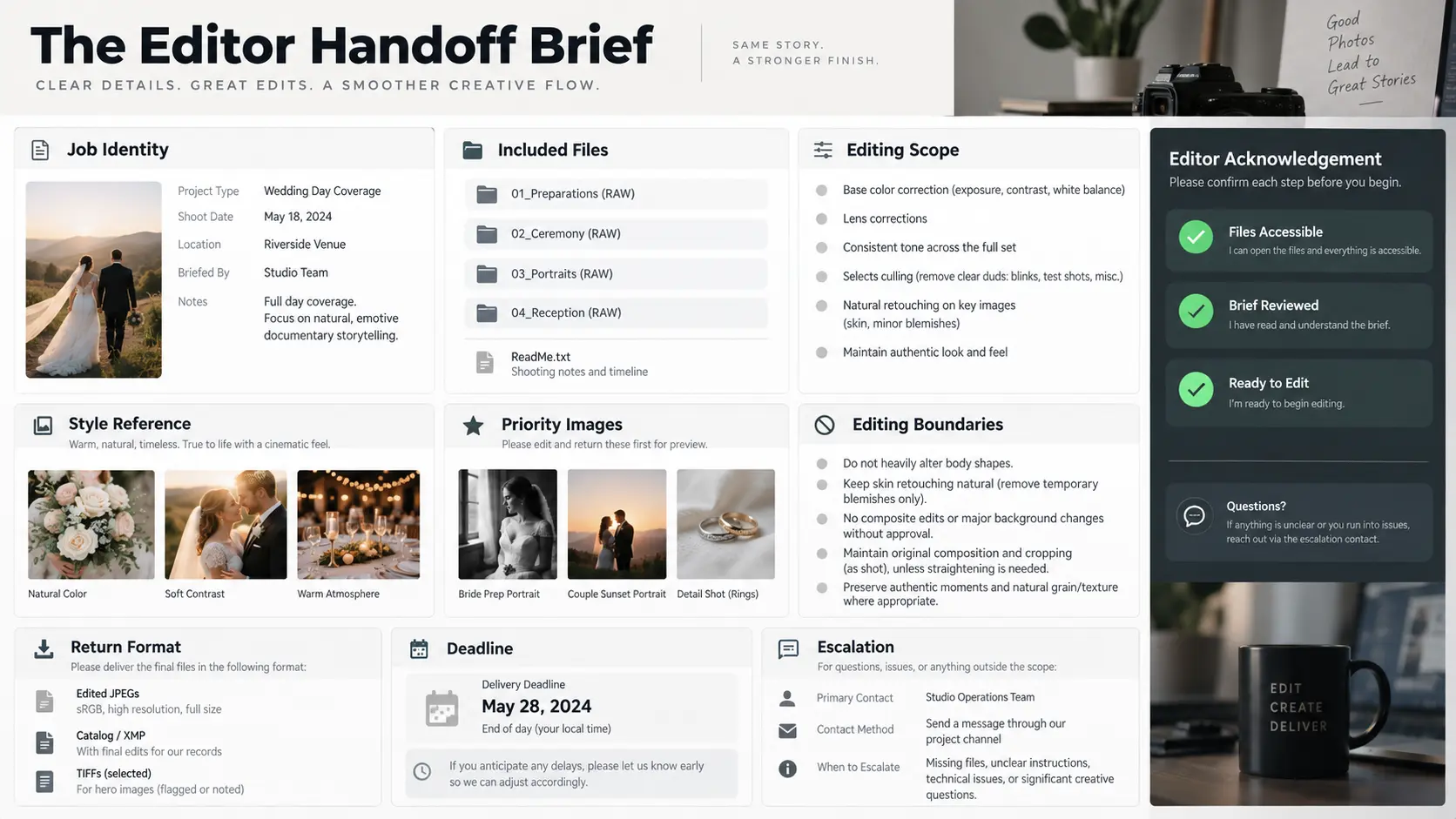
The editor needs enough context to reproduce the studio's intent without repeatedly asking what each folder means. A useful photography file transfer workflow therefore includes an edit brief alongside the working set.
For every handoff, define the booking or project, included events, editing stage, deadline, reference style and expected return format. Then add instructions that actually change how the editor should work.
For example:
| Brief field | What the editor needs to know |
|---|---|
| Job identity | Client, booking and event |
| Scope | Cull, colour edit, retouch or specific combination |
| Included set | Exact folders, selections or catalog |
| Style reference | Approved previous gallery, preset or representative edits |
| Priority | Preview images, hero photographs or urgent sequences |
| Editing boundaries | Skin treatment, cropping, object removal, black-and-white treatment, AI use or other limits |
| Output | Catalog, XMP, PSD/TIFF, JPEG or agreed combination |
| Deadline | First review and final return where applicable |
| Escalation | Who decides when an image falls outside normal instructions |
Avoid vague directions such as "make it cinematic" when the editor needs repeatable production guidance. A few approved references accompanied by concrete instructions are usually more useful than a long collection of unrelated inspiration images.
If you use freelancers repeatedly, permanent standards such as file confidentiality, card handling, communication expectations and normal delivery behaviour should already be established during onboarding. The freelance photographer onboarding checklist covers that broader relationship; the individual edit brief should concentrate on what is different about this job.
5. Confirm receipt before deleting temporary copies
"Uploaded" is not the same as "received."
A 200 GB transfer can finish on the photographer's side while the editor sees an incomplete folder, a failed archive, inaccessible permissions or a missing catalog. The handoff should therefore have an acknowledgement point.
A useful sequence is:
Prepared → Sent → Received → Verified → Editing
Verification does not need to become a forensic exercise for every portrait session. At minimum, the editor should be able to open the package, confirm the expected folders or selection, access the editing material and understand the brief. For high-value or difficult-to-repeat jobs, studios can add file counts, transfer manifests or checksum verification to the process.
Only temporary transfer copies should be considered for cleanup after successful receipt and according to the studio's retention procedure. This is not permission to delete the protected originals or the studio's required backups. The source archive should survive the editor handoff.
That distinction is essential. Transfer cleanup is storage housekeeping. Original retention is a separate preservation decision.
6. Return edited files without overwriting source
The return journey deserves the same structure as the outbound handoff.
Do not let returned files land directly inside the source archive with filenames or edit data that make the original state difficult to reconstruct. Give the editor a dedicated return location and define what belongs there.
A Lightroom-based photography file handoff may return editing instructions through a catalog or compatible metadata workflow. Advanced retouching may return layered PSDs or TIFFs. Another workflow may return approved high-resolution exports plus a list of files requiring additional work. There is no universal return package, which is exactly why it should be agreed before editing starts.
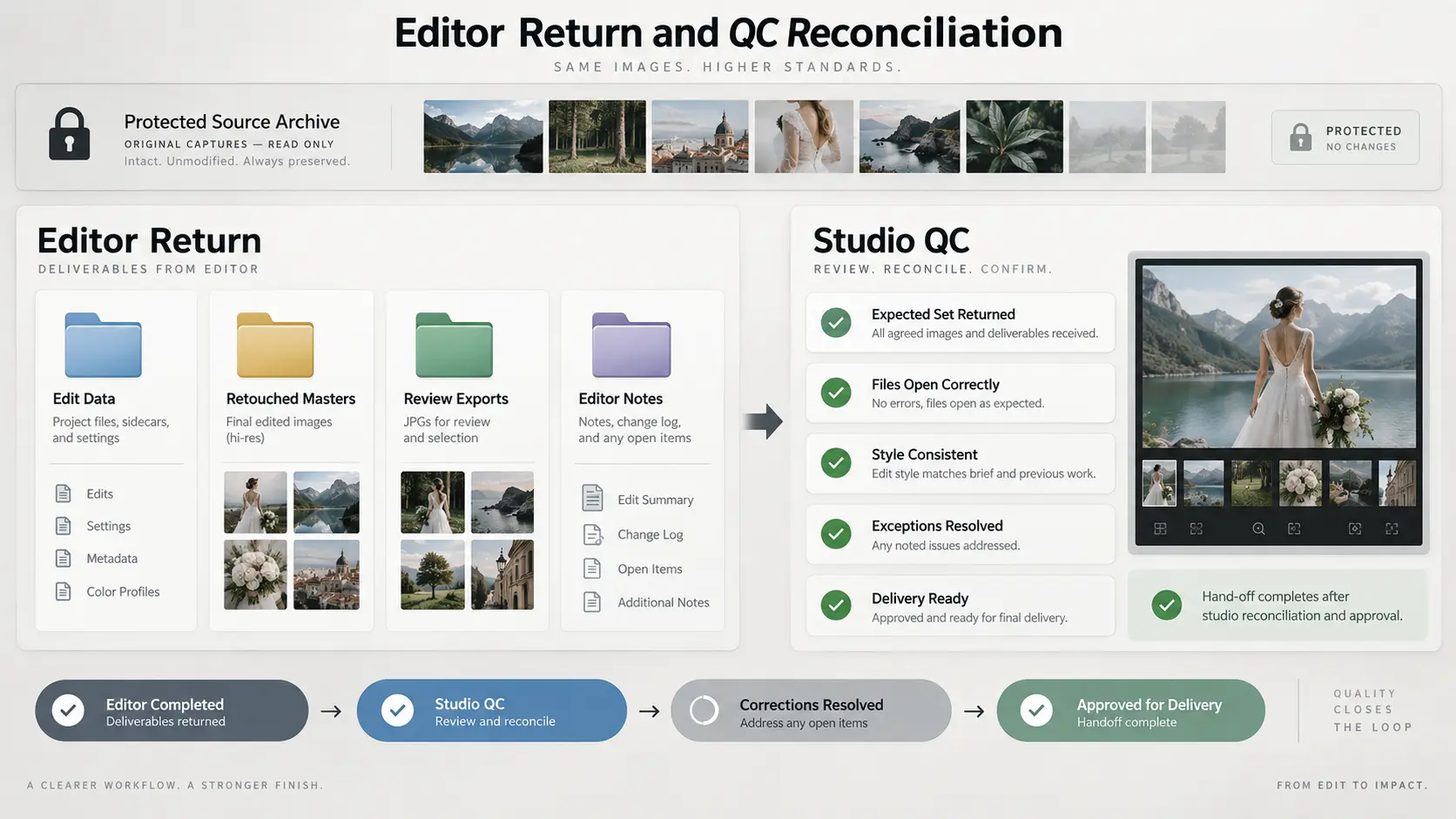
The return folder might contain:
03_EDITOR_RETURN/ ├── CATALOG_OR_EDIT_DATA/ ├── RETOUCHED_MASTERS/ ├── REVIEW_EXPORTS/ └── EDITOR_NOTES/
Keep derivative work derivative. The editor can transform the photograph without turning the only preserved source into the working version.
It is also useful for the editor to report exceptions rather than silently making assumptions. A photograph that cannot be recovered cleanly, a missing source file, an unusual mixed-light sequence or an image requiring substantial compositing should return with a note or flag that the studio can resolve deliberately.
7. Close the handoff with QC
An editor marking a job "finished" means the responsibility is coming back to the studio. It does not automatically mean the photography post-production handoff is closed.
The studio should reconcile the returned package against the assignment. Check that the expected files came back, that returned catalogs or edit data reconnect correctly, that required retouched masters are present and that nothing remains unresolved in the editor's notes.
Then review the photographs as a collection rather than judging only a few attractive hero images. Look for consistency between changing lighting conditions, natural skin treatment, exposure, white balance, crop choices, black-and-white usage, noise treatment and the studio's established visual style. Wedding photographers should pay particular attention to transitions between photographers, cameras, venues and parts of the day because inconsistency often becomes more visible when the final gallery is viewed as one story.
The final state should be explicit:
Editor completed → Studio QC → Corrections resolved → Approved for delivery
For studios handling many simultaneous bookings, this is where operational software becomes more useful than another folder hierarchy. GoPickle's Photography Booking Management keeps the client, booking, events, crew and deliverables around the same job context, so the operational responsibility surrounding post-production does not have to live entirely inside file-transfer messages. Once the work has passed studio QC, finished photographs can move into the client experience through GoPickle Client Galleries rather than treating the editor's return folder as the client-delivery system.
Photographer-to-editor file handoff checklist
Before the editor starts, confirm:
- the complete capture has been ingested;
- the studio's required backups exist;
- original/source files remain protected;
- photographer and camera identity can still be traced;
- the editor working set is clearly defined;
- culling, editing and retouching responsibilities are explicit;
- style references and job-specific instructions are attached;
- the expected return format is agreed;
- the editor has acknowledged successful receipt;
- temporary transfer copies are not confused with the protected archive;
- returned work lands separately from source originals;
- the studio performs QC before the job moves to client delivery.
A good photography file handoff to an editor should feel uneventful. The editor knows exactly what has arrived and what they own. The studio knows its original capture is protected. Returned work has a clear destination, unresolved issues remain visible, and responsibility moves back to the studio only when the package is complete.
That is the standard worth designing for. Outsourcing post-production should remove production pressure, not exchange editing hours for uncertainty about where the photographs are and who is responsible for them.