Photography Client Feedback Survey: Questions That Reveal What to Improve After Delivery
Use this photography client feedback survey to learn what clients thought about booking, communication, the shoot, turnaround and gallery delivery and what your studio should improve next.

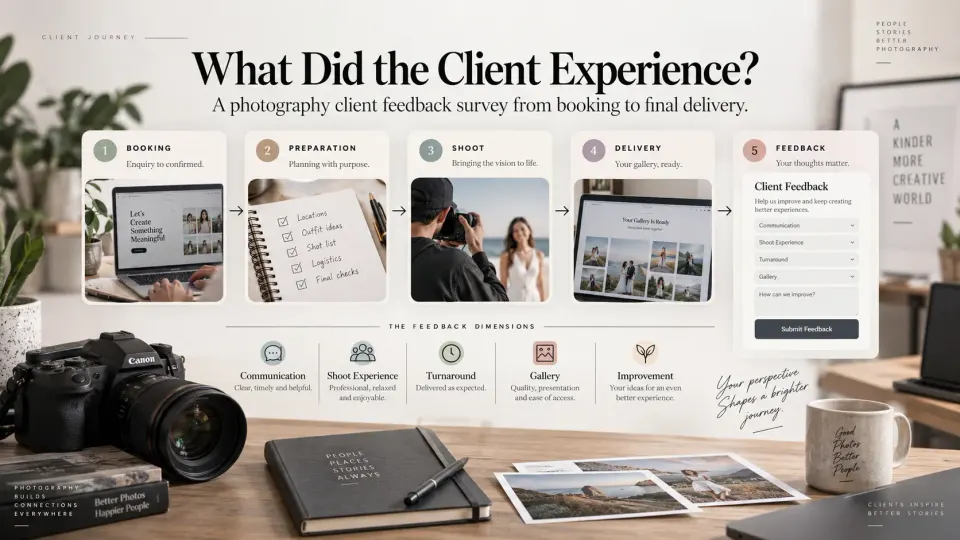
A client receives the final gallery, sends a message saying, “We love the photos,” and leaves a five-star review. That is valuable, but it does not tell you whether your enquiry response was clear, whether the consultation answered their questions, whether the team made them comfortable during the shoot, whether they understood the delivery timeline, or whether finding and downloading photographs from the gallery was harder than it needed to be.
A photography client feedback survey should uncover those details.
The purpose is different from collecting testimonials. Reviews help prospective clients decide whether to trust your studio. Feedback helps the studio decide what to change.
That distinction matters because a survey filled with questions such as “How happy were you?” and “Would you recommend us?” may confirm that a client had a positive experience without showing why. A better photographer client survey breaks the experience into stages and asks questions whose answers can alter a workflow, script, timeline, gallery setup or client communication.
At GoPickle, we would rather learn that clients regularly felt uncertain between the shoot and gallery delivery than collect another generic compliment saying the team was “amazing.” One changes the way the studio operates. The other belongs on the testimonial page.
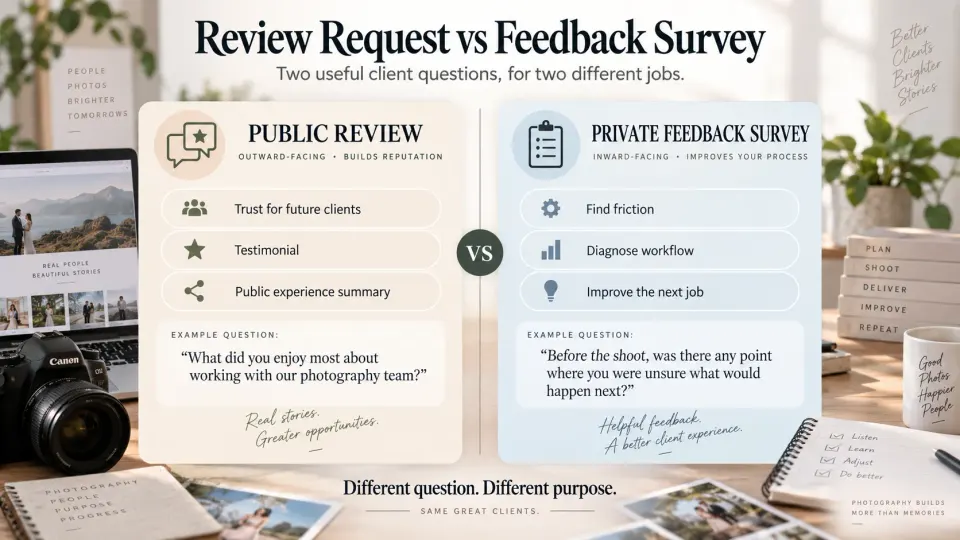
A Review Request and a Feedback Survey Are Different Jobs
A review request is public-facing. You are asking a client to describe their experience for future customers, often on Google or another platform where prospective clients may discover the studio.
A feedback survey is primarily for you.
Consider these two questions:
Review prompt:
“What did you enjoy most about working with our photography team?”
Operational feedback question:
“Before the shoot, was there any point where you were unsure what would happen next?”
The first can produce excellent testimonial material. The second can reveal a broken onboarding step.
You can ask for both, but do not make a positive public review the price of giving private feedback. Clients should be able to tell you that the photographs were excellent while the communication was confusing, or that the shoot was enjoyable but album selection was difficult.
If your current goal is generating more public reviews, our guide to asking photography clients for reviews without feeling pushy covers that process separately.
For this article, we are interested in the questions you ask when you genuinely want to find friction.
Ask About Booking and Communication Separately
Communication is too broad to measure with one question.
A client may have received quick responses but still found the quotation confusing. They may have understood the package perfectly but not known when the next payment was due. They may have loved the consultation but had no idea when they would hear from the studio again.
Avoid questions such as:
How would you rate our booking process and communication?
That combines two things. If the client gives it a mediocre rating, you still do not know which part needs attention.
Use separate photography feedback questions instead.
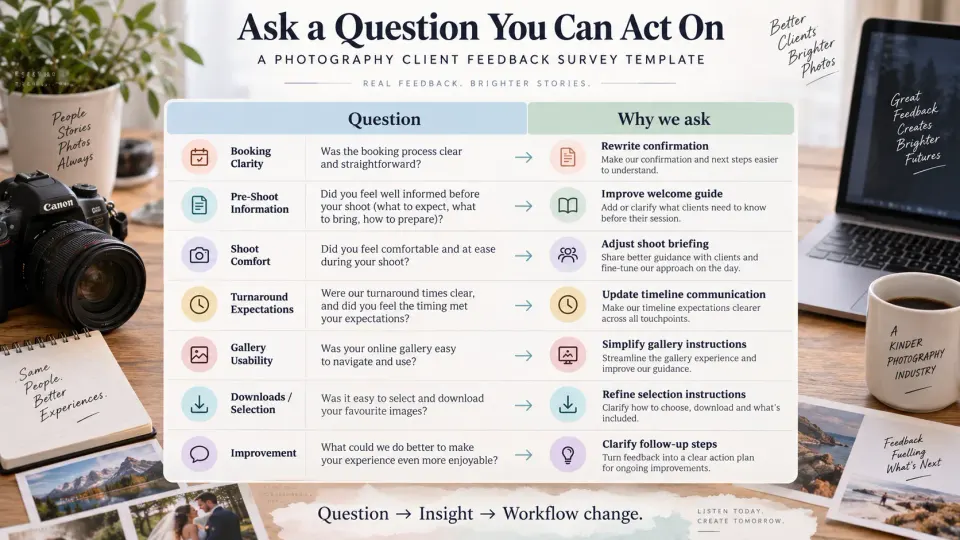
Suggested booking and communication questions
| Question | What the answer helps you diagnose |
|---|---|
| How clear was the process from your first enquiry to confirming the booking? | Lead-to-booking clarity |
| Did you know what action you needed to take to secure the booking? | Booking instructions and confirmation |
| Were the services and deliverables in your quotation easy to understand? | Quotation clarity |
| Before the shoot, did you know what would happen next and when? | Onboarding communication |
| Was there any stage where you had to ask for information you expected us to provide automatically? | Missing proactive communication |
The last question is particularly useful because clients remember unnecessary chasing.
If several responses mention payment instructions, quotation revisions or uncertainty about confirmation, that is not a “communication problem” in the abstract. It gives you a specific workflow to repair.
Ask What the Shoot Felt Like, Not Only Whether the Photos Were Good
A client can love the final photographs and still have had an uncomfortable shoot.
For weddings and events, the experience may depend on how the team handled family groups, crowded timelines, venue restrictions, guests and unexpected delays. Portrait clients may care more about posing guidance and whether they felt comfortable in front of the camera. Commercial clients may judge preparation, punctuality, communication with their team and disruption to the working environment.
Useful shoot-day questions include:
- Did you feel prepared for the shoot before it began?
- Did our photographer or crew make it clear what they needed from you?
- How comfortable did you feel being photographed?
- Was there any part of the shoot that felt rushed, confusing or unnecessarily slow?
- Did our team interact appropriately with your family, guests, employees or other vendors?
- Is there anything you wish we had handled differently during the shoot?
For a wedding photographer feedback form, it can also be useful to ask whether the photographer balanced requested portraits with candid coverage appropriately, whether group-photo organisation felt manageable, and whether the couple felt pulled away from their wedding more than expected.
Notice that these questions are about the experience, not creative validation. “Do you like our photography style?” is far less useful after the client has already selected, booked and received that style.
Delivery and Photo Selection Deserve Their Own Questions
Final delivery is one of the easiest places for photographers to mistake silence for satisfaction.
The client received the link. Nobody complained. Job complete.
But perhaps the gallery worked well on a laptop and poorly on the client's phone. Perhaps they could view photographs but could not understand which files to download. Perhaps a wedding couple understood favourites but their parents did not. Perhaps an album-selection process required screenshots, messages and repeated reminders.
A useful client experience survey for a photographer should therefore ask about the delivery itself.
Suggested delivery questions
How easy was it to open and view your gallery?
Use a simple response scale from difficult to easy, followed by an optional comment.
Were the photographs organised in a way that made sense to you?
This can reveal whether collections such as getting ready, ceremony, reception or portraits are helping or confusing clients.
Was it clear how to download, favourite or select photographs?
Do not combine these if your workflow uses several actions and you need to know exactly which one creates friction.
Did you mainly view the gallery on a phone, tablet or computer?
This gives context to usability complaints.
Was there anything you expected to be able to do in the gallery but could not find?
That question can reveal client expectations that your internal testing misses.
GoPickle Client Galleries for photographers are designed around final delivery, organised collections, favourites, access controls, downloads and mobile viewing. Whatever gallery system you use, feedback should test the actual client journey rather than only whether the gallery looked attractive.
If delivery problems keep appearing in surveys, the photography gallery delivery checklist is a useful place to audit the release process itself.
Turnaround Feedback Should Measure Expectations, Not Demand “Faster”
A question such as:
Were the photos delivered quickly enough?
sounds reasonable, but it can produce an answer that is difficult to interpret. A client who expected two weeks and received photographs in three weeks may be disappointed. Another who was clearly promised six weeks and received them in five may be perfectly satisfied.
The more useful question is whether reality matched the expectation you created.
Ask: Was the delivery timeline clear before and after the shoot?
Then: Did the final delivery arrive when you expected it to?
If the answer is no, give the client room to explain why.
You can also ask: While you were waiting for the final gallery, did you feel sufficiently informed about progress?
That separates production speed from communication. Sometimes the turnaround is reasonable and the silence is the real problem.
If those responses show a recurring gap, do not automatically shorten every deadline. First compare what the studio promises with what its editing capacity can reliably deliver. Our guide to setting a photography turnaround time your studio can actually keep explains that calculation.
Always Leave Room for the Thing You Did Not Think to Ask
Structured questions are good for comparing one client with another. They are also limited by what you already thought was worth measuring.
Every photography customer feedback form should therefore include at least one broad improvement question.
The version we prefer is:
“If you could change one thing about your experience with our studio, what would it be?”
“One thing” is deliberate. It encourages the client to identify the most important friction rather than write an unfocused summary.
A second useful prompt is:
“Was there any point in the process where you were unsure, inconvenienced or had to follow up with us?”
For highly satisfied clients, you can finish with:
“What should we make sure we never change?”
Operational feedback is not only about fixing problems. You also want to know which parts of your workflow clients genuinely value before somebody removes them in the name of efficiency.
A Practical Photography Client Feedback Survey Template
For most studios, the survey does not need dozens of questions. It needs enough separation to tell you where the experience changed.
A practical post-delivery form could use this sequence:
- How clear was the process from enquiry to confirmed booking?
- Were the services, deliverables and next steps easy to understand before you booked?
- Before the shoot, did you feel you had all the information you needed?
- How comfortable and well-guided did you feel during the shoot?
- Was there anything about the shoot-day experience we could have handled better?
- Was the expected delivery timeline clear?
- Did your photographs arrive when you expected them to?
- How easy was the final gallery to open and browse?
- Were downloads, favourites or selections clear where they applied to your project?
- Was there any stage where you had to contact us because you were unsure what was happening?
- If you could change one thing about the experience, what would it be?
- What should we make sure we continue doing?
You can adapt the wording for portraits, weddings, commercial work, school photography or events. The underlying categories remain surprisingly consistent: booking, preparation, shoot, communication, delivery and expectation management.
Tag Feedback So You Can See Patterns Instead of Anecdotes
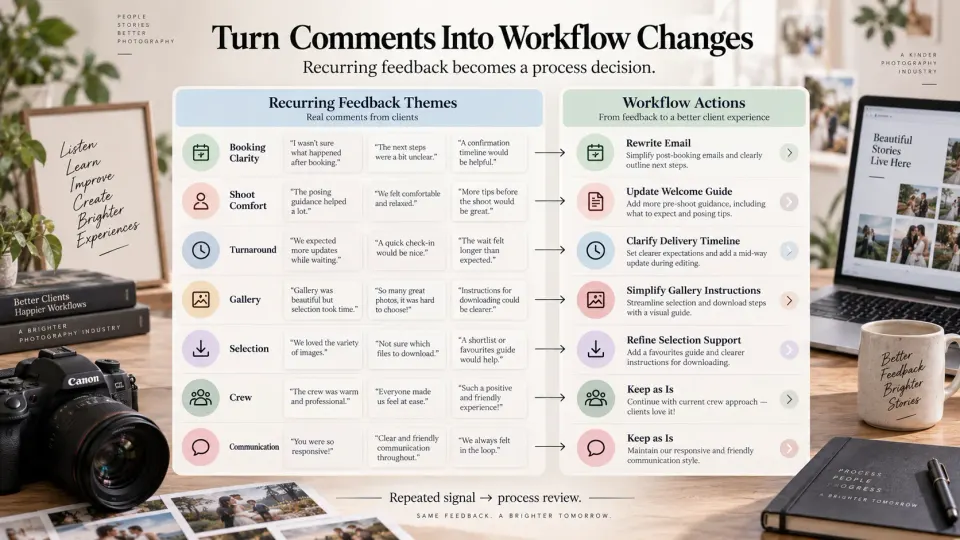
One negative comment can matter, particularly when it describes a serious service failure. But the real operational value appears when the same theme starts showing up across different clients.
Do not leave every response as a block of text in an inbox.
Tag feedback into categories such as:
Booking clarityQuotationPre-shoot communicationShoot comfortCrew behaviourTimelineTurnaroundGallery usabilityDownloadsSelectionsAlbum processPositive feedbackFollow-up required
Then review the patterns periodically.
If four different clients mention that album selection was confusing, investigate the selection workflow. If commercial clients repeatedly praise delivery speed but complain that filenames are difficult for their marketing teams, improve naming rather than editing faster. If wedding couples regularly say that communication became quiet after the shoot, add a post-shoot status update.
This is also where retention becomes connected to client experience. A useful repeat-client system for photographers should remember more than the fact that somebody booked before. Preferences, unresolved problems and relevant history all affect whether the next interaction feels personal.
The Best Survey Question Is One You Are Willing to Act On
Before adding a question to your photography client feedback survey, ask what you would do differently if the answer were poor.
If there is no possible action, the question may be there mainly because surveys are supposed to contain it.
A good survey should help you change something tangible: quotation wording, pre-shoot instructions, response ownership, posing guidance, crew briefing, delivery expectations, gallery organisation, download instructions, album selection or post-delivery follow-up.
That is more valuable than chasing a generic satisfaction score or comparing your studio with an unsupported industry benchmark.
At GoPickle, we think the client experience is the complete chain around the photographs: enquiry, quotation, booking, preparation, shoot, payment and final delivery. A platform such as GoPickle can keep those stages connected, but software does not decide whether the experience felt clear to the client.
For that, you still have to ask. And the useful question is not simply, “Did you love the photos?”, it is, “What should we do differently on the next job?”.