Photography Crew Assignment Checklist: Role, Reporting Time, Venue, Coverage and File Handoff
Use this photography crew assignment checklist to define roles, reporting time, venue, coverage, equipment, contacts and file handoff for every shoot.

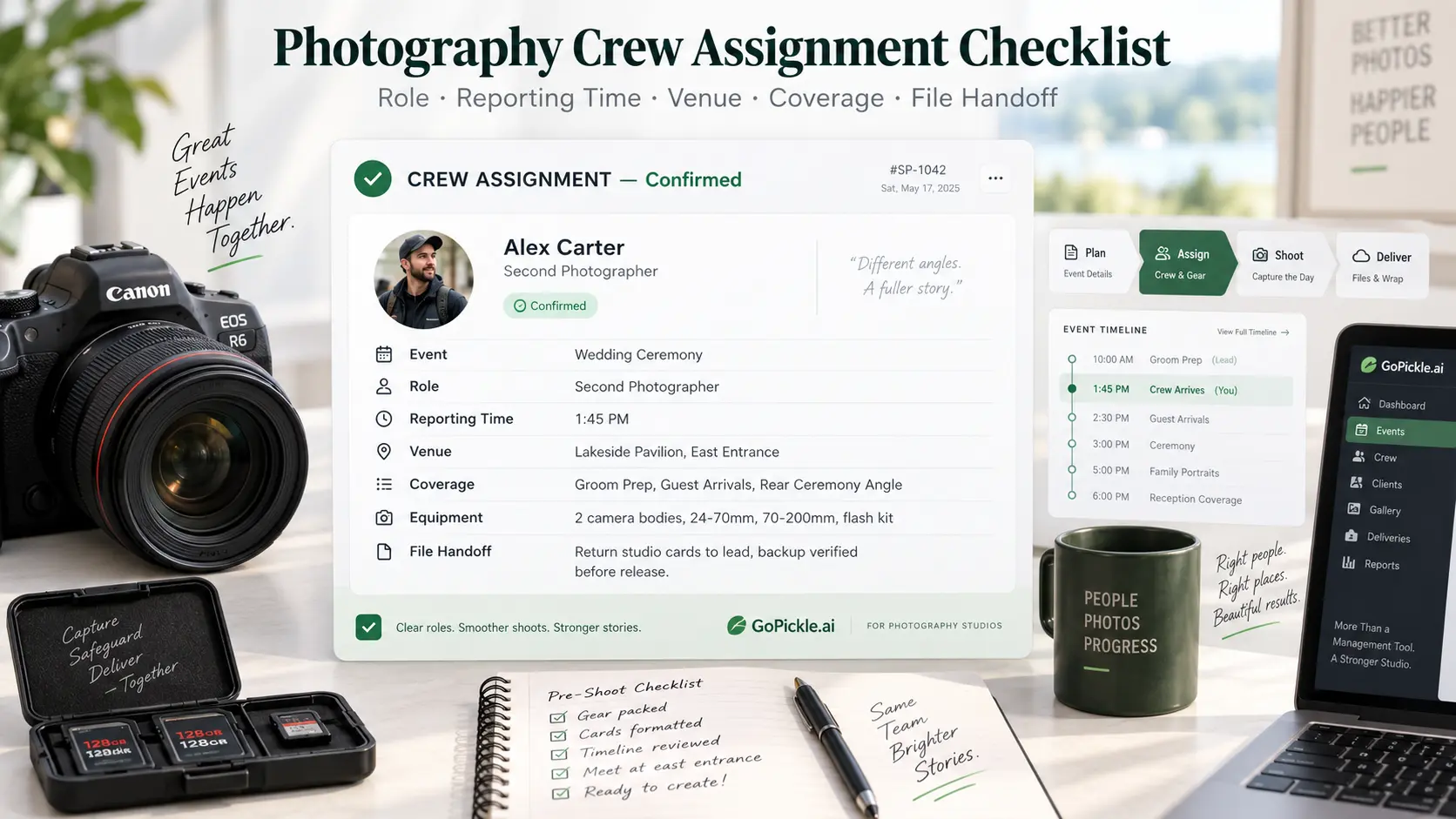
Assigning a photographer to a booking is not the same as preparing them to shoot it. A name against a calendar date tells the studio who may be working, but it does not tell that person what they own, where they need to report, which part of the event they are covering, what equipment they are responsible for or what should happen to the files when coverage ends.
That gap becomes more expensive as a photography business grows. A solo photographer can hold a surprising amount of operational detail in memory. A studio coordinating lead photographers, second shooters, cinematographers, assistants and freelancers across several events cannot safely work that way. Every photographer job assignment needs a small, reliable operational record.
This photography crew assignment checklist is designed for that record. It is intentionally not a full call sheet. A production call sheet can contain the complete schedule, vendors, talent, weather information, logistics and wider production notes. A photographer assignment sheet has a narrower job: tell one assigned person exactly where they fit into the shoot and how their responsibility begins and ends.
For studios coordinating several people, that assignment should remain connected to the booking and event rather than becoming another disconnected PDF or message. GoPickle's Crew Management workflow is built around that model, connecting availability, event assignments, roles, reporting context, tasks and handoffs to the photography work the studio is actually running.
1. Start with the booking and event identity
Every photography crew brief should begin by making the assignment unmistakable. This sounds basic until a photographer is working three weddings in the same month, two corporate jobs have similar client names, or a multi-day booking contains several venues and different crew combinations.
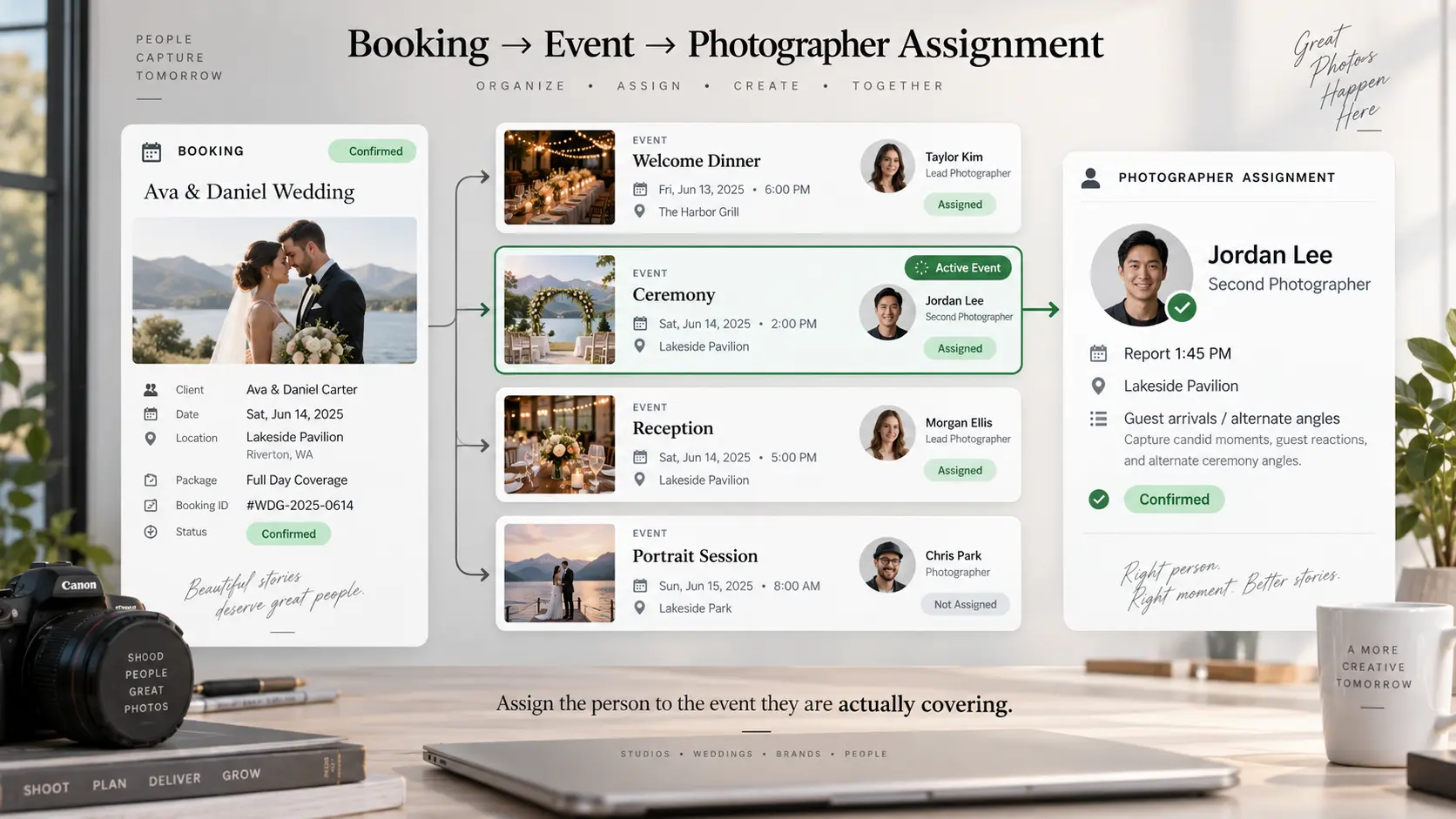
Record the client or booking name, event or function, date, scheduled event time and exact venue. For a wedding, “Ava & Daniel Wedding” is usually not specific enough if the same booking contains a welcome dinner, ceremony and reception. The assignment should say which event the photographer is actually covering.
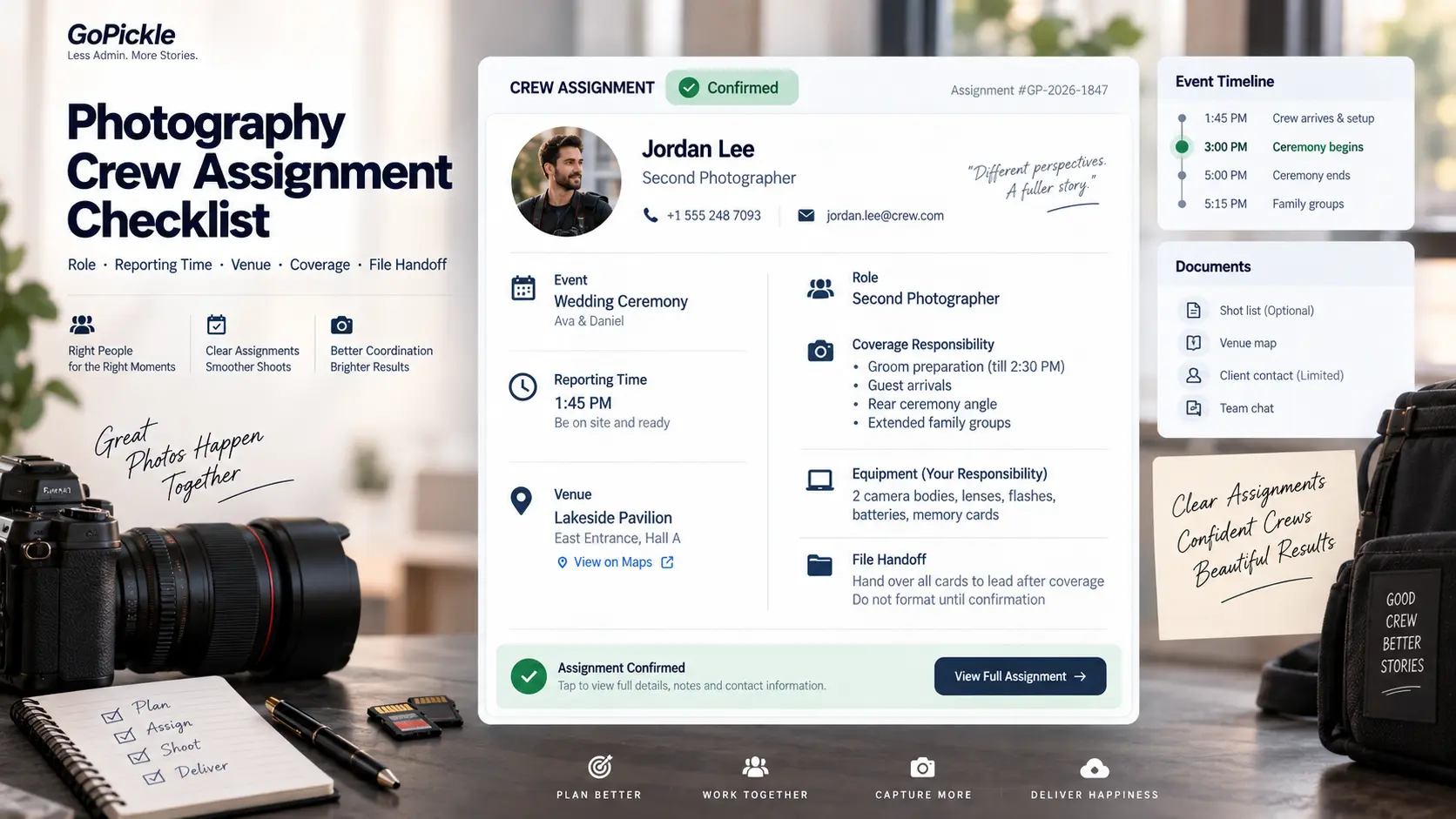
A useful identity block looks more like this:
| Assignment field | Example |
|---|---|
| Booking | Ava & Daniel |
| Event | Wedding Ceremony |
| Date | 18 October 2026 |
| Event time | 3:00 PM–5:00 PM |
| Venue | Lakeside Pavilion |
| Assigned person | Jordan Lee |
| Role | Second Photographer |
| Reporting time | 1:45 PM |
| Assignment status | Confirmed |
Notice that event time and reporting time are separate. That distinction matters throughout the assignment. The client may expect photography from 3:00 PM, while the photographer needs to arrive considerably earlier for access, equipment checks, camera synchronisation and a briefing with the lead.
For multi-event studios, assignments should also happen at event level. A cinematographer confirmed for the wedding does not automatically become the cinematographer for every function associated with that booking. GoPickle's crew workflow supports assigning people around the actual events within a booking so that different functions can carry different team configurations.
2. Define the assigned role and coverage responsibility
A role name is the beginning of the instruction, not the complete instruction.
“Second photographer” tells someone their position in the team. It does not tell them whether they are covering groom preparation, guest arrivals, alternate ceremony angles, family groups or an entirely separate venue while the lead photographer is somewhere else.
For every photography team assignment, write down the role and its principal coverage responsibility. The amount of detail depends on the job. A simple portrait assistant may only need one clear responsibility. A wedding photography crew assignment may need several defined coverage blocks because two or three photographers are working simultaneously.
A useful assignment can state:
Role: Second Photographer
Primary responsibility: Groom preparation and guest arrivals
Ceremony position: Rear aisle / alternate angles
Group coverage: Extended family while lead handles immediate family
Do not duplicate: Couple portraits unless requested by lead
Reports to: Lead Photographer
That is different from writing an entire shot list. The assignment record should establish ownership and boundaries; detailed creative direction can live elsewhere when required.
Coverage boundaries become particularly important when photographers separate geographically. If the lead photographer is with one partner and the second shooter is at another preparation location, there should be no ambiguity about when that photographer leaves, where they go next and who becomes responsible for the following part of the timeline.
The same principle applies outside weddings. A commercial photography team may separate product, environmental and executive portrait coverage. An event photography crew may divide stage coverage, audience reactions and sponsor activations. A school or sports operation may divide photographers by field, group or station.
Good photography crew management removes the sentence, “I thought someone else was covering that.”
3. Give a reporting time and an exact reporting location
“Venue: Grand Hotel” may still be insufficient.
Large hotels, convention centres, resorts, stadiums, campuses and outdoor venues can have several entrances, loading points, halls and parking areas. A photographer who reaches the property at the correct time but spends twenty minutes searching for the team is operationally late.
A photographer assignment sheet should therefore distinguish the venue from the reporting point. Include the venue name and usable address, then add the entrance, room, hall, floor, meeting point or coordinator instruction that helps the assigned person reach the team.
Reporting time should be the time the crew member is expected to be present and ready for their assignment, not simply the start time copied from the client's schedule. If setup or briefing is required, account for it explicitly.
Where useful, include parking, loading, credentials, access restrictions, travel arrangements and the name of the person the crew member should contact on arrival. Destination work may require additional transport or accommodation information, but the assignment record should only carry the details that person actually needs.
This is one reason a photographer scheduling system alone does not solve photography team management. A calendar can reserve someone's time; the operational assignment needs to explain what that reserved time means.
4. Set client and lead-contact boundaries before the shoot
Assigned photographers need enough contact context to operate independently without accidentally becoming a second sales channel for the studio.
The photographer should know who leads the assignment, who can make operational decisions and whom to contact when something changes. Depending on the job, this may be the studio owner, lead photographer, production manager, planner or designated client contact.
It is equally useful to define what the assigned crew member should not decide independently.
Suppose a client asks the second shooter to remain for another two hours, add a separate portrait session or promise an earlier delivery date. The photographer may want to be helpful, but those requests can affect scope, price, crew availability and the studio's agreement with the client. The correct response may be to acknowledge the request and escalate it to the lead or studio manager rather than making a commercial commitment on the spot.
The assignment should therefore state the escalation path for scope changes, timing changes, access issues, client complaints and other decisions outside the person's role.
Share client phone numbers and personal information only when the assignment genuinely requires them. Privacy and data-handling obligations vary by jurisdiction, so a photography studio should avoid giving every freelancer unrestricted access to every client record simply because they are part of the crew. The useful principle is role-based context: give the person enough information to perform the assignment without exposing unrelated business or client data.
GoPickle applies the same operating model in its crew-management workflow, where assigned people can be given relevant event and task context while the studio retains control over wider operational and financial information.
5. Make equipment responsibility explicit
“Bring your gear” is not a reliable equipment plan.
The assignment should identify what the photographer is expected to provide personally and what the studio, lead photographer or production team is supplying. This becomes increasingly important when photographers share lighting systems, radio triggers, audio equipment, drones, storage media or specialised production gear.
For example, a photographer job assignment might state that the photographer supplies two camera bodies, lenses, flashes, batteries and their normal card set, while the studio supplies wireless triggers and the memory cards that must be returned after the shoot.
The goal is not to build an exhaustive inventory inside every assignment. It is to remove ambiguity around equipment whose absence could prevent the person from completing their responsibility.
Also record technical requirements that affect the wider workflow. If several photographers' files will eventually be merged, their camera clocks should be synchronised before coverage begins. If the studio requires RAW capture, dual-card recording or a particular file format, make that clear before the shoot rather than discovering incompatible files afterwards.
For drone work, controlled venues, commercial productions and other regulated activities, the studio must also determine which permits, permissions, operator qualifications or insurance requirements apply in the relevant jurisdiction. An assignment card can record responsibility, but it should not be treated as proof that regulatory requirements have been met.
Studios using freelancers regularly should settle the broader equipment, working-standard and commercial expectations during onboarding instead of renegotiating them on every job. Our freelance photographer onboarding checklist covers that permanent readiness layer; the assignment sheet should then contain only what is specific to this particular shoot.
6. Define the file handoff before anyone starts shooting
The most overlooked line on a photography crew assignment often comes after the final photograph.
Who receives the files?
When?
On whose storage?
When may the photographer format their cards?
Does the photographer hand over RAW files and leave, make a verified copy first, upload later, or retain a temporary backup?
There is no single file-handoff method that suits every studio, but there should be one agreed method for each assignment.
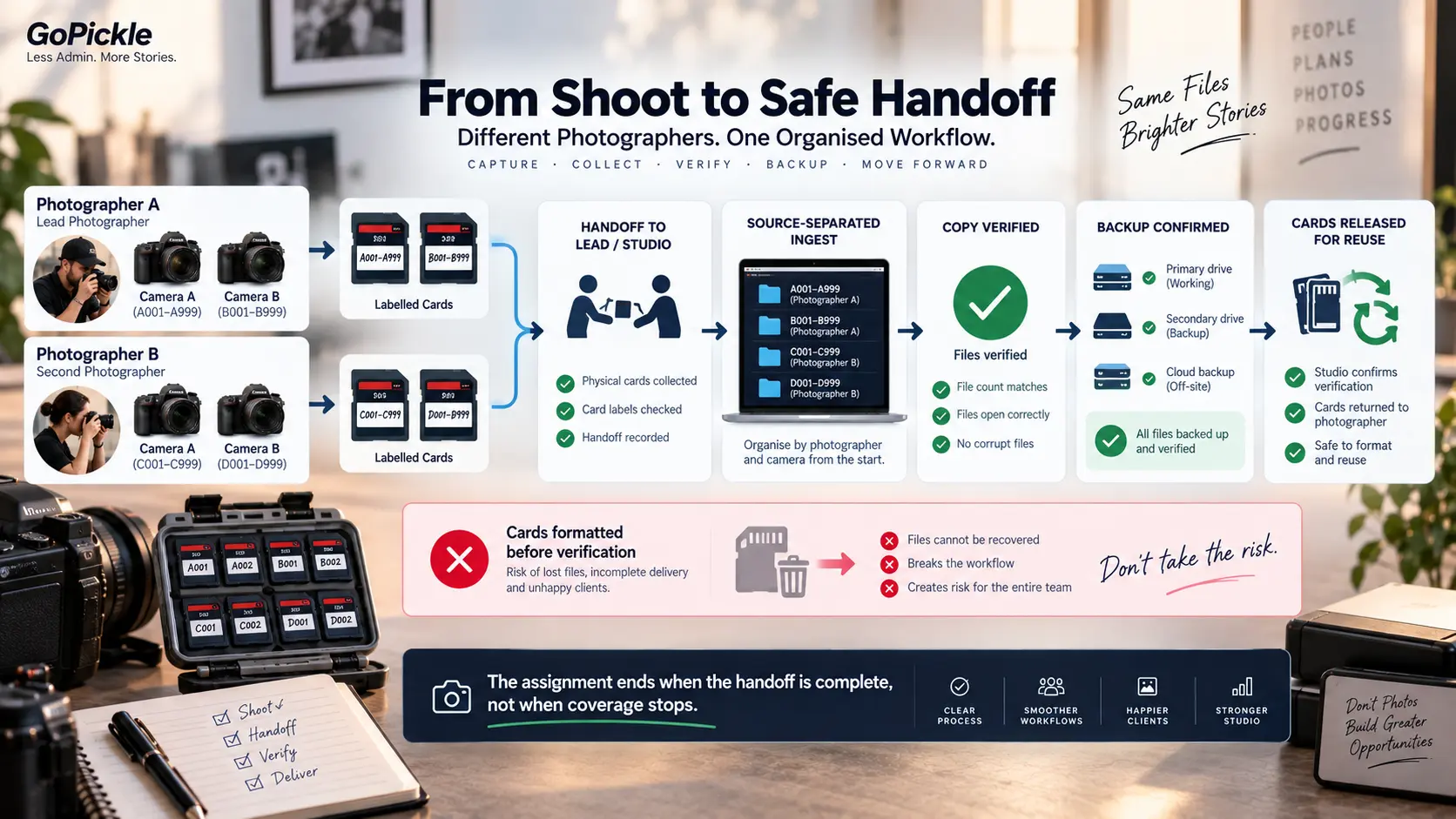
A wedding photography crew brief might specify:
Capture: RAW to both card slots
Camera identification: Photographer initials + body A/B
Handoff: Studio-provided cards returned to lead after coverage
Backup owner: Lead photographer / studio
Card release: Photographer may erase personal backup only after studio confirms verification
Another studio may collect files through SSD transfer immediately after the event. A commercial team may ingest to a production workstation on location. A distributed destination team may require encrypted upload later. The technology can vary; responsibility should not.
File ownership also needs to remain visible during ingest. If four cameras produce identical filenames such as DSC_0001, separating the source by photographer or camera before merging the material protects the audit trail and simplifies post-production. We cover that workflow in detail in the GoPickle guide to merging files from multiple photographers without breaking the wedding timeline.
File handoff is part of the assignment, not an informal favour after the photographer's “real work” is finished.
7. Record changes, acknowledgement and escalation
Assignments change. A ceremony moves earlier, the ballroom changes, a replacement photographer takes over, the client adds another event or the lead redistributes coverage after seeing the venue.
The risk is not the change itself. It is having one person working from the updated plan while another works from the original assignment.
For material changes, update the assignment record and require the photographer to acknowledge the current version. At minimum, reconfirm any changed date, reporting time, venue, role, coverage responsibility or file-handoff instruction. A message buried among unrelated group-chat conversations should not be the only evidence that a critical crew change was communicated.
The assignment should also tell the photographer what to do when execution becomes impossible. Escalation triggers might include lateness, illness, equipment failure, inaccessible venues, unexpected schedule changes, lost or damaged media, conflict with another assignment or a client request that expands the agreed scope.
Studios should plan for complete crew failure separately from ordinary assignment updates. Our backup photographer plan covers replacement readiness, approved backup photographers and the minimum information an emergency substitute needs.
The crew member's final acknowledgement can remain simple:
Assignment reviewed → Role understood → Reporting details confirmed → Equipment responsibility confirmed → Handoff understood → Assignment accepted
That small confirmation is far more useful than discovering on shoot morning that “confirmed” meant only that the photographer was free that day.
The minimum photography crew assignment checklist
Before marking any photographer assignment ready, make sure the record contains:
- booking and event name;
- event date and event timing;
- assigned photographer or crew member;
- exact role;
- coverage responsibility and boundaries;
- reporting time;
- venue and precise reporting point;
- lead or escalation contact;
- client-contact boundaries where relevant;
- equipment the photographer must provide;
- equipment supplied by the studio;
- technical capture requirements;
- file-handoff method and deadline;
- assignment changes or special instructions;
- acknowledgement or confirmation status.
This does not need to become a ten-page document. In many studios, the best photographer assignment sheet is one well-structured screen or card attached to the booking and event.
That is the approach behind GoPickle's crew management software for photographers. Availability helps you choose who can take the work, but the assignment then needs to carry the role, event, reporting context and next responsibility through the shoot and into the handoff. Tasks and crew-payment context can remain connected to the same operational workflow instead of being reconstructed later from chats and spreadsheets.
The test is straightforward: if an assigned photographer opens the job without calling the studio owner, can they tell which event they are covering, what they own, where and when they report, what they bring, who they answer to and what happens to the files afterwards?
If the assignment answers those questions, the crew can spend shoot day making photographs instead of reconstructing the plan.