Photography Discount Policy: Protect Margin Without Sounding Inflexible
Build a photography discount policy that protects profit margins. Learn when to discount, reduce package scope, reward referrals and show discounts clearly on quotes.

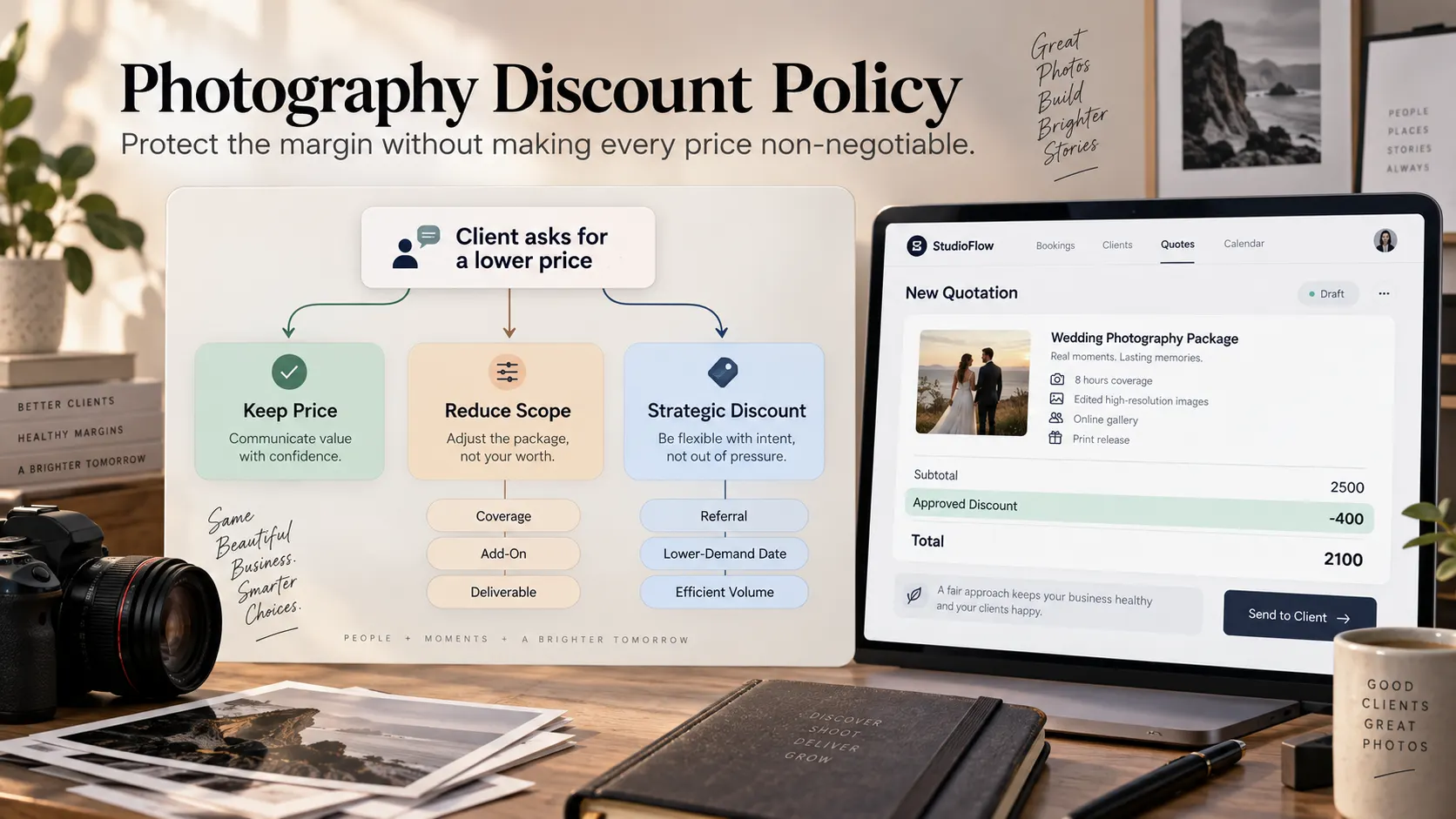
A client likes the work, the date is available and the quotation is close to what they expected. Then comes the familiar question, “Can you give us a discount?”
The difficult part is rarely answering that one client. The difficult part is deciding what your studio will do the next fifty times the question appears.
Without a photography discount policy, pricing decisions become dependent on who is handling the enquiry, how badly the studio wants the booking and how confidently the client negotiates. One client receives a reduction because they asked. Another pays the full amount for the same scope. A third is promised a “special price” before anyone has checked the actual production cost. Eventually the discount stops being an exception and becomes part of the studio's unofficial pricing.
A useful policy does not mean refusing every negotiation. It means knowing when a lower price creates a worthwhile business outcome, when the better answer is to change the scope, who has authority to approve a reduction and how the final photography quote should show what was agreed.
Why unstructured discounts become permanent pricing
The problem with casual photographer discounts is not the occasional reduction itself. It is the absence of a reason.
Suppose your standard wedding photography package is quoted at $4,000 in your local currency. One prospect asks for a better price and receives $3,700 without changing anything in the package. Their sibling enquires six months later and mentions the previous booking. A planner sends another couple after hearing that your studio is “flexible on price.” A salesperson on your team begins quoting $3,700 whenever a promising lead hesitates.
The advertised price may still be $4,000, but the working price has quietly become $3,700.
That makes future pricing harder to defend because clients learn that the first quotation is only a starting point for negotiation. It can also create inconsistency inside a growing studio when different team members make different concessions for similar enquiries.
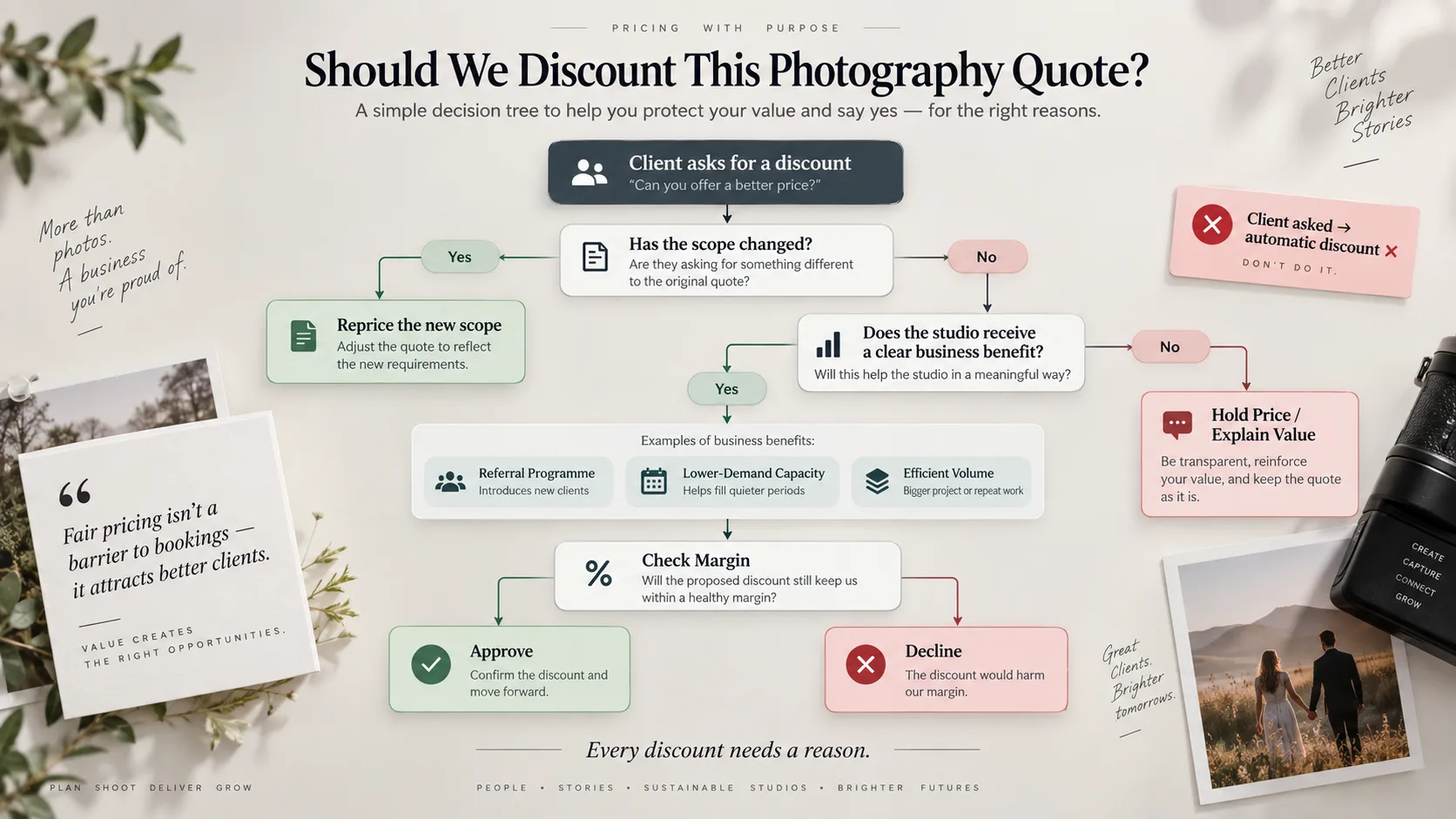
A photography discount policy should therefore answer a simple question before anyone reduces a price:
What does the studio receive in exchange for this discount?
That return might be filling otherwise unused capacity, securing a genuinely efficient volume agreement, rewarding a structured referral programme or adjusting an offer for a lower-cost version of the job. “The client asked” is not a pricing strategy.
Know the margin before discounting
Discounts come from revenue, but many of the costs required to deliver the photography remain unchanged.
Consider an illustrative package priced at $1,000. Assume the studio expects the booking to cost $800 to produce after crew, editing, album production, travel, allocated operating costs and owner labour. The expected profit is $200.
Now reduce the quote by 10% without changing the scope:
| Original quote | Discounted quote | |
|---|---|---|
| Client price | $1,000 | $900 |
| Cost to deliver | $800 | $800 |
| Remaining profit | $200 | $100 |
The client received a 10% photography pricing discount, but the amount remaining as profit was cut in half.
That is why there is no useful universal answer to “How much discount should a photographer give?” A reduction that one studio can absorb comfortably may make another booking commercially pointless.
Before approving a photography package discount, understand the expected cost and margin of the job. Our guide to calculating photography profit margin on every booking explains how to account for crew, editing, albums, travel, payment costs, overhead and your own time rather than looking only at the package price.
For an initial pricing reference, the GoPickle Photography Pricing Calculator can also help evaluate an assignment using its location, coverage, services, crew and deliverables before you prepare the final quote.
The important point is that the discount decision happens after you understand the economics, not before.
Discount the price or reduce the scope?
A client's budget being lower than your quotation does not automatically mean the existing package needs a cheaper price.
Often, the cleaner solution is to change what the client is buying.
Suppose a wedding photography quote includes two events, two photographers, cinematography, a premium album and extended evening coverage. If the client needs the total reduced, there are several possible conversations:
| Approach | What changes | Commercial effect |
|---|---|---|
| Price discount | Nothing | Studio absorbs the reduction |
| Scope reduction | Coverage, crew or deliverables | Price and workload both reduce |
| Package change | Client moves to a smaller predefined option | Keeps pricing structure intact |
| Remove optional add-on | Non-essential extra is removed | Core service stays complete |
| Value trade | Client accepts a different timing or specification | Can reduce cost or capacity pressure |
The distinction is important. If you remove a premium album, an extra hour or a genuinely optional deliverable, the quote may become cheaper because the studio is doing or buying less. That is different from delivering exactly the same photography package for less money.
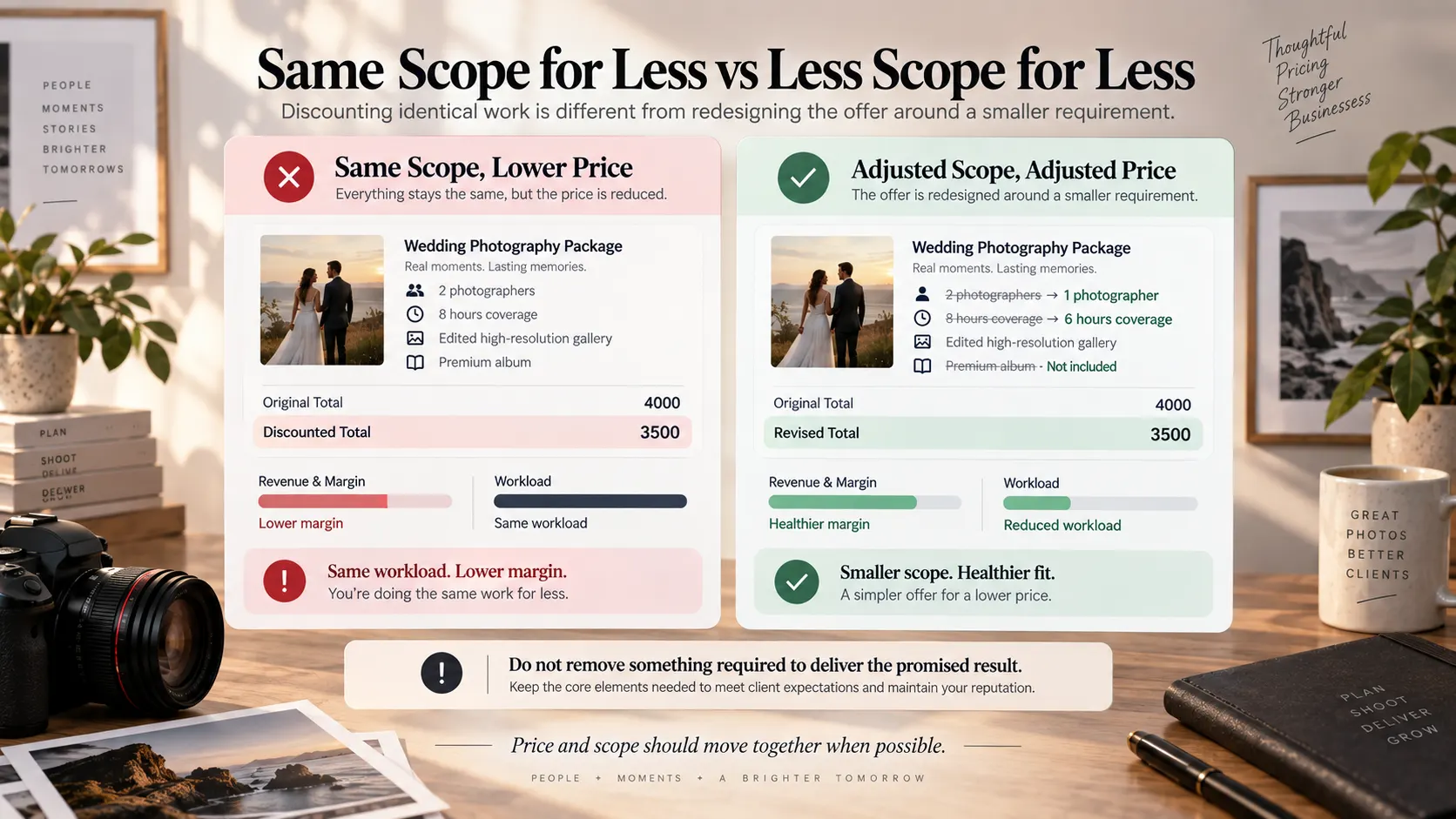
There is one important limit: do not remove something that the studio considers necessary to deliver the promised result simply to hit a budget.
If a particular event genuinely requires two photographers for simultaneous coverage, reducing the team to one may create an operational problem rather than an efficient package. If professional editing is part of the finished service, it should not suddenly become optional because the client negotiated.
A well-designed package structure makes these conversations easier. Our guide to building photography packages, add-ons and upgrade paths explains how to separate the complete base offer from genuine optional extras.
Referral, weekday and volume incentives can be strategic
Some discounts make sense because the booking creates a different economic situation for the studio.
Referral incentives
A referral programme can reward clients or partners who generate qualified business, but it should be intentional. Decide who qualifies, what triggers the benefit and whether the reward applies to the referring client, the new client or both.
This is different from telling every referred prospect, “Since you came through a friend, we'll reduce the price.”
A structured referral benefit can be measured. An informal referral discount usually cannot.
Weekday or lower-demand dates
A photography studio with strong weekend demand may value an otherwise unused weekday differently. Portrait studios may have quiet session periods; wedding photographers may have lower-demand dates; corporate photographers may have production gaps between larger assignments.
In that situation, the commercial logic is not “weekday clients deserve cheaper photography.” The logic is that the booking uses capacity that might otherwise remain unsold.
You can present this as specific weekday pricing or a clearly defined availability incentive rather than repeatedly negotiating down your normal package.
Avoid invented countdowns or fake “today only” offers. If the lower price exists because a particular date or booking condition is genuinely different, say so plainly.
Volume arrangements
Volume can justify different pricing when volume actually creates efficiency.
A company booking executive portraits across several dates, a school contracting repeat photography or a brand commissioning a series of consistent product shoots may reduce sales effort, setup time or other per-assignment costs.
But ten jobs do not automatically deserve a volume discount if each job still consumes the same crew, travel, editing and production resources. Before offering reduced volume pricing, identify what becomes cheaper or more predictable for the studio.
Set approval rules before your team starts negotiating
Discount control becomes particularly important once more than one person can prepare or negotiate quotations.
A studio policy does not need to be complicated, but it should define:
- which situations qualify for a discretionary discount;
- whether certain packages, products or high-cost items are excluded;
- the minimum acceptable margin or price floor for a booking;
- who may approve a reduction;
- when owner or manager approval is required;
- whether discounts can be combined with other incentives;
- how the reason for the discount is recorded.
The approval rule does not have to be a universal percentage. A wedding studio, portrait business and commercial production company may have very different cost structures.
A useful internal workflow could be:
Original scope → Expected cost → Standard price → Reason for concession → Revised scope or discount → Margin check → Approval → Client quotation
This creates consistency without forcing every client into the same answer.
Show the real price and the real discount on the quotation
Once a discount has been approved, the quotation should make the commercial agreement easy to understand.
Avoid quietly replacing the original package value with a lower number if the scope has not changed. The client should be able to see what the work costs, what adjustment was made and the resulting amount.
For example:
| Quotation item | Amount |
|---|---|
| Photography package | 4,000 |
| Additional album | 500 |
| Subtotal | 4,500 |
| Approved referral incentive | -250 |
| Total before applicable tax | 4,250 |
This is clearer than changing the package itself to 3,750 and leaving no record of how the final price was reached.
It is equally important not to inflate the “original” price simply to manufacture a dramatic-looking discount. The pre-discount amount should be a genuine price for the quoted scope, not an artificial anchor created for the negotiation.
GoPickle Quotations are designed to keep the requirement, package, services, deliverables, pricing and commercial terms together so the client can evaluate the complete offer rather than receiving an unexplained number. Our photography quotation guide also covers how discounts, add-ons, taxes and payment terms should remain visible in the final quote.
Measure whether discounts actually produce better business
A discount policy should eventually be judged by results rather than intuition.
For each discounted booking, retain enough information to answer:
- Why was the discount approved?
- What was the original quoted value?
- What was the final booking value?
- Did the scope change?
- What margin did the booking produce?
- Did the discount help convert a booking that otherwise would have been lost?
- Did the client generate repeat or referred business?
- Did the incentive help fill capacity that would otherwise have remained unused?
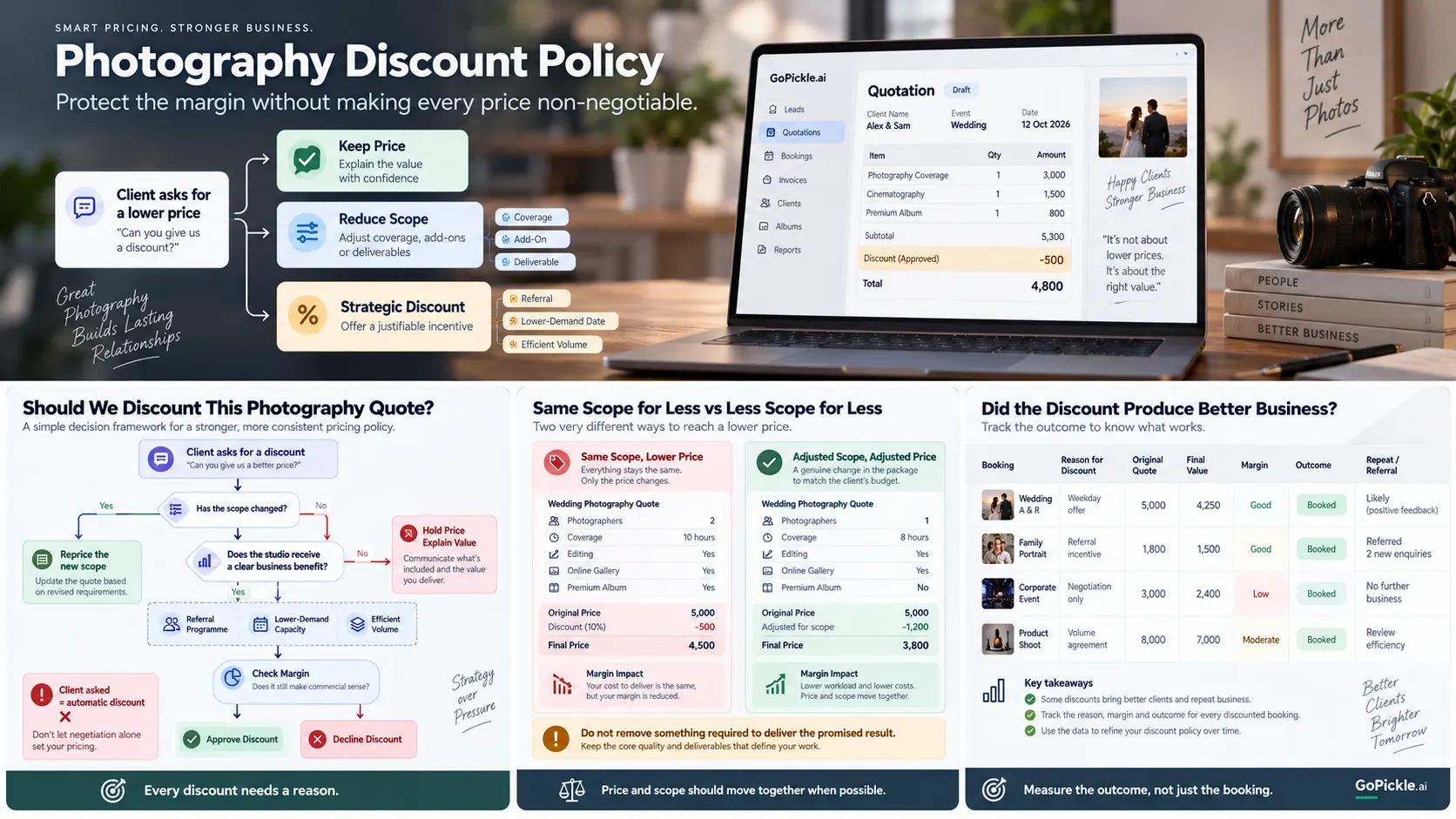
Over time, patterns become visible.
You may find that a weekday offer fills unused portrait capacity profitably. A referral incentive may produce excellent clients without weakening the standard rate. A wedding photography discount offered whenever a prospect hesitates may produce plenty of bookings but consistently weak margins. A corporate volume agreement may work well because production becomes repeatable, while another “volume client” creates additional administration and revisions that erase the expected benefit. Those are business decisions you can improve.
The goal of a photography discount policy is therefore not to become rigid about price. It is to make flexibility deliberate.
Sometimes holding the price is right. Sometimes reducing the scope is better. Sometimes an incentive helps the studio secure valuable work on commercially sensible terms. Occasionally, the right decision is simply to decline a booking that cannot work at the client's budget.
When the team knows the cost, the reason, the approval rule and the final margin, a discount stops being an anxious reaction to negotiation. It becomes one controlled tool inside a much stronger photography pricing strategy.