Photography Quote Expiry: How Long Should an Estimate Stay Valid?
How long should a photography quote stay valid? Learn how to set quotation expiry dates for standard packages, weddings, events and custom commercial photography.

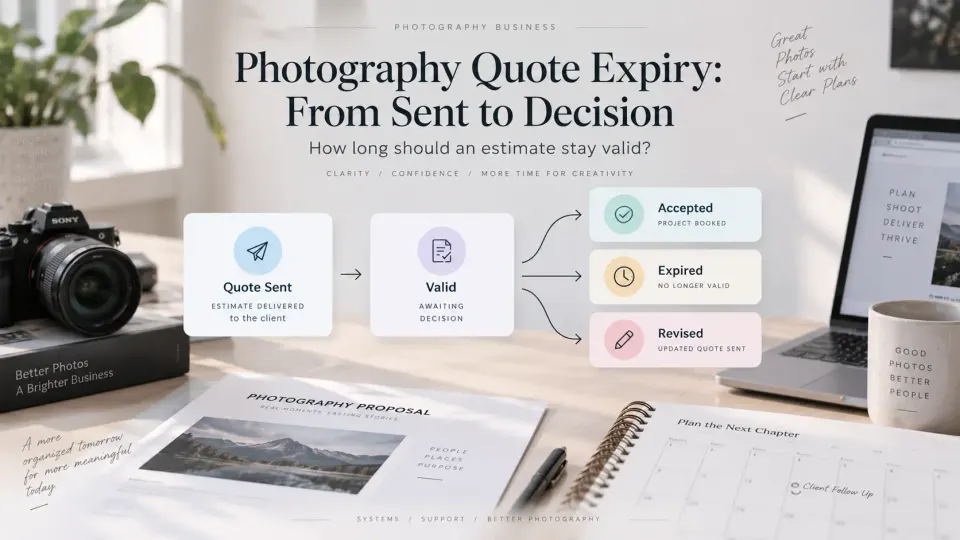
A client asks for wedding photography in November. You prepare the package, check the date, calculate the crew, include travel and send the quotation. Three months later, the client comes back with the PDF and says, “We’re ready to confirm at this price.”
Meanwhile, your album supplier has changed its rates, your preferred second photographer is no longer available, accommodation around the venue costs more, and you have already taken another serious enquiry for the same weekend.
This is exactly why a photography quote expiry date belongs in the quotation.
Quotation validity is not there simply to pressure clients into deciding quickly. It defines how long the commercial assumptions behind your offer remain current. A photographer quote that made sense when it was prepared may no longer make sense weeks or months later, particularly when the assignment depends on crew, travel, production expenses, licensing, external suppliers or a specific date in your calendar.
The useful question is therefore not, “Should every photography quote expire after seven days or 30 days?” It is how long can you reasonably stand behind this scope, price and set of assumptions without checking them again?
Why Photography Quotes Need a Validity Period
A quotation is normally prepared before the booking is confirmed. You are telling the prospective client what you can provide and what you expect it to cost based on the information available at that point.
Leaving the photography estimate validity open indefinitely creates unnecessary ambiguity. A package sent in January could reappear in June after your pricing has changed. A commercial estimate may depend on a location rental that was only provisionally priced. A destination wedding quotation may include airfare or accommodation that is considerably more expensive when the couple finally decides.
A simple statement such as:
Quotation valid until 18 September 2026. Pricing and availability may be reviewed after this date.
is much clearer than allowing the document to remain open without a defined end point.
The exact wording should fit your business and local legal requirements, but the operational principle is straightforward: the client can see the period during which you are prepared to honour the current offer, and your studio knows when an old quotation requires review.
This is also why quotation validity belongs alongside scope, deliverables, pricing and payment terms in a professional proposal. Our guide to creating a photography quotation includes validity as part of the commercial information that should be clear before a client approves.
What Can Change After a Photography Quote Is Sent?
Photography prices are rarely built from camera time alone. Even when your creative fee stays unchanged, the cost of delivering the assignment may move.
Crew availability can change. Freelancers may accept other work. Album, printing and framing costs can move. Flights, accommodation and local transport may become more expensive. Rental equipment, studios, permits, models, stylists, makeup artists and production assistants may quote their own temporary rates. A client may also return with a requirement that looks similar to the original enquiry but now contains an additional location, longer coverage, more deliverables or broader commercial image usage.
Commercial work deserves particular attention because the estimate may include costs supplied by several parties. Professional Photographers of America describes commercial bidding as a process involving production budgeting, timelines, deliverables and usage licensing rather than a simple price quote. Our own guide to what a corporate photography quotation should include covers the same issue from the studio side: crew, overtime, travel, retouching, licensing and production scope can all affect what the assignment eventually costs.
A photography proposal expiry gives you a natural point to recheck those assumptions instead of silently absorbing changes.
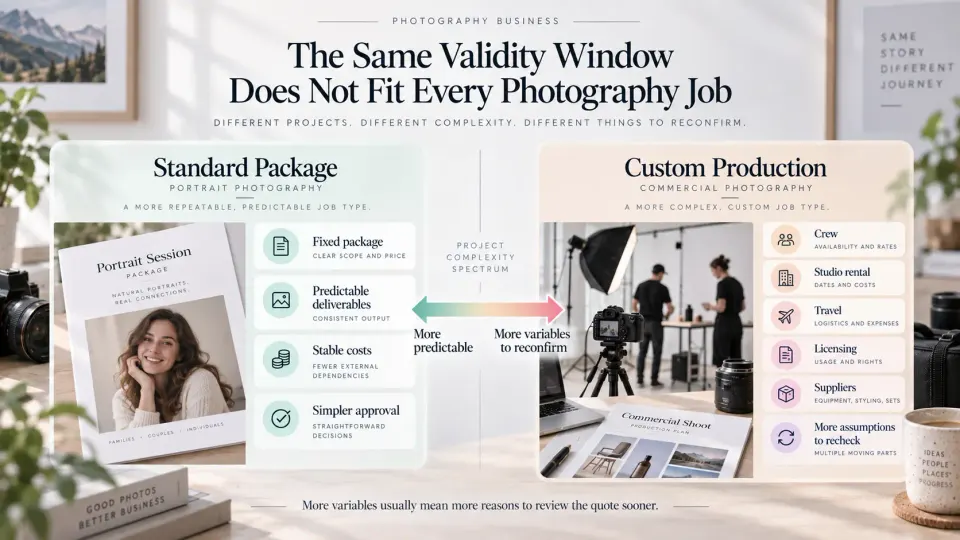
Standard Photography Packages and Custom Productions Need Different Validity Logic
There is no useful worldwide rule saying every photographer quote must remain valid for the same number of days.
For a predictable portrait session with a fixed package, stable delivery costs and plenty of calendar availability, the quotation may remain commercially accurate for longer. For a destination wedding during peak season or a commercial production involving several suppliers, the assumptions can become stale much faster.
A practical studio policy can look something like this:
| Type of quotation | Practical starting approach | Why |
|---|---|---|
| Standard portrait or family package | Around 2–4 weeks | Pricing and fulfilment are usually relatively predictable |
| Wedding or event quotation for a specific high-demand date | Around 1–2 weeks | Calendar and crew pressure can change quickly |
| Regular corporate event with known scope | Around 2–4 weeks | Gives the client time for internal approval while keeping assumptions current |
| Custom commercial production | Match validity to supplier quotes and production assumptions | Rentals, crew, travel, licensing and production costs may move independently |
| Quote issued during a planned price change | Expire before the new pricing takes effect | Prevents two price structures remaining open simultaneously |
These are working policy examples, not industry rules. Your sales cycle matters. If the organisations you serve normally require three weeks of procurement approval, making every quotation valid for five days simply creates administrative churn. Equally, leaving a destination-production estimate open for two months when supplier prices are changing does not make the client experience better.
The same distinction applies to how you price the work in the first place. Our comparison of photography packages versus custom quotations explains why repeatable services are easier to standardise while complex assignments need more individual pricing.
What Should Happen When a Photography Quote Expires?
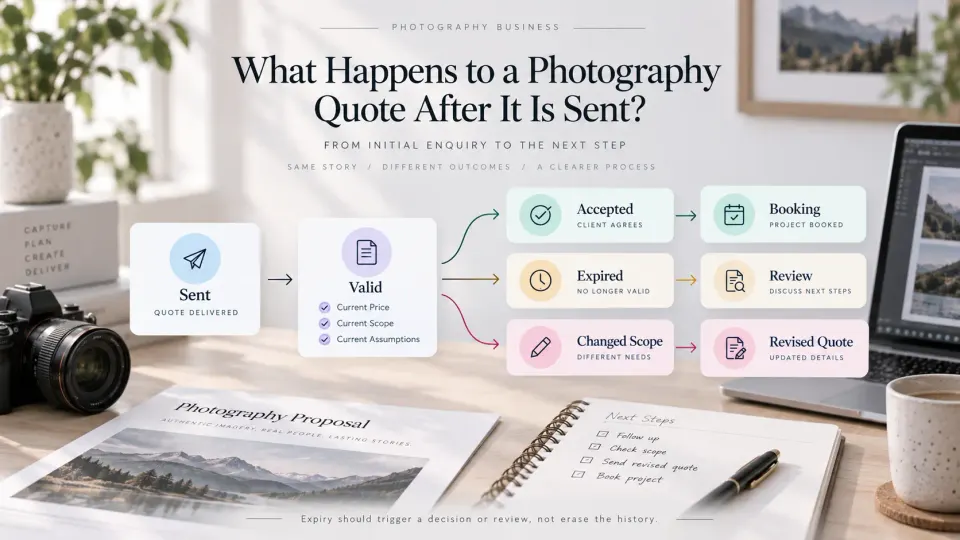
An expired quotation should normally move into a review state, not disappear.
Suppose a wedding photography quote expired yesterday and the client contacts you this morning ready to proceed. If the date is still available, the package has not changed and the original price remains commercially sensible, you may simply extend or reissue the quotation.
If something has changed, revise it.
That might mean updating the total because accommodation has increased, replacing a crew member, changing an album specification, correcting the event schedule or updating a commercial licence because the client now wants additional usage.
What you should avoid is treating quotation expiry as an excuse to surprise the client with a different price. If the revised amount changes, explain what changed.
For example:
The original estimate has expired, so we rechecked the production costs before reopening it. The photography fee remains unchanged, but the quoted studio rental has increased and the revised estimate reflects the supplier's current rate.
That is considerably easier for a client to understand than simply sending a higher total.
One important qualification: this article is discussing pre-acceptance quotation workflow. Do not assume that an expiry date automatically cancels commitments after a quotation has already been accepted, signed or incorporated into a contract. The legal effect of quotations, acceptance and agreements varies by jurisdiction and by the wording of the documents involved. Once an agreement exists, follow the agreed terms and obtain professional legal advice where necessary.
Renew or Revise the Quote Instead of Editing the Old Offer Quietly
Once the photography pricing validity period has passed, preserve what the client originally received.
If nothing has changed, extend the validity and record the new expiry date. If price, scope or terms have changed, issue a revised version and make it obvious which quotation is current.
This matters more than it may seem. A client may have downloaded the earlier PDF, forwarded it to a partner, wedding planner, marketing manager or procurement team, and then receive a newer version later. If both documents look identical except for a different total, confusion is almost guaranteed.
A clear revision might show:
Quotation Q-1042 · Revision 2 · Issued 18 September 2026 · Valid until 2 October 2026
The old version remains part of the sales history, while the latest version becomes the active offer.
This is one reason we built GoPickle Quotation Management around quotation status and revisions rather than treating every proposal as an isolated PDF. A studio can keep track of what has been sent, viewed, revised or approved and carry the agreed scope forward when the client books.
Keep Date Availability Separate From Price Validity
This is the most important distinction in the entire photography quote expiry discussion.
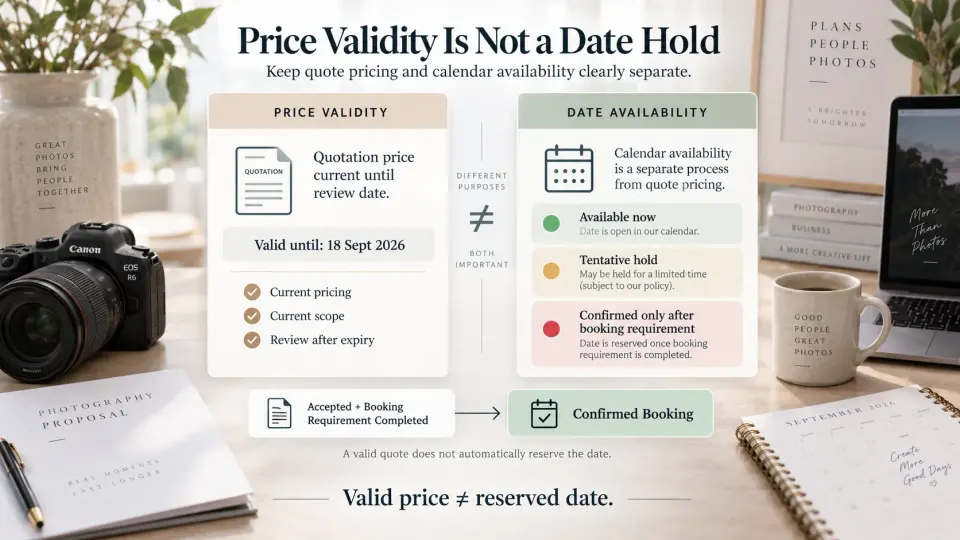
A price can be valid while the date is not being held.
If your quotation says “Valid for 14 days,” a client may reasonably assume that everything inside the offer, including the event date, is reserved for those 14 days. That may not be what you intended.
If you continue accepting enquiries for the same date until a booking advance or signed agreement arrives, say so separately.
For example:
Pricing validity: This quotation is valid until 18 September 2026.
Date availability: The event date remains subject to availability and is confirmed only after completion of the studio's booking requirements.
If you do offer tentative holds, define those separately as well. A hold may expire sooner than the quotation, or it may require confirmation when another client asks for the same date.
That distinction becomes even more important when crew is involved. Our guide to photography crew availability and tentative holds explains why provisional commitments need an expiry or review rule instead of occupying the calendar indefinitely.
A Good Expiry Policy Protects Clarity, Not Just Pricing
The best quotation validity photographer workflows are not built around artificial urgency. They are built around keeping the offer accurate.
Choose a validity window that gives a serious client enough time to make the decision your type of photography requires. Shorten it when calendar pressure, supplier quotes or production costs can move quickly. Allow more time when the service is standardised or the client's internal approval process genuinely needs it. When the deadline passes, review the quotation instead of assuming the old price or availability still applies.
Most importantly, keep three states separate: the price is valid, the date is available, and the booking is confirmed.
Those statements do not mean the same thing.
At GoPickle, we think quotation software should make that progression easier to see. The proposal defines the current offer; approval identifies what the client wants to proceed with; and the confirmed scope then moves into the photography booking workflow, where the actual events, crew, payments and deliverables can be managed.
An expiry date is only one line in a quotation. Used properly, it prevents that one line from becoming a much larger misunderstanding later.