Photography Sales Forecast: Estimate Likely Bookings From Open Leads and Quotes
Build a photography sales forecast using open leads, quotation values, expected booking dates, scenarios and studio capacity without treating pipeline as booked revenue.


A photography studio can have a promising sales month without having booked the work yet.
There may be three wedding quotations waiting for decisions, a commercial campaign in negotiation, two portrait enquiries that have supplied dates and budgets, and several early leads that still need qualification. Add all of those values together and the pipeline can look enormous. Treat none of them as meaningful and the studio is equally blind.
A useful photography sales forecast sits between those extremes. It estimates what the current lead and quotation pipeline could realistically produce, while keeping uncertain opportunities separate from confirmed bookings.
For us at GoPickle, that distinction matters because forecasting is not about making an impressive revenue number appear on a dashboard. It is a management tool. A studio should be able to look ahead and ask: What is likely to book? When might it book? Which shoot months would those wins fill? Which quotations need attention? And if the optimistic case happens, can the studio actually fulfil the work?
A sales forecast is not booked revenue
Start by separating four numbers that are often mixed together.
Open pipeline value is the potential value of leads and quotations that have not yet been won or lost. Forecast value is an estimate of how much of that open pipeline may become bookings. Booked revenue comes from work the client has actually confirmed. Collected revenue is money the studio has actually received.
Those numbers answer different questions.
Imagine a studio has five open wedding opportunities worth a combined $20,000. That does not mean the studio has booked $20,000. If two clients confirm work worth $8,000, the studio now has $8,000 of booked value from those opportunities, but it may have collected only deposits so far.
The distinction becomes especially important when planning payroll, equipment purchases or owner withdrawals. An open photography quote pipeline is not cash, and confirmed work is still different from money received. Our guide to booked revenue vs collected revenue for photography studios covers that financial separation in more detail.
A photography sales forecast therefore belongs above the sales pipeline, not inside the bank balance.
Build the open-pipeline inventory before forecasting anything
Forecast quality depends more on pipeline quality than on clever maths.
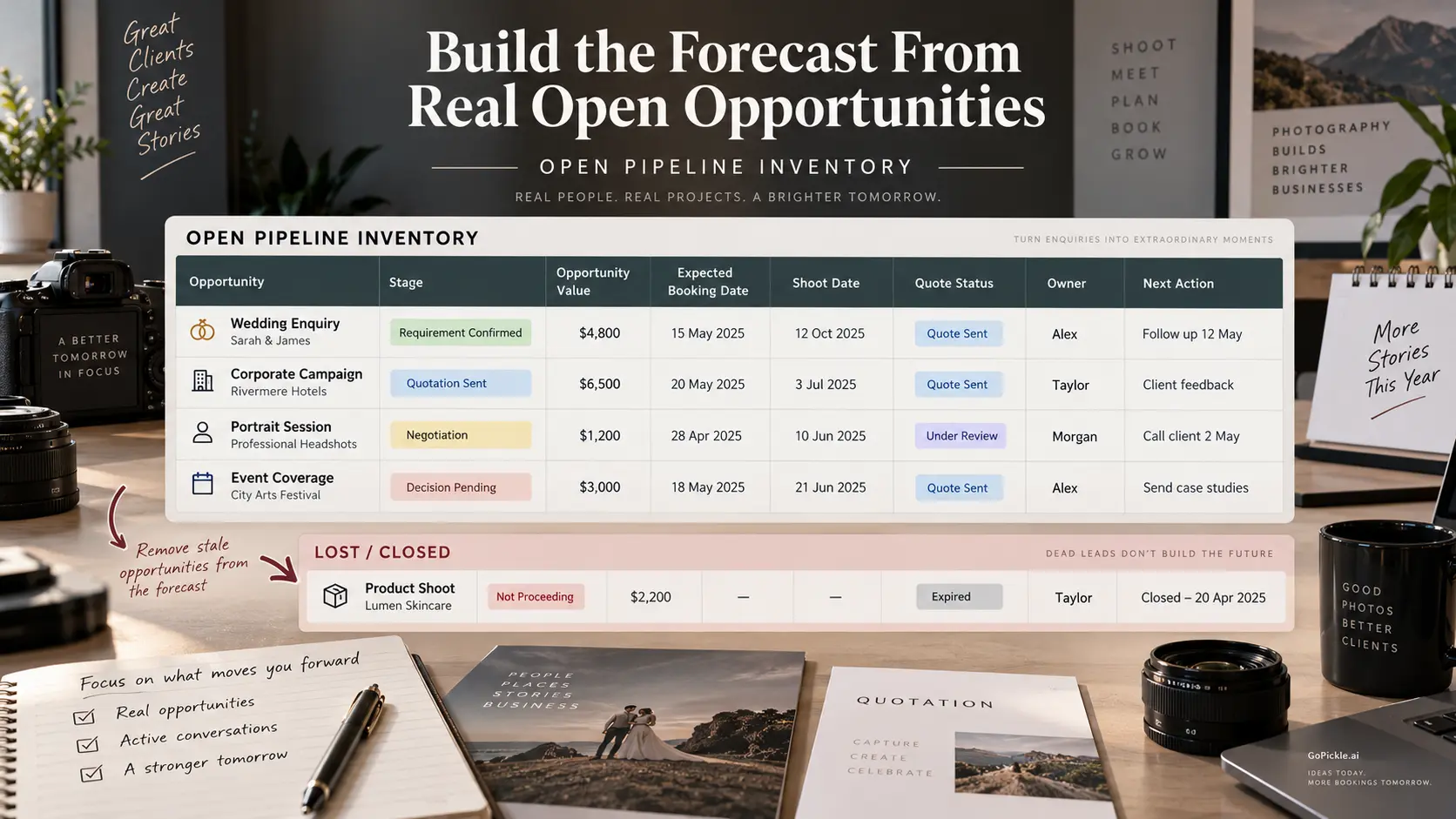
Before estimating likely bookings, list every genuinely active sales opportunity. That means more than collecting names from WhatsApp, email and Instagram. Each open opportunity needs enough commercial context to explain what may happen next.
At minimum, we would want to know:
- client or company;
- photography service required;
- current pipeline stage;
- estimated opportunity value or current quotation value;
- expected booking decision date;
- shoot or event date, when known;
- quotation status;
- lead owner;
- next action and due date;
- last meaningful activity.
A lead without a current stage is difficult to forecast. A quotation with no expected decision period is just money floating somewhere in the pipeline. A five-month-old proposal that nobody has contacted recently should not remain indefinitely beside a quotation the client reviewed yesterday.
This is where structured lead management for photographers becomes useful. GoPickle keeps the requirement, source, expected value, ownership, follow-up and movement toward quotation and booking connected around the same opportunity instead of forcing the studio to rebuild a forecast from disconnected conversations.
A practical photography sales pipeline forecast should also exclude opportunities that are no longer genuine. If the date became unavailable, the client explicitly chose another photographer or the project was cancelled, close the lead appropriately. Keeping dead opportunities open makes the pipeline larger without making the business healthier.
Separate opportunity value from forecast value
One of the easiest forecasting mistakes is treating every currency figure as the same kind of value.
Suppose a commercial photographer is discussing a project expected to be worth $6,000. The $6,000 is the opportunity value. It describes the size of the possible assignment.
It does not describe the probability of winning it.
If another $6,000 quotation has already gone through several revisions, the procurement team has requested final terms and a decision is expected this week, those two opportunities should not necessarily contribute equally to the forecast simply because their prices match.
Keep the full value intact, then calculate or categorise forecast contribution separately.
In a weighted model:
Forecast contribution = Opportunity value × confidence assumption
If a hypothetical $6,000 opportunity were assigned a 50% planning assumption, it would contribute $3,000 to the weighted forecast. That does not mean the studio will receive $3,000. In reality, the project will normally be won, lost, changed or postponed. The weighted figure is only a portfolio-level planning device.
This distinction also prevents an awkward CRM problem where the studio can no longer tell whether “expected value” means “the client may spend $6,000” or “we currently forecast $3,000 from this opportunity.” Keep both concepts visible.
Use stage scenarios instead of pretending probabilities are facts
Sales CRMs commonly use stages and probability assumptions to produce weighted forecasts. The useful part of that approach is not the percentage itself. It is forcing the studio to distinguish an early conversation from a serious decision-stage opportunity.
There is no universal conversion probability for photographers at each stage. A referral-based wedding studio, commercial photographer, school photography company and high-volume portrait business can have completely different sales behaviour. Even within the same studio, a quotation sent to a repeat corporate client may behave differently from a cold website enquiry.
Build assumptions from your own history once you have enough comparable data.
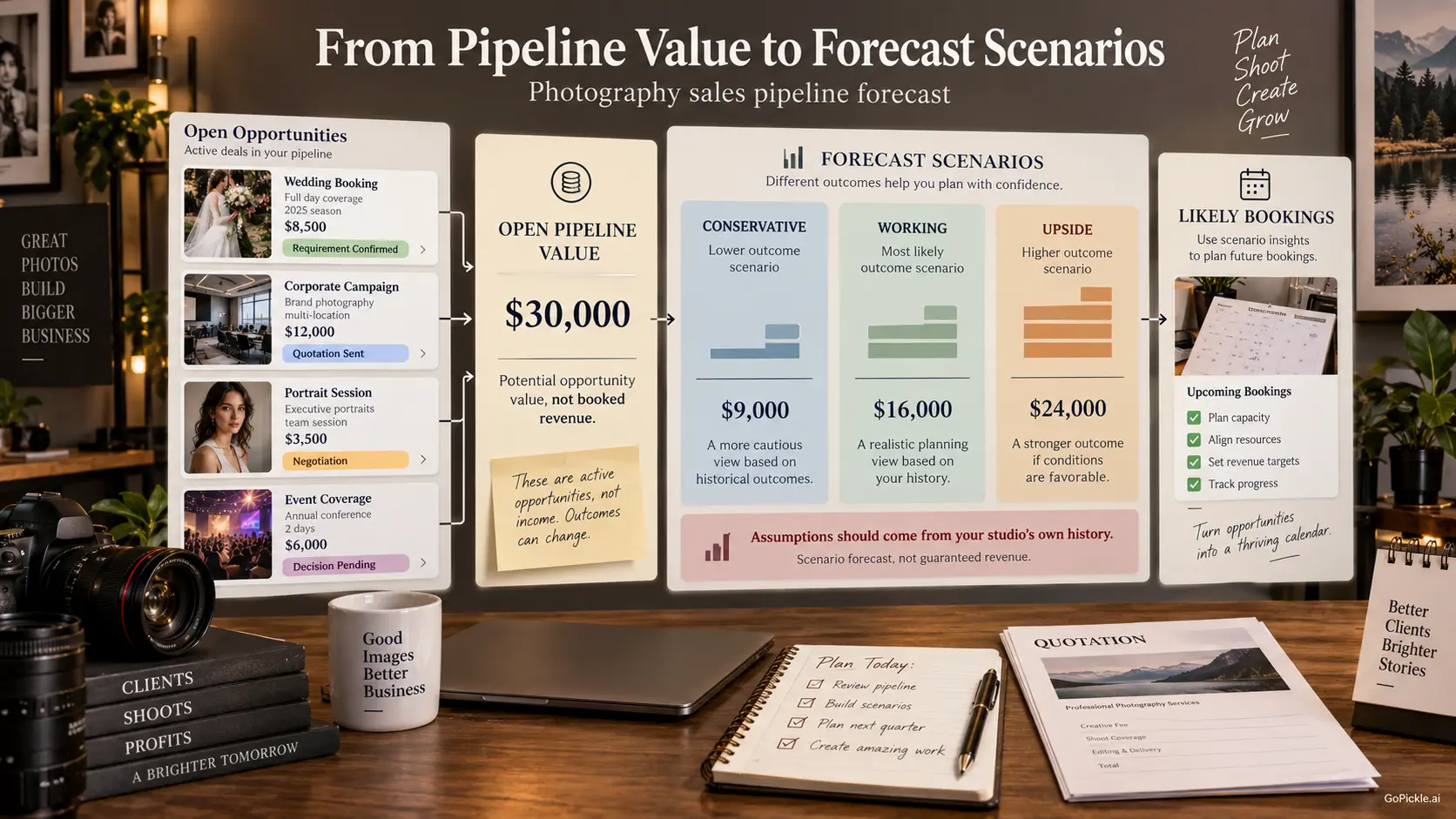
If you do not yet have reliable history, start with scenarios rather than pretending your estimates are statistically precise.
Here is an illustrative example only, not a recommended industry probability model:
| Open opportunity | Current stage | Opportunity value | Expected decision | Conservative scenario | Working scenario | Upside scenario |
|---|---|---|---|---|---|---|
| Wedding A | Quotation sent | $4,000 | October | Exclude | Partial weight | Higher weight |
| Brand campaign | Negotiation | $7,500 | October | Partial weight | Higher weight | Near-full value |
| Portrait session | Requirement confirmed | $900 | October | Exclude | Partial weight | Higher weight |
| Wedding B | Decision pending | $5,200 | November | Partial weight | Higher weight | Near-full value |
| Corporate event | Early enquiry | $3,000 | November | Exclude | Low weight | Partial weight |
The percentages behind “low”, “partial” or “higher” weight should eventually come from the studio's own results. The table works before that data exists because management can still compare conservative, working and upside cases without presenting guesses as historical truth.
Stage definitions need discipline as well. “Negotiation” should mean something observable, such as the client discussing price, scope or terms after receiving a proposal. It should not mean “I feel positive about this client.”
The same principle applies to photography conversion reporting. If your pipeline stages are inconsistent, neither your forecast nor your conversion rate will be trustworthy. Our guide to photography lead-to-booking conversion rate explains why enquiry, qualified-lead, quotation and booking conversion should be measured separately.
Forecast by booking month and shoot month
Photography businesses have a timing problem that many ordinary sales forecasts miss.
The month a client confirms the work and the month the photography actually happens may be completely different.
A couple might book in October for a wedding the following May. A brand might approve a campaign this month for production next month. A corporate client may request a quotation for an event only two weeks away.
Your photography booking forecast should therefore have two dates.
Expected booking month answers the sales question: When is this opportunity likely to become won or lost?
Expected shoot month answers the operations question: If we win it, when will it consume production capacity?
Those views tell different stories. October may have a very strong booking forecast while containing relatively few shoots. December may show modest new sales but already be overloaded with assignments sold months earlier.
A good forecast should let you move between both perspectives rather than treating every future currency value as one undated pipeline total.
Quotations deserve particular attention here because they often contain the clearest current commercial value. GoPickle's photography quotation and proposal workflow keeps proposal value and status connected to the enquiry, giving the studio a cleaner picture of what has been sent, what needs follow-up and what can move into a confirmed booking.
Compare the sales forecast with capacity before celebrating it
A strong forecast can reveal a problem as easily as an opportunity.
Suppose the upside scenario shows six additional weddings likely to land in the same month. That sounds excellent until you compare the dates with photographers, cinematographers, editors, travel requirements, existing bookings and delivery commitments.
Photography inventory is partly time.
You cannot manufacture another Saturday, and selling more work does not automatically create another editing team. This makes capacity an important second layer of photography CRM forecasting.
For each shoot month, compare:
Confirmed work + plausible forecast work → required studio capacity
Look beyond shoot count. A three-day destination wedding is not operationally equivalent to a two-hour portrait session. A large commercial production may need pre-production, assistants, equipment rental and extensive retouching. Two bookings of equal value can place very different demands on the studio.
Our guide to planning photography studio workload during peak season covers this capacity side in more detail.
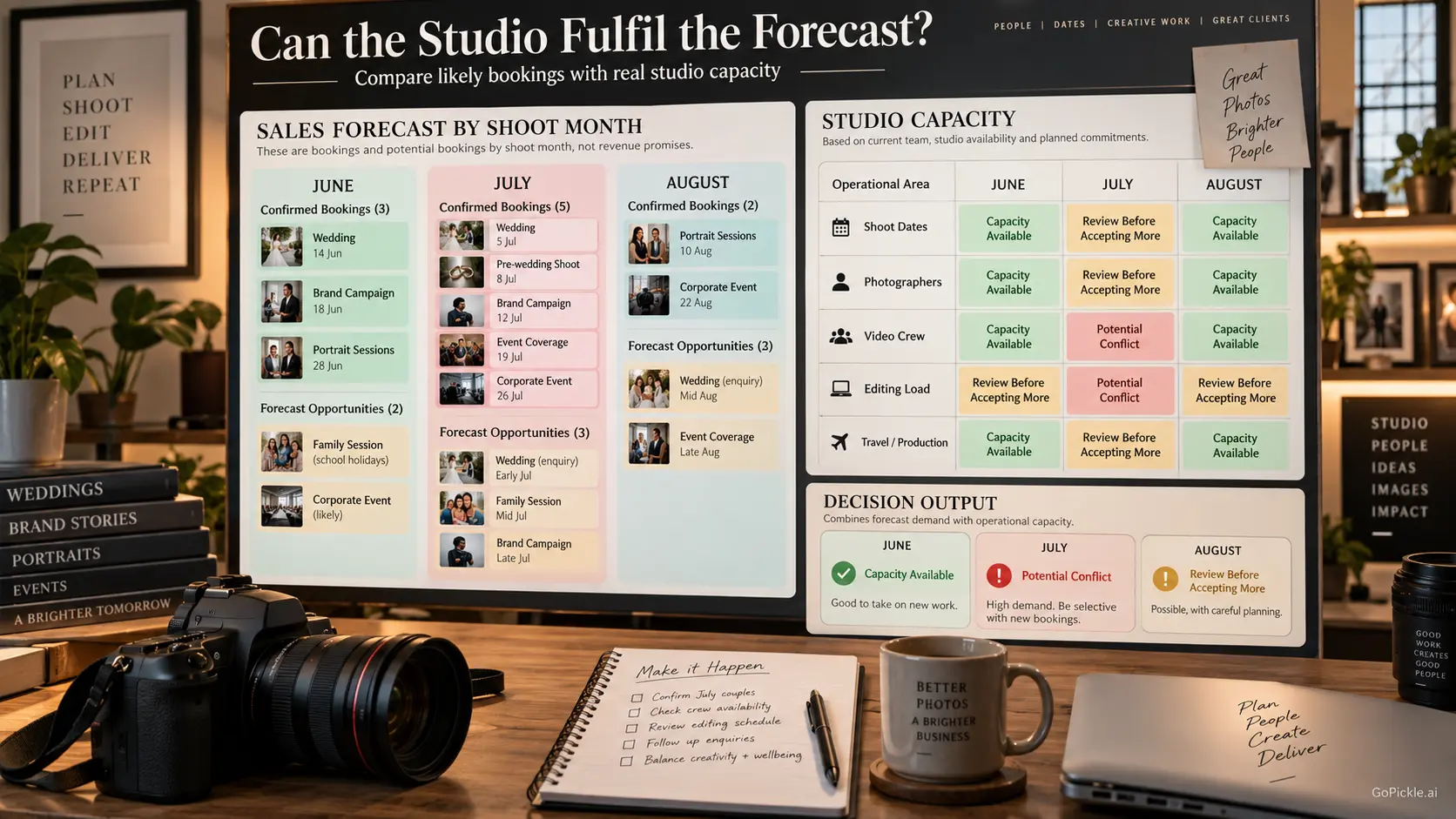
This comparison can change sales behaviour. If a peak month is nearly full even under the conservative forecast, the studio may tighten date holds, protect specialist crew or stop aggressively pursuing poor-fit work for those dates. If a future month remains weak across every scenario, the problem becomes visible early enough to focus marketing and follow-up there.
That is more useful than discovering a capacity shortage after every promising quotation becomes a booking.
Review forecast accuracy instead of defending the forecast
A forecast becomes better when the studio is willing to show where it was wrong.
At the end of each month, save what you forecast and compare it with what actually happened. Which opportunities were won? Which were lost? Which simply moved into another month? Were quote values reduced before confirmation? Were supposedly strong opportunities repeatedly pushed forward?
Then look for patterns.
If decision-pending leads consistently convert at a much lower rate than your model assumes, lower the weight. If repeat-client quotations close reliably, their scenario may deserve different treatment from new enquiries. If your team keeps changing expected booking dates at the end of every month, the problem may be optimistic date selection rather than probability.
A useful review can track forecast versus actual booked value, opportunities pushed into later periods, stale quotations, win rates by stage and average time spent in each stage. Over time, your photography revenue forecast from leads starts relying less on intuition and more on your own operating history.
Review the forecast regularly enough that it remains a decision tool. Photography pipelines can move quickly: dates become unavailable, couples change plans, procurement teams delay projects and quotations get revised. A forecast assembled once at the beginning of a quarter and never updated is soon just an old opinion.
At GoPickle, we think the useful progression is straightforward:
Enquiries → Qualified opportunities → Quotations → Forecast → Confirmed bookings → Invoices and collections
Each layer answers a different question.
The lead pipeline tells you what your studio is currently pursuing. The photography sales forecast estimates what that pipeline may produce. Booking management records what clients have actually committed to. Financial reporting then tells you what has been invoiced, collected and remains outstanding.
When those layers stay separate but connected, the forecast stops being a hopeful number at the top of a spreadsheet. It becomes an early-warning system for the next few months of the photography business.