Commercial Photography Case Study Page: Turn Past Assignments Into Search and Sales Assets
Learn how to build a commercial photography case study around the client brief, production constraints, image evidence, deliverables, SEO context and enquiry CTA.


A commercial photographer can have an excellent portfolio and still leave a prospective client with surprisingly little information.
The photographs may prove that you can produce polished work, but a marketing manager, creative director, agency producer or business owner is often evaluating something broader. They want to know whether you understand briefs, whether you can operate inside real production constraints, what kinds of assignments you have handled, how you make decisions when conditions change, and whether your studio could manage a project similar to theirs.
A commercial photography case study gives a past assignment a second job. The original photographs were created for a client; the case study turns appropriate parts of that work into a search and sales asset for your own studio.
Done properly, it is not a long caption wrapped around an image gallery. A useful photography project case study explains what the client needed, what made the assignment demanding, how the photographer approached it, what was delivered and what a prospective buyer can learn from the example. It also gives search engines substantially more context about the industries, photography services, locations and project types your studio actually works with.
The important constraint is that the story must remain true. Do not invent campaign performance, client outcomes, production complexity or glowing testimonials simply because a case study feels stronger with them. Commercial buyers are looking for evidence, and fabricated evidence defeats the point.
A commercial photography case study is different from a portfolio gallery
A portfolio answers one important question:
Do I like this photographer's work?
A case study helps answer another:
Could this photographer handle my assignment?
That distinction becomes particularly important in B2B photography. A commercial photographer portfolio case study can demonstrate planning, production judgement and business understanding in ways that an image grid cannot.
| Portfolio gallery | Commercial photography case study |
|---|---|
| Shows selected finished work | Explains a specific assignment |
| Primarily demonstrates visual style | Demonstrates visual and operational capability |
| May combine work from many clients | Usually centres on one project or coherent campaign |
| Requires little written context | Includes brief, constraints, decisions and deliverables |
| Helps a buyer assess taste | Helps a buyer assess project fit |
| Often targets broad portfolio browsing | Can support specific service, industry and location searches |
You still need a portfolio. The two formats serve different purposes.
A creative director who already knows your name may happily browse twenty photographs and call. Someone discovering you through search for the first time may need more context before putting you on a shortlist. That is where a strong photography case study website structure becomes valuable.
Our guide to building a photography portfolio that converts visitors into enquiries covers the broader portfolio experience. A case-study page should go deeper into selected assignments rather than repeating the same gallery structure.
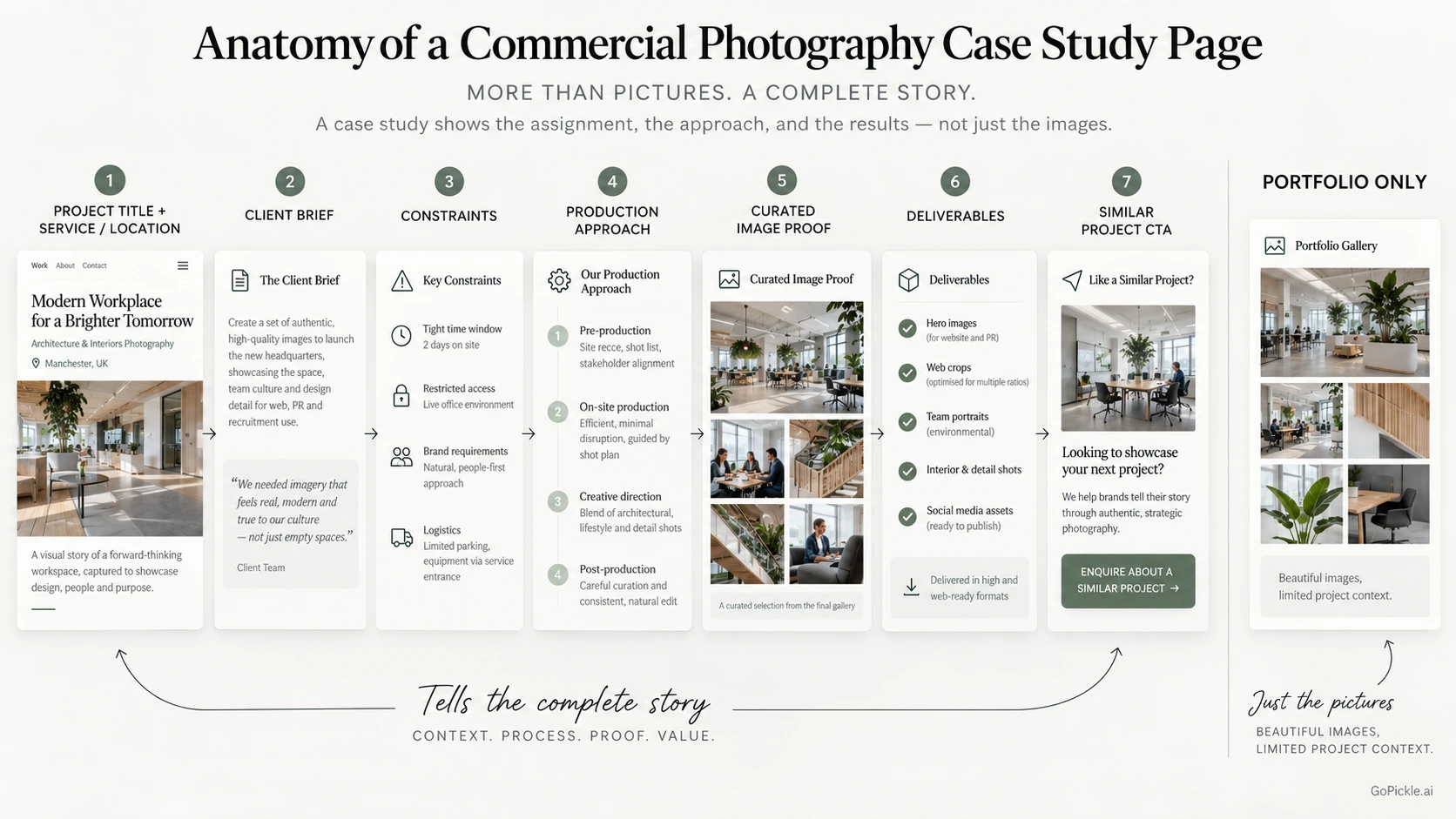
Lead with the client problem and the brief, not your camera settings
Start by explaining why the assignment existed.
That sounds obvious, but commercial photography portfolios frequently begin with behind-the-scenes details before the reader understands what the photographs were supposed to achieve.
A useful opening might establish:
- the type of client or industry;
- the photography requirement;
- where the images were intended to be used, if publishable;
- the broad deliverables;
- the location or production environment;
- the central creative or operational requirement.
For example, imagine a manufacturer commissioning photography for a new product range. The useful story is not that you used a particular camera body and three lights. The story may be that the company needed one visual system capable of supporting product pages, distributor material and a campaign launch while maintaining consistent colour and scale across dozens of products.
For a corporate assignment, the brief might involve executive portraits, office-environment photographs and same-day conference images for a communications team. A hospitality project may need architecture, food, staff and guest-experience imagery created within narrow windows when spaces are available.
This context immediately helps another prospective client recognise a familiar requirement.
You do not need to reproduce the client's confidential creative brief. Summarise only what you are entitled to publish, and describe the assignment in language that a buyer outside the photography industry can understand.
Show the production constraints and the decisions you made
The finished photograph hides most of the work.
That is often a strength of professional photography, but it can make commercial portfolios look deceptively simple. A prospective client sees a clean product image or polished executive portrait without seeing the location restriction, time window, changing weather, production schedule, safety requirement, talent availability or brand constraint behind it.
A commercial photography case study is a good place to expose some of that thinking.
Suppose a hotel could only release rooms for photography between guest checkout and the next arrival. The meaningful case-study detail is that the shoot plan had to prioritise spaces based on temporary access windows.
Suppose an industrial assignment involved active machinery and restricted production areas. Explain that locations and shooting positions had to be coordinated around operational or safety constraints, if you have permission to discuss them.
Suppose a brand photography case study involved photographing employees who were available for only a few minutes each. Explain how the lighting and set were designed for repeatability rather than presenting every portrait as though it appeared effortlessly.
This is the material that distinguishes professional judgement from a collection of attractive images.
It can also support the commercial conversation before a quote is requested. Buyers begin to understand why commercial photography pricing may involve preparation, crew, production, post-production and image rights rather than only the number of hours spent pressing the shutter. Our guide to commercial photography creative fees, day rates and licensing explains those cost layers in more detail.
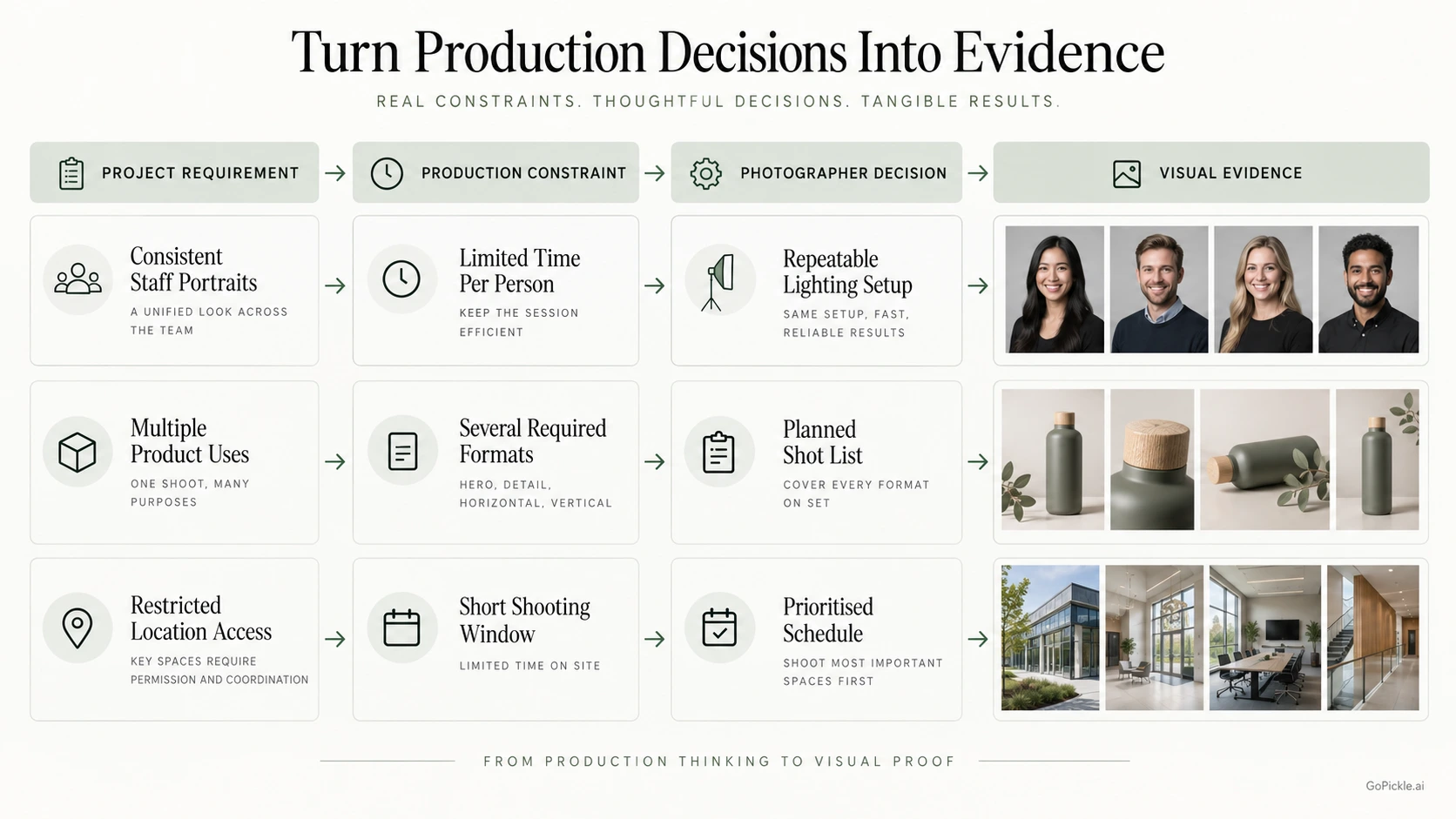
Curate photographs as evidence, not decoration
A case study does not need every image delivered to the client.
Choose photographs that support the story you are telling.
If you explain that a campaign required both environmental lifestyle photographs and controlled product detail, show examples of both. If consistent employee portraits were an important part of the brief, a small sequence can demonstrate that consistency more convincingly than one hero image. If the production challenge involved several spaces, showing how the visual language carries across them makes the claim tangible.
Think of each image as evidence attached to a sentence.
The page may open with the strongest finished photograph, but the images that follow should help answer questions such as:
- What kinds of subjects did you photograph?
- How broad was the assignment?
- Did the work remain visually consistent?
- Can you handle both hero imagery and practical supporting assets?
- Does the work resemble the requirement the prospective client has now?
Image captions can add useful context where necessary. Alt text should describe what is genuinely visible rather than becoming a place to repeat “commercial photographer” several times.
The objective is a curated commercial story, not an archive dump.
Explain deliverables without exposing confidential project information
Commercial clients often care about what came out of an assignment as much as how it was photographed.
Where you have permission, a case study can describe the deliverable structure in broad factual terms: campaign hero photographs, product images, executive portraits, web-ready files, social-media crops, press imagery, priority selects, retouched finals or another relevant output.
Be more careful when discussing usage.
Commercial image licensing can involve media, territory, duration, exclusivity and third-party permissions. Publishing “the client received unlimited worldwide usage” because it sounds impressive could disclose a commercial term that was never intended to be public, or it may simply be inaccurate.
If licensing is relevant to the case-study story, keep the public version proportionate. You might say that the assignment created imagery for digital advertising and owned brand channels without publishing the client's exact licence fee, contractual wording or campaign term.
Our detailed guide to usage rights, licensing and buyouts in commercial photography quotes explains the distinction between the photographs delivered and the rights granted to use them.
The same caution applies to budgets, internal deadlines, unreleased products, locations, customer data, production problems and testimonials. Check your agreement, NDA obligations, approvals and applicable legal requirements before publishing. A client hiring you to make photographs does not automatically mean every detail of the assignment belongs on your website.
Anonymous case studies can still work. “Global healthcare company”, “independent hotel group” or “consumer electronics manufacturer” may provide enough useful context when the client name cannot be disclosed, provided those descriptions are accurate and permitted.
Add service, industry and location context naturally
A useful commercial photography case study can also support commercial photography SEO because a genuine project naturally contains specific information that a generic portfolio page often lacks.
The key word is naturally.
Do not turn a case study into:
Commercial photographer London commercial photography London brand photographer London corporate photographer London.
That gives neither a buyer nor a search engine a better understanding of the assignment.
Instead, state the real context.
A page title might be:
Brand Photography for a Sustainable Skincare Company in Copenhagen
or:
Corporate Photography Case Study: Executive Portraits and Office Imagery in Singapore
The introduction can explain what was photographed and why. The production section can mention the location where it affected planning. Image captions can identify meaningful subjects. The page can link to your relevant commercial service page and to related assignments.
Google's published search guidance consistently favours descriptive page titles, useful page content, relevant link text and descriptive image information over keyword repetition. A detailed project provides an opportunity to create that context from genuine experience instead of manufacturing thin location pages.
This also means you should resist publishing twenty nearly identical case studies purely to target twenty search terms. Choose assignments that genuinely broaden the evidence on your website: another industry, production scale, service, environment, creative problem or geography.
A good case-study library starts to answer, collectively, “What kinds of commercial work has this studio actually handled?”
Finish with a CTA for a similar project
Do not make the reader return to the main navigation after they have just found a project that resembles their own.
The end of the case study should provide a direct next step.
A simple CTA can connect the demonstrated capability to the prospective client's requirement:
Planning a similar brand photography project? Tell us what you need, where the shoot will take place and how the images will be used.
That is more useful than a generic “Contact us”.
The enquiry does not need to collect the complete production brief. At this stage, enough information to understand the organisation, project type, approximate timing, location and requirement is usually more useful than forcing a marketing manager through a twenty-field questionnaire.
Once the enquiry arrives, keep the case-study source attached to the lead if your workflow allows it. Knowing that a prospect contacted you after reading an industrial photography case study, for example, gives useful context for the first conversation.
GoPickle Lead Management for photographers is built around keeping the requirement, source, follow-up and sales stage together rather than leaving serious commercial enquiries scattered across inboxes and message threads.
When the requirement becomes clear, the same conversation can move into a properly scoped commercial proposal. The distinction between a commercial photography estimate, quote and proposal matters here because larger B2B assignments often need more than a simple price list. GoPickle's Photography Quotation & Proposal Software lets the photographer combine relevant portfolio work, assignment scope, deliverables, pricing and terms in one client-facing proposal.
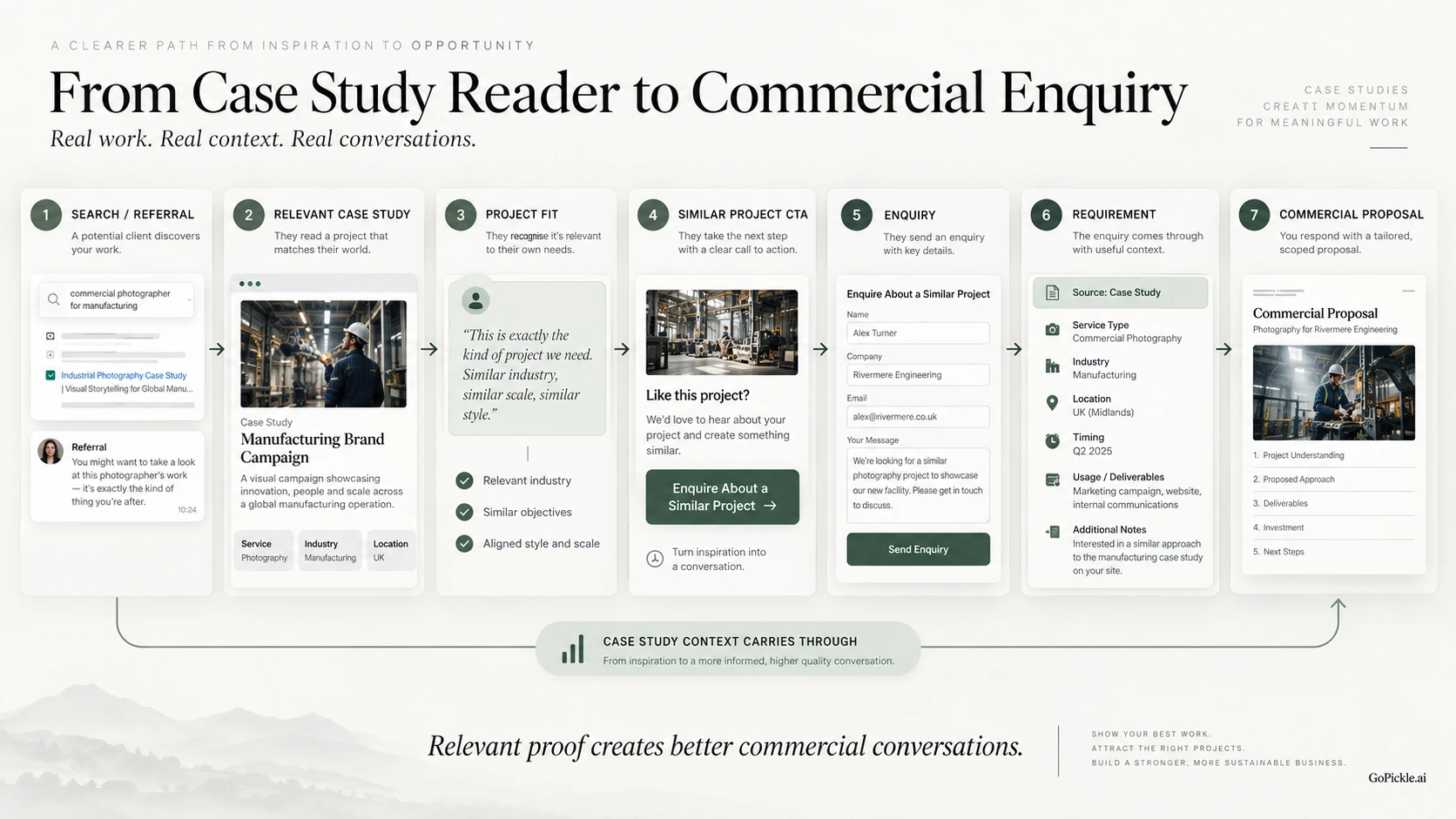
Turn completed assignments into evidence for the next client
Commercial photography produces unusually rich marketing material. Every appropriate completed project can potentially provide photographs, a production story, industry context and proof that your studio has handled a particular kind of requirement before.
Most of that value disappears when the work is uploaded as ten un-captioned images under “Recent Projects”.
A better commercial photography case study preserves the part that matters to the next buyer: what the client needed, what made the project specific, how you approached it, what was created and whether that experience resembles the assignment they are now planning.
You do not need dramatic results or invented success metrics to make the page persuasive. For a serious commercial buyer, clear evidence of relevant experience is already valuable.
Publish fewer case studies if necessary. Make each one specific, truthful and useful enough that a prospective client could read it and understand not only how your photographs look, but how you work.