Photography Client Complaint Handling: A Studio Workflow for Delivery, Editing and Communication Problems
Build a calm photography client complaint handling workflow for delivery delays, editing issues and communication problems, from triage to resolution.


The difficult part of a photography client complaint is rarely the first message. It is the scramble afterwards. Someone searches an old chat for the promised delivery date, the editor remembers a different revision request, and two team members start replying from different versions of the story. A recoverable problem becomes harder because the studio cannot establish one reliable record of what was agreed and what actually happened.
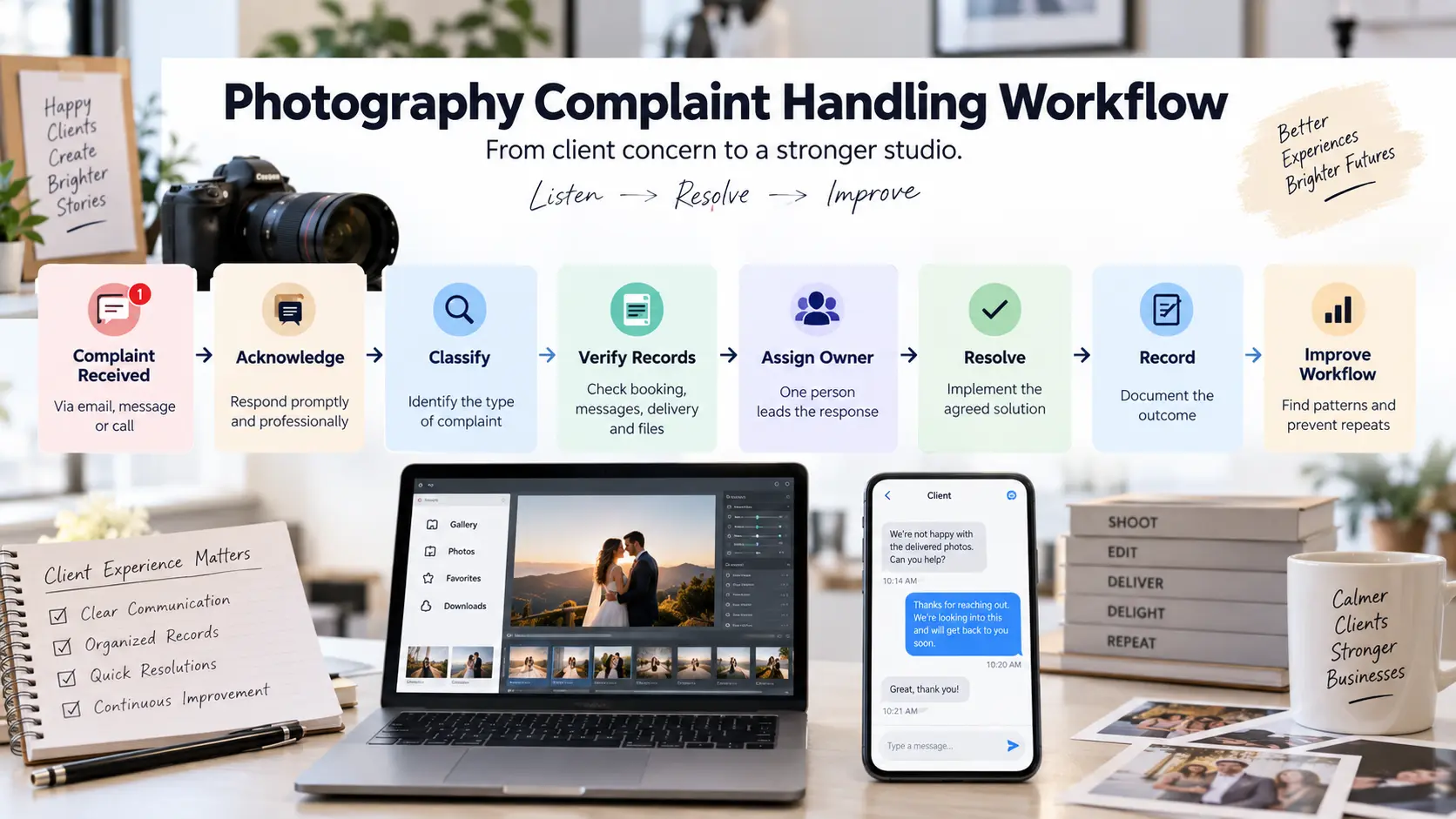
Good photography client complaint handling is therefore less about finding the perfect sentence and more about running a controlled service-recovery process: classify the issue, verify the facts, assign one response owner, choose the right remedy and record the outcome so the failure does not quietly repeat.
Acknowledge the complaint without admitting facts you have not checked
An unhappy photography client usually wants confidence that the message has been taken seriously and clarity about what happens next. You can provide both without arguing or making an admission before you have reviewed the project.
A useful first response is factual and bounded:
Thanks for raising this. I understand that your concern is about the gallery delivery and the editing on the selected portraits. I’m reviewing the booking, messages and delivered files so I can give you an accurate response. I’ll come back to you by [date/time] with the next step.
That response does not decide who is right. It confirms what you understood and creates a review window. Avoid replying line by line while frustrated, blaming the client for not reading an earlier message, or promising a refund, reshoot or re-edit before you know what the booking actually included.
Once the facts are clear, be direct. If the studio missed an agreed deadline or delivered the wrong files, say so and correct it. If the client is asking for a different creative direction after the agreed work was delivered, treat that as a scope discussion.
Classify the complaint before choosing a solution
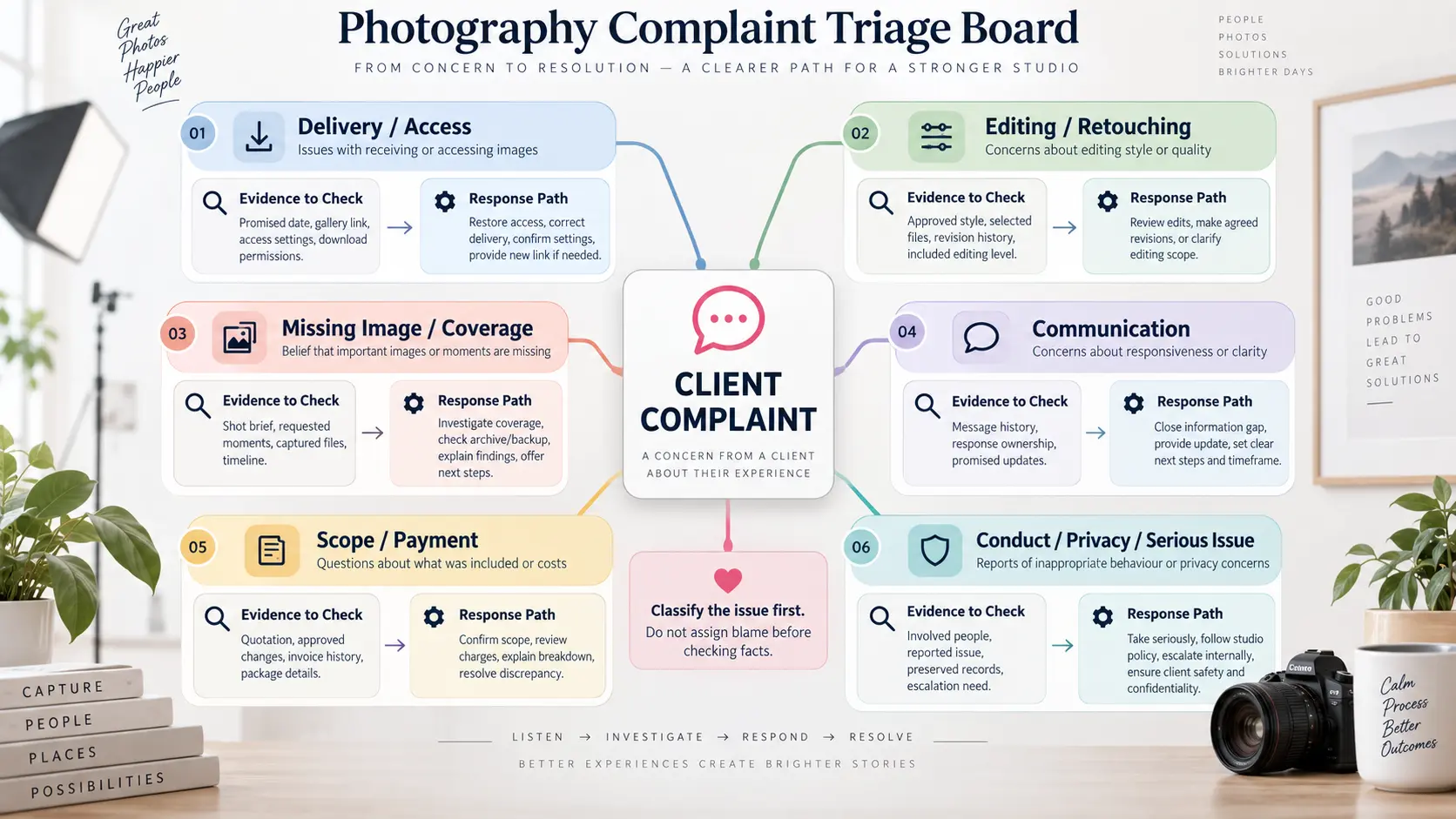
Photography client complaints often arrive as one long message, but the underlying problems are different. “We are unhappy with the photos” could mean a download problem, disliked colour treatment, missing expected photographs or retouching that the client thought was included. Each needs different evidence and a different response path.
| Complaint type | What to establish first | Typical next path |
|---|---|---|
| Delivery or access | Promised date, actual release date, gallery link, access settings, download permissions | Restore access, correct delivery, clarify instructions or address a genuine delay |
| Editing or retouching | Approved style, reference images, selected files, included editing level, revision history | Correct a production error, clarify style expectations or quote additional retouching |
| Missing image or coverage | Shot brief, timeline, requested groups/moments, captured files, culling notes where relevant | Investigate capture/delivery, explain findings and determine what recovery is actually possible |
| Communication | Messages sent, response ownership, promised updates, unanswered questions | Close the information gap and repair the communication process |
| Scope, package or payment | Accepted quotation, booking details, approved changes, invoice history | Fulfil agreed scope or document and price a genuine scope change |
| Conduct, privacy or serious dispute | Who was involved, what was reported, relevant records and local obligations | Escalate internally and obtain appropriate professional advice where needed |
The classification is a routing decision, not a label for the client. One complaint can contain several categories; a late gallery may become a larger customer-service problem because nobody updated the client.
Gather booking, message and delivery evidence before debating memory
Start with what you can verify. Check the accepted scope. Review the quotation or package, confirmed booking, deliverables, event dates, promised turnaround, payment status and any approved changes. A connected photography booking management workflow makes this reconstruction considerably easier than piecing a project together from memory because the client, events, services, deliverables and other booking information remain attached to the same job.
Then build the client-facing timeline. When was the gallery promised and released? Was the date changed? Which link was sent? Were access and downloads configured correctly? Which revision did the client request, and which version was delivered? For delivery complaints, the photography gallery delivery checklist is a useful audit because it separates file QC, gallery structure, privacy, downloads, mobile testing and the final release record.
Preserve the historical record rather than editing old documents until they match the current situation. If a client approved an additional retouching request or a new deliverable, retain the original scope and the later change. If a complaint moves into a serious contractual, privacy, safety or legal dispute, requirements vary by jurisdiction; preserve relevant records and obtain qualified advice rather than relying on a generic customer-service playbook.
Assign one owner for the client response
Letting the salesperson, photographer, editor and studio owner all reply independently quickly creates contradictions on dates, scope and promises.
Assign one person to own the external conversation. They gather facts, keep the response coherent, state the next action and stop the client from repeating the complaint to several people.
Internally, the complaint should have a simple operational record: client, booking, complaint category, date received, owner, evidence being reviewed, next response date, proposed resolution and current status. For a solo photographer, this may be a structured note rather than a separate system. For a growing studio, it becomes part of photographer customer service discipline: the owner of the problem is always visible, even when the next task belongs to an editor or gallery manager.
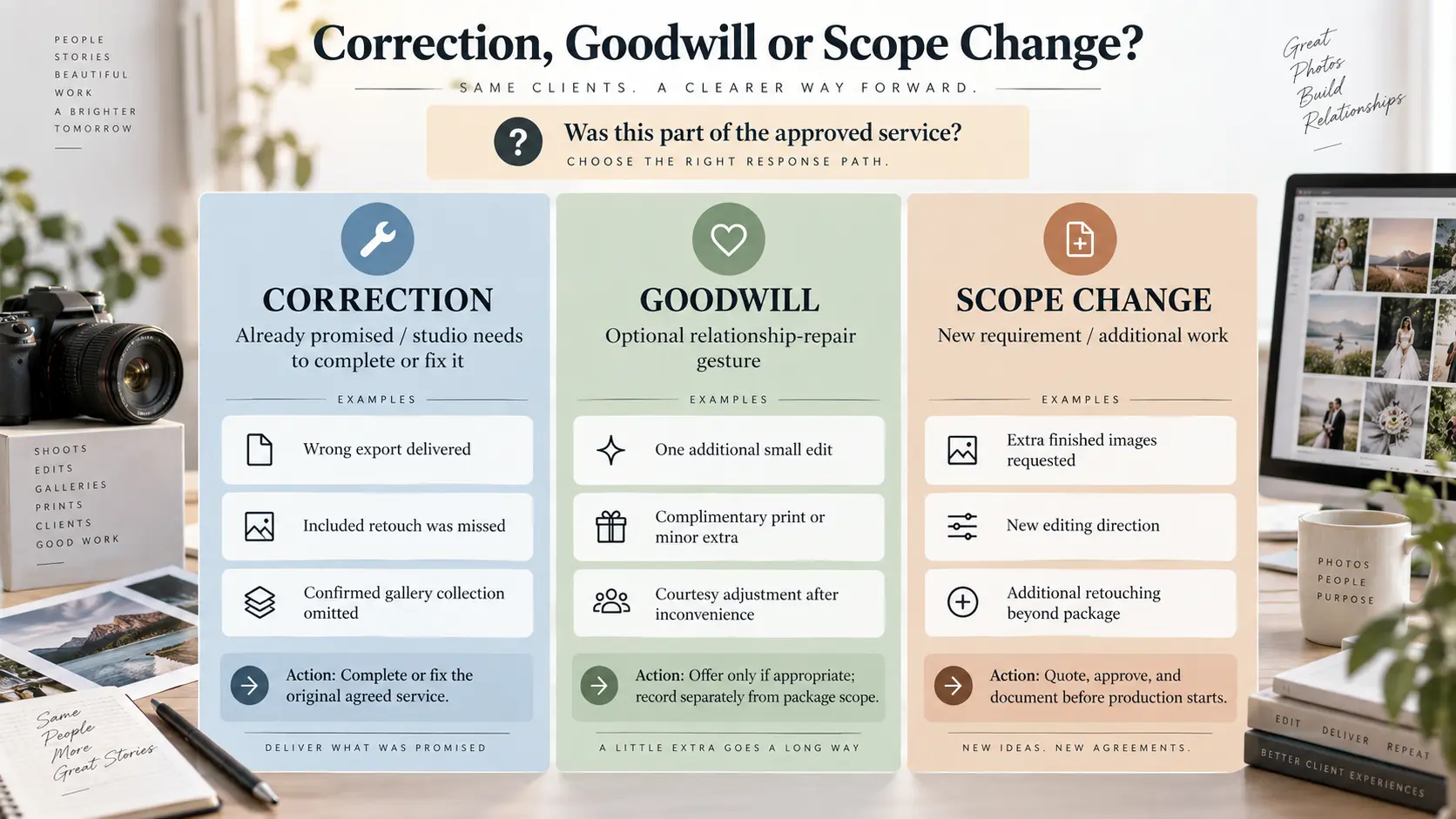
Separate correction, goodwill and scope change
This distinction prevents both unnecessary conflict and unnecessary free work.
A correction restores what the studio already agreed to provide. If the final gallery contains the wrong export, an included retouch was missed, or a confirmed collection was accidentally omitted, correcting that issue is part of completing the original service.
Goodwill is different. It is a discretionary gesture intended to repair the relationship, such as an extra print, a small additional edit or another reasonable accommodation. Goodwill should be deliberate, not something offered automatically because the client sounds upset. Record it separately so the team does not later mistake a one-off gesture for a permanent package entitlement.
A scope change creates new work. A portrait client who purchased ten finished images may later want five more. A commercial client may approve the original clean catalogue edit and then ask for complex compositing. A wedding couple may request a different creative treatment across hundreds of already approved images. Those requests can be completely reasonable, but they are not automatically corrections. The same principle we use in the photography quote-to-invoice workflow applies here: preserve the approved baseline and document what changed.
This is especially important when handling a photo editing complaint from a client. Separate technical errors from taste changes. A missed mask, inconsistent white balance, export artefact or agreed retouching instruction that was not applied can be checked against a clear production standard. “Can you make the whole wedding warmer and more cinematic now?” is a creative change. “Please remove a temporary blemish from the five portraits where retouching was included” may be a straightforward correction. The response should match the actual category rather than the emotion around the request.
Document the agreed resolution before work begins
A complaint is resolved when both sides understand what will happen next and the agreed action is completed.
After a phone or video conversation, send a written summary covering the issue, agreed action, affected deliverables, owner and expected completion point. If there is additional paid work, record the changed scope and approval before production starts. If a goodwill concession has been offered, state it clearly without rewriting the original package.
Version control matters here. A re-edited gallery should not leave the client with three links called “final,” “final new” and “final latest.” If delivery is being corrected, use a clear replacement path and verify the client experience before re-release. GoPickle Client Galleries are designed around organised final delivery, controlled access, downloads and client-facing gallery presentation; whatever platform you use, the client should know which delivery is current and what action, if any, remains.
The closure record should also state whether the client has accepted the resolution or whether another step remains. “Sent revised files” is an action. “Complaint closed” is a status that should mean the agreed service-recovery work is actually finished.
Feed recurring complaints back into the studio workflow
A single complaint needs a response. Repeated complaints need a process change.
Tag the root cause after resolution: unrealistic delivery promise, missed status update, unclear package wording, inconsistent edit, gallery access problem, crew communication, unrecorded scope change, selection confusion or another category that is meaningful to your studio. Then review patterns periodically instead of treating every incident as a unique personality conflict.
If several clients complain about late delivery, the issue may be capacity planning rather than customer service. Revisit how you set photography turnaround times. If clients repeatedly struggle to download photographs, audit the gallery release process and instructions. If the same editor generates repeated colour or retouching complaints, improve the brief and QC stage. If clients regularly say they were surprised by what was not included, revise the quotation and pre-booking explanation.
This is also where complaints and structured feedback should meet. A complaint tells you where one relationship experienced friction; a photography client feedback survey helps you test whether similar friction exists elsewhere, including among clients who never complained directly.
Build service recovery into normal studio operations
Strong photography service recovery does not mean saying yes to every request or defending the studio until the client gives up. It means establishing facts, fixing genuine failures, pricing new work and keeping one traceable record of what was agreed.
For us at GoPickle, the operational lesson is simple: complaints become harder when the underlying booking, delivery and communication history is scattered. Keeping those records connected will not prevent every unhappy photography client, but it gives the studio a much better foundation for resolving the problem professionally.
The most valuable outcome is not merely that one complaint disappears. It is that the next booking benefits from what the studio learned.