Photography Client Off-boarding Checklist: Close a Job Cleanly After Final Delivery
Use this photography client off-boarding checklist to close payments, approvals, gallery access, archives, reviews and follow-ups after final delivery.


The final gallery has been released. The client can download the photographs. The shoot is no longer sitting in the editing queue.
That does not necessarily mean the job is finished.
There may still be a balance to collect, an album selection waiting for confirmation, an approved print order that has not been handed over, a commercial stakeholder who has not signed off, or a gallery that will remain accessible for a defined period. The client may also need to know what happens to their files after that access period ends. Internally, the studio needs to decide which records remain, what can be archived, whether future contact is appropriate and when the booking can finally leave the active workload.
That final stage is photography client off-boarding.
It is deliberately different from delivery. If you are preparing a gallery that has not yet been sent, use our photography gallery delivery checklist first. Off-boarding begins after the client has received the final deliverables and the studio needs to close every remaining operational loop.
For a portrait photographer this may take a few minutes. For a wedding photography studio delivering photographs, films and albums, the photography project closeout may continue for weeks after the main gallery goes live. Commercial photographers can face another variation entirely, with final approvals, usage documentation and several stakeholders involved.
A reliable photographer client off-boarding checklist prevents those differences from turning into forgotten work.
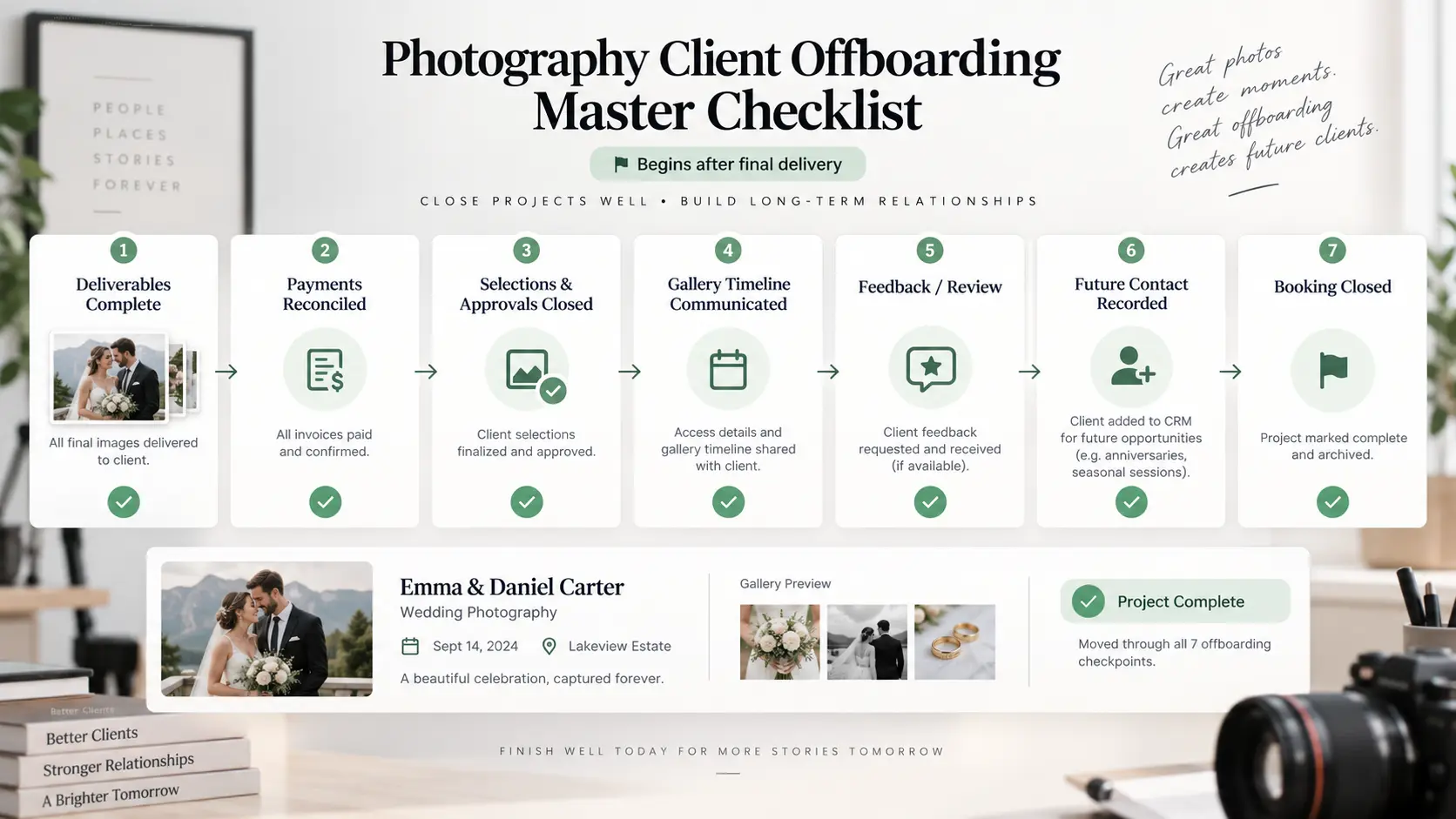
A useful photography job completion checklist should answer eight questions before a project disappears from the active queue:
- Have all contracted deliverables reached their intended final state?
- Is every client payment accounted for?
- Are selections, approvals and revisions resolved?
- Does the client know how long gallery access remains available?
- Is the studio's archive or retention position clear?
- Has feedback or a review been requested at an appropriate time?
- Are future-contact preferences and relevant client history recorded?
- Can the booking be closed without somebody discovering another obligation later?
Confirm every promised deliverable is complete
Start the off-boarding process with the agreement that created the job, not with the latest message in the client chat.
A wedding package may include a final photo gallery, teaser film, highlight film, reels, an album and parent albums. A portrait session may include a defined number of retouched photographs plus prints. A commercial assignment could require high-resolution masters, web exports, alternate crops or another agreed set of assets. The client receiving the most visible deliverable does not make the others disappear.
This becomes especially important for studios offering both photography and video. As we cover in our guide to tracking photography deliverables across one booking, each output should have a meaningful final state rather than allowing the first gallery delivery to make the entire project look complete.
A practical closeout review might look like this:
| Deliverable | What completion should mean |
|---|---|
| Final client gallery | Correct final files released and client access working |
| Retouched selections | Agreed files completed and delivered |
| Film or reel | Contracted final version delivered or otherwise formally resolved |
| Album | Selection, design approval, production and agreed handover completed |
| Prints or physical products | Produced and delivered, shipped or collected as agreed |
| Commercial assets | Required file sets and agreed handoff completed |
The exact definition belongs in your own workflow and contract. What matters is that “done” can be verified.
A studio should never need to reopen the quotation three months later just to discover whether an album was part of the package.
Reconcile final payments
Production completion and financial completion are related, but they are not the same thing.
A client may have paid in full before editing begins. Another may owe a final balance after gallery delivery. An album upgrade, additional retouching, extra coverage or another approved change may also have altered the original amount. Before off-boarding finishes, reconcile the commercial record rather than assuming the latest invoice tells the whole story.
Check the approved project value, advance payments, instalments, add-ons, credits or adjustments, final invoice and recorded receipts. Tax documentation and invoicing requirements vary by jurisdiction, so the studio's accounting process should follow the rules that apply where it operates.
Using dedicated invoice management for photographers makes this considerably easier than reconstructing payment history from bank alerts and messages. GoPickle's invoicing workflow keeps advances, partial payments, balances and payment status connected to the client and booking, which gives the studio a clearer financial closeout point.
An unpaid amount should never disappear simply because production has finished. If your system separates production status from payment status, it is perfectly reasonable for the work to show as delivered while the balance remains open. Photography client off-boarding is complete only when that remaining financial responsibility has a clear state and owner.
Close selections, approvals and revisions
Some of the longest-running photography jobs are technically delivered but still waiting for a client decision.
The couple has the wedding gallery but has not chosen album photographs. A portrait client has marked favourites but has not confirmed which images should receive detailed retouching. A commercial marketing team has commented on a proof set but has not supplied final approval. An album layout has been viewed but the studio does not know whether the latest version is accepted.
Do not translate all of these states into “waiting for client.”
Record exactly what decision remains.
There is also an important distinction between browsing activity and production approval. A favourite is not automatically a locked selection. A casual positive message is not always the same as approving a commercial deliverable. Where the next production step depends on the client's decision, capture that decision in a form your team can reliably use.
Once the selection or approval is final, resolve any remaining revision allowance and move the associated deliverable to its true completed state. The objective is simple: nobody should be able to reopen the job later and reasonably ask, “Were we still supposed to do something with this?”
Communicate the gallery and archive timeline
A client gallery can remain useful long after delivery, but gallery access, cloud storage and the studio's long-term archive are three different things.
The client should understand how long their online gallery will remain available, whether they need to download the photographs before a particular date and what happens if they request access later. If reactivation is possible, explain the process and any applicable fee before the gallery disappears rather than introducing it only when a client asks years later.
GoPickle's Client Galleries for photographers are designed around organised online delivery, downloads, favourites and controlled access. Whatever gallery platform you use, the policy around access still belongs to the studio.
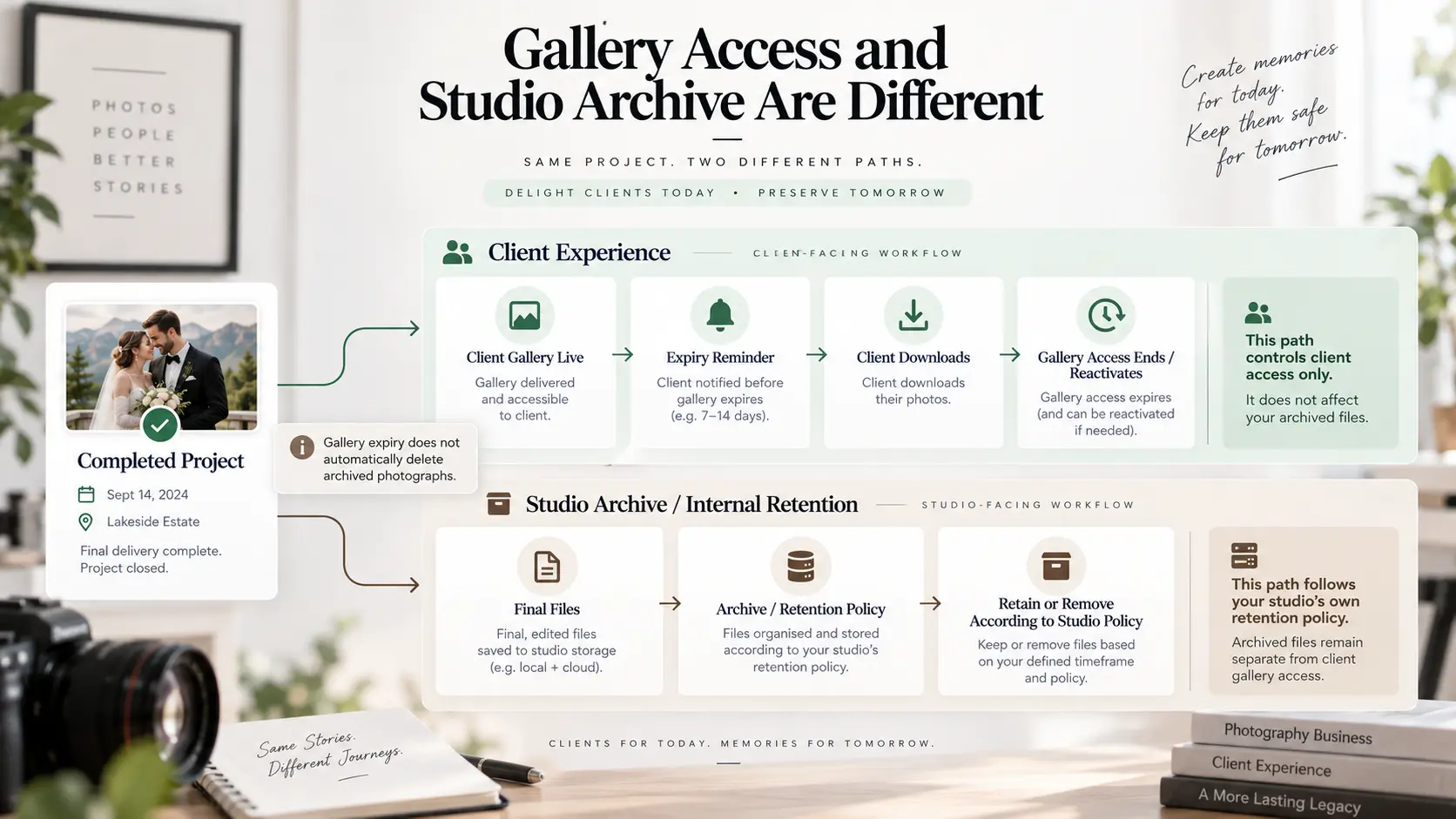
Avoid implying that gallery expiry means the photographs have immediately been deleted from every studio system. Equally, avoid implying that the photographer promises permanent archival storage unless that is genuinely part of the service.
Your internal retention policy may distinguish final JPEGs, source files, RAW files, contracts, invoices and client records. Those categories may have different operational, contractual, accounting or legal reasons for retention. Privacy and data-retention obligations also vary across jurisdictions; for businesses subject to GDPR, for example, personal data should not simply be kept indefinitely without a continuing purpose.
The useful client-facing message is much simpler: when does their access end, what should they download, and what can they expect from the studio afterward?
Request feedback or a review at the right moment
A review request is most useful when the client has actually experienced the completed service.
For a straightforward portrait session, that might be shortly after the client has viewed and downloaded the final photographs. For wedding photography client follow up, it may make more sense to wait until the couple has seen the gallery and responded positively. If an album was a major part of the package, the strongest closing moment may be after the physical album has been handed over rather than immediately after the digital gallery arrives.
If a problem remains unresolved, solve the problem first.
Feedback and public reviews also serve different purposes. A review helps prospective clients understand what it was like to work with the studio. A private survey helps the studio find weaknesses in booking, communication, the shoot, turnaround, delivery or album handling. Our photography client feedback survey guide covers that operational side, while our guide to asking photography clients for reviews naturally focuses on public review requests.
Do not make the off-boarding sequence feel like a final sales campaign. One thoughtful request after the client is satisfied is usually more consistent with a premium client experience than several automated messages competing for attention.
Record referral and repeat-client permission
Closing a booking should preserve useful relationship context without turning the client's record into a collection of assumptions.
Record information the client actually gave you: the service booked, preferences that affected the assignment, relevant delivery notes, communication preferences, a future service they specifically mentioned or a recurring commercial requirement that is already known.
Then distinguish operational communication from future marketing.
A phone number or email address supplied for a photography booking should not automatically be treated as unlimited permission to send promotional messages forever. Marketing rules differ by country and by communication channel. Some jurisdictions allow specific forms of existing-customer marketing under defined conditions; others impose different consent and opt-out requirements. Maintain the appropriate permission or lawful basis for your market and always respect a client's decision not to receive future promotions.
Our guide to building a repeat-client system for a photography studio goes deeper into this distinction.
The same discipline applies to referrals and portfolio use. Permission to stay in touch, permission to use a testimonial and permission to publish client photographs are separate decisions. Do not merge them into one vague “client consent” flag.
A strong retention workflow remembers enough to make a future conversation relevant without inventing personal milestones the client never shared.
Mark the booking closed only when nothing remains
“Closed” should be one of the most trustworthy statuses in a photography studio.
It should mean that the team can stop looking at the booking as active work.
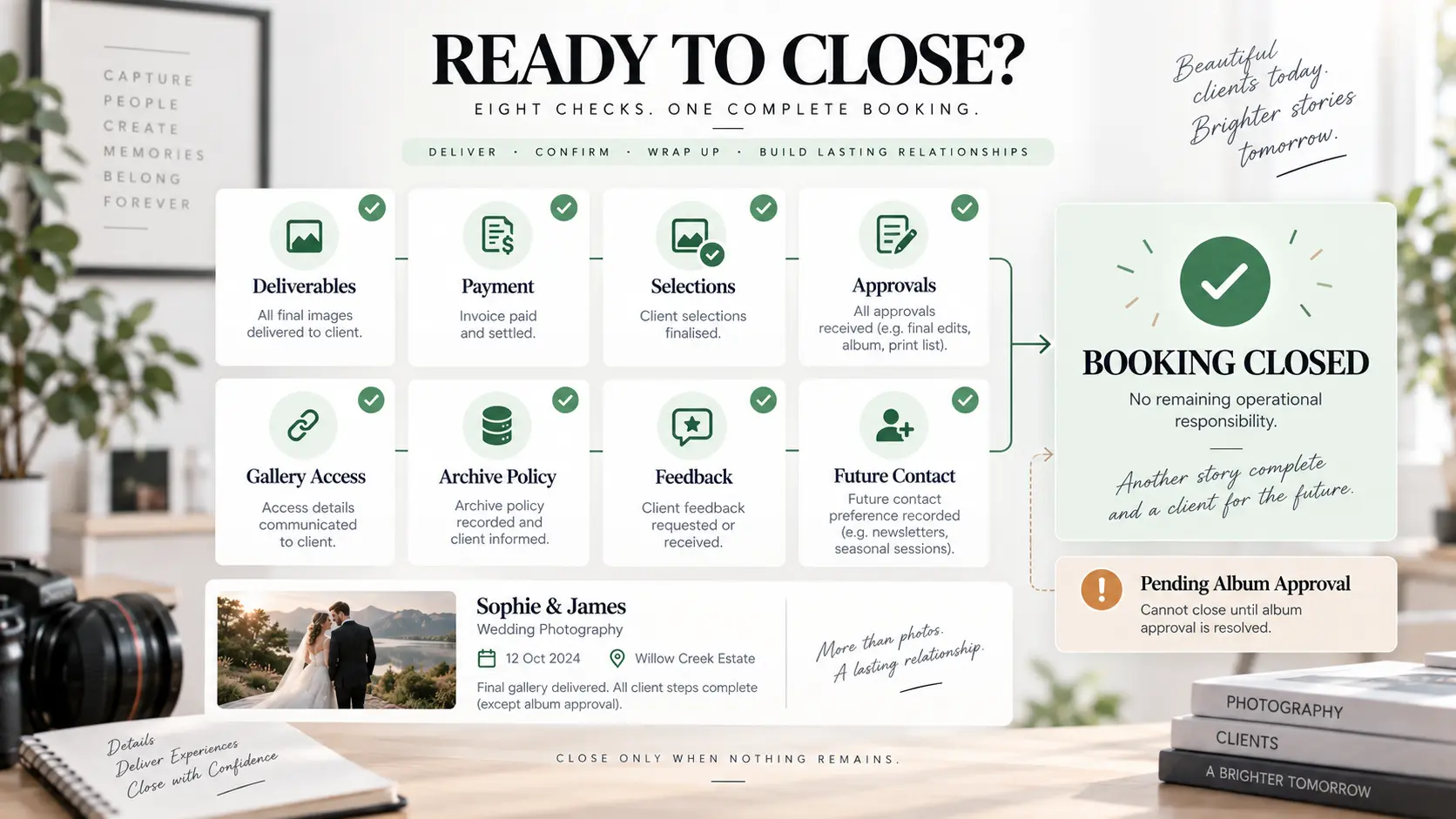
Before moving a project there, run one final gate:
- Every contracted deliverable is delivered, accepted or otherwise formally resolved.
- All required selections and approvals are complete.
- Revision obligations are finished.
- Physical products have reached the agreed handover stage.
- Payment status is reconciled and any remaining receivable has an explicit process.
- Client gallery access and archive expectations have been communicated.
- Relevant feedback, review and future-contact actions have been recorded.
- There is no hidden next action sitting in somebody's messages, notes or memory.
Closing the booking does not mean deleting the client or destroying every project record. It means the active photography workflow after delivery is finished. Records that must or should remain under your studio's legitimate retention policy can move into the appropriate archive without keeping the operational project artificially open.
This distinction becomes more valuable as a studio grows. When photographers, filmmakers, editors, album designers and office staff all touch the same booking, everyone needs to trust what the status means. GoPickle's broader photography workflow management system keeps bookings, invoices, payments, crew and client delivery around the same business context, reducing the number of loose ends that have to be reconstructed during closeout.
And when that client returns six months or three years later, start a new opportunity for the new requirement rather than reopening the old job. The relationship continues; the completed project remains complete.
That is the real purpose of photography client off-boarding. It gives the work a deliberate ending, gives the client certainty about what happens next and gives the studio a clean boundary between work that is genuinely finished and work that merely looks finished because the main gallery has already been sent.